


How to Choose the Right Hot Plate for Electric Cooker Manufacturing
Selecting a hot plate for electric cooker production involves more than choosing a circular heating component with the correct diameter. For appliance manufacturers, product engineers, OEM brands, and international sourcing teams, the heating plate must work as part of a complete electrical and thermal system.
A suitable hot plate needs to match the cooker's operating voltage, rated power, housing dimensions, mounting arrangement, control system, wiring structure, and intended cooking performance.
An incorrect specification can create problems that are difficult to solve after production begins.
For example, a heating plate may physically fit into an appliance while drawing more electrical current than the original design intended. Another plate may have an acceptable power rating but an incompatible terminal arrangement. A third may perform well during a short bench test yet cause excessive temperatures inside the final cooker enclosure.
These problems demonstrate why selecting an electric cooker hot plate should begin with application requirements rather than catalog appearance.
For most OEM projects, the correct approach is to confirm the appliance's electrical and mechanical design, select a compatible heating plate, evaluate the complete heating system, and approve representative samples before mass production.
Five requirements deserve particular attention:
-
Heating-zone dimensions: The plate must fit the cooker and provide an appropriate cooking contact area.
-
Electrical compatibility: Voltage, wattage, and current requirements must match the appliance design.
-
Mechanical integration: Mounting, terminals, installation height, and internal clearance must be suitable.
-
Heating and control performance: The plate must work with the selected power-control and safety systems.
-
Production consistency: The approved component must remain consistent across manufacturing batches and repeat orders.
WEBO offers hot plate components within its broader heating-element portfolio, with product categories covering 90mm, 110mm, and 145mm diameters.
Appliance manufacturers can review the available hot plate components for electric cooker applications when evaluating suitable starting points for new designs or replacement programs.
This guide explains how to translate cooker performance requirements into a practical heating-component specification, compare available dimensions, test prototypes, avoid common sourcing mistakes, and prepare a detailed OEM quotation request.
What Is a Hot Plate for an Electric Cooker?
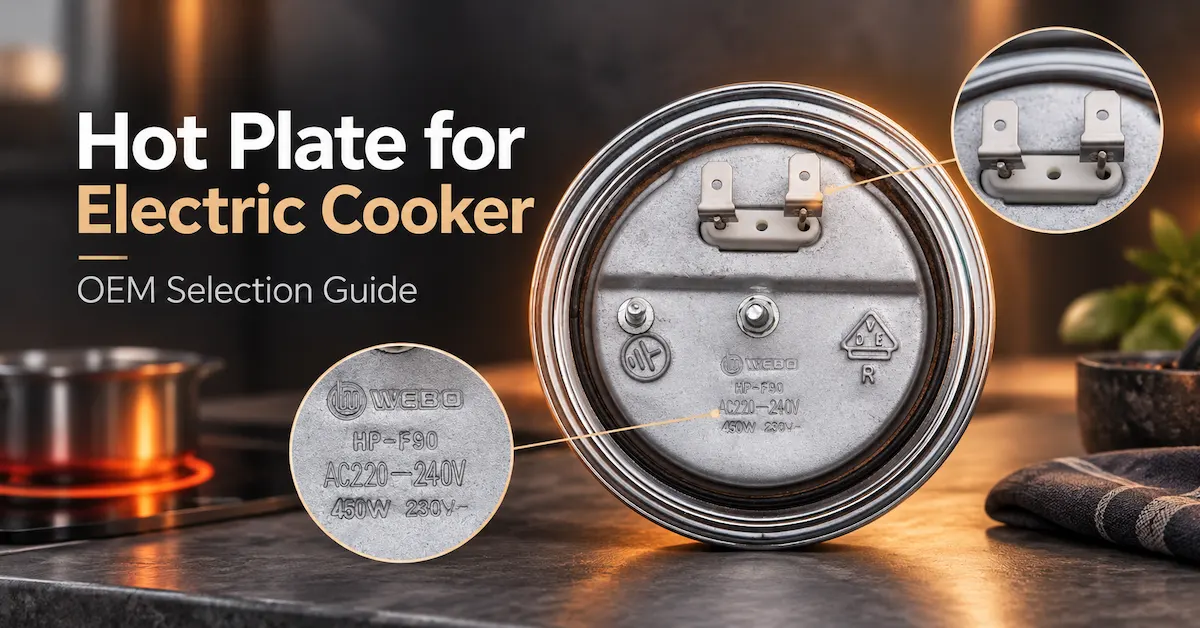
In this article, a hot plate refers primarily to the electrical heating component installed in an electric cooker, rather than the entire countertop appliance.
This distinction is important because the phrase electric hot plate is used in several ways.
It may describe:
-
a complete portable single-burner cooker;
-
a solid electric heating plate installed inside that cooker;
-
a radiant heating element used beneath ceramic glass;
-
or, in some contexts, another electrically heated cooking surface.
For OEM component sourcing, these products should not be treated as interchangeable.
How a Solid Electric Hot Plate Works
A conventional solid hot plate uses electrical resistance heating.
When the heating element receives power, electrical energy is converted into heat. That heat moves through the plate structure and cooking surface before being transferred to suitable cookware.
The complete heating process involves several thermal relationships:
Electrical input → Heating-element temperature → Plate surface temperature → Cookware heat transfer → Food heating
The design and materials of the plate affect the way heat is distributed and retained.
A solid contact plate commonly has more thermal mass than a lightweight exposed heating element. This can provide useful heat retention, although it may also mean that the surface responds more slowly when power is reduced.
The precise behavior depends on the particular plate construction.
Is a Hot Plate the Same as an Induction Heating Element?
No.
A solid electric hot plate primarily transfers heat from an electrically heated surface to the cookware.
An induction cooker uses a coil and electronic power system to generate heating within compatible cookware.
The two systems have different electrical architectures, heating mechanisms, control requirements, and component specifications.
A hot plate designed for resistance heating should not be selected as a replacement for an induction coil.
Is It the Same as a Ceramic Radiant Heater?
Not necessarily.
A radiant heater for a ceramic hob is normally designed to operate beneath a suitable glass-ceramic surface.
A solid hot plate is generally a direct-contact heating component.
These differences influence mechanical integration, temperature limits, surface construction, and the control system.
Before sourcing, buyers should identify the heating technology used in the final appliance.
Which Electric Cookers Commonly Use Solid Hot Plates?
Solid electric hot plates are relevant to several appliance designs, although the exact requirements vary.
Portable Single-Burner Electric Cookers
Portable cookers often need a compact heating system that can be integrated into a relatively small housing.
Important requirements include:
-
suitable heating-zone diameter;
-
compatible electrical rating;
-
sufficient internal clearance;
-
stable mounting;
-
controlled enclosure temperature;
-
and a user-friendly power-control system.
Because portable appliances are moved and handled regularly, mechanical stability and packaging protection may also be important.
Double-Burner Electric Stoves
A double-burner cooker may use two different heating-zone sizes.
For example, a product-development team might evaluate a smaller plate for compact cookware and a larger plate for general cooking.
However, the combination must be determined by the actual cooker layout and electrical design.
The engineering team should consider:
-
total connected electrical load;
-
individual control circuits;
-
separation between heating zones;
-
housing temperatures;
-
wiring arrangements;
-
and simultaneous operation.
Two individually acceptable hot plates do not automatically form a compliant double-burner appliance.
Compact Kitchen Appliances
Some compact kitchen products use solid heating plates where a simple contact-heating system is appropriate.
These applications may prioritize:
-
controlled dimensions;
-
consistent heat delivery;
-
straightforward assembly;
-
and repeatable manufacturing quality.
Replacement Heating Components
Replacement-parts distributors often source hot plates for established cooker models.
In these applications, the main objective is compatibility with the original appliance.
The buyer should compare dimensions, electrical ratings, terminals, mounting, and relevant construction features rather than selecting a replacement based only on diameter.
Commercial and Specialized Equipment
Solid electric heating plates may also be considered for selected professional or specialized applications.
However, a component designed for a domestic portable cooker should not automatically be assumed suitable for equipment with higher usage intensity or different environmental requirements.
The application and duty conditions must be evaluated separately.
How to Choose Between 90mm, 110mm, and 145mm Hot Plates
Hot plate diameter is one of the first specifications buyers consider.
WEBO's current product range includes 90mm, 110mm, and 145mm categories.
These dimensions provide practical starting points, but they do not establish the complete suitability of a product.
90mm Hot Plates
A 90mm heating plate can be considered for compact appliance designs where installation space is limited.
Potential applications include small cooking zones or equipment with relatively small cookware requirements.
For OEM buyers, the main advantage of evaluating a smaller-diameter component is the potential to fit a compact mechanical layout.
However, a smaller diameter does not automatically mean lower power, greater efficiency, or better temperature control.
Those characteristics must be confirmed from the actual model.
110mm Hot Plates
A 110mm plate represents an intermediate nominal size within WEBO's published range.
It may be relevant when the cooker design requires a compromise between the available cooking contact area and overall appliance dimensions.
The engineering team should review:
-
the intended cookware base;
-
cooker housing opening;
-
available mounting space;
-
heating requirement;
-
and position of nearby electrical components.
145mm Hot Plates
A 145mm hot plate may be evaluated for electric cooker designs requiring a larger contact-heating zone.
The larger nominal diameter can accommodate a different cooker layout from smaller heating plates.
However, the design must also account for the additional installation area and surrounding thermal conditions.
Buyers should not assume that every 145mm plate has the same electrical rating or thermal performance.
Hot Plate Size Comparison for OEM Selection
| Nominal Diameter | Potential Design Application | Main Engineering Consideration | Required Verification |
|---|---|---|---|
| 90mm | Compact cooking zones | Limited installation space | Dimensions, load and cookware fit |
| 110mm | Intermediate cooker designs | Balance of size and mechanical layout | Heating performance and mounting |
| 145mm | Larger cooking zones | Cooking area and enclosure integration | Power, clearance and temperature |
| Custom dimension | Application-specific designs | Engineering feasibility | Drawings, samples and qualification |
This table is a dimensional selection guide, not a statement of verified wattage or performance for individual WEBO models.
Are WEBO Hot Plate Models Available for Each Size?
WEBO's product pages identify examples such as HP-F90, HP-F110, and HP-F145, corresponding to the published diameter categories.
Before using one of these models in an appliance, buyers should request its current technical specification.
The model name alone does not confirm rated voltage, wattage, mounting dimensions, terminal construction, or applicable certification.
Why Diameter Alone Cannot Determine Heating Performance
A common mistake is assuming that the largest hot plate always provides the best cooking performance.
In practice, diameter is only one part of the heating system.
Cooking performance depends on several interacting factors.
Electrical Power
The input power determines the rate at which electrical energy is supplied to the heating system under its rated conditions.
Plate Construction
The materials, geometry, and thermal mass influence how heat moves through the component.
Cookware Contact
Heat transfer depends partly on the contact relationship between the plate and cookware.
Cookware Properties
Different pots and pans have different masses, base thicknesses, and thermal characteristics.
Control Strategy
A power regulator or other control device influences how electrical energy is supplied during operation.
Environmental Heat Loss
Heat is also transferred to surrounding air and nearby structures.
A larger heating surface may be useful for particular cookware sizes, but it should not be selected without considering these factors.
For OEM buyers, a meaningful comparison should involve actual appliance-level heating tests under equivalent conditions.
How to Match Hot Plate Voltage and Wattage to an Electric Cooker
Electrical compatibility is one of the most important selection requirements.
An electric hot plate must be selected according to the cooker's electrical design and intended market.
Confirm the Target Supply Voltage
Different countries and regions use different nominal electrical supply systems.
A manufacturer designing appliances for multiple markets may need separate electrical configurations or a design specifically approved for the applicable supply conditions.
The heating element must be appropriate for the intended voltage.
A hot plate should not be assumed suitable for another voltage merely because the mechanical dimensions are identical.
Understand the Relationship Between Voltage, Resistance, and Power
For a simplified resistive heating element, electrical relationships include:
P = V × I
where:
-
P is electrical power;
-
V is voltage;
-
I is current.
Under a simplified constant-resistance assumption:
P = V² / R
where R represents resistance.
These relationships explain why changing the applied voltage can significantly alter electrical power.
Real heating elements can have resistance characteristics that vary with temperature, so detailed appliance design should use the relevant component data.
Why Higher Wattage Is Not Automatically Better
A higher-power plate may deliver more heating energy, but it also creates additional demands on the appliance.
The engineering team may need to evaluate:
-
supply current;
-
conductor and connection suitability;
-
switch or regulator ratings;
-
internal temperature rise;
-
surface temperatures;
-
ventilation;
-
and protective systems.
Increasing wattage without reviewing the entire cooker can create new design risks.
Compare Power Against the Actual Cooking Requirement
A cooker intended for warming or gentle simmering may require different heating behavior from one designed for faster boiling or higher thermal output.
The correct specification should reflect the appliance's intended function.
Instead of choosing power solely from a competitor's catalog, buyers should establish measurable performance targets.
These may include:
-
heating response;
-
time to reach a defined operating condition;
-
maximum operating behavior;
-
performance at reduced power;
-
and behavior during repeated heating cycles.
The values and test methods should be defined by the OEM engineering team.
Hot Plate for Electric Cooker: Electrical and Mechanical Specification Checklist
A professional RFQ should contain enough information for the supplier to evaluate the application accurately.
| Specification | Information Required | Importance |
|---|---|---|
| Heating technology | Solid contact hot plate | Prevents wrong product selection |
| Nominal diameter | 90mm, 110mm, 145mm or custom | Mechanical fit |
| Rated voltage | Appliance electrical design | Electrical compatibility |
| Rated wattage | Heating performance requirement | Thermal and electrical loading |
| Resistance specification | Where relevant to the design | Electrical verification |
| Overall dimensions | Drawing and dimensional tolerances | Assembly compatibility |
| Mounting structure | Holes, brackets and retention | Mechanical stability |
| Terminal type | Connection requirements | Wiring compatibility |
| Terminal orientation | Harness direction and clearance | Assembly efficiency |
| Surface finish | Appearance and operating environment | Durability and cleaning |
| Control system | Switch, regulator or other approved control | Functional compatibility |
| Installation environment | Temperature and ventilation | Safety and reliability |
| Applicable standards | Destination market and appliance category | Compliance planning |
| Qualification tests | Performance and acceptance criteria | Product validation |
| Order volume | Samples, pilot and annual demand | Commercial planning |
A complete specification can reduce development time by identifying possible incompatibilities before samples are manufactured.
Mechanical Integration: What Makes a Hot Plate Fit an Electric Cooker?
A hot plate may have the correct nominal diameter and still fail to fit the final appliance.
This is why mechanical integration must be evaluated separately from product selection.
Overall Diameter and Installation Opening
The nominal heating diameter does not necessarily describe every external dimension of the component.
The buyer should confirm the complete dimensional drawing.
Relevant details may include:
-
heating-surface diameter;
-
outside dimensions;
-
flange or supporting features;
-
underside dimensions;
-
and housing opening requirements.
Installation Height
The vertical position of the hot plate influences how the cooking surface sits relative to the appliance housing.
If the plate is positioned incorrectly, it may create assembly, cleaning, or appearance problems.
The designer should confirm the intended height and support arrangement.
Mounting Method
The heating plate needs a secure installation method suitable for the final appliance.
Buyers should verify:
-
mounting points;
-
retaining hardware;
-
supporting structure;
-
mechanical tolerances;
-
and requirements arising from thermal expansion.
The approved mounting design should keep the component secure during normal handling and use.
Terminal Clearance
Electrical connections need sufficient space from adjacent components and structures.
The terminal arrangement should be reviewed within the actual appliance enclosure.
A terminal that appears acceptable on a separate component drawing may interfere with a bracket, panel, or wiring harness after assembly.
Allowance for Thermal Conditions
Heating and cooling can create dimensional changes and mechanical stresses.
The supporting structure should be evaluated under the intended thermal conditions.
The appliance manufacturer should also determine appropriate materials and protective measures for surrounding components.
Why Hot Plate Surface Quality and Cookware Contact Matter
The heating surface forms an important interface between the component and cookware.
Its characteristics can influence both appearance and thermal performance.
Surface Flatness
A suitable contact relationship between cookware and the heating plate supports effective heat transfer.
Poor contact can introduce additional thermal resistance.
However, cookware-base geometry also affects the result.
A perfectly manufactured hot plate cannot compensate for every possible cookware design.
Surface Finish
Surface treatment and finish requirements should be confirmed according to the product specification.
Relevant considerations may include:
-
corrosion behavior;
-
cleaning requirements;
-
appearance;
-
thermal cycling;
-
and long-term surface condition.
Different plate constructions may use different materials or finishes.
Buyers should request the actual material and coating information instead of assuming that all solid hot plates use an identical surface system.
Surface Changes During Use
Heating components may experience changes in appearance during repeated operation.
Not every appearance change represents a functional defect.
Nevertheless, the OEM should define acceptable surface conditions and the circumstances under which damage or deterioration is considered unacceptable.
Cleaning and User Interaction
The final cooker should be evaluated for practical cleaning and handling requirements.
A component may be suitable thermally but difficult to integrate into a product with the intended cleaning or appearance expectations.
This is another reason to evaluate the heating plate within the complete appliance design.
How Does an Electric Cooker Hot Plate Work With a Power Control System?
A heating plate does not independently determine the complete cooking experience.
The control system influences how power is supplied.
Different electric cookers may use different control architectures.
Mechanical Energy Regulators
A conventional energy regulator can adjust the average electrical input to a resistive heating load through repeated switching.
The suitability of this arrangement depends on the actual hot plate and regulator specifications.
The regulator must be rated and configured for the intended circuit.
Rotary Switches
A rotary switch may select defined operating states or circuit arrangements.
However, a rotary selector switch is not automatically equivalent to a cycling power regulator.
The required electrical function should be established from the appliance circuit.
Thermostatic Controls
A thermostat responds to temperature through a suitable sensing mechanism.
It should not be confused with a device that only adjusts average electrical power.
An appliance may use different control and protection functions depending on its design.
Temperature-Limiting Devices
Where required, protective temperature-limiting functions should be evaluated independently from ordinary user controls.
An adjustable cooking control should not automatically be treated as a substitute for an appropriate safety-protection system.
Control-System Compatibility Checklist
Before approving a hot plate, verify:
-
heating-element electrical rating;
-
controller electrical rating;
-
required switching function;
-
connection arrangement;
-
operating temperature;
-
intended user-control behavior;
-
and applicable safety functions.
The complete heating and control system must be qualified together.
How to Evaluate Heating Performance in a Real Electric Cooker
Catalog specifications are necessary, but they cannot fully describe cooking performance.
The final appliance influences how the hot plate behaves.
For this reason, OEM buyers should create a repeatable testing procedure.
Heating Response Test
A heating response test can evaluate how the appliance performs after power is applied.
The engineering team should define:
-
initial conditions;
-
cookware specification;
-
test load;
-
electrical supply conditions;
-
control setting;
-
measurement locations;
-
and acceptance criteria.
Without consistent test conditions, comparisons between two hot plates can be misleading.
Cooking Load Test
A representative cookware and cooking load can help determine whether the system meets the appliance's intended purpose.
The test should reflect realistic use.
A cooker intended for compact cookware should not be judged only by tests using unusually large pots.
Low-Power Operation
Low-power behavior matters for applications such as warming and simmering.
Buyers should evaluate whether the selected control system and heating plate provide acceptable results.
The behavior may depend on both the regulator and the thermal mass of the plate.
Maximum-Power Operation
At high output, the appliance should be evaluated for the required heating performance and relevant temperature conditions.
The testing program should consider the complete cooker rather than only the exposed heating surface.
Repeated Heating Cycles
Heating and cooling may introduce mechanical and thermal stresses.
Repeated-cycle testing can help identify potential problems involving:
-
surface condition;
-
mounting stability;
-
terminal integrity;
-
and performance consistency.
Qualification requirements should be based on the intended appliance and applicable standards.
Does a Solid Hot Plate Save More Energy Than Other Heating Technologies?
Energy efficiency comparisons require careful interpretation.
A solid electric hot plate, radiant ceramic hob, and induction cooker transfer energy to cookware through different mechanisms.
It would be misleading to claim that one technology is always the most efficient without specifying the system and test conditions.
Solid Contact Hot Plates
A solid contact plate transfers heat from the heated plate surface to cookware.
The plate itself stores thermal energy.
This stored heat can continue to warm cookware after electrical power is reduced or switched off.
However, residual heat also means that some energy remains in the heating plate rather than being transferred immediately to the cooking load.
Radiant Ceramic Hobs
Radiant systems transfer heat through a glass-ceramic cooking surface.
Their performance depends on the heating assembly, glass, cookware, and control conditions.
Induction Systems
Induction heating creates heat within compatible cookware through electromagnetic effects.
It uses a different power-conversion architecture and requires compatible cookware.
Compare the Complete Cooking Task
For an OEM project, the most useful comparison is not the component's name.
Instead, define a repeatable cooking task and measure relevant outcomes.
These may include energy consumption, time, operating behavior, and thermal performance.
The appropriate technology depends on the product positioning, expected customer use, manufacturing complexity, and commercial requirements.
Hot Plate vs Radiant Heater vs Induction: Which Is Better for OEM Electric Cookers?
| Selection Factor | Solid Contact Hot Plate | Radiant Ceramic Heating | Induction Heating |
|---|---|---|---|
| Main heating principle | Resistance heating with contact heat transfer | Resistance heating beneath ceramic glass | Electromagnetic heating of suitable cookware |
| Main cooking interface | Heated plate surface | Glass-ceramic surface | Compatible cookware above glass |
| Control architecture | Application-specific resistive-load control | Radiant-heater control and protection | Electronic induction control |
| Mechanical integration | Plate mounting and contact surface | Heater and ceramic-glass assembly | Coil, ferrite, glass and electronics |
| Thermal mass | Depends on plate construction | Depends on complete assembly | Different heat-generation arrangement |
| Cookware requirements | Suitable cookware with appropriate base | Suitable cookware for radiant cooking | Induction-compatible cookware |
| OEM complexity | Depends on product design | Requires coordinated glass/heater integration | Requires electronic power-system integration |
| Most relevant buyer decision | Plate size, load and mounting | Heater/glass compatibility | Coil, electronics and cookware compatibility |
The table describes technology differences, not an absolute performance ranking.
A product engineer should select the heating method according to the finished cooker's requirements.
What Safety Standards Matter for Electric Cooker Hot Plates?
Safety standards should be considered early in product development.
A heating component may satisfy a supplier's internal requirements while the finished appliance still requires further evaluation.
Portable Electric Cookers
IEC 60335-2-9:2019 addresses particular safety requirements for specified portable cooking appliances, including hotplates and cookers within its scope.
The relevant edition, national adoption, amendments, and other applicable requirements should be confirmed for the destination market.
Stationary Cooking Appliances
Stationary electric cooking ranges, hobs, ovens, and similar equipment may fall under the applicable requirements of the IEC 60335-2-6 series.
The appliance's actual construction and intended use determine the appropriate standard.
Component Certification Is Not the Same as Appliance Certification
A component-level approval does not automatically establish compliance for the finished electric cooker.
Similarly, a manufacturer's management-system certificate should not be represented as a product safety approval.
For example:
-
ISO 9001 concerns quality management systems.
-
ISO 14001 concerns environmental management systems.
-
CE marking relates to applicable European conformity requirements.
-
RoHS concerns restrictions on certain hazardous substances in applicable products.
-
UL, VDE, and other product certification or testing schemes have their own scopes and conditions.
Buyers should request documents relevant to the exact component model and target market.
Safety-Related Engineering Review
Depending on the finished product, evaluation may address:
-
electrical insulation;
-
protective earthing where applicable;
-
dielectric withstand;
-
leakage current;
-
temperature rise;
-
abnormal operation;
-
mechanical stability;
-
and protection against contact with hazardous parts.
The exact methods and limits should come from the applicable requirements.
Electrical and thermal testing should be conducted by appropriately qualified personnel using suitable equipment and procedures.
What Quality Tests Should a Hot Plate Manufacturer Perform?
For B2B buyers, a good-looking sample is not enough.
A heating plate should be evaluated against clearly defined quality requirements.
Dimensional Inspection
Critical measurements may include:
-
nominal and overall diameter;
-
mounting dimensions;
-
component height;
-
terminal position;
-
and installation interfaces.
The inspection plan should identify the dimensions that affect assembly.
Electrical Performance
Electrical evaluation may include confirmation of the component's specified rating and applicable electrical characteristics.
Testing conditions and acceptance limits should be documented.
Insulation Verification
Where required, insulation-related testing helps evaluate relevant electrical safety characteristics.
The method should match the applicable product requirements.
Terminal and Connection Inspection
Terminals should meet the approved configuration.
Loose, damaged, or incorrectly positioned connections can affect installation and electrical performance.
Surface Inspection
Surface inspection can identify damage, inappropriate finish conditions, or other defects that affect acceptance.
Heating Performance Verification
Where part of the qualification plan, the heating plate should be evaluated under defined operating conditions.
Packaging Inspection
Products may be damaged during transportation even after passing functional testing.
Packaging needs to protect the heating surface, terminals, and mounting features.
Production Traceability
A suitable traceability arrangement can help connect the delivered product with its approved specification and relevant manufacturing records.
Common Hot Plate Problems in Electric Cooker Production
Understanding typical integration problems can help buyers establish better engineering requirements.
| Problem | Possible Cause | Recommended Prevention |
|---|---|---|
| Plate does not fit housing | Incorrect dimensions or mounting | Review assembly drawing |
| Heating response is too slow | Unsuitable power or thermal design | Test realistic cooking loads |
| Excessive enclosure temperature | Thermal integration problem | Conduct appliance-level temperature tests |
| Incorrect electrical load | Voltage or power mismatch | Verify rating and circuit |
| Control behaves unexpectedly | Controller/plate incompatibility | Validate complete control system |
| Knob settings feel inconsistent | Control characteristics or system response | Evaluate representative appliance |
| Terminals interfere with housing | Connection orientation mismatch | Review installation clearance |
| Surface damage during shipment | Inadequate packaging | Approve protective packing |
| Replacement part does not fit | Incomplete cross-reference | Compare controlled specifications |
| Different behavior across batches | Manufacturing variation | Establish quality and traceability controls |
These are potential engineering issues, not diagnoses of any particular WEBO product.
A structured investigation should consider the heating plate, electrical circuit, control system, and appliance construction before assigning a root cause.
OEM Sample Development: From Hot Plate Selection to Production Approval
A disciplined development process reduces the risk of production changes after tooling and assembly plans have been finalized.
Step 1: Define the Appliance Requirements
Begin with the finished electric cooker.
Confirm the intended market, electrical supply, cooking-zone dimensions, performance targets, and product architecture.
Step 2: Review Existing Hot Plate Models
Determine whether an existing diameter and construction can meet the requirements.
Using a suitable existing platform may simplify development.
Step 3: Confirm Electrical and Mechanical Specifications
Before sample production, document:
-
diameter;
-
voltage;
-
power;
-
mounting;
-
terminals;
-
surface requirements;
-
and other critical characteristics.
Step 4: Obtain Representative Samples
Samples should be identified by model and specification revision.
If they differ from the intended production construction, those differences should be disclosed.
Step 5: Conduct Component-Level Checks
Review dimensions, electrical characteristics, appearance, and relevant quality requirements.
Step 6: Install Samples in the Cooker
Perform mechanical integration and system testing.
This stage should confirm the real relationship between the heating plate, control system, wiring, and enclosure.
Step 7: Record Results and Revisions
If the sample fails a requirement, document the problem and the agreed modification.
Avoid informal changes that are not reflected in the technical drawing.
Step 8: Approve a Golden Sample
The approved reference should correspond with the accepted specification.
Step 9: Conduct Pilot Production
A limited production run can help reveal issues involving assembly efficiency, repeatability, inspection, and packaging.
Step 10: Release Mass Production
Once relevant qualification and commercial requirements are satisfied, the approved configuration can be used for production.
WEBO's existing hot plate OEM manufacturing guide provides additional information about customization and sample coordination for appliance projects.
How Should Electric Cooker Brands Evaluate Hot Plate Suppliers?
Choosing the correct product is only part of the sourcing process.
For long-term production, buyers also need a supplier capable of maintaining the approved specification.
Technical Communication
The supplier should be able to review drawings, samples, voltage requirements, power ratings, mounting, and terminal details.
A quotation without technical clarification may leave important risks unresolved.
Product Documentation
Request technical specifications applicable to the exact model.
Avoid relying on general category descriptions when product-level information is needed.
Manufacturing Consistency
Ask how the supplier controls critical dimensions and electrical characteristics during production.
Sample Traceability
Approved samples should be linked to their corresponding specifications and revisions.
Change Control
A material, terminal, mounting, or other critical design change may require buyer review.
Order Forecasting
Provide expected trial quantities and annual demand so the supplier can evaluate available production arrangements.
Packaging
Confirm the protection required for international shipping and warehouse handling.
After-Sales Support
Clarify how the supplier handles suspected quality problems, technical questions, and replacement orders.
The best commercial arrangement is one that supports both the initial launch and subsequent production.
What Determines the Cost of a Hot Plate for Electric Cooker Projects?
The cost of a heating plate depends on more than its diameter.
Important factors may include:
-
component construction;
-
size;
-
electrical specifications;
-
material and surface requirements;
-
terminal configuration;
-
mounting features;
-
customization;
-
production quantity;
-
tooling;
-
qualification testing;
-
packaging;
-
and logistics.
Standard vs Custom Hot Plates
An existing standard model may reduce development complexity where it meets the appliance requirements.
A custom configuration may be justified when the cooker needs a specific dimension, terminal arrangement, or other technical feature.
Customization should solve a defined problem rather than be selected automatically.
Consider Total Procurement Cost
A component with a lower purchase price may create higher total costs if it causes:
-
assembly rework;
-
repeated testing;
-
delayed production;
-
additional inventory;
-
packaging damage;
-
or product returns.
Buyers should compare suppliers using equivalent technical specifications and quality requirements.
How Should Buyers Request Pricing?
A useful quotation should identify:
-
exact product model;
-
technical specification;
-
order quantity;
-
sample terms;
-
tooling conditions if applicable;
-
inspection requirements;
-
packaging;
-
delivery terms;
-
and quotation validity.
Without these details, two prices may not represent equivalent products.
What Makes WEBO Relevant to Electric Cooker Hot Plate Projects?
GUANGDONG WEBO TECHNOLOGY CO., LTD is a China-based manufacturer of heating elements and related appliance components.
According to WEBO's company introduction, the company was established in 1998 in Yangjiang, Guangdong, China.
Its published product portfolio includes:
-
Hot Plate;
-
Ceramic Heater;
-
Tube Heating Element;
-
Cast Iron Pan Support;
-
Induction Coil;
-
Ceramic Glass;
-
Rotary Switch;
-
and Energy Regulator.
This range is relevant to appliance manufacturers that need to evaluate multiple components within a heating or cooking system.
For an electric cooker project, coordinating the heating plate with the control system, mounting structure, and electrical design can reduce integration uncertainty.
WEBO's Hot Plate categories include 90mm, 110mm, and 145mm options.
However, buyers should confirm the exact current model specifications, customization feasibility, applicable product documents, MOQ, and production terms before placing orders.
The most practical starting point is a technical inquiry that includes the appliance design and required heating performance.
Hot Plate for Electric Cooker: A Complete OEM RFQ Template
A detailed RFQ improves the quality of the supplier's technical response.
The following template can be used by appliance engineers and international purchasing teams.
Project Information
Application:
Portable electric cooker / Single-burner stove / Double-burner stove / Replacement component / Other appliance
Project type:
New development / Existing design / Second-source qualification / Replacement-parts program
Destination market:
[Country or region]
Appliance production forecast:
[Expected annual quantity]
Heating Component Requirements
Hot plate type:
Solid contact heating plate
Nominal diameter:
90mm / 110mm / 145mm / Custom
Required voltage:
[Specified value]
Required wattage:
[Specified value]
Operating requirements:
[Describe intended heating performance]
Surface requirements:
[Material or finish specification if available]
Mechanical Requirements
Overall dimensions:
[Drawing attached]
Mounting method:
[Drawing attached]
Terminal type:
[Connection specification]
Terminal orientation:
[Drawing or sample]
Available installation space:
[Assembly dimensions]
Existing sample:
Yes / No
Control-System Information
Control device:
Energy regulator / Rotary switch / Thermostat / Other
Electrical diagram:
[Attached]
Required operating behavior:
[Describe]
Protective controls:
[Applicable design requirements]
Quality Requirements
Required inspections:
[Project requirements]
Qualification testing:
[Project requirements]
Applicable standards:
[Target-market requirements]
Product identification:
[Part number and traceability requirements]
Commercial Requirements
Sample quantity:
[Quantity]
Pilot-order quantity:
[Quantity]
Annual demand:
[Quantity]
Target delivery schedule:
[Date]
Packaging:
Bulk carton / Custom label / Other
Delivery destination:
[Location]
Additional OEM requirements:
[Specify]
Providing these details gives the supplier a stronger basis for selecting a suitable model and discussing technical feasibility.
For a product review, customized heating-component inquiry, or bulk-order quotation, buyers can send their electric cooker hot plate specifications to WEBO.
Frequently Asked Questions About Hot Plates for Electric Cookers
1. What is the best hot plate for an electric cooker?
The best hot plate is the one that meets the electrical, mechanical, thermal, and safety requirements of the finished cooker.
Buyers should compare diameter, voltage, wattage, mounting, terminal structure, cookware requirements, and heating performance.
No single diameter or model is automatically suitable for every electric cooker.
2. What is the difference between a solid hot plate and a complete electric cooker?
A solid hot plate is a heating component.
A complete electric cooker includes the heating component together with the housing, wiring, control system, user interface, and applicable protective features.
OEM buyers should specify whether they are purchasing the heating plate alone or a finished appliance.
3. Which is better for an electric cooker: 90mm, 110mm, or 145mm?
The correct diameter depends on the cooker layout and intended cookware.
A smaller plate may fit a compact design, while a larger plate may suit a different cooking zone.
However, diameter alone does not determine electrical power or heating performance.
The proposed component should be tested in the actual appliance.
4. Can a 145mm hot plate replace a 110mm plate?
Not without engineering verification.
The diameter difference affects the mechanical layout, and the electrical specifications may also differ.
The buyer must confirm dimensions, mounting, voltage, wattage, terminals, and compatibility with the control system.
A larger nominal diameter does not establish interchangeability.
5. Can hot plate voltage and wattage be customized?
Customization may be possible depending on the manufacturing platform and supplier's capabilities.
For OEM projects, buyers should provide the target voltage, required power, dimensions, and operating requirements.
Any modified configuration needs appropriate technical verification and qualification before production approval.
6. Does a higher-wattage hot plate always cook faster?
Higher electrical input can increase available heating power under suitable conditions, but actual cooking performance depends on the whole system.
Cookware mass, heating-surface characteristics, heat losses, control behavior, and appliance construction all influence results.
Higher wattage also increases electrical and thermal demands on the design.
7. Does an electric cooker hot plate need a thermostat?
That depends on the appliance architecture and applicable requirements.
Some designs use adjustable power-control devices, while others use thermostatic controls or additional protective mechanisms.
A power regulator and a temperature limiter do not necessarily perform the same function.
The complete control and safety design should be evaluated by the appliance manufacturer.
8. Can a solid hot plate be controlled with an energy regulator?
A compatible energy regulator may be used to adjust average electrical power supplied to a suitable resistive heating load.
However, the regulator must have the correct electrical rating, circuit configuration, and operating characteristics.
The combination should be validated in the finished cooker.
9. What tests are important before purchasing hot plates in bulk?
Important evaluation areas may include:
-
dimensional inspection;
-
electrical performance;
-
insulation-related requirements;
-
terminal connections;
-
heating response;
-
temperature behavior;
-
repeated heating cycles;
-
and appliance-level compatibility.
The exact test plan should follow the approved product and applicable standards.
10. How do I select a hot plate for a portable electric cooker?
Start with the cooker's intended use, electrical supply, housing dimensions, cookware requirements, and heating performance.
Then evaluate available plate sizes and compatible power configurations.
Check mounting, terminals, ventilation, and the control system before approving a sample.
The finished appliance must undergo appropriate qualification.
11. Is a solid hot plate more energy-efficient than induction?
There is no universal answer independent of test conditions.
The technologies transfer energy to cookware differently.
A meaningful comparison should use a defined cooking task, suitable cookware, and consistent measurement conditions.
For an OEM project, efficiency is only one of several considerations alongside cost, product design, control complexity, and user requirements.
12. Can hot plates be used in double-burner electric stoves?
Yes, suitable hot plates may form part of a double-burner resistance-heating appliance.
However, the manufacturer must evaluate the total electrical load, individual controls, simultaneous operation, housing temperatures, and other system requirements.
The two heating components must be qualified as part of the complete appliance.
13. How can I identify a compatible replacement electric hot plate?
Compare the original component's model and technical specification with the proposed replacement.
Important information includes:
-
dimensions;
-
electrical rating;
-
mounting;
-
terminals;
-
construction;
-
and intended appliance application.
Photographs alone are not sufficient to establish compatibility.
14. What is the MOQ for OEM electric cooker hot plates?
MOQ varies according to the product model, customization requirements, production arrangement, and commercial terms.
A standard hot plate may have different minimum-order conditions from a modified design.
Buyers should provide sample quantity, trial-order quantity, and projected annual demand when requesting a quotation.
15. What information should I send WEBO for a hot plate quotation?
Provide the cooker application, required diameter, voltage, wattage, mounting structure, terminal arrangement, intended market, quantity, and available drawings or samples.
For an OEM project, include the control-system requirements and relevant performance targets.
This helps WEBO evaluate available models and confirm the technical and commercial details needed before sampling or bulk production.
Conclusion
Selecting the right hot plate for electric cooker manufacturing requires a complete evaluation of heating-zone size, electrical ratings, mechanical integration, control compatibility, and appliance-level performance. A suitable heating plate must not only fit the cooker but also deliver the intended function consistently throughout production.
WEBO offers 90mm, 110mm, and 145mm hot plate categories for appliance-component sourcing. If you are developing a portable electric cooker, updating an existing stove design, or sourcing OEM heating plates in bulk, contact WEBO with your drawings, specifications, and order requirements to discuss available models, samples, and suitable manufacturing options.