


Choosing a reliable solid hot plate custom manufacturer is important for electric stove brands, portable cooker manufacturers, appliance importers, private label companies, and OEM factories.
A solid hot plate may appear to be a standard heating component, but its diameter, voltage, rated power, terminal arrangement, mounting structure, and surface treatment must match the final appliance. Even a small difference can create assembly delays, unstable heating, wiring problems, or higher warranty costs.
Standard products are suitable for common applications. However, appliance projects with specific housings, regional voltage requirements, performance targets, or branding plans often need a customized solution.
A professional manufacturing partner should help buyers confirm specifications, develop samples, test product compatibility, manage production quality, and maintain consistent repeat orders.
What Does a Solid Hot Plate Custom Manufacturer Do?
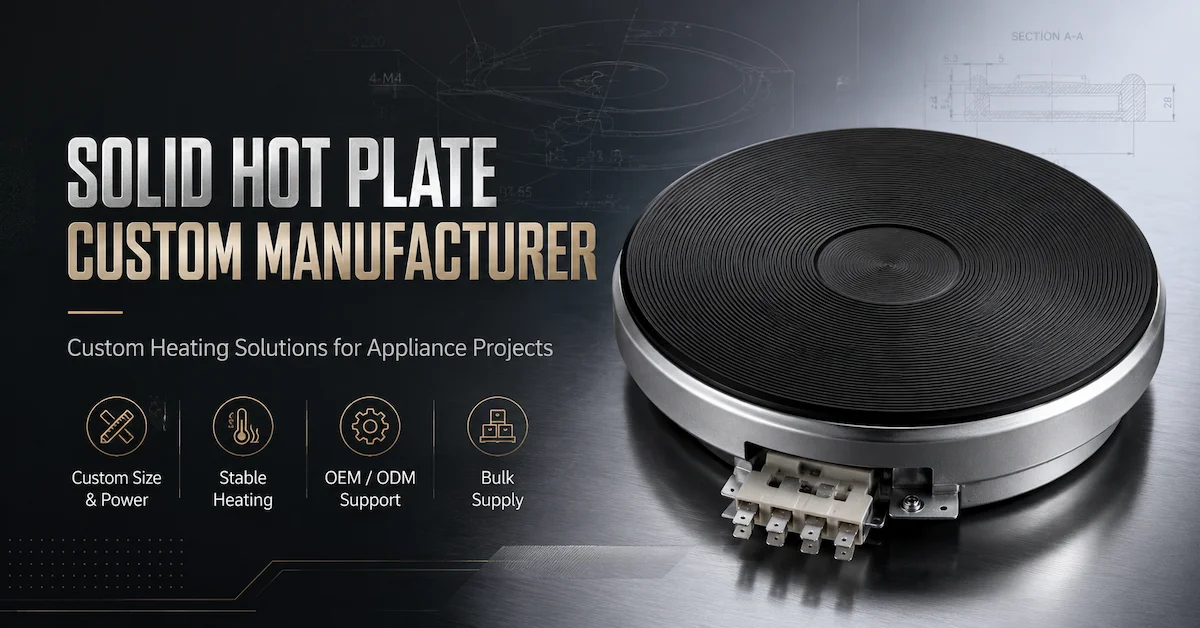
A solid hot plate custom manufacturer develops and produces electric heating plates according to the buyer’s appliance design and commercial requirements.
Customization may involve modifying an existing model or developing a product according to drawings, samples, and technical specifications.
Typical customization support includes:
- Custom diameter and thickness
- Market-specific voltage
- Custom rated power
- Terminal type and position
- Mounting structure
- Surface finish
- Wiring compatibility
- Switch or regulator matching
- Product labels
- Private label packaging
- Export carton requirements
- Bulk production planning
WEBO supplies hot plates and related appliance heating components. Buyers can review available product categories on the WEBO products page.
When Is a Custom Solid Hot Plate Necessary?
A standard hot plate may be sufficient when the appliance uses a common structure and electrical configuration. Custom manufacturing becomes necessary when the product must meet more specific requirements.
| Project Requirement | Why Customization May Be Needed |
|---|---|
| Special appliance housing | Standard diameter or mounting points may not fit |
| Regional voltage difference | Electrical specifications must match the target market |
| Specific heating performance | Rated power may need adjustment |
| Existing wiring design | Terminal position and structure must be compatible |
| Compact appliance design | Product dimensions may need optimization |
| Replacement-parts program | Dimensions must match existing equipment |
| Private label project | Product labels and packaging may require customization |
| Long-term OEM production | Specifications must remain consistent across batches |
The goal of customization is not simply to make the product different. It is to improve appliance compatibility, production efficiency, heating performance, and market suitability.
Who Needs a Solid Hot Plate Custom Manufacturer?
Different B2B buyers use customized solid hot plates for different purposes.
Electric Stove Manufacturers
Electric stove factories need heating components that fit the stove housing, wiring system, control structure, and rated performance.
Portable Cooker Brands
Portable appliance brands often require compact heating plates with specific voltage, power, and mounting configurations.
Appliance Importers
Importers may need products adapted to local electrical standards, packaging requirements, and customer expectations.
Repair-Parts Distributors
Replacement-parts businesses need repeatable dimensions and terminal layouts that match existing appliance models.
Private Label Buyers
Private label customers may require customized cartons, labels, barcodes, product identification, and regional instructions.
OEM Appliance Factories
OEM factories need a stable component supplier capable of following drawings, approved samples, and recurring production schedules.
What Can Be Customized?
A capable solid hot plate custom manufacturer should clearly explain which specifications can be adjusted and which changes may require additional development.
| Custom Item | Purpose |
| Diameter | Fits the appliance housing |
| Voltage | Matches the destination market |
| Rated power | Controls heating speed and performance |
| Terminal type | Fits the electrical connection |
| Terminal location | Improves wiring and assembly |
| Mounting structure | Ensures secure installation |
| Surface finish | Supports durability and appearance |
| Product labeling | Helps with model and brand identification |
| Packaging | Supports export, wholesale, or private label sales |
| Carton marks | Improves logistics and warehouse management |
Common hot plate categories may include sizes such as 90mm, 110mm, and 145mm. The correct model should still be selected according to the appliance, voltage, power, terminal structure, and installation requirements.
Custom Solid Hot Plate Development Process
A structured development process helps reduce misunderstandings and prevents mass-production problems.
Step 1: Submit Application Requirements
The buyer provides the appliance type, target market, required size, voltage, power, expected quantity, and packaging needs.
Step 2: Review Existing Models
The manufacturer checks whether an existing solid hot plate can meet the project or serve as a modification base.
Step 3: Confirm Technical Specifications
Both sides confirm:
- Diameter
- Voltage
- Rated power
- Terminal type
- Terminal position
- Mounting details
- Surface requirements
- Testing requirements
- Packaging
- Estimated order quantity
Step 4: Prepare Samples
The manufacturer produces samples according to the agreed specification.
Step 5: Test Samples in the Appliance
The buyer installs the sample in the final appliance and evaluates heating, wiring, installation, controls, and user operation.
Step 6: Revise the Product
If the initial sample does not fully meet the requirements, selected specifications can be adjusted.
Step 7: Approve the Final Sample
The approved sample, drawing, technical specification, and packaging requirements become the production reference.
Step 8: Begin Bulk Production
Mass production should follow the approved standard, with inspection throughout the production process.
Why Appliance Testing Is Essential
A hot plate should not be approved only by checking its appearance or measuring its diameter.
It should be tested inside the actual appliance to confirm:
- Structural fit
- Mounting stability
- Terminal accessibility
- Wiring compatibility
- Heating speed
- Power performance
- Control response
- Surface condition
- Appliance operating temperature
- Safety performance
Testing the component in the final appliance helps identify problems before they affect hundreds or thousands of finished products.
For custom projects, the approved sample should remain the reference for future production and repeat orders.
Quality Control for Custom Solid Hot Plates
Customized products require clear quality standards because buyers cannot rely only on a general catalog specification.
A professional solid hot plate custom manufacturer should control the following areas.
Incoming Materials
Metal housings, heating structures, insulation materials, terminals, and surface materials should meet the confirmed requirements.
Product Dimensions
Diameter, thickness, mounting points, and terminal locations should match the approved drawing or sample.
Electrical Performance
Testing should verify rated power, electrical continuity, insulation performance, and agreed technical parameters.
Heating Stability
The product should provide consistent heating performance according to the intended appliance design.
Terminal Quality
Terminals should be correctly positioned, securely installed, and suitable for the buyer’s wiring system.
Surface Quality
Heating surfaces and metal housings should be checked for scratches, deformation, or finishing defects.
Final Packaging
Products, quantities, labels, cartons, and protective materials should be inspected before shipment.
For B2B buyers, quality consistency across production batches is more important than receiving one excellent development sample.
Custom Manufacturing vs Standard Supply
| Supply Type | Best For | Main Advantage |
| Standard hot plate | Common appliance and replacement applications | Faster sourcing and lower development cost |
| Customized hot plate | OEM appliances and special product structures | Better compatibility and differentiation |
A standard model is usually the more efficient choice when it already meets the appliance requirements.
Custom manufacturing is more suitable when standard models create limitations in installation, electrical performance, appearance, controls, or packaging.
A responsible manufacturer should not recommend unnecessary customization. It should help the buyer select the most practical solution.
OEM and ODM Cooperation Options
OEM and ODM projects require different levels of supplier participation.
OEM Solid Hot Plate Manufacturing
OEM is suitable when the buyer already has:
- A complete drawing
- An existing sample
- Confirmed specifications
- A mature appliance structure
- Fixed packaging requirements
The manufacturer follows the approved requirements and produces the product accordingly.
ODM Solid Hot Plate Development
ODM is suitable when the buyer has an appliance concept or market need but requires assistance selecting and adapting an existing model.
The supplier may recommend a suitable product platform and adjust its size, power, voltage, terminals, or packaging.
After the final model is approved, the project can enter stable mass production.
Cost Factors in a Custom Solid Hot Plate Project
The quotation for a custom product depends on more than the unit price.
Important cost factors may include:
- Product dimensions
- Voltage and power
- Terminal structure
- Required modification
- Sample development
- Testing requirements
- Tooling
- Order quantity
- Packaging
- Private labels
- Certification needs
- Production complexity
Buyers should also consider the total sourcing cost.
A cheaper product may become more expensive if it creates:
- Appliance rework
- Production delays
- High inspection costs
- Product returns
- Warranty claims
- Packaging damage
- Incompatible inventory
A well-matched product can reduce these hidden costs.
What Should Buyers Provide for a Custom Quote?
A complete inquiry helps the manufacturer evaluate the project accurately.
| Required Information | Example |
| Appliance application | Electric stove, portable cooker, heating device |
| Target market | Europe, North America, Asia, Africa |
| Required diameter | Standard or custom size |
| Voltage and power | Based on the appliance design |
| Terminal requirement | Drawing, photo, or existing sample |
| Mounting method | Appliance structure or technical drawing |
| Quantity | Sample, trial order, annual demand |
| Certification needs | Based on the target market |
| Packaging | Bulk carton, private label, barcode |
| Reference material | Sample, drawing, specification sheet |
Buyers should also explain the main problem they want to solve. For example, the existing hot plate may heat too slowly, fail to fit the housing, or create difficulties during wiring.
This information helps the supplier provide a useful recommendation rather than only a general quotation.
Buyer Checklist Before Approving a Manufacturer
Before selecting a solid hot plate custom manufacturer, check whether the supplier can answer these questions:
- Does it understand the final appliance application?
- Can it recommend a suitable existing model?
- Can it modify size, voltage, power, and terminals?
- Is the sample process clearly explained?
- Can the buyer test samples before production?
- Will mass production follow the approved sample?
- Are quality-control steps documented?
- Can the supplier support OEM and ODM projects?
- Can it provide suitable export packaging?
- Can it maintain repeat-order consistency?
- Can it support the expected annual demand?
- Does it provide clear technical communication?
Why Choose WEBO for Custom Solid Hot Plates?
WEBO supports appliance brands, OEM factories, importers, wholesalers, and distributors with solid hot plates and related heating components.
Its product portfolio includes:
- Hot Plate
- Ceramic Heater
- Tube Heating Element
- Cast Iron Pan Support
- Induction Coil
- Ceramic Glass
- Rotary Switch
- Energy Regulator
As a solid hot plate custom manufacturer, WEBO can support:
- Product model selection
- Custom size, voltage, and power
- Terminal and mounting adjustments
- Sample development
- OEM and ODM projects
- Bulk production
- Private label packaging
- Export-oriented supply
- Related cooktop component sourcing
- Long-term production cooperation
Buyers can explore available heating-component categories on the WEBO products page.
More information about the company and manufacturing background is available on the WEBO About Us page.
For samples, drawings, custom specifications, private label requirements, or bulk pricing, submit the project through the WEBO contact page.
FAQ
1. What does a solid hot plate custom manufacturer provide?
A custom manufacturer develops electric hot plates according to the buyer’s required size, voltage, power, terminals, mounting structure, and packaging.
2. Can an existing solid hot plate model be modified?
Yes. An existing model may be adjusted when its basic structure is suitable for the appliance project.
3. What information is required for customization?
Buyers should provide the application, size, voltage, power, terminals, mounting details, quantity, market, and packaging requirements.
4. Why should buyers test samples in the final appliance?
Appliance testing confirms structural fit, wiring compatibility, heating performance, controls, and operating conditions before mass production.
5. What is the difference between OEM and ODM hot plate development?
OEM follows a buyer-provided design, while ODM helps the buyer select and modify an existing product platform.
6. Can customized solid hot plates be privately labeled?
Private label packaging, product labels, barcodes, and carton marks can be discussed according to the order requirements.
7. Can WEBO support bulk production after sample approval?
WEBO can support sample development, specification confirmation, OEM or ODM cooperation, and bulk order discussions.
8. How can buyers request a custom quotation?
Send the appliance application, drawings or samples, specifications, order quantity, destination market, and packaging requirements through the contact page.
Conclusion
Choosing the right solid hot plate custom manufacturer helps appliance buyers improve component compatibility, reduce production problems, and protect long-term product quality.
A dependable custom partner should understand the appliance application, support sample testing, control technical specifications, provide reliable quality inspection, and maintain consistency during bulk production.
WEBO provides standard and customized solid hot plates for electric stoves, portable cookers, small appliances, replacement systems, and private label projects. Buyers can submit appliance drawings, existing samples, technical requirements, expected quantities, and target-market information for product evaluation and quotation.