


Quick Answer: When selecting a cast iron hot plate supplier for existing electric cookers, first verify the original component's construction, installation dimensions, voltage, wattage, terminals, and control-system compatibility. Then compare candidate components using a documented cross-reference matrix and test representative samples in the target appliance. Matching diameter or appearance alone does not establish replacement compatibility.
A cast iron hot plate may look like a straightforward heating component, but replacing it in an established appliance design can introduce electrical, mechanical, and safety risks.
For an appliance manufacturer, an incorrect replacement may create assembly-line interruptions. For a spare-parts distributor, it can result in customer returns, incompatible inventory, and warranty disputes.
These risks are particularly important when sourcing from a new manufacturer or introducing a second supplier.
Two heating plates may share the same nominal diameter yet differ in overall height, mounting geometry, resistance, electrical rating, terminal position, or heating behavior.
Consequently, procurement teams need a reliable method to distinguish physical similarity from approved interchangeability.
WEBO, officially GUANGDONG WEBO TECHNOLOGY CO., LTD, is a China-based manufacturer of electric heating elements and related appliance components, established in 1998.
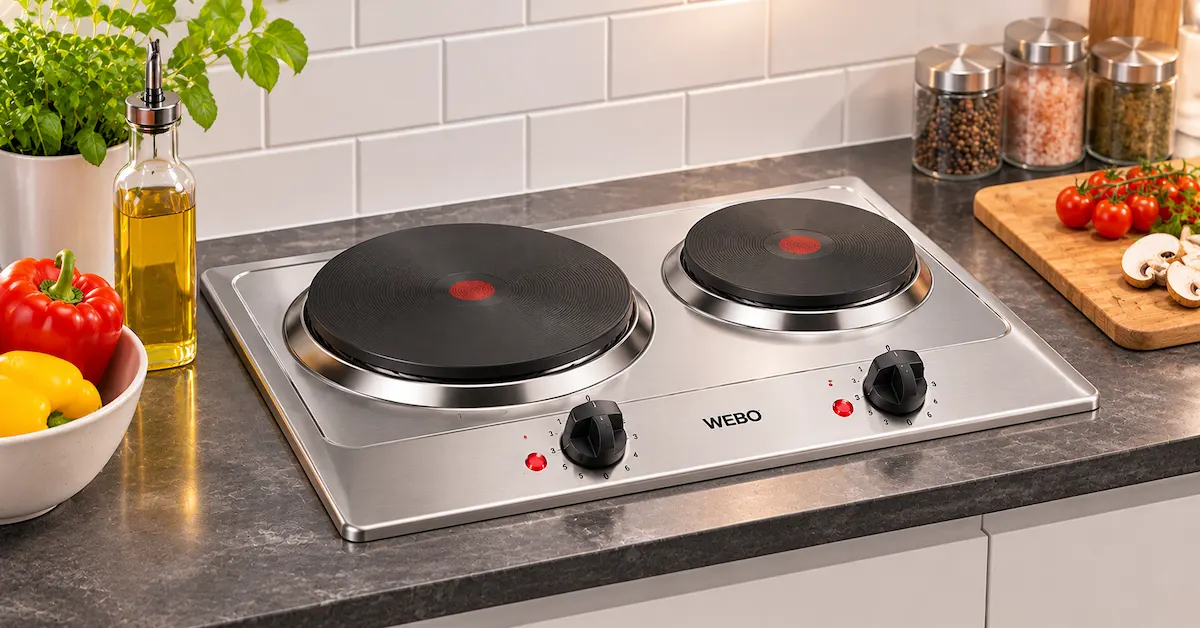
Its published product range includes solid electric hot plates in nominal 90mm, 110mm, and 145mm categories.
These products provide potential starting points for sourcing discussions, although their exact material composition, electrical configurations, and compatibility with existing cookers must be confirmed individually.
This guide explains how OEM buyers and replacement-parts distributors can evaluate candidate products, prevent wrong-part purchasing, and establish an approved alternative supply arrangement.
Explore the WEBO Hot Plate Product Range for available references.
Key Takeaways
-
Nominal diameter is only a starting point. Electrical ratings, installation geometry, and interfaces also determine compatibility.
-
Identify the product correctly. A cast iron electric heating plate is not the same as a cast iron pan support for a gas stove.
-
Build a component cross-reference matrix. Compare the original part, the proposed replacement, and the finished appliance requirements.
-
Do not assume universal compatibility. Approval must apply to a defined product configuration and application.
-
Qualify alternative suppliers through testing. Review documents, evaluate samples, and verify assembly-level performance.
-
Control approved part numbers and revisions. Technical changes should be reviewed before they enter production or replacement-parts inventory.
1. What Does a Cast Iron Hot Plate Supplier Provide?
A cast iron hot plate supplier may provide complete electric cooking appliances or individual heating plate components, depending on the business.
For OEM and industrial component purchasing, the relevant product is often the solid electric heating plate installed inside a cooker.
This distinction should be made clear during the initial inquiry.
Electric Hot Plate vs. Cast Iron Pan Support
| Product | Primary function | Typical purchasing application |
|---|---|---|
| Cast iron electric hot plate | Transfers electrically generated heat to cookware | Electric cooker manufacturing and replacement |
| Complete electric hot plate appliance | Provides a finished portable cooking unit | Retail and private-label appliance distribution |
| Cast iron pan support | Supports cookware above a gas burner | Gas stove manufacturing and replacement |
| Ceramic radiant heater | Supplies radiant heat within a suitable cooktop assembly | Ceramic-glass electric cooker production |
WEBO lists Hot Plate and Cast Iron Pan Support as separate product categories.
Buyers should not confuse these two product families.
Additionally, a solid hot plate should not automatically be described as a verified cast iron component without confirming its material and construction.
Who Needs This Supplier Evaluation?
This guide is particularly relevant to electric cooker manufacturers, appliance sourcing managers, replacement-parts importers, repair-parts distributors, and quality engineers introducing alternative suppliers.
For buyers developing an entirely new appliance, the same compatibility principles remain useful, but the process begins with a design specification rather than an existing reference component.
2. Why Do Replacement Hot Plate Orders Fail?
Wrong-fit component orders often begin with insufficient technical information.
A purchasing team may identify a replacement using only a product photograph or approximate diameter.
Although the candidate appears suitable, the differences become apparent during assembly or operation.
Common Purchasing Errors
| Purchasing mistake | Potential consequence | Recommended prevention |
|---|---|---|
| Matching diameter only | Incorrect mounting or installation height | Compare controlled drawings |
| Ignoring voltage ratings | Electrical incompatibility | Verify approved electrical configuration |
| Using photographs as the main reference | Hidden interface differences | Obtain technical specifications |
| Assuming identical terminals | Wiring or connection problems | Confirm terminal geometry and ratings |
| Ignoring the control system | Incorrect heating behavior | Evaluate complete appliance operation |
| Mixing similar-looking variants | Warehouse picking errors | Use separate approved part numbers |
| Accepting unreviewed product changes | Loss of approved compatibility | Establish change-control requirements |
The important distinction is between a product that looks compatible and one that has been technically approved.
Example: Two 145mm Heating Plates
Consider an appliance originally designed for a nominal 145mm heating plate.
A proposed alternative also has a nominal diameter of 145mm.
However, the replacement has a different underside profile and terminal orientation.
Although both products meet the initial size description, the candidate may not fit the enclosure or connect to the existing wiring.
Purchasing recommendation: Never approve a replacement based on nominal diameter alone.
3. The 7 Critical Compatibility Checks for Cast Iron Hot Plate Sourcing
A supplier comparison should begin with a technical matrix that identifies the required characteristics of the original heating component.
The following seven checks provide a practical structure.
Seven-Point Compatibility Matrix
| Check | Verification requirement | Main purchasing risk |
|---|---|---|
| 1. Material and construction | Confirm the actual heating plate construction and specified material | Incorrect product type |
| 2. Mechanical dimensions | Diameter, total height, mounting and clearances | Wrong-fit components |
| 3. Electrical characteristics | Rated voltage, wattage and resistance under defined conditions | Electrical mismatch |
| 4. Terminal configuration | Terminal type, position, orientation and connection requirements | Wiring incompatibility |
| 5. Control and protection | Compatibility with regulators, thermostats and protective devices | Unsafe or incorrect operation |
| 6. Thermal performance | Heating response and temperatures in the intended assembly | Performance or overheating problems |
| 7. Documentation and revision | Drawing, part number, applicable test evidence and revision | Uncontrolled substitution |
Check 1: Material and Construction
A supplier should identify the actual construction of the heating plate.
If cast iron is a required material, the buyer should request an appropriate material specification or confirmation.
Do not assume all solid electric hot plates use identical material grades or internal heating structures.
Check 2: Mechanical Dimensions
The buyer should compare more than the outer diameter.
Critical measurements may include the overall height, mounting features, underside geometry, terminal clearance, and installation envelope.
The component must fit the actual appliance under its required assembly conditions.
Check 3: Electrical Characteristics
Verify rated voltage and power against the original appliance design.
Resistance measurements should be compared under specified test conditions, considering possible temperature dependence.
A component rated for one electrical configuration should not be substituted into another without engineering approval.
Check 4: Terminal Configuration
Terminal type, orientation, spacing, and mechanical connection requirements affect installation.
The buyer should also evaluate the temperature exposure and electrical suitability of the connection arrangement.
Check 5: Control and Protection Compatibility
A heating plate operates as part of a wider system.
Power regulators, switches, thermostats, protective devices, and wiring must remain suitable for the proposed component.
The electrical control system should not be treated as independent of the heating element.
Check 6: Thermal Performance
A replacement may deliver the expected electrical input but behave differently under load.
Assess heat-up response, operating temperatures, cookware contact, and temperatures near sensitive appliance components.
Check 7: Documentation and Revision Control
The candidate supplier should identify the exact product configuration being offered.
Approved drawings and part numbers help prevent changes to materials, terminals, or construction from reaching the buyer without review.
A suitable replacement must pass all mandatory compatibility requirements. A high overall supplier score cannot compensate for a critical safety or fit failure.
4. Which WEBO Hot Plate Models Can Buyers Evaluate?
WEBO's published Hot Plate range includes three nominal diameter categories.
These models may be used as initial references during supplier discussions.
WEBO Product Comparison
| Product reference | Published diameter | Potential evaluation purpose | Information still required |
|---|---|---|---|
| HP-F90 | 90mm | Compare compact heating-zone requirements | Material, voltage, wattage, mounting |
| HP-F110 | 110mm | Evaluate intermediate installation geometry | Terminal arrangement, electrical rating |
| HP-F145 | 145mm | Compare larger nominal heating-zone designs | Construction, clearances, thermal behavior |
The listed applications are preliminary engineering considerations, not verified replacement approvals.
The published product references do not establish complete electrical or mechanical specifications.
What Buyers Should Request
Before comparing these models with an existing appliance, request the latest drawing, material information, electrical data, mounting details, and sample availability.
The selected component should then be evaluated against the original application requirements.
Important: HP-F90, HP-F110, and HP-F145 are not interchangeable simply because they belong to the same product family.
5. How Do You Build a Replacement-Part Cross-Reference Matrix?
A cross-reference matrix records the relationship between an existing component and a proposed alternative.
It helps buyers and engineering teams identify differences before purchasing approval.
Recommended Cross-Reference Template
| Parameter | Existing approved component | Proposed replacement | Approval status |
|---|---|---|---|
| Manufacturer part number | Record original | Record candidate | Pending |
| Material and construction | Record requirement | Request confirmation | Pending |
| Nominal diameter | Record value | Compare value | Pending |
| Total installation height | Drawing reference | Candidate measurement | Pending |
| Mounting arrangement | Original drawing | Candidate drawing | Pending |
| Rated voltage | Approved value | Candidate rating | Pending |
| Rated wattage | Approved value | Candidate rating | Pending |
| Terminal configuration | Original specification | Candidate specification | Pending |
| Thermal behavior | Approved test limits | Candidate test results | Pending |
| Compliance evidence | Applicable requirements | Available documentation | Pending |
| Product revision | Approved revision | Proposed revision | Pending |
This is a blank evaluation framework, not a completed product comparison.
A buyer should enter actual measured or documented values before reaching a decision.
Use Three Reference Points
A reliable comparison should consider:
Original component: The approved heating plate currently used in the appliance.
Proposed replacement: The candidate component offered by the new supplier.
Finished appliance: The electrical, mechanical, thermal, and safety requirements the component must satisfy.
Comparing only two component drawings can overlook system-level requirements.
Approval Status
Each characteristic can be recorded as:
-
Approved
-
Conditional approval
-
Engineering review required
-
Not approved
The final purchasing decision should be documented and connected to the exact part number and revision.
6. How Can Buyers Qualify a Second Cast Iron Hot Plate Supplier?
Adding a second supplier can reduce dependence on a single source, but introducing an alternative product without sufficient qualification may increase operational risk.
Second-source approval should combine engineering, quality, and purchasing assessments.
Recommended Six-Step Qualification Process
Step 1: Establish the existing design baseline
Collect the current component drawing, purchase specification, electrical ratings, inspection records, and relevant appliance test requirements.
Step 2: Review the alternative supplier's documentation
Compare the candidate specifications with the existing approval baseline.
Identify missing information and potential differences.
Step 3: Evaluate representative samples
Inspect dimensions, construction, terminals, and electrical characteristics.
Samples should represent the proposed production configuration.
Step 4: Test the finished appliance
Install the candidate component in the intended cooker.
Evaluate heating behavior, controls, protective functions, mechanical fit, and relevant safety requirements.
Step 5: Verify production repeatability
Where appropriate, review production-intent samples or a pilot lot.
Check whether the supplier can reproduce the approved configuration.
Step 6: Release and control the approved source
Record the approved supplier, part number, drawing revision, inspection criteria, and any application restrictions.
This process is a recommended purchasing framework, not a claim that WEBO automatically performs every step for every order.
First-Article Approval
For projects with critical dimensional or electrical requirements, a first-article inspection may help confirm that production-intent components meet the agreed specifications.
The buyer should define the required inspection report format and acceptance criteria.
7. Standard Replacement, Alternative Supplier, or Custom Component?
Not every sourcing project requires the same solution.
The buyer should determine whether the goal is an exact replacement, an approved second source, or a redesigned component.
| Purchasing approach | Appropriate situation | Main evaluation |
|---|---|---|
| Existing approved component | Current supplier meets requirements | Supply and commercial performance |
| Equivalent replacement | Alternative component appears compatible | Full comparison and application verification |
| Second-source approval | Buyer wants an additional qualified supplier | Technical approval and repeatability |
| Customized heating plate | Existing designs cannot meet requirements | Engineering development and validation |
When Is a Standard Replacement Better?
When an existing approved component is available and meets the appliance requirements, using that configuration may avoid unnecessary development work.
When Is a Second Supplier Valuable?
An alternative supplier may be worth qualifying when the buyer wants additional purchasing flexibility or improved supply continuity.
However, the candidate should not automatically be classified as interchangeable.
When Should Buyers Consider Customization?
If the mounting structure, terminals, or electrical characteristics cannot be matched by an existing product, a custom design may be necessary.
Custom development should be supported by engineering feasibility review and project-specific qualification.
8. How Should Quality and Compliance Documents Be Reviewed?
A supplier's company certifications do not automatically prove that a specific component meets every applicable requirement.
For OEM buyers, it is important to distinguish management-system evidence from product-specific test results.
Recommended Documentation Checklist
| Document | Main purpose |
|---|---|
| Technical datasheet | Defines electrical and product characteristics |
| Controlled drawing | Establishes critical dimensions and interfaces |
| Material specification | Confirms required construction |
| Electrical test records | Supports performance evaluation |
| Inspection criteria | Defines acceptance requirements |
| Applicable compliance documents | Supports regulatory and safety review |
| Batch identification | Connects delivered goods to production records |
| Change notification arrangement | Controls future product modifications |
WEBO's company website references ISO 9001 and ISO 14001 management standards, along with VDE, TÜV, UL, CE, and RoHS.
The applicability of these references to a specific hot plate model must be verified.
For applicable household and similar portable cooking appliances, IEC 60335-1 and IEC 60335-2-9 are relevant safety references.
The correct requirements depend on the actual appliance, intended use, destination market, and applicable editions or national adoptions.
Component compatibility and finished-appliance conformity must be assessed separately.
9. How Can Buyers Prevent Wrong-Part Deliveries After Approval?
Successful sample testing is only the beginning of long-term supplier management.
The approved configuration must remain identifiable during production, packaging, shipping, and warehouse operations.
Part Number Control
Use distinct part numbers where electrical or mechanical configurations differ.
An identical nominal diameter is not sufficient reason to combine different components under one inventory code.
Revision Control
Maintain a record of approved drawings and product changes.
Modifications affecting material, heating construction, terminals, mounting, or electrical characteristics should be reviewed before release.
Carton Identification
Depending on the buyer's requirements, carton labels can identify the product model, customer SKU, quantity, and production lot.
Receiving Inspection
Compare the delivered components with the purchase order, approved specification, and relevant receiving criteria.
Corrective Actions
When a discrepancy occurs, the buyer and supplier should establish how affected lots will be identified, evaluated, and resolved.
These processes are particularly valuable for distributors handling several similar-looking electric heating components.
10. What Is the True Cost of Choosing the Wrong Supplier?
A lower component price does not necessarily create a lower purchasing cost.
Incompatible heating plates may generate expenses that are not visible in the original quotation.
Potential costs include:
-
Additional incoming inspection
-
Assembly rework
-
Incorrect replacement-part shipments
-
Customer returns
-
Inventory segregation
-
Production delays
-
Retesting and engineering investigation
-
Shipment or replacement costs
Total Cost Comparison
| Cost category | Low-price, unqualified source | Qualified component source |
|---|---|---|
| Component price | May appear attractive | Depends on quotation |
| Compatibility risk | Unknown until verified | Evaluated against defined requirements |
| Inspection requirements | Potentially greater uncertainty | Agreed acceptance process |
| Wrong-fit returns | Potential exposure | Reduced through verified matching |
| Engineering changes | May be uncontrolled | Defined approval requirements |
| Repeat-order confidence | Depends on evidence | Based on production records |
Qualification does not eliminate all defects or commercial risks.
It does, however, provide a clearer basis for comparing alternatives.
A useful purchasing principle is:
Compare the cost of approved, usable components—not simply the quoted price per unit.
11. Why Consider WEBO for Electric Hot Plate Sourcing?
WEBO is a China-based manufacturer established in 1998, with a published portfolio of electric heating elements and cooking appliance components.
Its product categories include Hot Plate, Ceramic Heater, Tube Heating Element, Cast Iron Pan Support, Induction Coil, Ceramic Glass, Rotary Switch, and Energy Regulator.
This product scope may be relevant to buyers managing several related cooker components.
For example, a replacement hot plate project may also require a review of the associated power-control arrangement.
WEBO lists Energy Regulators and Rotary Switches.
The compatibility of any selected components must be confirmed through technical evaluation.
According to its published company introduction, WEBO serves international customers and operates manufacturing facilities in Yangjiang, Guangdong Province.
However, current production capacity, MOQ, lead times, product-specific certificates, and replacement compatibility require individual confirmation.
Learn more about WEBO's Company Background.
12. What Should Buyers Include in a Cast Iron Hot Plate RFQ?
A complete request for quotation makes it easier for the supplier to determine whether an existing product is suitable or whether further development is required.
Technical and Commercial RFQ Checklist
| RFQ requirement | Buyer information |
|---|---|
| Buyer company | Name and destination market |
| Product application | Electric cooker OEM or replacement parts |
| Existing part | Original model, drawing, photographs, or sample |
| Required material | Cast iron specification, if applicable |
| Target diameter | Nominal size and tolerances |
| Electrical ratings | Voltage, wattage, and relevant characteristics |
| Mechanical requirements | Height, mounting, terminal arrangement |
| Control system | Regulator, thermostat, and protection details |
| Compatibility scope | Appliance models requiring approval |
| Qualification needs | Tests, samples, and required documents |
| Order quantity | Initial and expected annual volume |
| Packaging | SKU and carton identification |
| Commercial terms | Pricing, MOQ, lead time, and shipping |
Request a Supplier Compatibility Review
Looking for a cast iron hot plate supplier for an existing cooker, replacement-parts program, or second-source project?
Start by identifying the original component and the finished appliance requirements.
WEBO's published hot plate references provide several diameter categories for initial evaluation.
Share your original part number, drawings, electrical requirements, product photographs, estimated quantity, and intended market.
Ask WEBO to confirm the available material and construction, evaluate potential product references, and discuss a project-specific quotation.
Explore WEBO Hot Plate Products
Contact WEBO for Technical Review and Supplier Quotation
13. Frequently Asked Questions
1. What does a cast iron hot plate supplier provide?
A cast iron hot plate supplier may offer solid electric heating components or complete portable cooking appliances. Buyers should identify the exact product required and verify its material and electrical construction before ordering.
2. Does WEBO offer cast iron electric hot plates?
WEBO publishes a range of solid electric hot plate products. The exact cast iron material and construction of individual models should be confirmed through current technical documentation.
3. What hot plate sizes does WEBO list?
WEBO publishes HP-F90, HP-F110, and HP-F145 within nominal 90mm, 110mm, and 145mm categories. These are starting references, not evidence of compatibility with specific appliances.
4. Can a 145mm hot plate replace any other 145mm heating plate?
No. Diameter alone does not establish compatibility. Voltage, wattage, mounting, height, terminals, and thermal behavior must also meet the appliance's approved requirements.
5. What documents are needed to cross-reference replacement hot plates?
Useful documents include the original part specification, controlled drawings, electrical ratings, material information, mounting details, inspection criteria, and applicable safety requirements.
6. How do OEMs qualify an alternative hot plate supplier?
Compare the candidate with the original component, review documentation, test representative samples, verify operation in the intended appliance, and approve the production configuration.
7. Can cast iron hot plates be customized?
Customization may be considered when existing products do not meet project requirements. The feasibility of material, dimension, terminal, or electrical modifications must be confirmed with the manufacturer.
8. How can buyers prevent incorrect replacement-parts shipments?
Use controlled part numbers, clear SKU identification, approved drawings, carton labels, and receiving checks. Different electrical configurations should not be grouped solely by appearance.
9. What affects cast iron hot plate prices and lead times?
Material requirements, electrical configuration, quantity, customization, qualification needs, packaging, and production scheduling may influence quotations. WEBO's actual terms require confirmation.
10. How can I request a cast iron hot plate quotation from WEBO?
Provide the original component details, technical drawings, required electrical ratings, target appliance, estimated order quantity, and destination market. Submit the information through the WEBO Contact Page.
Conclusion
Selecting a dependable cast iron hot plate supplier requires more than finding a heating plate with a similar diameter or appearance.
For cooker manufacturers, repair-parts distributors, and international importers, the most important purchasing objective is to obtain components that satisfy the intended application's electrical, mechanical, thermal, and documentation requirements.
A structured cross-reference matrix helps identify differences between an original component and a proposed replacement.
When introducing a second supplier, technical documentation, representative samples, system-level testing, and production configuration control should form the basis of approval.
WEBO, established in 1998, manufactures electric heating elements and related appliance components. Its published Hot Plate range includes HP-F90, HP-F110, and HP-F145, offering possible references for initial sourcing evaluation.
The exact cast iron material, electrical specifications, replacement compatibility, sample availability, MOQ, and lead time must be confirmed for each project.
Planning to replace an existing electric cooker heating plate or qualify a second component supplier?
Share your original part number, product drawings, voltage and wattage requirements, installation details, target market, and purchasing forecast with WEBO.
View WEBO Hot Plate Products or Request a Cast Iron Hot Plate Supplier Quotation to begin your technical sourcing discussion.