


Selecting a hot plate for food warming equipment requires careful consideration of temperature distribution, electrical power, thermal control, food safety, equipment construction, and long-term component reliability. For OEM manufacturers, the goal is not simply to generate heat but to develop a complete appliance capable of maintaining the required food temperature consistently during its intended operating conditions.
A heating plate may perform well during an electrical test yet fail to maintain suitable food temperatures when installed beneath a large serving container. Differences in container material, food depth, ambient temperature, lid usage, and heat losses can significantly affect the finished equipment's performance.
For commercial foodservice equipment manufacturers, this distinction is essential. Heating plate temperature is not the same as food temperature, and a heating component cannot independently guarantee safe hot holding.
WEBO, officially GUANGDONG WEBO TECHNOLOGY CO., LTD, is a Chinese manufacturer of electric heating elements and related appliance components established in 1998. Its product portfolio includes solid hot plates, ceramic radiant heaters, tubular heating elements, and electrical control components.
The company's published hot plate range includes HP-F90, HP-F110, and HP-F145, corresponding to nominal 90mm, 110mm, and 145mm product categories.
These products may provide starting points for preliminary engineering discussions. However, their publicly available specifications do not establish suitability for commercial food-holding appliances, food-contact applications, or particular equipment certifications.
This guide explains how food warming equipment manufacturers can evaluate heating components, develop appropriate temperature-control systems, identify commercial equipment requirements, and prepare a technical purchasing specification for OEM production.
Explore the WEBO Hot Plate Product Range to review available product categories before requesting detailed engineering documentation.
1. What Is a Hot Plate for Food Warming Equipment?
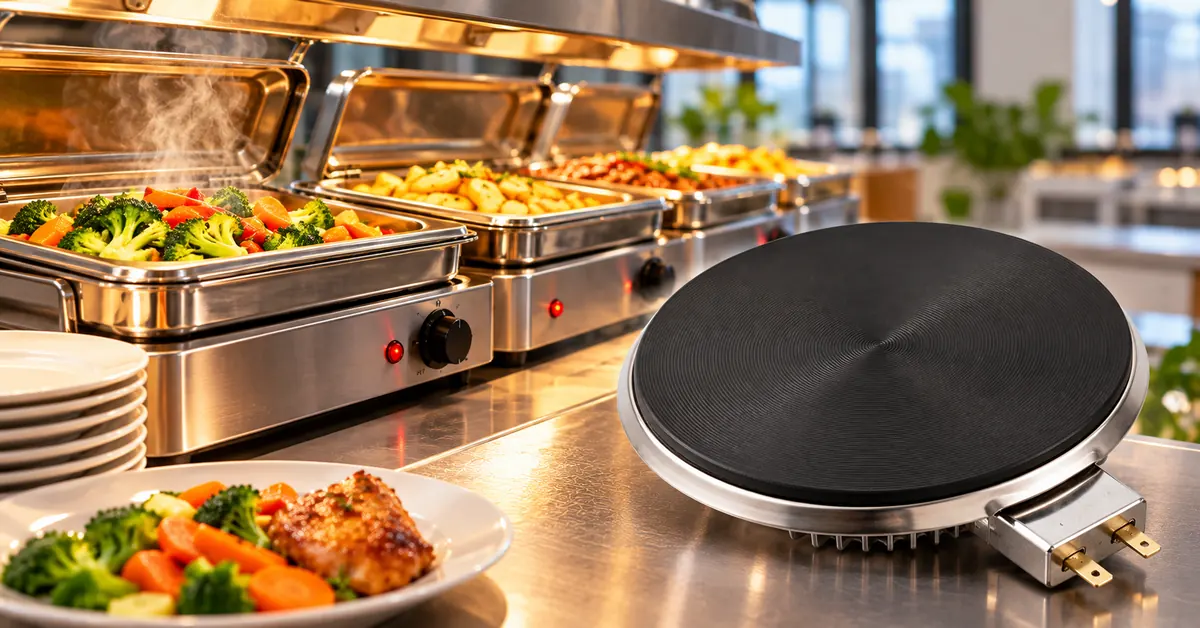
A hot plate for food warming equipment is an electrically powered heating component or heating surface used within a system intended to maintain the temperature of prepared food or serving vessels.
In commercial equipment, heat can be transferred to the food through direct contact with a heated support surface, through a metal container, or through an intermediate medium such as water.
The heating component generates thermal energy, while the finished equipment determines how that energy reaches the food.
Typical food warming systems may incorporate:
-
An electric resistance heating element
-
A heat-transfer plate or support structure
-
A temperature controller or energy regulator
-
One or more temperature sensors
-
Thermal protection devices
-
Food containers or serving pans
-
An enclosure with appropriate insulation and electrical protection
-
Operator controls and status indicators
Not every design includes the same components.
For example, a dry-heat warming shelf and a commercial bain-marie use different methods of transferring heat to food containers.
Heating component versus complete food warmer
A solid hot plate is not the same as a completed commercial food warmer.
The hot plate is one component responsible for generating and transferring heat.
The finished food warmer must combine heating, temperature control, mechanical construction, cleaning access, electrical protection, and suitable food-holding performance.
This distinction affects purchasing decisions.
A heating element manufacturer may supply an electrical component, but the OEM equipment manufacturer remains responsible for validating the complete food warming appliance.
OEM selection principle: Choose a heating component only after defining the finished equipment's intended holding conditions, thermal load, and operating requirements.
2. Which B2B Buyers Need Food Warming Heating Components?
The primary buyers are businesses that develop, manufacture, distribute, or maintain foodservice equipment.
Unlike retail customers looking for a countertop warmer, these organizations typically require technical drawings, electrical specifications, repeatable quality, and bulk purchasing arrangements.
| Customer type | Typical equipment project | Main purchasing requirement |
|---|---|---|
| Commercial food warmer manufacturers | Heated shelves and food holding appliances | Consistent thermal performance |
| Buffet equipment OEMs | Buffet serving and warming systems | Container compatibility and temperature holding |
| Catering equipment manufacturers | Portable food warming equipment | Thermal control and mechanical durability |
| Hospitality equipment brands | Food warming appliances for service areas | Product consistency and equipment safety |
| Foodservice equipment distributors | Replacement heating components | Accurate compatibility and repeat supply |
| OEM product developers | New electrically heated food holding products | Engineering documentation and sample evaluation |
| Purchasing managers | Bulk component sourcing | Cost, quality, availability, and delivery planning |
| Quality engineers | Component qualification | Inspection, traceability, and technical evidence |
Primary purchasing concerns
A commercial equipment purchasing manager may focus on the total cost of sourcing and the supplier's ability to maintain consistent product specifications.
A product engineer needs to understand how the heating component behaves inside a complete thermal system.
A quality manager needs evidence that incoming components meet controlled requirements.
These needs overlap, but they are not identical.
An effective supplier evaluation therefore combines technical qualification, commercial assessment, and manufacturing quality planning.
When a solid hot plate is not suitable
A solid cooking-style heating plate should not automatically be selected for every food warmer.
A large buffet counter requiring broad, uniform heating may benefit from a different heating structure.
A water-based warming system requires compatible components designed for the intended thermal environment.
An application involving frequent cleaning, splashing, or exposure to liquids may also require different protection and construction.
A conventional hot plate should never be considered suitable for direct food contact without appropriate material and sanitary design evidence.
The final decision must be based on the intended use rather than the availability of a familiar heating component.
3. Common Applications of Food Warming Equipment
Food warming equipment serves different commercial environments, each with its own thermal and operational requirements.
Understanding these differences helps manufacturers avoid using one heating design across incompatible applications.
3.1 Buffet food warming stations
Buffet stations are designed to keep prepared food available during service.
The equipment may need to support multiple serving containers while maintaining appropriate food temperatures.
Heat distribution is especially important because different containers may receive different amounts of thermal energy.
The manufacturer should evaluate the entire food-holding area rather than measuring only the heating element.
3.2 Catering food warmers
Catering equipment may be installed temporarily or moved between locations.
The design may require suitable mechanical strength, transport protection, electrical connections, and thermal stability.
For portable equipment, movement and installation conditions should be considered during the risk assessment.
3.3 Restaurant food holding stations
Restaurants may use heated holding surfaces to keep prepared food available before service.
The heating system must match the intended holding duration, food containers, and operational workflow.
Equipment designed only for holding already-hot food should not be used as a substitute for properly designed cooking or reheating equipment.
3.4 Hotel breakfast service
Hotels may use warming equipment for breakfast service and buffet presentation.
Equipment design priorities may include reliable operation, practical cleaning, user-accessible controls, and consistent holding performance.
The equipment should be evaluated under actual serving conditions, including the effects of container lids being opened.
3.5 Heated serving shelves
Heated shelves transfer energy through a supporting surface or integrated heating structure.
Their performance depends on surface geometry, container contact, and thermal losses.
A localized circular hot plate may not provide appropriate heating across a large shelf without additional heat-distribution design.
Application comparison
| Application | Typical heating approach | Main engineering challenge |
|---|---|---|
| Buffet warmer | Dry or water-assisted heating | Uniform food temperature |
| Catering warmer | Integrated electric heating | Portability and reliable holding |
| Restaurant holding station | Controlled contact or enclosed heating | Duty cycle and temperature recovery |
| Hotel breakfast warmer | Controlled serving equipment | Service interruptions and repeated opening |
| Heated serving shelf | Distributed surface heating | Hot and cold spots |
| Food holding cabinet | Enclosed thermal system | Air circulation and load variation |
| Commercial bain-marie | Water-mediated heating | Water temperature and vessel heat transfer |
These are equipment categories, not verified applications for specific WEBO hot plate models.
4. Food Holding Versus Cooking and Reheating: A Critical Design Difference
One of the most important considerations in food warming equipment engineering is understanding the difference between cooking, reheating, and hot holding.
These processes have different thermal objectives.
Cooking
Cooking involves applying sufficient heat to food to achieve the required preparation outcome.
Depending on the food, this may include a specific internal temperature and holding duration.
Reheating
Reheating involves raising previously prepared food to an appropriate temperature under the applicable food safety requirements.
Equipment designed for reheating must be capable of increasing food temperature sufficiently and within the required time.
Hot holding
Hot holding is the process of maintaining food that has already been properly cooked or reheated at an appropriate temperature until service.
Hot holding equipment is generally designed to compensate for ongoing heat losses rather than rapidly heat cold food.
This distinction matters because a device with enough power to maintain hot food may not have enough effective heating capacity to reheat the same food safely.
Why the difference affects component sourcing
If an OEM manufacturer develops a holding-only appliance, the heating component must support the required steady-state holding conditions.
If the product is intended to reheat food, additional capacity, control performance, and verification may be required.
The equipment's intended function should therefore be determined before selecting a heating plate.
The United Kingdom Food Standards Agency specifically advises that food holding equipment should not be used to cook or reheat food unless the equipment is designed for that purpose.
For manufacturers, the practical lesson is clear: do not advertise a food-holding appliance as a reheating device without adequate supporting design and performance evidence.
5. What Temperature Must Commercial Food Warming Equipment Maintain?
Food-holding temperature requirements depend on the country, jurisdiction, type of food, and applicable food safety rules.
The most useful distinction for engineering teams is between the temperature of the heating component and the temperature of the food.
United States: FDA Food Code guidance
The U.S. FDA Food Code 2022 provides a model food safety framework used by adopting jurisdictions.
For most time/temperature control for safety (TCS) foods under standard hot-holding conditions, Section 3-501.16 specifies maintaining food at 57°C (135°F) or above, subject to defined exceptions and alternative provisions.
The Food Code is a model, not a uniform federal operating rule automatically applicable to every foodservice establishment.
Manufacturers must check the requirements adopted in their target markets.
United Kingdom: Hot-holding requirements
UK Government food hygiene guidance states that hot food must generally be kept at 63°C or above when it is not served immediately.
Separate exceptions and time-based provisions may apply.
A commercial food warmer intended for the UK market therefore needs to be evaluated against the relevant local food safety framework.
International market comparison
| Market reference | General hot-holding temperature | Important qualification |
|---|---|---|
| U.S. FDA Food Code 2022 | Generally 57°C / 135°F or above | Model code; local adoption and exceptions matter |
| UK food hygiene guidance | Generally 63°C or above | Applicable rules and exceptions must be checked |
| Other export markets | Depends on jurisdiction | Confirm local food safety requirements |
Why heating surface temperature is not enough
A heating plate may operate at a temperature substantially above the required food temperature.
However, heat must pass through the supporting structure, container, and food.
Temperature differences can develop between the bottom and upper portions of a serving container.
A high plate temperature can coexist with inadequate food holding in another location.
Therefore, the finished appliance must be tested using actual food temperatures or appropriate validated food simulants, as required by the applicable qualification plan.
Important: A 63°C heating plate surface does not guarantee that the food itself remains at 63°C.
6. Understanding Heat Transfer in Food Warming Equipment
A food warmer must supply enough thermal energy to replace the heat continuously lost to its surroundings.
The rate of heat transfer depends on several factors.
These include contact between the heating surface and container, material conductivity, temperature difference, insulation, exposed area, and ambient conditions.
Conduction
Conduction transfers heat through solid materials.
In a direct-contact warming system, thermal energy may travel from a metal heating surface into a compatible food container.
The quality of the contact interface influences how effectively energy is transferred.
Poor contact can create uneven temperatures.
Convection
Convection involves heat transfer through moving fluids or gases.
Within the food itself, convection may help distribute heat in liquids, while thick or highly viscous foods may behave differently.
In the surrounding equipment, moving air can increase heat losses.
Radiation
Radiation transfers thermal energy through electromagnetic radiation.
Radiant heating can be useful in certain equipment architectures, but it has different design requirements from direct conductive heating.
A simplified heat-loss model
For preliminary engineering estimates, heat loss can be approximated using:
Q = U × A × ΔT
Where:
-
Q is the approximate heat-transfer rate
-
U is an effective heat-transfer coefficient
-
A is the relevant heat-transfer area
-
ΔT is the temperature difference
This simplified model is useful for understanding the influence of surface area, insulation, and temperature difference.
However, actual food warming equipment may involve multiple heat-transfer mechanisms and changing operating conditions.
Detailed design should use appropriate thermal modeling and physical testing.
Why thermal uniformity matters
The objective is not necessarily to make every point on the heating plate identical in temperature.
Instead, the equipment must maintain the required food conditions across its intended load configurations.
For example, a warmer supporting multiple containers should be assessed at positions most likely to experience insufficient heating.
This may include edge containers, partially filled pans, or containers exposed to frequent lid opening.
7. Technical Specifications for Food Warming Heating Plate Selection
A technical specification should identify the component properties that determine electrical compatibility, mechanical installation, and thermal performance.
Nominal diameter and wattage are useful starting points, but they do not define complete suitability.
Recommended OEM specification table
| Technical parameter | Buyer decision | Required supplier confirmation |
|---|---|---|
| Heating technology | Type of equipment being developed | Available element construction |
| Nominal diameter | Heating interface geometry | Model diameter |
| Rated voltage | Appliance electrical design | Actual model voltage |
| Rated wattage | Required thermal capacity | Actual rated power and tolerance |
| Resistance | Electrical compatibility | Measurement conditions and limits |
| Overall height | Mechanical envelope | Controlled drawing |
| Terminal configuration | Wiring and connector design | Terminal geometry and ratings |
| Heating surface material | Thermal and environmental requirements | Material and coating details |
| Installation method | Assembly and maintenance | Approved mounting arrangement |
| Thermal performance | Holding system behavior | Available component test data |
| Insulation performance | Electrical safety | Relevant testing information |
| Operating conditions | Duty cycle and environment | Permitted component conditions |
| Certifications | Target-market requirements | Model-specific documents |
| Packaging | Bulk shipment protection | Agreed packaging specification |
The exact values must be confirmed before sample approval.
WEBO's published hot plate product pages do not provide complete verified data for all these parameters.
How to assess rated power
For a simplified resistive heating component:
Electrical power (W) ≈ Voltage (V) × Current (A)
The nominal electrical rating must be compatible with the appliance's control devices, wiring, and protective components.
However, power rating alone cannot establish food-holding performance.
A higher-rated component may simply cycle less frequently under some conditions, while an improperly designed control system may cause undesirable temperature fluctuations.
The complete heating system must be evaluated.
8. Choosing Between WEBO HP-F90, HP-F110, and HP-F145
WEBO publishes several solid hot plate models that may be considered during preliminary component selection.
The available references include HP-F90, HP-F110, and HP-F145.
These products belong to different nominal diameter categories.
Their exact electrical ratings, materials, mounting configurations, and suitability for food warming applications must be verified.
WEBO model comparison
| WEBO model | Published nominal diameter | Preliminary design consideration | Information to verify |
|---|---|---|---|
| HP-F90 | 90mm | Small heating contact area | Power, voltage, mounting, thermal capability |
| HP-F110 | 110mm | Intermediate heating geometry | Terminal configuration and heat transfer |
| HP-F145 | 145mm | Larger localized heating surface | Heat distribution and installation requirements |
These are product references for technical comparison, not confirmed commercial food warmer applications.
HP-F90: Evaluating smaller heating interfaces
A 90mm nominal plate may be considered when equipment dimensions require a small localized heating zone.
However, it may not be appropriate for large containers or broad warming surfaces.
An engineering assessment must determine whether the intended vessel receives sufficient heat.
HP-F110: Evaluating intermediate dimensions
A 110mm nominal plate provides another physical size for development discussions.
The OEM must examine contact geometry, mounting features, electrical characteristics, and thermal performance.
A matching diameter alone does not establish suitability.
HP-F145: Evaluating larger contact areas
A 145mm nominal plate may be considered when a larger heating interface is required.
Nevertheless, a larger nominal diameter does not automatically provide improved food-temperature uniformity or better energy efficiency.
Actual performance depends on the complete equipment design.
Recommended model selection process
First determine the required food container geometry.
Next identify the necessary heat-transfer area and available mechanical space.
Then compare suitable heating component technologies and obtain the required electrical specifications.
Finally, test the assembled equipment under representative food loads.
If no existing model satisfies the requirements, a different heating architecture may be necessary.
9. Heating Plate Materials, Surface Construction, and Cleaning Requirements
Food warming equipment often operates in environments where cleaning, moisture, and repeated temperature changes are important design considerations.
Material selection therefore affects both equipment reliability and sanitary design.
Heating plate construction
A resistive heating component may include a metal heating surface, internal heating structure, insulation materials, terminals, and supporting features.
The exact construction of a particular product must be confirmed with the manufacturer.
The heating surface's material properties can affect heat transfer, thermal expansion, and durability.
Surface corrosion and cleaning exposure
Commercial foodservice environments may expose equipment to moisture, food residues, and cleaning chemicals.
These conditions can affect metal surfaces and electrical connections.
A component that performs well under dry laboratory testing may require additional protection when installed in an environment involving repeated cleaning.
The intended cleaning procedure should be evaluated during equipment development.
Food-contact versus non-food-contact components
A heating plate located beneath an enclosed food container is not necessarily a direct food-contact surface.
However, the finished equipment must still satisfy applicable sanitary design requirements.
If a component can directly contact food, additional material and hygienic considerations apply.
Buyers should not assume that a general appliance component is suitable for direct food contact.
Thermal expansion
Repeated heating and cooling can cause dimensional changes.
Mounting structures and connections must accommodate these changes without creating unacceptable mechanical stress.
Engineering validation should include representative thermal cycles.
Electrical terminal protection
Terminals and connectors should be protected from temperatures and environmental conditions outside their ratings.
Their installation should also support suitable cleaning and maintenance arrangements.
The correct design depends on the complete appliance construction.
10. Designing a Reliable Temperature Control System
A food warming appliance requires a control strategy appropriate to its thermal load.
The heating element generates thermal energy, while the control system determines when and how electrical power is supplied.
Basic energy regulation
Some heating systems use an energy regulator that periodically switches electrical power to control average energy input.
The selected setting may influence heating intensity without directly measuring food temperature.
This can be sufficient for some applications, but it should not automatically be interpreted as closed-loop food temperature control.
Thermostat-based control
A thermostat monitors temperature at a defined location and switches the heating system according to the control conditions.
Its effectiveness depends on sensor placement, response characteristics, and equipment design.
A thermostat mounted close to the heating element may not accurately represent the temperature of food elsewhere in the system.
Electronic temperature control
More advanced systems may use electronic sensors and controllers.
They can support different control strategies, including proportional or other closed-loop methods.
However, even a precise controller cannot guarantee uniform food temperature without appropriate heat distribution and sensor integration.
Independent thermal protection
The equipment designer should consider relevant failure scenarios.
Depending on the risk assessment and applicable equipment standards, independent thermal protection may be necessary.
The protective function should not rely solely on the normal temperature controller where that would create an unacceptable hazard.
WEBO control component options
WEBO also lists Energy Regulator Products within its broader component portfolio.
Their actual electrical ratings, operating characteristics, and suitability for commercial food warming systems must be confirmed individually.
A control component should be selected only after the heating load and relevant safety requirements have been defined.
11. How to Validate Food Temperature Distribution Before Mass Production
For food warming equipment OEMs, the most important performance test is not simply measuring whether the heating plate becomes hot.
The key question is whether the assembled appliance can maintain appropriate food temperatures throughout its intended operating conditions.
Step 1: Define the test load
The test should use representative containers and food loads or suitable validated simulants.
The manufacturer should define the amount of material, initial temperature, container properties, and intended operating conditions.
Step 2: Establish measurement locations
Temperature sensors should be positioned at locations relevant to the holding performance.
Depending on the system, this may include multiple containers and different positions within each container.
The measurement plan should consider likely cold spots.
Step 3: Allow controlled stabilization
For holding performance tests, the equipment may need to reach its intended operating condition before measurements are evaluated.
The procedure must distinguish initial preheating from steady-state holding.
Step 4: Record temperature over time
Measurements should capture changes throughout a representative holding period.
A single reading cannot demonstrate stability over several operating cycles.
Step 5: Evaluate disturbances
Real foodservice operations involve changing conditions.
Opening a lid, moving a serving container, or reducing the food quantity may affect temperature distribution.
Representative disturbances should be included when relevant to the intended use.
Step 6: Evaluate recovery
Following a disturbance, the equipment's response should be measured.
Recovery performance is important because food holding conditions may vary during service.
Step 7: Review results against acceptance criteria
The manufacturer should establish acceptance criteria before testing.
Results should be evaluated against the applicable food safety, equipment performance, and engineering requirements.
Example test matrix
| Test condition | What to measure | Purpose |
|---|---|---|
| Initial preheating | Equipment stabilization behavior | Confirm readiness for holding |
| Full load | Food temperature at defined points | Verify holding capability |
| Partial load | Temperature changes under lighter load | Identify overheating or instability |
| Multiple containers | Temperature variation between positions | Identify cold spots |
| Lid opening | Food temperature response | Evaluate service disturbance |
| Extended operation | Holding stability and equipment temperatures | Evaluate duty-cycle behavior |
| Supply variation | Applicable equipment response | Assess electrical compatibility |
| Control fault | Required protective response | Support safety qualification |
These are recommended engineering test categories, not a claim of WEBO model qualification.
A successful food-holding design must be validated using the complete equipment, not only the heating element.
12. Commercial Food Warming Equipment Safety and Certification
The safety and sanitation requirements applicable to food warming equipment depend on the product design and destination market.
Manufacturers should distinguish electrical safety standards from sanitary equipment standards and food operating rules.
IEC 60335-2-49
IEC 60335-2-49 addresses safety requirements for commercial electric appliances intended to keep food and crockery warm.
Depending on the equipment configuration, its scope includes certain heated tops, hot cupboards, heated display cases, heated tables, and related appliances.
The applicable edition and national adoption must be confirmed for the specific project.
IEC 60335-2-50
IEC 60335-2-50 addresses commercial electric bains-marie.
This may be relevant where the finished equipment uses a water-assisted warming architecture.
It should not automatically be applied to unrelated dry-contact heating appliances.
IEC 60335-2-12
IEC 60335-2-12 addresses warming plates and similar appliances intended for household and similar use.
It is important to distinguish this scope from equipment intended for professional commercial foodservice use.
NSF/ANSI 4
NSF/ANSI 4-2026 covers sanitation and food-protection requirements for commercial cooking, rethermalization, and powered hot food holding and transportation equipment and related components.
Its scope concerns materials, design, construction, and performance from a sanitation and food-protection perspective.
NSF/ANSI 4 does not itself establish electrical safety requirements.
Certification responsibility
WEBO's website references management systems and product certification schemes, including ISO 9001, ISO 14001, VDE, TÜV, UL, CE, and RoHS.
These references should not be interpreted as proof that every WEBO hot plate model has been independently approved for commercial food warming equipment.
Buyers should request documentation relevant to the exact component.
The finished equipment manufacturer must determine the applicable standards, obtain necessary testing, and establish appropriate conformity evidence.
13. Manufacturing Quality Control for Food Warmer Heating Components
Quality control should focus on the component characteristics that affect its ability to perform consistently within the approved equipment design.
A successful sample evaluation is only the first step.
Bulk production requires a repeatable manufacturing and inspection process.
Incoming material inspection
Where applicable, incoming inspection may verify that specified materials and purchased components match approved requirements.
Dimensional control
Dimensions affecting mounting, heat-transfer contact, and electrical connections should be controlled.
Critical tolerances must be defined in approved drawings.
Electrical performance inspection
Relevant electrical characteristics may include resistance, insulation performance, and connection integrity.
Test conditions and acceptance limits should be documented.
Surface inspection
The supplier and buyer should agree on visible defects, finish requirements, and other relevant surface characteristics.
Thermal performance qualification
Depending on the project, representative samples may require thermal evaluation.
Such tests should be based on defined operating conditions.
Reliability testing
Repeated heating cycles can reveal mechanical, electrical, or material-related problems.
The test plan should reflect the intended operating conditions.
Suggested QC checklist
| Quality characteristic | Potential problem | Verification approach |
|---|---|---|
| Plate dimensions | Installation interference | Drawing-based dimensional inspection |
| Terminal position | Wiring mismatch | Connection layout inspection |
| Resistance | Electrical performance variation | Defined-condition measurement |
| Insulation integrity | Electrical safety risk | Applicable electrical testing |
| Mounting features | Assembly instability | Mechanical inspection |
| Surface finish | Cosmetic or durability issues | Approved visual criteria |
| Thermal cycling | Degradation during repeated operation | Qualification testing |
| Identification | Incorrect component installed | Traceability inspection |
| Packaging | Damage during transport | Packaging and shipment checks |
The table represents recommended quality-planning practices.
The exact manufacturing and testing capabilities available from WEBO should be confirmed through technical communication.
14. OEM and ODM Customization for Food Warming Equipment
Commercial equipment manufacturers frequently require heating components with specific mechanical or electrical characteristics.
Standard parts may not match every application.
Customization discussions can therefore become part of the sourcing process.
Mechanical integration
The buyer may require a specific mounting arrangement, overall height, terminal orientation, or connection interface.
These requirements should be described through controlled drawings.
Electrical specification
A proposed electrical rating must be reviewed against the appliance's supply conditions and heating requirements.
Changes to electrical characteristics can affect control compatibility and equipment qualification.
Thermal system design
A broader warming surface may require heat distribution measures beyond a conventional circular plate.
The OEM should determine whether an existing component is technically appropriate or whether another heating structure would be better.
Packaging and identification
Bulk buyers may require part-number labels, approved packaging, batch identification, and export documentation.
These requirements support logistics and inventory control.
Development responsibilities
The exact scope of WEBO's OEM or ODM support should be confirmed before project approval.
Not every requested modification can be assumed technically feasible or commercially available.
For successful cooperation, the buyer should provide a clear technical specification and identify which party is responsible for design, testing, tooling, and final equipment certification.
15. Bulk Procurement, Production Planning, and Lead Times
Large-volume sourcing requires coordination between technical approval and commercial planning.
A component should not be placed into mass production before the approved specification has been finalized.
Engineering samples
Initial samples allow the OEM to evaluate mechanical and electrical compatibility.
The sample request should identify the required revision and test objectives.
Pilot production
Pilot production evaluates whether the approved component can be installed consistently using the intended assembly process.
It can also help identify inspection and packaging requirements.
Bulk manufacturing
After technical approval, buyers should confirm order quantities, production arrangements, and delivery conditions.
A supplier's overall factory size does not automatically establish the capacity available for a specific component.
Repeat orders
Repeat purchasing should use the approved part number and controlled specification.
Any material or design changes that may affect performance should follow an agreed notification and approval process.
Commercial questions to confirm
| Procurement item | Information required |
|---|---|
| MOQ | Minimum order quantity for the selected model |
| Sample lead time | Timing for engineering samples |
| Production lead time | Confirmed order-specific schedule |
| Tooling | Whether new tooling is required |
| Customization | Available technical modifications |
| Quality documentation | Inspection and qualification records |
| Packaging | Protection, labeling, export carton specifications |
| Shipping | Agreed shipping terms and documentation |
| Repeat orders | Forecast and production planning arrangements |
WEBO's complete product-specific MOQ, lead-time, and customization conditions are not established by its public hot plate listings.
Buyers should obtain a current quotation before making commercial commitments.
16. Understanding the Total Cost of Food Warming Heating Components
The purchase price is only one part of the sourcing decision.
A low-cost heating element can become expensive if it creates integration problems, unstable performance, additional inspection work, or customer complaints.
For OEM procurement, the better approach is to evaluate total cost.
Total sourcing cost = component cost + tooling + qualification + assembly + logistics + inspection + rework + warranty-related costs
Component price
The quotation must correspond to a defined specification.
Products with different construction or technical requirements should not be compared as though they were identical.
Qualification cost
Prototype testing, safety assessment, and thermal validation can require engineering resources.
Selecting a component that later proves unsuitable may create expensive redesign work.
Production cost
A component that is difficult to mount or connect can increase assembly time.
Dimensional variation may also create rework.
Quality-related costs
Poor consistency can lead to rejected materials, additional inspection, or production interruptions.
After-sales costs
A heating system that performs inconsistently may affect customer satisfaction and service requirements.
For food warming equipment, these problems can be particularly serious because holding performance is related to the appliance's intended food safety function.
Procurement recommendation
Compare suppliers through both commercial quotations and technical evidence.
An apparently inexpensive component should not be approved until its suitability for the intended appliance is established.
17. Common Mistakes When Selecting Food Warming Heating Plates
Several recurring mistakes can increase the risk of OEM equipment development.
Mistake 1: Measuring only the heating plate temperature
A hot surface does not guarantee suitable food temperature.
Better approach: Measure the food or validated test load at relevant locations.
Mistake 2: Confusing holding equipment with reheating equipment
A warmer may maintain temperature without having sufficient capacity for rapid reheating.
Better approach: Define the appliance's intended function and qualify it accordingly.
Mistake 3: Selecting by nominal diameter alone
Diameter does not establish power, thermal behavior, material compatibility, or installation suitability.
Better approach: Obtain complete drawings and model specifications.
Mistake 4: Ignoring serving container construction
Container material, shape, contact area, and food depth affect heat transfer.
Better approach: Test representative containers under realistic operating conditions.
Mistake 5: Assuming all heating technologies are interchangeable
Solid hot plates, radiant heaters, and tubular heating elements have different integration requirements.
Better approach: Choose heating technology based on the complete system design.
Mistake 6: Assuming general certifications cover every product
A manufacturer's general certification statements do not automatically establish a specific component's approvals.
Better approach: Request documentation tied to the exact product and application.
Mistake 7: Evaluating only the purchase price
Low purchase cost may not compensate for quality failures or redesign expenses.
Better approach: Compare total project costs and technical compatibility.
Mistake 8: Beginning volume production before qualification
A successful prototype does not prove that every production batch will perform consistently.
Better approach: Complete controlled sample evaluation and pilot production before full release.
18. Hot Plate vs. Other Heating Technologies for Food Warmers
The most suitable heating method depends on the finished equipment's construction and intended operating conditions.
| Heating technology | Potential equipment application | Main advantage to evaluate | Main limitation to assess |
|---|---|---|---|
| Solid hot plate | Localized contact-heating systems | Direct contact heat transfer | Limited heating area |
| Tubular heating element | Custom heating assemblies | Flexible element geometry | Requires suitable integration |
| Ceramic radiant heater | Compatible radiant systems | Radiant energy transfer | Surface and control compatibility |
| Distributed electric heating | Larger heated surfaces | Potentially broader heat coverage | Design and control complexity |
| Water-assisted heating | Commercial bain-marie | Heat distribution through water | Water system construction and maintenance |
| Enclosed hot-air heating | Heated cabinets | Distributed enclosure heating | Airflow and thermal losses |
This comparison describes engineering options rather than verified product-specific advantages.
For example, a manufacturer developing a large heated serving shelf may find that a distributed heating design is more appropriate than one localized solid hot plate.
Similarly, an enclosed holding cabinet may need controlled air circulation rather than a direct-contact plate.
WEBO's Tube Heating Element Product Category provides another component family for technical consideration.
However, any particular model's suitability must be established through its specifications and intended application.
19. Preparing an Effective OEM RFQ for WEBO
A complete request for quotation helps reduce delays and ensures that technical and commercial discussions use the same requirements.
Before contacting a supplier, the purchasing team should coordinate with engineering and quality departments.
Food warming heating component RFQ checklist
| RFQ field | Information to provide |
|---|---|
| Company details | Company name, country, contact person |
| Equipment type | Buffet warmer, warming shelf, food holding station, or other |
| Intended function | Hot holding, reheating, or another defined process |
| Target market | Countries where the finished equipment will be sold |
| Heating method | Proposed contact, radiant, tubular, or other system |
| Candidate product | WEBO model reference, if applicable |
| Heating dimensions | Required contact area and installation dimensions |
| Rated voltage | Electrical supply requirements |
| Target power | Required heating capacity |
| Food-holding requirements | Applicable food temperature performance |
| Control strategy | Thermostat, energy regulation, or electronic control |
| Operating environment | Ambient conditions, duty cycle, cleaning exposure |
| Mechanical drawing | Mounting, terminals, clearances |
| Material requirements | Applicable construction and environmental requirements |
| Standards | Relevant equipment and destination-market requirements |
| Sample quantity | Engineering evaluation quantity |
| Production forecast | Expected annual volume |
| Customization | Required modifications |
| Packaging | Labeling and transport protection |
| Commercial details | MOQ, quotation, tooling, delivery terms |
Why a detailed RFQ improves purchasing efficiency
A supplier cannot reliably evaluate compatibility from a broad statement such as "We need a hot plate for a buffet warmer."
The technical response becomes more meaningful when the buyer provides the actual heating requirements and equipment design.
For example, a buyer developing a dry-contact warming shelf should identify the surface geometry, supported containers, holding-temperature requirements, and control strategy.
A buyer developing a water-assisted warmer should describe the operating environment and component exposure.
These details may determine whether a conventional hot plate is appropriate or whether a different heating technology should be investigated.
Request a technical quotation from WEBO
WEBO manufactures electric heating elements and related appliance components for international customers.
If you are developing a food warming appliance, the next step is to discuss whether the company's available heating products are compatible with your proposed equipment design.
Include your mechanical drawings, electrical requirements, target holding performance, destination market, and anticipated purchasing quantity.
Explore WEBO Hot Plate Products
Contact WEBO for Heating Component Specifications and OEM Quotation
20. Frequently Asked Questions About Hot Plates for Food Warming Equipment
1. Can a solid hot plate be used in commercial food warming equipment?
A solid hot plate may be evaluated as a heating component for certain food warming equipment designs, but its suitability is not automatic.
The finished appliance must provide appropriate heat distribution, food-temperature performance, electrical safety, and sanitary construction.
A conventional cooking hot plate may not be suitable for large warming surfaces or specialized commercial equipment.
The OEM should confirm component specifications and validate the complete equipment before production approval.
2. What is the minimum temperature required for hot food holding?
The required temperature depends on the jurisdiction and food category.
The U.S. FDA Food Code 2022 generally specifies 57°C (135°F) or above for most TCS foods under standard hot-holding conditions, subject to exceptions.
UK Government guidance generally requires hot-held food to remain at 63°C or above.
Manufacturers must determine the applicable requirements for their destination markets.
3. Is a hot plate surface temperature of 63°C sufficient for safe food holding?
Not necessarily.
The temperature of the heating surface is not equivalent to the temperature of the food.
Heat losses and container characteristics can result in lower food temperatures.
The finished equipment should be evaluated using appropriate food temperature measurements under representative operating conditions.
A surface setpoint alone does not establish safe holding performance.
4. What is the difference between food warming and food reheating equipment?
Food warming equipment is generally intended to maintain the temperature of food that has already been properly cooked or reheated.
Reheating equipment must raise food temperature sufficiently within the applicable time and temperature requirements.
A device designed only for holding may not reheat food quickly enough.
Manufacturers should define the intended function before selecting the heating system.
5. Are WEBO HP-F90, HP-F110, and HP-F145 certified for commercial food warmers?
WEBO publishes these models within its Hot Plate category, but the publicly available model listings do not establish dedicated certification for commercial food warming equipment.
Buyers should request model-specific technical and certification documents.
The finished appliance must also be assessed against the requirements applicable to its intended market and use.
General company certification statements are not substitutes for product-specific evidence.
6. Which heating element is better for a buffet warmer?
The best heating element depends on the buffet warmer's design.
A localized solid heating plate may be considered for a small compatible heating interface.
A larger warming area may require distributed heating, a water-assisted system, or another heating architecture.
Engineers should compare technologies based on container geometry, required temperature performance, environmental conditions, and equipment construction.
No technology should be selected solely because it is available from a supplier.
7. How can manufacturers improve temperature uniformity in food warming equipment?
Manufacturers can improve temperature distribution by optimizing the heating architecture, container contact, thermal insulation, and control system.
Sensor placement and operating conditions also influence the result.
The most reliable approach is to measure food temperatures at representative locations and identify any cold spots.
Design changes should then be validated through repeatable testing.
Temperature uniformity must be evaluated at the system level.
8. What documents should an OEM buyer request from a heating plate supplier?
A buyer should request the current component datasheet, mechanical drawing, electrical ratings, material information where relevant, available test evidence, and model-specific certification documents.
The project may also require inspection criteria, approved samples, identification requirements, and change-control arrangements.
Documents should identify the actual model and revision.
Any missing information should be resolved before production approval.
9. Can food warming heating elements be customized for OEM equipment?
Customization may be possible depending on the component design and supplier capabilities.
Potential requirements include dimensions, electrical characteristics, mounting features, terminal arrangements, and packaging.
The feasibility of each modification must be assessed individually.
Changes may require additional engineering, tooling, samples, and qualification.
For WEBO projects, buyers should submit detailed technical requirements for review rather than assuming that every customization is available.
10. How can overseas buyers source hot plate components from WEBO?
Overseas buyers can begin by reviewing WEBO's published product categories and identifying candidate heating components.
They should prepare an RFQ containing the equipment application, required dimensions, electrical ratings, operating conditions, target market, sample requirements, and projected order quantity.
WEBO can then be contacted to discuss available specifications, technical feasibility, customization possibilities, and commercial terms.
Buyers can submit their requirements through the WEBO Contact Page.
Conclusion
Selecting a hot plate for food warming equipment requires more than comparing component dimensions, wattage, or purchase prices. The heating element must operate as part of a complete system capable of delivering suitable thermal performance, maintaining required food temperatures, and supporting the intended commercial operating environment.
For foodservice equipment manufacturers, the most important engineering distinction is between heating surface temperature and actual food temperature. A component may generate substantial heat without providing uniform or adequate food holding across the complete appliance.
Successful OEM development therefore begins with defining the intended holding application, selecting an appropriate heating technology, identifying electrical and mechanical specifications, and validating temperature distribution under representative operating conditions.
Safety and sanitary requirements must also be considered according to the destination market. Relevant frameworks may include IEC 60335-2-49, IEC 60335-2-50, NSF/ANSI 4, and applicable food safety regulations, depending on the finished equipment.
WEBO, established in 1998, manufactures electric heating elements and related appliance components. Its published Hot Plate range includes HP-F90, HP-F110, and HP-F145, which may be considered for preliminary engineering discussions where their construction and technical characteristics are relevant.
However, these models should not be represented as certified commercial food warming components without additional product-specific evidence and qualification.
For purchasing managers and OEM engineers, the strongest sourcing strategy combines accurate technical specifications, representative performance testing, supplier qualification, controlled production requirements, and transparent commercial communication.
Developing a buffet warmer, heated serving surface, catering food holding system, or other OEM food warming appliance?
Share your heating area, target voltage, power requirements, operating conditions, thermal-control expectations, technical drawings, destination market, and estimated purchasing volume with WEBO.
The company can then review whether its available heating elements are suitable candidates for further technical evaluation and provide project-specific commercial information.
View WEBO Hot Plate Products or Request an OEM Heating Component Quotation to begin your supplier evaluation.