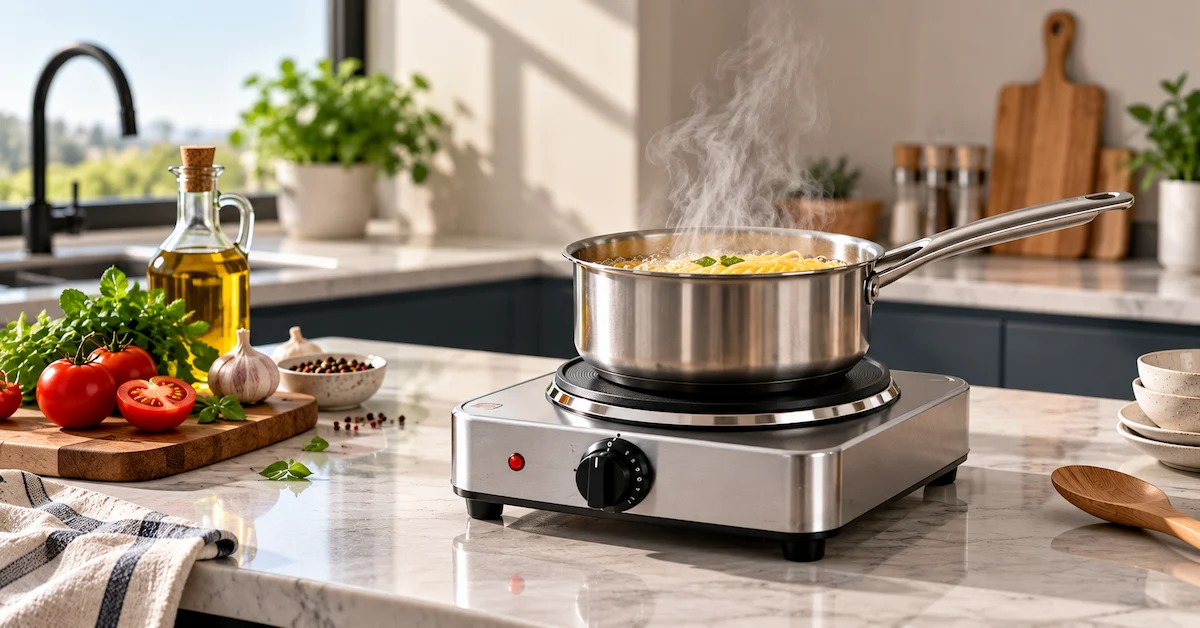



Quick answer: A reliable hot plate for household cooker programs must be approved against the complete appliance design. Diameter is only the first filter. The engineering team should also verify rated voltage, power, resistance, terminal configuration, mounting envelope, cookware zone, control device, thermal clearances, insulation, surface temperature, packaging, and the compliance documents required for the destination market.
For a household cooker manufacturer, the heating plate is a controlled electrical and thermal component, not a generic replacement part. A visually similar plate can still create wiring errors, uneven heating, excessive heat around the control panel, or a failed assembly trial. This article gives OEM brands, private-label manufacturers, importers, and distributors a practical framework for selecting a hot plate for household cooker production and preparing a meaningful RFQ.
1. What Is a Hot Plate for Household Cooker?
A household cooker hot plate is a resistive heating component that converts electrical energy into heat and transfers that heat to cookware through a heated metal surface. It is commonly integrated into single-zone cookers, compact electric stoves, tabletop appliances, portable cooking units, and replacement-part programs.
The component normally works with a switch, energy regulator, thermostat, wiring harness, protective device, insulation, support structure, and sometimes a ceramic glass cooking surface. Its actual performance therefore depends on the surrounding appliance. The same nominal diameter may behave differently when the voltage, power, cookware, airflow, control cycle, or installation clearance changes.
WEBO publicly presents 90mm, 110mm, and 145mm hot plate categories. These categories are useful starting points for a sourcing discussion, but a published size does not replace an approved drawing or model-specific data sheet. Review the WEBO product overview and hot plate category before selecting a candidate model.
2. Who Should Use This Selection Guide?
This guide is intended for:
- Household cooker and electric stove OEMs.
- Private-label appliance brands and contract manufacturers.
- Product engineers responsible for mechanical, electrical, or thermal integration.
- Procurement teams qualifying a new or second hot plate supplier.
- Importers and distributors sourcing replacement or approved components.
- After-sales teams that must verify electrical and mechanical compatibility.
It is not a substitute for a finished-appliance safety assessment. Consumers replacing a failed part should use the original appliance model, approved service information, and a qualified technician rather than choosing a component by diameter alone.
3. Common Household Cooker Applications
The right hot plate for household cooker projects depends on the appliance platform and intended use.
| Application | Typical sourcing question | Validation focus |
|---|---|---|
| Compact single-zone cooker | Can the plate fit the small housing and cookware area? | Mounting, heat spreading, enclosure temperature |
| Full-size single-zone cooker | Can the appliance handle the selected load continuously? | Power, wiring, control cycle, thermal mapping |
| Multi-zone electric stove | Can multiple plates run without exceeding the total appliance limit? | Combined load, protection, harness temperature |
| Portable countertop unit | Can the part work within a tight installation envelope? | Clearance, vibration, transport, user-touch temperatures |
| Private-label cooker platform | Can one approved specification serve several models? | Variant control, labels, drawings, change management |
| Replacement-part program | Is the candidate truly compatible with the original part? | Rating, terminals, mounting, fitment evidence |
For each application, document the intended cookware, target market voltage, rated power, control method, surrounding materials, and annual demand before asking for a final quotation.
4. Technical Specification Checklist
The following fields should appear in the RFQ and on the approved product record.
| Specification field | What to confirm | Why it matters |
|---|---|---|
| Diameter and geometry | Nominal size, overall height, support shape, critical tolerances | Controls fit, cooking-zone coverage, and assembly interchangeability |
| Rated voltage | Required regional supply and test condition | Prevents an electrical variant from being used in the wrong market |
| Rated power and resistance | Approved wattage, resistance range, and tolerance | Affects heating output, current, wiring, and protection |
| Terminals | Type, position, orientation, spacing, and connection diagram | Prevents harness rework and incorrect polarity or routing |
| Mounting envelope | Brackets, fasteners, underside clearance, insulation space | Prevents interference and local overheating |
| Control interface | Rotary switch, energy regulator, thermostat, or electronic control | Determines cycling behavior and load compatibility |
| Surface and materials | Heated surface, support, insulation, finish, and corrosion needs | Affects durability, cleaning, appearance, and heat transfer |
| Test conditions | Ambient temperature, cookware load, measurement points, and acceptance limits | Makes sample and batch results comparable |
| Packaging and identification | Part number, revision, labels, carton protection, and lot information | Reduces mixed variants and transport damage |
Do not approve a household cooker hot plate from a photograph, a marketplace listing, or a diameter statement alone. Request a dimensioned drawing and a controlled specification for every electrical variant.
5. Materials, Components, and Workmanship
A hot plate assembly is a system of materials and interfaces. The heating surface must transfer heat effectively while tolerating repeated thermal cycles. The internal resistive element and insulation must maintain electrical separation under the specified operating conditions. Terminals must remain mechanically secure and electrically stable after assembly and use. Supports, brackets, and nearby insulation must hold the component in the intended position without creating a local heat trap.
Ask the supplier to identify which material and process details are fixed by the approved drawing and which can change between batches. Useful questions include:
- Which dimensions are critical to assembly fit?
- Which components are inspected at incoming quality control?
- How are resistance and power checked during production?
- How are terminal position and connection strength verified?
- What appearance or surface defects are unacceptable?
- How are engineering changes communicated and requalified?
If a project includes a ceramic glass cooktop, also verify the panel thickness, opening, printed markings, edge treatment, thermal-shock requirements, and contact conditions. A hot plate for household cooker equipment should be evaluated with the actual panel and support structure, not on an isolated bench only.
6. Thermal Safety and Control Matching
Thermal safety starts with the complete heat path. Review the distance between the plate and the appliance enclosure, wires, switches, knobs, glass, plastic parts, and user-touch surfaces. Map temperatures at normal operation and at defined abnormal conditions. Confirm that the control cycle does not create an unacceptable peak temperature even when the average power appears correct.
An energy regulator can adjust average power through periodic switching, while a rotary switch selects functions or fixed levels. These components are not interchangeable by appearance. Their ratings, terminals, shaft dimensions, load type, and operating environment must match the selected plate and the finished cooker. A control designed for a resistive plate should not be assumed suitable for an induction system or a precision closed-loop temperature application.
For multi-zone cookers, calculate the combined load. A plate that passes an individual component test may still be unsuitable when two or more zones operate together. Review conductor size, protective devices, control ratings, ventilation, and abnormal-operation behavior at appliance level.
7. 90mm, 110mm, or 145mm: How Should OEMs Compare Models?
WEBO’s published hot plate categories provide a practical first screen. The final choice should be based on the appliance’s cookware zone, housing, rated load, and target market rather than size alone.
| Category | Typical evaluation role | Advantages to investigate | Main risks to check |
|---|---|---|---|
| 90mm | Compact single-zone or space-limited platforms | Smaller installation envelope and lower zone coverage | Insufficient cookware coverage, local heat concentration |
| 110mm | Mid-size countertop or household cooker platforms | Balance of zone size, installation space, and load | Housing clearance, control rating, combined-load limits |
| 145mm | Larger single-zone or full-size cooker platforms | Larger cookware coverage and higher design flexibility | Higher thermal load, enclosure temperature, wiring and protection |
These are evaluation categories, not universal performance claims. Ask for the approved voltage, power, resistance, terminal layout, drawing, sample status, and applicable certification documents for the exact model.
Request a Project-Specific Quote
8. Quality Control and Certification Questions
Before bulk sourcing, request evidence that connects the approved sample to repeat production. A practical quality review can include:
- Incoming inspection for materials and purchased subcomponents.
- Dimensional checks for diameter, height, brackets, and terminals.
- Resistance and power verification under defined conditions.
- Insulation and electrical safety checks appropriate to the component.
- Appearance and surface inspection.
- Functional checks of the plate with the intended control device.
- Lot identification, inspection records, and packing verification.
- A documented change-notification and requalification process.
WEBO states on its company page that it operates under ISO 9001 and ISO 14001 management standards and that its products have obtained external quality certifications including VDE, TUV, UL, CE, and RoHS. These statements should be treated as a starting point for supplier qualification. Ask for the certificate number, validity, applicable model, standard, test report, and destination-market scope before using any certification claim in a product specification.
The finished cooker may also fall under applicable household-appliance safety requirements, such as the relevant part of the IEC 60335 series or local market rules. The correct standard, edition, test responsibility, and documentation scope must be confirmed for the complete appliance rather than assumed from a component name.
Read the WEBO company profile for the published manufacturing background, then request model-specific documents for the household cooker hot plate under review.
9. Capacity, Lead Time, and Commercial Risk
A low unit price does not necessarily produce the lowest program cost. For every hot plate for household cooker project, compare the complete cost of a qualified and delivered component, including sampling, validation, incoming inspection, assembly effort, rework, packaging, freight, duties, warranty exposure, and the cost of an uncontrolled engineering change.
MOQ, sample fees, production capacity, and lead time depend on the model, customization, materials, season, order volume, and destination. They should be confirmed in a current quotation rather than copied from an old blog post or product page. For repeat orders, include a forecast, approved part number, revision, packaging specification, inspection method, and change-notification rule.
10. OEM and ODM Development Process
For a new hot plate for household cooker program, a controlled development sequence reduces avoidable rework:
- Define the application. List cooker models, cookware, voltage, power target, control method, installation envelope, market, and annual demand.
- Review feasibility. Compare the drawing or sample with candidate standard parts and identify required modifications.
- Approve representative samples. Check dimensions, electrical values, appearance, terminals, and packaging identification.
- Integrate into the appliance. Test mounting, wiring, heat distribution, controls, nearby materials, and user-touch temperatures.
- Run a pilot build. Measure assembly yield, rework, inspection time, variant identification, and shipping protection.
- Freeze the specification. Approve the drawing, revision, quality plan, documentation, commercial terms, and requalification triggers.
- Release production. Track lot information and review any proposed change before shipment.
This process supports both standard sourcing and customized OEM/ODM work. The actual scope, sample terms, testing responsibility, and production schedule should be agreed in writing for each project.
11. What to Include in a Hot Plate RFQ
Send the supplier enough information to distinguish a standard quotation from a development project. A complete hot plate for household cooker RFQ gives the engineering team enough context to confirm feasibility instead of guessing from a product photo:
- Cooker type, model family, and intended use.
- Target country or voltage system.
- Candidate diameter and complete installation drawing.
- Rated power, resistance, control device, and terminal requirements.
- Cookware zone, panel material, thermal clearance, and nearby components.
- Sample quantity, annual forecast, first order, and expected demand variation.
- Required inspection, testing, certification documents, and traceability.
- Packaging, labels, shipping destination, and delivery terms.
- Existing sample or approved replacement reference, if applicable.
Talk to WEBO Heating Element Experts
12. Frequently Asked Questions
1. What is the most important factor when selecting a hot plate for household cooker equipment?
The most important factor is system compatibility. Confirm electrical ratings, mechanical fit, thermal clearances, control interface, cookware zone, and appliance-level test results together.
2. Can I choose a hot plate by diameter only?
No. Diameter does not define power, resistance, terminal position, height, mounting, or control compatibility. A dimensioned drawing and approved electrical data are required.
3. How do I compare 90mm, 110mm, and 145mm hot plates?
Start with the cookware zone and available housing space, then compare voltage, power, resistance, thermal load, wiring, controls, and protection. The larger category is not automatically faster or better.
4. Can one plate be used in several cooker models?
Possibly, but only after electrical, mechanical, thermal, control, and compliance requirements are shown to match each model. Use a controlled master specification and model-variant table.
5. How should the voltage and wattage be confirmed?
State the target market and test condition in the RFQ. Ask the supplier to confirm rated voltage, rated power, resistance range, tolerance, and the measurement method for the exact part number.
6. Can an energy regulator be used with any household cooker hot plate?
No. The regulator must match the resistive load, voltage, current, frequency, terminal arrangement, shaft, installation temperature, and required control behavior.
7. Does a component certification certify the complete cooker?
No. A component document may apply only to a model or defined scope. The finished cooker still has its own design, testing, labeling, and market-compliance responsibilities.
8. What should be tested before mass production?
Verify dimensions, resistance, power, insulation, terminals, mounting, heat distribution, nearby surface temperatures, control cycling, normal operation, abnormal operation, pilot yield, and packaging.
9. How do I reduce replacement-part compatibility risk?
Compare the original part number, drawing, voltage, power, resistance, terminal layout, mounting, height, and control interface. Do not approve a replacement from a photograph or diameter match alone.
10. How can I request a quotation from WEBO?
Prepare the drawing or sample details, target voltage and power, candidate size, application, forecast volume, market, testing, certification, and packaging needs. Then contact the WEBO team for a project-specific review.
Conclusion
Selecting a hot plate for household cooker production is a controlled engineering and sourcing decision. The best result comes from matching the plate to the complete appliance: electrical supply, power, resistance, terminals, mounting, cookware zone, controls, thermal clearances, glass or metal surfaces, testing, and market requirements. WEBO’s published portfolio includes 90mm, 110mm, and 145mm hot plate categories, supported by a broader range of heating and cooker components. For current model availability, certification scope, MOQ, lead time, and customization, use the WEBO hot plate range and submit a complete RFQ through the contact page.