


Selecting a hot plate for electric stove production is a decision that reaches well beyond the price of a heating component. For an appliance manufacturer, the plate becomes part of the electrical, mechanical, and thermal design of the finished stove. For a distributor, the same component determines whether a replacement part fits the customer's appliance, performs as expected, and can be supplied consistently across future orders.
A circular hot plate may appear straightforward. Yet two plates with similar-looking surfaces can differ in rated voltage, resistance, heat output, mounting geometry, terminal orientation, surface finish, and compatibility with the stove's control system. These differences matter during appliance assembly and may become expensive after a product reaches the market.
The consequences of poor selection are rarely limited to a single defective part. An unsuitable heating plate can require wiring modifications, affect product performance, delay approval testing, create unnecessary warranty claims, or force a manufacturer to revise an entire appliance platform.
For overseas buyers, the challenge is therefore not simply finding a supplier with an attractive quotation. It is establishing a repeatable specification that works within the intended electric stove and remains consistent from prototype to mass production.
This guide focuses on the engineering and purchasing decisions that matter most when sourcing solid electric hot plates. It covers diameter selection, electrical matching, installation design, heating performance, quality inspection, compliance considerations, OEM development, and bulk purchasing.
It also explains how appliance brands, engineering teams, and component distributors can work with WEBO's hot plate product range when evaluating suitable components for their projects.

What Is a Hot Plate for an Electric Stove?
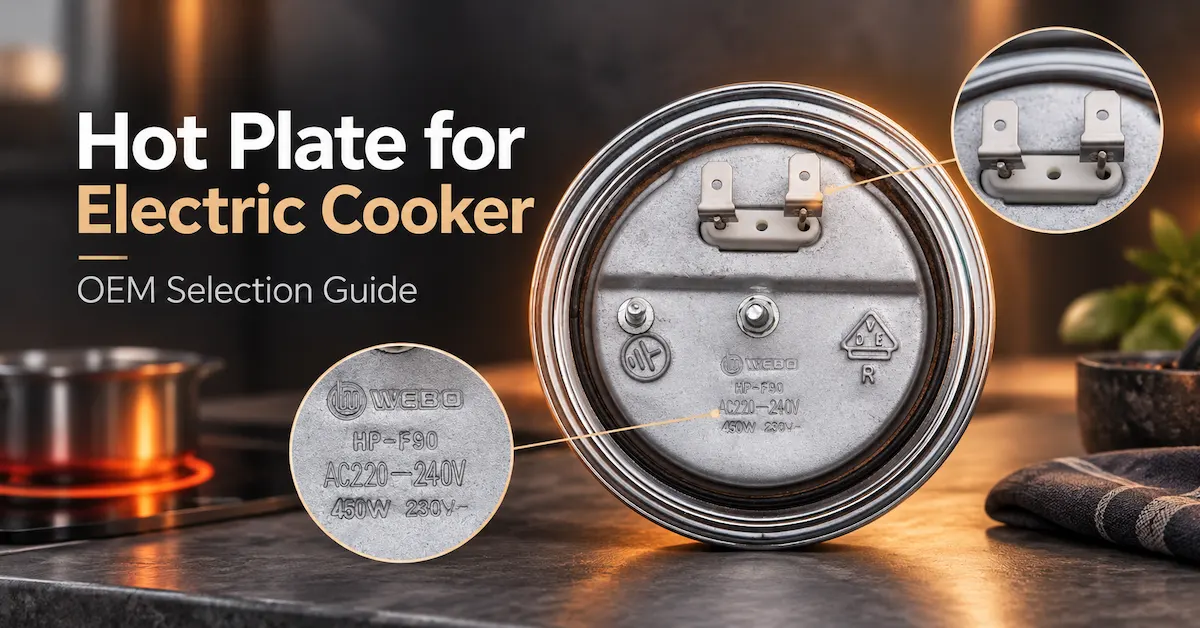
A hot plate for an electric stove is an electrically powered heating component designed to transfer heat to cookware through its heated surface. In a conventional solid hot plate design, electrical resistance produces heat inside the heating assembly, while the plate structure distributes that heat toward the cookware.
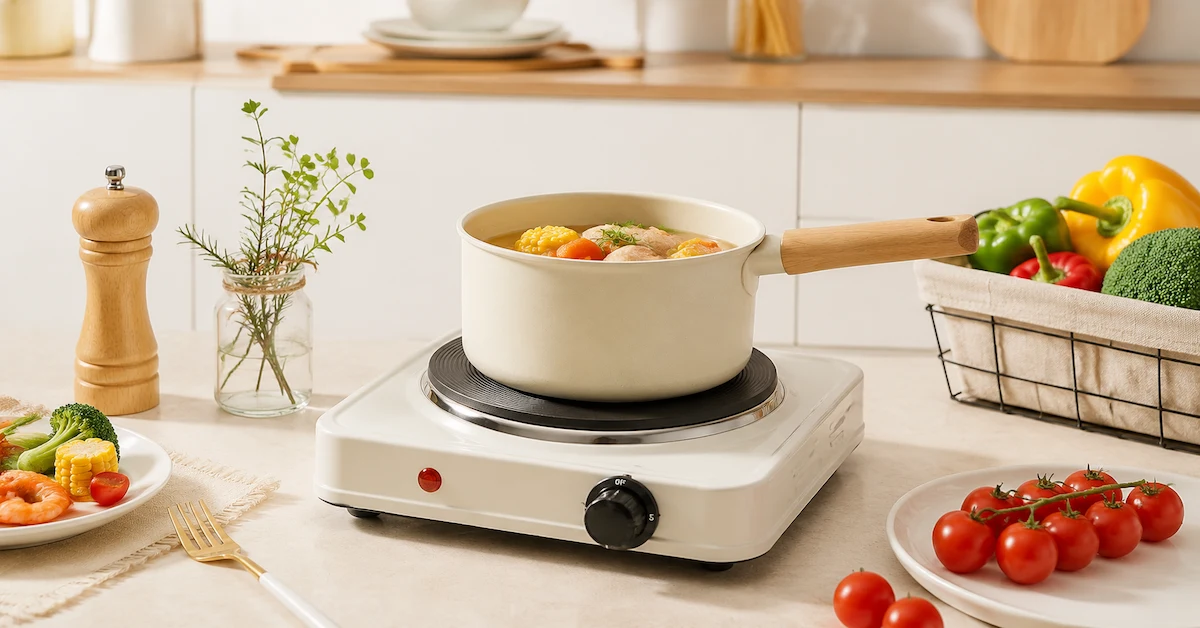
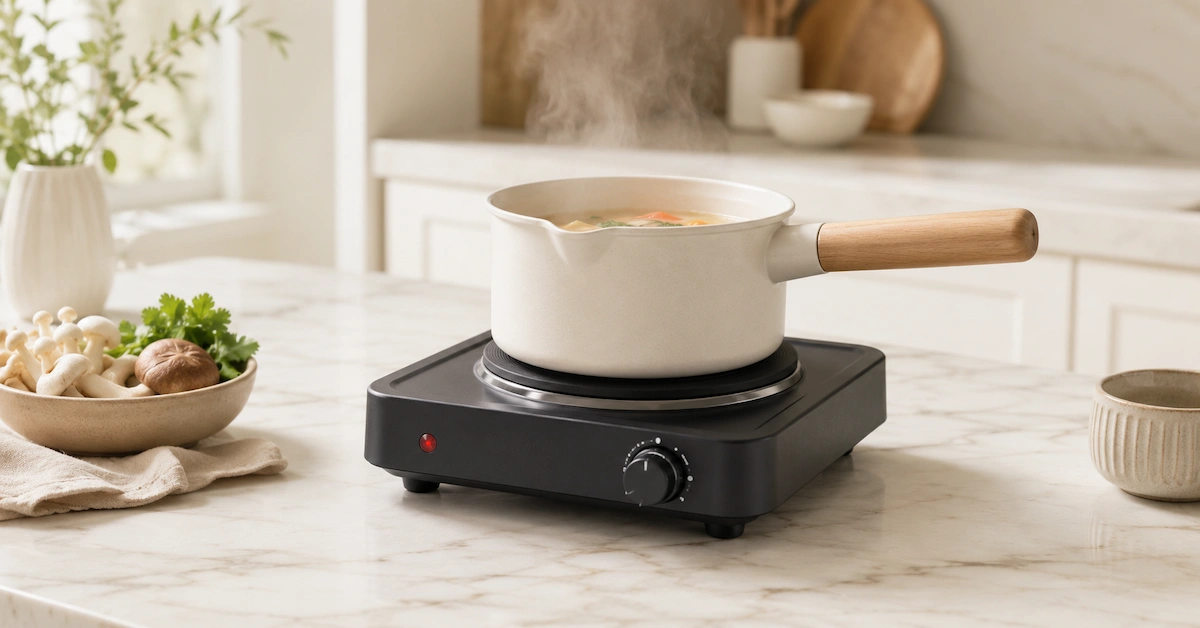
This type of heating component is used in traditional electric stoves, portable cookers, tabletop cooking appliances, compact kitchen equipment, and certain replacement-part programs.
Unlike an induction cooking system, a solid hot plate does not depend on generating heat directly inside compatible magnetic cookware. Instead, the plate itself becomes hot and transfers energy to the cooking vessel.
That distinction affects appliance design in several important ways.
First, the solid plate stores thermal energy. It generally continues releasing heat after electrical power is switched off. This behavior needs to be considered when designing user controls, warning labels, adjacent components, and housing ventilation.
Second, heat transfer depends on the relationship between the plate surface and the cookware base. A flat-bottomed pan that makes suitable contact with the heated surface generally transfers heat more effectively than a warped pan with limited contact.
Third, the heating plate operates as part of a complete electrical appliance. Its safety and performance depend not only on the heating component but also on wiring, control devices, thermal protection, mechanical support, and the finished stove's construction.
For OEM manufacturers, this means that a hot plate should be evaluated as an integrated appliance component rather than an interchangeable metal disc.
How Does a Solid Electric Hot Plate Work?
The fundamental mechanism is resistance heating.
When an appropriate electrical supply is applied to a resistive heating element, electrical energy is converted into thermal energy. In a solid hot plate assembly, this heat passes through the surrounding structure and reaches the cooking surface.
The heating behavior is influenced by several interacting factors:
-
The element's electrical resistance and rated voltage.
-
The thermal mass and geometry of the plate.
-
The material and construction of the heating assembly.
-
Contact between the heating surface and the cookware.
-
Heat losses to surrounding air and appliance components.
-
The switching behavior of the power control system.
An electric hot plate does not maintain a single temperature simply because it has a fixed wattage. Its actual operating temperature depends on the electrical input, cookware load, heat loss, control method, and operating conditions.
For example, the surface temperature measured with an empty plate may differ significantly from the temperature observed when a pan containing water is placed on it. The loaded operating condition can alter heat transfer and change the temperature distribution within the appliance.
This is why heating performance should be assessed under representative cooking conditions, not solely through an unloaded power-on test.
For an appliance engineer, the important question is not merely, "Does the plate get hot?" It is, "Does this plate provide the required cooking performance while keeping the complete appliance within its defined safety and design limits?"
How to Choose the Right Hot Plate Size for an Electric Stove
Diameter is usually the first specification discussed during sourcing. It is also one of the easiest specifications to misunderstand.
A nominal diameter is useful for identifying a product family, but it does not fully describe the shape, installation envelope, or functional heating area of the component.
WEBO's published product navigation identifies 90mm, 110mm, and 145mm hot plate categories, providing buyers with a starting point for selecting a suitable component size.
The final choice must still be confirmed against the actual appliance drawing.
Comparing 90mm, 110mm, and 145mm Hot Plates
|
Nominal Size |
Potential Application |
Engineering Considerations |
Recommended Buyer Action |
|---|---|---|---|
|
90mm |
Compact cooking zones and small-appliance designs |
Limited cooking area, housing clearance, cookware compatibility |
Confirm the required heated area and allowable power |
|
110mm |
Small portable electric stoves and compact cookers |
Balance between cooking zone size, electrical input, and available space |
Review mounting dimensions and loaded heating performance |
|
145mm |
Conventional electric stove burners and larger compact cooking zones |
Mechanical support, thermal mass, cookware contact, electrical load |
Validate the complete installation and heating-control arrangement |
|
Custom size |
Application-specific OEM equipment |
Design feasibility, tooling, electrical rating, mounting, and testing |
Submit drawings and operating requirements for evaluation |
The applications above are engineering selection examples, not guarantees that every WEBO model in a particular diameter has a specific power rating or intended appliance application.
A larger hot plate may accommodate a larger cookware base, but it does not automatically heat faster. Heating speed depends on available power, thermal design, cookware, and control strategy.
Likewise, a smaller plate is not necessarily more energy-efficient in every application. If it transfers heat poorly to the intended cookware or takes much longer to complete a heating task, its practical energy use may not meet the appliance designer's expectations.
Why Nominal Diameter Is Not Enough
Consider two nominally 145mm electric hot plates supplied by different manufacturers.
Both may fit a basic product description, yet their assemblies could differ in total height, mounting position, underside clearance, terminal arrangement, or the shape of the surface that contacts the appliance housing.
A manufacturer replacing one supplier with another must therefore check the complete installation envelope.
The engineering drawing should identify the dimensions and tolerances that are critical to assembly, including the actual plate diameter, overall height, mounting interface, terminal location, and any required clearance.
A sample should then be assembled into the intended appliance housing.
This prevents a common sourcing failure: purchasing a component that meets the advertised diameter but cannot be installed without modifying the stove.
WEBO provides an HP-F145 product page within its 145mm category. Buyers evaluating this product should request the current technical drawing, voltage and power options, terminal details, and applicable documentation before approving it for production.
How to Select the Size for a New Appliance Design
For a new electric stove, begin with the cooking task and product architecture.
Determine the expected cookware dimensions, the number of heating zones, the available enclosure space, and the total appliance electrical capacity.
Next, identify any physical constraints created by controls, wiring routes, ventilation openings, or adjacent heating components.
Only then should a plate diameter be shortlisted.
A useful selection process is to compare the available diameter options against three practical questions:
-
Will the intended cookware make suitable contact with the heated surface?
-
Can the plate be safely and consistently mounted inside the appliance?
-
Can the complete stove deliver the required heating performance without exceeding its design limits?
If one of these questions cannot be answered with reasonable confidence, the project needs further design review before selecting a production component.
Matching Voltage and Wattage to the Electric Stove Design
Electrical compatibility is one of the most critical factors when choosing a hot plate for an electric stove.
A plate may have the correct diameter and mounting arrangement but still be unsuitable if its electrical characteristics do not match the intended appliance.
Manufacturers need to confirm the destination market's nominal supply voltage, the rated power of the heating component, the allowable current through the control system, and the thermal capacity of the surrounding structure.
These requirements become particularly important when a single appliance platform is sold in multiple countries.
Why Voltage Matching Matters
Electric stoves are designed around specific electrical supply conditions. A heating element intended for one voltage cannot automatically be used at a different voltage simply because its physical dimensions are identical.
For a simplified resistive load, electrical power can be expressed as:
P = V² / R
Where:
-
P represents electrical power in watts.
-
V represents the voltage applied across the element.
-
R represents electrical resistance in ohms.
The relationship illustrates why voltage mismatches can be serious.
For example, consider a hypothetical 1,000W heating element designed for operation at 230V.
Using the simplified equation:
R = 230² / 1,000 = 52.9Ω
A hypothetical 1,000W element designed for 120V would have a different calculated operating resistance:
R = 120² / 1,000 = 14.4Ω
These calculations are illustrative engineering examples, not specifications for any WEBO product. Actual heating elements may have resistance that varies with temperature, and cold resistance measurements may differ from the resistance used in nominal operating calculations.
The important purchasing lesson is that equal wattage does not mean electrical interchangeability.
A buyer should never approve a hot plate for another voltage without appropriate manufacturer confirmation and engineering validation.
Should Buyers Always Choose a Higher-Wattage Hot Plate?
Not necessarily.
Higher rated power can increase the available heating input, but it also changes the electrical and thermal demands placed on the appliance.
The correct wattage depends on the intended cooking performance and the operating limits of the complete stove.
Before increasing the heating plate's power, engineers should review:
-
The current-carrying capacity of internal wiring.
-
The electrical ratings of switches and control components.
-
The adequacy of thermal protection.
-
The temperature limits of nearby plastic, insulation, and structural parts.
-
The appliance's maximum total electrical load.
-
Expected operating time and duty cycle.
-
Relevant safety-test requirements.
A higher-power plate fitted into an enclosure designed for a lower heat load may create unwanted temperatures around wiring or housing components.
Conversely, a plate with inadequate output may produce slow cooking performance even when it fits perfectly.
For OEM development, rated power should therefore be treated as a coordinated appliance design parameter rather than an isolated selling point.
Electrical Specification Checklist
|
Parameter |
What to Confirm |
Why It Matters |
|---|---|---|
|
Rated voltage |
Approved voltage or voltage range |
Prevents electrical mismatch |
|
Rated power |
Nominal wattage and applicable tolerance |
Supports cooking performance and thermal design |
|
Electrical resistance |
Expected measurement conditions and acceptance range |
Supports incoming inspection and product identification |
|
Rated current |
Load calculation and control-component compatibility |
Helps prevent overloaded electrical connections |
|
Electrical terminals |
Connection type, geometry, and conductor suitability |
Supports safe and repeatable assembly |
|
Insulation properties |
Applicable insulation requirements and test methods |
Addresses electrical safety |
|
Operating conditions |
Expected duty cycle, cookware load, and thermal environment |
Supports realistic performance verification |
|
Protection design |
Required independent or supplementary thermal protection |
Helps manage abnormal operating conditions |
The acceptance values for these parameters should come from approved drawings, specifications, and applicable safety requirements.
For buyers sourcing multiple voltage configurations, separate part numbers or clearly identified variants can reduce the chance of mixing incompatible products during production and distribution.
Mechanical Compatibility: What Electric Stove Manufacturers Must Check
Electrical performance alone does not make a heating plate suitable for an appliance.
A hot plate for electric stove manufacturing must also fit the appliance consistently, withstand expected mechanical conditions, and maintain adequate clearance from surrounding components.
This is especially important during supplier replacement, appliance redesign, or large-volume production.
Mounting Dimensions and Installation Geometry
The outer diameter is only one element of mechanical compatibility.
Engineering teams should examine the complete geometry of the component, including its underside structure, available mounting positions, and the location of electrical connections.
A component that requires additional installation force or adjustment may create problems during mass production.
For example, a terminal located several millimeters away from the approved position could interfere with an existing wire harness. A difference in overall height could change the position of the cooking surface relative to the stove's upper housing.
Even if the assembled unit appears acceptable, these changes could influence heat transfer or strain electrical connections.
For this reason, an OEM specification should identify critical dimensions and agreed tolerances rather than relying on product photographs.
Terminal Design and Wire Routing
Electrical terminals are another frequent source of compatibility problems.
The connection system should match the intended wire harness, electrical rating, and assembly method.
Buyers should check terminal orientation, available clearance, connection retention, and the potential effect of temperature on the connection area.
Terminals also need protection against unwanted mechanical stress during assembly, transportation, and use.
A loose connection can create localized resistive heating. This is different from the intended heating action of the plate itself and may become a safety concern.
Connector temperature ratings, contact design, conductor selection, and applicable assembly procedures should be reviewed together.
Thermal Expansion and Structural Support
Electric hot plates experience repeated heating and cooling.
Different materials within the complete stove may expand by different amounts as their temperatures change.
The mounting arrangement therefore needs to accommodate the operating conditions without causing excessive stress, distortion, or loss of intended contact.
An overly rigid installation may create mechanical stress under thermal expansion. An insufficiently supported plate may move or become unstable during normal appliance use.
The correct solution depends on the actual component design and the stove's construction.
This is one reason production approval should include representative thermal cycling and mechanical-fit assessment, rather than a room-temperature installation check alone.
How to Evaluate Heating Performance and Temperature Distribution
A frequent mistake in electric stove procurement is judging performance only by how quickly an unloaded hot plate becomes visibly hot.
Such a test provides limited information about cooking performance.
For commercial buyers, the more meaningful question is whether the component produces repeatable results under conditions that represent the intended appliance application.
Heating Time Is Only One Performance Indicator
Heating time describes how quickly the system reaches a defined measurement point under specified conditions.
However, the result depends on the initial temperature, power input, thermal mass, cookware load, and test environment.
Two hot plates may have the same nominal electrical rating while producing different heating behavior because their constructions and heat-transfer characteristics differ.
A buyer comparing samples should therefore define a consistent test method.
For example, a comparative test may specify:
-
The same appliance housing and control arrangement.
-
The same supply voltage within the test conditions.
-
The same cookware geometry and material.
-
An identical measured water load.
-
The same initial water temperature.
-
Identical ambient conditions.
-
A defined endpoint and measurement method.
These controls make results more useful than an informal demonstration.
Any production acceptance criterion should be developed from appliance requirements, verified prototypes, and applicable standards.
Why Cookware Contact Matters
A solid hot plate transfers a significant portion of its useful heat through contact with the cookware.
If the cookware base is warped, excessively small, or poorly matched to the surface, heat transfer can be reduced.
Heat that does not enter the cookware must be dissipated elsewhere.
This can influence plate temperature, adjacent component temperature, and the time required to complete a cooking task.
For appliance brands, cookware compatibility should be considered when defining product instructions and performance tests.
Distributors should also avoid promising that a replacement hot plate will provide identical heating results with every type of pan.
Heat Distribution and Temperature Control
Temperature distribution matters because localized hot areas can influence cooking behavior and thermal stress.
Engineers can evaluate temperature behavior with suitable sensors, measurement equipment, and a repeatable test procedure.
Infrared imaging can sometimes help visualize temperature patterns, but reflected radiation and differences in surface emissivity can affect infrared measurements. Contact sensors or other validated methods may be required for accurate testing.
The purpose is not necessarily to achieve identical temperatures everywhere on the plate.
Instead, the objective is to confirm that temperature behavior meets the intended appliance design and safety requirements.
For OEM projects, a useful technical discussion should include both loaded and unloaded operation, normal controls, and relevant abnormal conditions.
Hot Plate Control Systems: Rotary Switches and Energy Regulators
The heating plate is only one part of the stove's operating system.
How electrical power is supplied and controlled affects user experience, operating temperature, and component requirements.
Conventional resistive cooking appliances may use mechanical switching arrangements or suitable energy regulators.
WEBO's published product portfolio includes both Rotary Switch and Energy Regulator categories alongside its hot plate products.
These categories represent related appliance components, but their suitability for a particular heating plate must be confirmed by electrical specifications and appliance design.
Rotary Switches
A rotary switch may be used to select electrical circuits, heating configurations, or operating positions depending on its design.
The number of switch positions does not, by itself, establish how the connected hot plate will behave.
A suitable switch must have the correct electrical ratings, contact arrangement, mechanical interface, and circuit compatibility.
An OEM buyer should request the switching diagram rather than assuming that two switches with similar knobs are interchangeable.
Energy Regulators
Some conventional electric stove designs use an energy regulator to control the average power delivered to a resistive heating element.
A typical cycling regulator adjusts the proportion of time that electrical power is applied rather than continuously changing the heating element's resistance.
The heating plate's thermal mass helps smooth the resulting temperature changes, but the actual temperature remains dependent on the cookware load and operating environment.
A cycling energy regulator should not be confused with an induction power-control system.
For a complete stove project, heating plate selection and control-component selection should be reviewed together.
Solid Hot Plate vs Ceramic Radiant Heater vs Induction Coil
Appliance manufacturers sometimes compare different heating technologies while planning a new product.
A solid hot plate remains relevant where the design prioritizes a contact-heating cooking surface, established appliance architecture, and a relatively straightforward heating system.
However, it is not the best choice for every product.
WEBO's wider heating component portfolio includes ceramic radiant heaters and induction coils, providing a useful starting point for comparing technologies at the application level.
|
Comparison |
Solid Electric Hot Plate |
Ceramic Radiant Heater |
Induction Coil |
|---|---|---|---|
|
Heating principle |
Resistance heating with heat transferred through a solid plate |
Electrical resistance heating with radiant heat transfer, commonly through glass ceramic |
Electromagnetic induction heating in suitable cookware |
|
Cooking surface |
Exposed heated solid plate |
Usually a glass-ceramic cooking surface |
Usually a glass-ceramic cooking surface |
|
Cookware considerations |
Flat contact surface is important |
Flat cookware supports effective heat transfer |
Requires compatible cookware |
|
Residual heat |
Plate can remain hot after switching off |
Cooking surface can retain residual heat |
Cookware can heat the glass surface, creating residual heat |
|
Control requirements |
Suitable switching or regulation system |
Appropriate heater controls and thermal protection |
Compatible electronic induction drive and controls |
|
Integration challenges |
Mechanical mounting, thermal clearance, wiring |
Glass-panel compatibility, thermal management, limiter design |
Coil-drive matching, thermal management, electromagnetic compatibility |
|
Typical OEM consideration |
Practical cooking solution for conventional stove designs |
Smooth-top radiant cooking applications |
Induction cooking platforms |
These differences should influence the appliance architecture before a component is purchased.
For example, changing from a solid hot plate to induction heating is not a direct component substitution.
It requires a different heating principle, suitable power electronics, appropriate cookware compatibility, and additional system-level engineering.
Likewise, using a ceramic radiant heater typically requires consideration of the intended glass-ceramic cooking surface and thermal protection arrangement.
The best technology depends on the appliance's performance targets, cost structure, user expectations, and regulatory requirements.
Materials and Surface Finish: Why They Matter in Long-Term Use
Solid hot plates are exposed to repeated temperature changes, cookware contact, cleaning, and potentially corrosive kitchen environments.
The construction material and surface treatment can therefore affect durability, appearance, and maintenance requirements.
Cast Iron and Thermal Behavior
Cast iron is commonly associated with traditional solid electric hot plates.
Its thermal mass contributes to heat storage, which can support relatively stable heating behavior after the element reaches operating temperature.
That same thermal mass also means the plate may take time to cool.
For appliance design, heat retention can be an advantage in certain cooking applications and a limitation in others.
The buyer should consider how the final product communicates residual heat risks to users.
Cast iron construction alone does not establish a particular heating rate, lifetime, surface hardness, or resistance to corrosion.These characteristics depend on the actual design, material quality, processing, and use conditions.
Surface Treatment and Corrosion Resistance
A hot plate's exposed surface must tolerate its intended thermal environment.
Any coating or surface treatment should be evaluated for compatibility with the operating temperature and expected cleaning conditions.
Buyers should ask the manufacturer to explain the specified finish and the testing used to evaluate it.
Surface appearance is also relevant to wholesale distribution.
A component with inconsistent finish, visible corrosion, or handling damage may be rejected by customers even when its electrical characteristics remain within specification.
For OEM and replacement-part buyers, the approved sample should therefore define appearance requirements as well as functional requirements.
Storage and Transport Environment
Long-distance transportation introduces additional considerations.
Humidity, condensation, packaging movement, and storage conditions may affect exposed metal surfaces and electrical terminals.
Export packaging should provide suitable separation and protection against movement and damage.
Where corrosion protection is necessary, the packaging method and any protective materials must be compatible with the product and its intended use.
A technical quotation should clarify whether the buyer requires ordinary bulk packaging, individual protective packaging, or a retail-ready presentation.
Quality Control Requirements for Electric Stove Hot Plates
For B2B buyers, product consistency is one of the most important reasons to evaluate a supplier carefully.
A successful first sample does not guarantee that subsequent production batches will perform identically.
The buyer needs a documented set of acceptance criteria that connects design specifications, component testing, and production inspection.
Recommended Quality Inspection Matrix
|
Inspection Area |
Suggested Verification |
Purchasing Risk Addressed |
|---|---|---|
|
Product identification |
Verify model, revision, voltage, and power markings |
Incorrect SKU or variant |
|
Mechanical dimensions |
Measure critical dimensions against approved drawings |
Poor assembly fit |
|
Electrical resistance |
Test using specified conditions and acceptance range |
Incorrect electrical characteristics |
|
Electrical power |
Verify under defined operating conditions |
Heating performance variation |
|
Insulation resistance |
Apply the relevant approved test method |
Electrical insulation concerns |
|
Dielectric withstand |
Test according to applicable safety requirements |
Electrical breakdown risk |
|
Terminal integrity |
Check geometry, retention, and connection condition |
Loose or unsuitable wiring connections |
|
Heating performance |
Evaluate under agreed appliance conditions |
Slow or inconsistent heating |
|
Thermal cycling |
Examine changes after defined heating and cooling cycles |
Thermal durability concerns |
|
Surface appearance |
Inspect coating, finish, and visible damage |
Cosmetic rejection or surface defects |
|
Packaging |
Confirm identification, protection, and carton configuration |
Shipping damage and inventory errors |
This matrix is a recommended supplier-qualification framework. It should not be interpreted as a statement that every WEBO model has undergone every listed test.
Specific test voltages, durations, sample quantities, limits, and acceptance criteria must be established from the applicable product and appliance requirements.
Incoming Quality Control for Appliance Factories
A stove manufacturer receiving hot plates in quantity should have a clear incoming inspection procedure.
The procedure can include verifying product identification, sampling according to an agreed inspection plan, checking critical dimensions, and evaluating defined electrical properties.
Any inspection process should also specify how nonconforming material will be separated and reported.
For high-impact characteristics, additional traceability or testing may be appropriate.
The goal is not to inspect every characteristic without considering cost. It is to identify the risks that matter most to the finished appliance and build an effective control plan around them.
Production Consistency and Change Control
A reliable OEM supply arrangement needs a system for handling engineering changes.
Consider what happens if a supplier modifies a terminal design or surface finish between orders.
Even if the new version appears equivalent, it may influence wiring assembly, mechanical fit, corrosion behavior, or thermal performance.
A purchasing agreement should therefore clarify which changes require customer notification and approval.
For critical components, a drawing revision, approved sample reference, and product identification system can reduce misunderstandings.
This is particularly important for appliance manufacturers that have already completed finished-product compliance testing.
An unreviewed component change may require additional technical assessment or retesting.
Safety Standards and Compliance for Export Markets
Safety documentation is often discussed late in the purchasing process, after price and delivery have already been negotiated.
That approach can create delays.
The applicable requirements should be considered at the beginning of product development, especially when the appliance will be sold in Europe, North America, or multiple international markets.
Component Compliance vs Finished Appliance Compliance
A heating component and a completed electric stove are not necessarily assessed under identical requirements.
The completed appliance includes the heating element, internal wiring, controls, enclosure, protective devices, user instructions, and other components that affect safety.
A component certificate does not automatically mean the complete stove is certified.
Similarly, a supplier's ISO management-system certification does not replace product safety assessment.
Buyers must confirm which documents apply to the specific component, which apply to the finished appliance, and which require additional testing.
Relevant International Safety Standards
Depending on the final product and the destination market, manufacturers may need to consider standards such as:
IEC 60335-1, which addresses general safety requirements for household and similar electrical appliances.
IEC 60335-2-6, which provides particular safety requirements for stationary cooking ranges, hobs, ovens, and similar appliances.
IEC 60335-2-9, which concerns certain portable cooking appliances and similar equipment, where its scope applies.
The appropriate standard, edition, national adoption, and certification route should be determined for the actual appliance. Commercial catering equipment or special operating environments may fall under different requirements.
The purpose of these references is to help buyers begin a compliance review, not to claim that any particular WEBO hot plate is certified to these standards.
CE, RoHS, UL, and VDE Documentation
WEBO's company website discusses several certification and compliance systems across its product portfolio.
However, buyers should request evidence applicable to the exact model and market.
For European projects, CE marking must be considered within the relevant EU legal framework for the applicable product. RoHS documentation concerns restricted substances in relevant electrical and electronic equipment.
In North American procurement, appropriate product or component evaluation may involve relevant UL or other recognized safety requirements, depending on the design and market.
VDE marks and documentation also require verification of the certificate scope and applicable product.
A responsible supplier assessment should ask for current certificates, declarations, test reports, and model identification rather than accepting a general certification logo as proof of universal product coverage.
For buyers reviewing WEBO components, the best approach is to communicate the destination country and required conformity documents before sample approval.
OEM Hot Plate Customization for Electric Stove Manufacturers
Standard catalog components are convenient when the appliance is designed around an existing product.
However, not every stove platform can use an off-the-shelf heating plate without modification.
OEM customization may be appropriate when an appliance needs a particular geometry, electrical rating, connection arrangement, surface finish, or packaging format.
WEBO describes OEM hot plate support in its published hot plate manufacturing and customization guide.
Project feasibility should always be confirmed against the specific requirements.
What Can Be Discussed During OEM Development?
Possible project variables include the nominal plate diameter, rated voltage, rated power, terminal orientation, mounting arrangement, identification, packaging, and other agreed characteristics.
Not every requested change will be technically or commercially feasible.
For example, changing the power rating while retaining the same plate geometry may affect thermal loading and safety margins.
Changing terminal positions may influence production tooling or assembly processes.
A manufacturer should review these implications before promising a customized solution.
A Practical OEM Approval Process
A structured development process can reduce avoidable revisions.
Requirement definition: The appliance brand submits the intended application, target electrical supply, performance expectations, installation constraints, and relevant drawings.
Engineering review: The parties assess feasibility, identify unclear requirements, and define any necessary revisions.
Sample preparation: A representative component is produced or selected for evaluation.
Appliance integration: The buyer installs the sample into the intended stove and conducts appropriate functional and safety assessment.
Revision and confirmation: Any necessary changes are documented before the final design is approved.
Production preparation: Drawings, inspection criteria, labeling, packaging, and delivery requirements are agreed upon.
Repeat-order management: Future orders reference the approved configuration and agreed change-control procedure.
For appliance brands, this process reduces the risk of discovering a fundamental incompatibility after placing a large purchase order.
For distributors, a simplified version of the same process can support replacement-part qualification.
Hot Plate Applications: Matching the Product to the Buyer
Different customer groups can purchase physically similar heating plates for very different commercial purposes.
An electric stove OEM may need design assistance. A distributor may prioritize repeatable SKUs. A replacement-parts supplier may require compatibility with existing appliance models.
Understanding these differences makes procurement discussions more productive.
Electric Stove Manufacturers
Manufacturers of conventional electric stoves need heating plates that integrate with the appliance's electrical supply, control system, enclosure, and intended cooking performance.
Their purchasing decisions are closely tied to engineering drawings, sample approval, production consistency, and finished-product compliance.
For these buyers, the right supplier should support clear technical communication rather than offering prices based only on product diameter.
Portable Electric Cooker Brands
Portable appliances often have strict limitations on overall dimensions, internal layout, and thermal management.
The heating plate must be evaluated alongside the supporting structure, wiring, controls, stability, and user-accessible surfaces.
Because the appliance may be placed on a tabletop or other supporting surface, engineers must also consider the temperature of surrounding and supporting materials during relevant tests.
A compact hot plate is useful only if the complete appliance meets its intended safety and performance requirements.
Importers and Wholesale Distributors
Importers often purchase multiple product variants for different customers.
They may need separate voltage configurations, product markings, packaging styles, or replacement compatibility information.
A clear SKU system helps prevent warehouse errors and unsuitable substitutions.
Wholesalers should also evaluate carton protection, documentation availability, reorder consistency, and claims handling.
Their principal risk is often not a single technical defect but the combined cost of incompatible products, returns, logistics, and after-sales support.
Replacement Parts Distributors
Replacement parts require particular caution.
A hot plate that looks similar to the original component may differ in electrical rating, underside geometry, mounting method, or terminal configuration.
Distributors should request original equipment information or a confirmed compatible specification.
Replacement compatibility should never be promised solely because two products share the same nominal diameter.
For electrical components, installation and repair should be performed by appropriately qualified personnel in accordance with applicable requirements.
Evaluating the Total Cost of Hot Plate Procurement
Unit price matters, but it is not the only cost an importer or appliance manufacturer should evaluate.
A lower component quotation may become less attractive when additional inspection, rework, freight damage, or replacement claims are considered.
A more useful commercial approach is to estimate total procurement cost.
Total Procurement Cost = Component Purchase Cost + Logistics and Duties + Incoming Inspection + Assembly and Rework + Expected Quality-Related Costs
The exact calculation depends on the buyer's operations and available cost data.
Why Technical Mismatch Can Become Expensive
Suppose a manufacturer purchases a batch of heating plates with terminals that do not align with the approved wiring harness.
Even if each component works electrically, workers may need to alter the assembly process or the company may have to reject the batch.
The true cost then includes more than the original purchase price.
It may include labor, production interruption, extra freight, additional inspection, and delayed delivery.
This is why drawing verification and sample approval can deliver more value than negotiating a small price reduction before specifications are finalized.
Packaging and Freight Considerations
Hot plates are relatively dense components with electrical connection features that may be vulnerable to unsuitable packaging.
A shipping plan should protect contact surfaces, terminal structures, and product identification.
For distributors, carton labeling is particularly important when several similar-looking sizes or voltage configurations are shipped together.
Packaging requirements should be included in the initial quotation.
This makes it easier to compare offers fairly and avoid unexpected charges after the purchase order is issued.
MOQ and Lead Time
Minimum order quantity and delivery lead time may vary according to the selected model, customization requirements, material availability, production arrangements, and order size.
A standard item and a modified OEM component may require different preparation work.
Buyers should request written confirmation of the applicable MOQ, sampling schedule, production lead time, and delivery conditions.
WEBO's publicly accessible hot plate pages do not establish a single universal MOQ or delivery time for all models.
For a project-specific quotation, buyers can contact WEBO directly with the required configuration and purchasing quantity.
How to Prepare a Complete RFQ for an Electric Stove Hot Plate
A well-prepared request for quotation helps the supplier understand the technical requirement and reduces unnecessary clarification.
This is especially important when the project involves OEM customization or purchasing replacement components for a specific appliance family.
Hot Plate RFQ Checklist
|
RFQ Information |
What the Buyer Should Provide |
|---|---|
|
Company and project |
Buyer company, project reference, intended application |
|
Appliance type |
Portable stove, conventional electric stove, replacement part, or another approved application |
|
Required diameter |
Nominal size and detailed dimensional requirements |
|
Rated voltage |
Intended electrical supply and target market |
|
Rated power |
Required nominal output and any specified tolerance |
|
Mechanical drawing |
Dimensions, mounting interface, height, and connection locations |
|
Terminal requirements |
Connector geometry, orientation, and wiring constraints |
|
Surface requirements |
Applicable finish, appearance, or environmental requirements |
|
Operating conditions |
Expected load, duty cycle, surrounding temperature, and other relevant conditions |
|
Compliance documents |
Required standards, declarations, or certificates for the intended market |
|
Sample requirement |
Sample quantity and validation plan |
|
Estimated purchasing volume |
Initial order, annual forecast, and expected repeat orders |
|
Packaging |
Bulk packaging, protection, labeling, or private-label requirements |
|
Commercial requirements |
Delivery destination, requested trade terms, and desired schedule |
Not every project requires the same level of information.
For an existing replacement part, a verified drawing, original product marking, and sample may provide a useful starting point.
For a new appliance design, a fuller engineering specification is usually necessary.
Questions to Ask Before Approving a Supplier
The following questions can help a purchasing manager evaluate whether an offer is technically complete.
Can the supplier identify the exact product configuration? A quotation should refer to a clear part number or controlled specification.
Are the electrical characteristics documented? The buyer should know the rated voltage, power, and relevant acceptance criteria.
Has mechanical compatibility been evaluated? Drawings and representative samples should confirm installation suitability.
Which tests and quality records are available? Suppliers should explain the applicable controls without making unsupported claims.
How will product revisions be managed? The purchase agreement should define the notification process for important changes.
What documentation is available for the destination market? Required compliance evidence should be discussed before production approval.
What happens if a production batch does not meet the specification? Buyers should understand how problems are reported, evaluated, and resolved.
These questions turn a basic price inquiry into a more reliable supplier qualification process.
Why Consider WEBO for Electric Stove Heating Components?
GUANGDONG WEBO TECHNOLOGY CO., LTD is a China-based heating element manufacturer established in 1998.
Its publicly presented product portfolio includes conventional hot plates, ceramic radiant heaters, tubular heating elements, induction coils, ceramic glass, rotary switches, energy regulators, and cast iron pan supports.
For an electric stove manufacturer, this product focus makes WEBO relevant when researching heating components and related appliance parts.
For a buyer, however, supplier qualification should still be tied to the particular product and project rather than relying on company background alone.
Product Selection and Engineering Communication
WEBO's Hot Plate category includes 90mm, 110mm, and 145mm classifications.
Buyers can begin by exploring the WEBO electric hot plate selection and identifying a potential diameter or model family.
If the project involves a 145mm component, the HP-F145 listing provides a specific product reference for discussion.
The next step is to confirm the current specification, available configuration, and compatibility with the target appliance.
OEM and Bulk Procurement Discussions
WEBO's published materials describe support for OEM hot plate requirements, including electrical specifications, physical dimensions, terminal matching, sample confirmation, and packaging discussions.
These capabilities may be relevant to appliance brands introducing new models or replacing an existing component supplier.
A buyer should send the application details and request confirmation of feasibility, applicable documentation, sampling conditions, and commercial terms.
Related heating components may also be explored through WEBO's complete product portfolio when a project requires multiple types of appliance parts.
Turning a Product Inquiry Into a Qualified RFQ
The most productive first inquiry identifies the appliance type, proposed plate size, electrical supply, target output, and estimated purchasing volume.
Where possible, attach a technical drawing or an existing approved sample reference.
If the component is intended for a particular export market, mention the required conformity documents.
This enables a more focused technical discussion and reduces the chance of receiving a quotation for a component that is physically similar but unsuitable for the project.
Planning an electric stove OEM project or sourcing hot plates in bulk? Contact WEBO to discuss specifications, samples, and quotation requirements.
Frequently Asked Questions About Hot Plates for Electric Stoves
1. What is the best hot plate for an electric stove?
The best hot plate is the one that meets the finished appliance's electrical, mechanical, thermal, and safety requirements.
There is no universally suitable diameter or wattage for every stove.
Buyers should evaluate the intended cookware, rated voltage, power requirement, mounting dimensions, control system, operating environment, and applicable standards.
A sample installed and tested in the actual appliance provides stronger evidence of suitability than a general product description.
2. Is a 145mm hot plate suitable for a standard electric stove?
A 145mm hot plate may be suitable for certain conventional electric stove designs, but nominal diameter alone does not prove compatibility.
The buyer must also confirm the rated voltage, power, total height, mounting geometry, terminal configuration, and thermal behavior.
WEBO lists HP-F145 within its 145mm category. Its suitability for a particular stove should be verified against the latest technical drawing and the appliance's approved requirements.
3. What is the difference between a solid hot plate and an induction cooker?
A solid hot plate uses electrical resistance heating to heat the plate surface, which then transfers heat to cookware.
An induction cooker uses an electromagnetic field to produce heat in suitable cookware.
The two technologies require different electrical and mechanical designs.
They are not directly interchangeable components. Changing from one system to the other generally requires substantial appliance engineering.
4. Can a 220–240V hot plate be used in a 110–120V electric stove?
Not without confirming the component's approved electrical specifications and the intended appliance design.
An element designed for a higher voltage will generally produce substantially less power when operated at a lower voltage if its resistance remains approximately constant.
Conversely, applying a higher voltage to an element designed for a lower voltage can create dangerous overloading.
Electrical compatibility must be verified by the manufacturer and qualified engineering personnel. Physical fit is not sufficient.
5. How do buyers determine the correct wattage for an electric stove hot plate?
Start with the required cooking performance and the electrical and thermal limits of the finished appliance.
The heating plate's rated power must be compatible with the supply voltage, wiring, switches, protective devices, and surrounding structure.
Engineers should then evaluate the selected component under representative operating conditions.
The objective is not simply to choose the highest available wattage. It is to achieve suitable heating performance while meeting safety and reliability requirements.
6. Can electric stove hot plates be customized for OEM manufacturing?
OEM customization may include diameter, electrical rating, terminal arrangement, mounting design, surface requirements, and packaging, depending on manufacturing feasibility.
WEBO describes OEM hot plate support in its published company materials.
Buyers should provide drawings, technical requirements, expected order quantities, and target-market information to discuss an appropriate configuration.
Requested changes should be reviewed and validated before bulk production.
7. What quality tests should buyers request before a bulk hot plate order?
Relevant verification may include dimensional inspection, electrical resistance measurement, power testing, insulation assessment, connection integrity, heating performance, thermal cycling, and appearance inspection.
The exact test plan depends on the component design, appliance application, and applicable standards.
Buyers should request documented acceptance criteria rather than a vague statement that the product has passed quality inspection.
For OEM appliances, sample evaluation should also include testing within the intended finished product.
8. Are all electric stove hot plates interchangeable if they have the same diameter?
No.
Two components can share the same nominal diameter while having different electrical ratings, mounting structures, total heights, terminal positions, or thermal characteristics.
Replacing a hot plate without verifying these characteristics can cause assembly problems or unsafe operation.
Distributors should confirm compatibility using technical specifications, drawings, and appropriate model references.
A similar appearance does not establish an approved replacement.
9. What information is required to obtain an OEM hot plate quotation?
A useful RFQ should include the appliance application, diameter, rated voltage, required power, mechanical drawing, connection requirements, estimated quantity, packaging needs, and destination market.
If the project involves replacing an existing component, a reference sample or original specification can support the evaluation.
Buyers should also state any required testing or conformity documents.
Providing these details helps the supplier assess the project and prepare a more relevant quotation.
10. Where can manufacturers and distributors source hot plates for electric stoves in bulk?
Appliance manufacturers and component distributors can evaluate suppliers specializing in electric heating elements and related appliance components.
The best supplier should be assessed on product compatibility, engineering communication, sample approval, documentation, quality consistency, and commercial requirements.
WEBO provides a published hot plate product category and information about OEM and bulk supply support.
Buyers interested in evaluating available options can review the WEBO Hot Plate collection and submit a project inquiry for current specifications and quotation details.
Conclusion
Choosing the right hot plate for electric stove manufacturing is not simply a matter of matching a circular heating component to an appliance opening. Successful sourcing requires coordinated decisions about diameter, rated voltage, electrical power, heating behavior, mechanical installation, terminal design, surface durability, and applicable safety requirements.
For electric stove manufacturers, the most valuable outcome is a heating component that can be integrated into an approved appliance design and manufactured consistently across production batches. For importers and distributors, the priorities often include accurate product identification, replacement compatibility, dependable documentation, suitable packaging, and repeat-order consistency.
These objectives are closely connected. A technically appropriate component can still become a costly purchasing problem if drawings are unclear, product revisions are unmanaged, or incoming quality requirements are not agreed upon.
Before placing a bulk order, buyers should establish a controlled specification, evaluate representative samples, confirm relevant compliance requirements, and agree on inspection and change-control procedures.
WEBO offers hot plates and related electric heating components for appliance applications, with published product categories covering 90mm, 110mm, and 145mm hot plates. Appliance brands, OEM manufacturers, wholesalers, and replacement-parts distributors can use these categories as a starting point for technical discussions and component selection.
If you are developing a new electric stove, qualifying an alternative component supplier, or planning bulk purchases for an existing product line, reviewing the project specifications before ordering can help reduce avoidable risks.
Explore WEBO's electric hot plate products or contact WEBO for an OEM hot plate quotation. Share your required diameter, voltage, wattage, drawings, application, destination market, and purchasing volume to begin a focused technical and commercial evaluation.