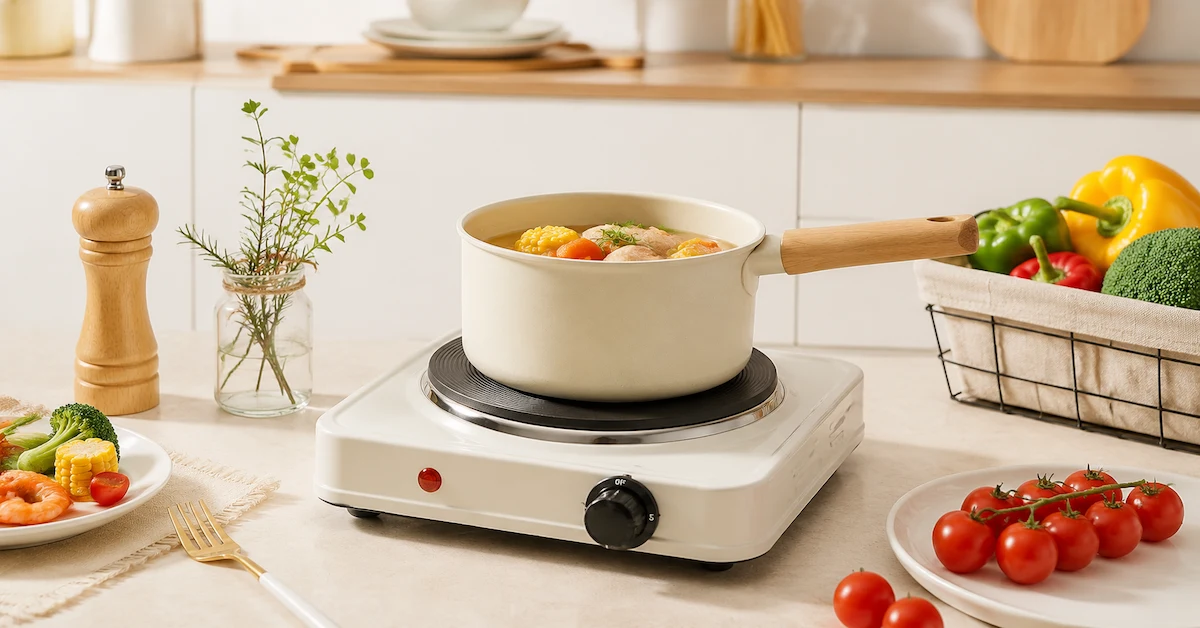



A hot plate for portable stove manufacturing must fit a compact enclosure without compromising safe operation on a countertop. The practical selection method is to match the plate's diameter, voltage and power with the enclosure's ventilation, underside temperature, wiring clearance, stability and control system, then validate the complete cooker before production approval.
For appliance brands, this is a different problem from specifying a burner for a larger stationary range. A portable cooker concentrates a heating surface, power controls, electrical wiring and supporting feet into a smaller footprint. Heat that is manageable in a spacious appliance may become problematic near a plastic knob, cord entry or countertop contact point. The most expensive sourcing mistake is choosing a heating plate that looks suitable in a catalog but requires redesign after integration testing.
This guide is for portable electric cooker OEMs, sourcing managers, product engineers and replacement-component importers. It explains compact packaging decisions, realistic verification tests, and how to prepare a component-specific inquiry using WEBO's published product references.
1. Why Portable Stoves Require a Different Heating-Plate Design Review
Portable cookers may be moved between shelves, tables and cooking areas, yet they still generate substantial heat during operation. In contrast with a built-in hob, a tabletop unit places the bottom enclosure close to an external supporting surface. Its lightweight structure also makes stability, cord routing and handling relevant design concerns.
The plate itself does not determine the product's safety. Performance depends on the assembly: the component, thermal shield, housing, ventilation, control, supply cord and protective devices must function together. A component maker can provide valuable data, but the finished-appliance manufacturer remains responsible for validating the final configuration and applicable market requirements.
2. Choosing 90mm, 110mm or 145mm for a Compact Cooker
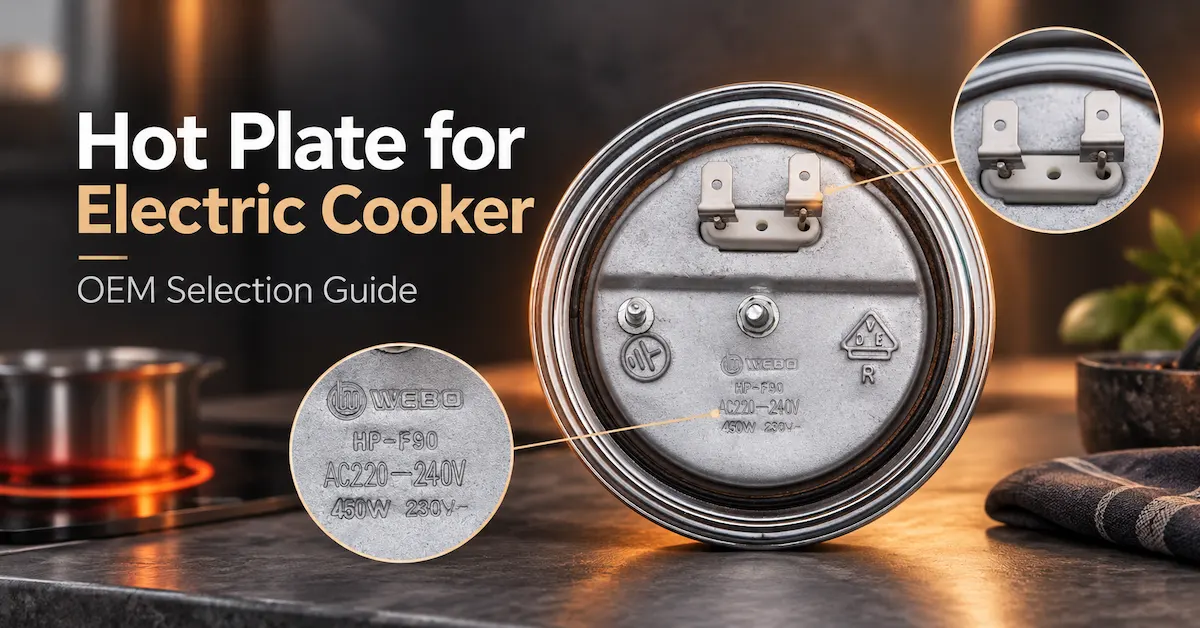
WEBO's published Hot Plate family includes 90mm, 110mm and 145mm categories, with individual listings for HP-F90, HP-F110 and HP-F145. These are useful model references for technical discussions. The listings do not provide complete verified electrical or installation data, so their exact voltage, power and mounting compatibility should be requested rather than assumed.
| Published model / size | Possible portable-appliance fit | Primary design trade-off | Validation priority |
|---|---|---|---|
| HP-F90 / 90mm | Very compact cooking-zone concepts | Restricted cookware contact area | Cookware stability and useful heating output |
| HP-F110 / 110mm | Small single-burner appliance concepts | Balance of footprint and usable heated area | Enclosure clearances and loaded thermal test |
| HP-F145 / 145mm | Portable cookers with larger cooking zones | More space needed for structure and thermal management | Underside heat, control location and stability |
When selecting a hot plate for portable stove applications, OEM manufacturers should evaluate more than the heating diameter. The selected component must match the cooker's rated voltage, available installation space, terminal configuration, and thermal protection requirements. These factors directly affect appliance integration, production consistency, and long-term reliability.
These use cases are engineering possibilities, not product approvals. A smaller diameter does not automatically mean lower power, and a larger plate is not automatically faster or more efficient. The selected cooking zone must match the intended cookware and the supply power available to the full appliance.
Before selecting a size, draw the cooker at assembly level: cookware envelope, outer housing, control knob, support feet, power-cord entry, plate fasteners and required clearances. Assess whether a pan overhang could expose plastic parts or make the unit easier to tip. Nominal diameter is only a starting dimension.
3. The Thermal Challenge: Keeping the Tabletop and Housing Within Limits
The most distinctive design problem in a portable hot plate is not how to make the upper surface hot; it is how to manage heat everywhere else. Energy can travel downward through brackets, radiate toward nearby components, or accumulate in poorly ventilated cavities. A small housing can allow these paths to interact.
Heat path A: conduction through the mounting structure
Metal fasteners and supports may conduct heat toward the base. An engineering review should trace each physical connection from the heating plate to the enclosure and identify any material whose rated temperature could be exceeded. Adding insulation without considering airflow or temperature distribution can relocate the problem rather than solve it.
Heat path B: radiation into the internal cavity
Hot surfaces emit thermal radiation. Wiring insulation, switch bodies, cable restraints and other nearby parts must be positioned and selected for realistic temperatures. Component ratings should be evaluated at the actual measured location, not only at a nominal room temperature.
Heat path C: airflow and blocked ventilation
Ventilation openings must be evaluated in their intended use position. A benchtop test with unrestricted airflow may be misleading if the final cooker has very short feet or is placed near surrounding objects. Designers should also consider foreseeable accumulation of debris and variations in installation on permitted supporting surfaces.
A reliable test plan records temperatures at the underside, feet, user controls, accessible surfaces, cord entry, switches and selected internal components. Temperature limits must come from the applicable appliance standard and component ratings; the buyer should not adopt an arbitrary universal pass temperature.
4. Portable-Cooker Electrical Integration: More Than Voltage and Wattage
Supply voltage and rated power remain essential, but their integration becomes more sensitive when wiring is compressed into a small volume. Select the electrical rating for the intended market, confirm the connection type, and verify that the complete circuit can carry the intended load under operating conditions.
For a simplified resistive element, P = V² / R illustrates why a component designed for one voltage is not automatically interchangeable with another. Resistance can change with temperature, so a cold resistance reading should be interpreted using the manufacturer's specified test conditions and tolerances.
Wire routing and strain relief
Keep supply conductors and internal wiring away from sharp edges and hot surfaces. Verify that the supply-cord entry and strain-relief arrangement remain effective when the appliance is lifted, moved or repositioned. Do not rely on terminal proximity or flexible cable movement to compensate for a mismatched heater.
Controls and overtemperature protection
A rotary switch or an energy regulator may be appropriate for some resistive-heating systems, but the contact rating, circuit diagram and mechanical interface must match the project. Thermal protection should be engineered at system level, including credible faults such as a control stuck on or operation without cookware where relevant. No control arrangement should be treated as a substitute for required appliance safeguards.
WEBO also lists rotary switches among its related heating-appliance components. A shared supplier can simplify initial discussion, but electrical compatibility must still be demonstrated for the actual circuit.
5. Stability, Handling and Real-World Use Cases
A portable stove is often marketed for small kitchens, temporary cooking areas, pantry counters or hospitality applications. These are possible end-use environments, not assurances that an individual hot plate is approved for every location.
Under normal cooking conditions, the unit must remain stable with suitable cookware, including foreseeable user actions permitted by the appliance instructions. The designer should consider the position of the hot zone relative to the feet, the height of the cookware and the direction of handle forces.
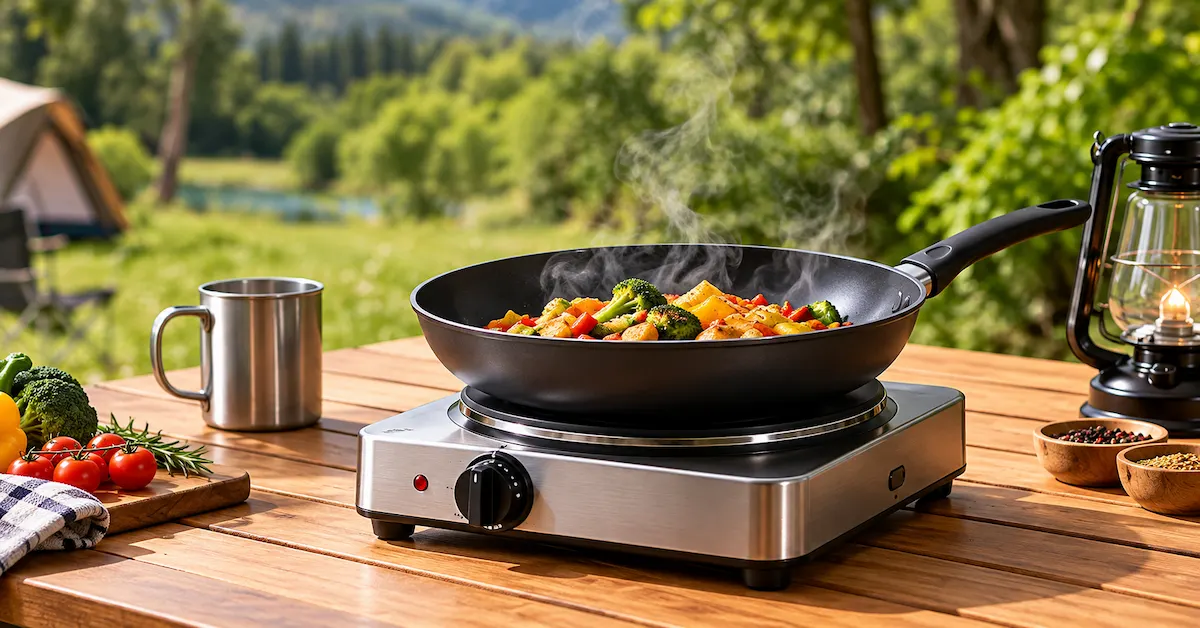
Portable does not automatically mean suitable for outdoor use, RV electrical systems, boats or power inverters. Exposure to moisture, movement and nonstandard electrical supplies may introduce additional requirements. Such uses should only be claimed when the finished appliance has been designed and assessed accordingly.
Use-case matrix for B2B product planning
| Target product | End-user priority | OEM verification question |
|---|---|---|
| Compact apartment cooker | Small footprint, practical cooking | Does the selected cookware fit without compromising stability? |
| Temporary countertop cooking unit | Easy movement and storage | Are accessible surfaces and the supply cord protected during expected handling? |
| Hospitality pantry appliance | Predictable operation and cleaning | Is the design suitable for its specified duty cycle and intended users? |
| Portable-cooker replacement part | Correct fit and electrical operation | Does the component match the original approved drawing and rating? |
6. A Portable Hot Plate Test Matrix Before OEM Sign-Off
A short, well-defined design validation plan is more useful than an unstructured demonstration that the plate becomes hot. The following matrix is a project-planning tool, not a statement that all tests have been completed by WEBO.
| Test area | Recommended evidence | Failure mode to investigate |
|---|---|---|
| Electrical identification | Drawing, marking, power and resistance under defined conditions | Incorrect voltage variant or unexpected load |
| Mechanical fit | Approved assembly drawing and installed sample inspection | Contact with enclosure, fasteners or wiring |
| Loaded heat performance | Repeatable cookware-and-water test method | Inadequate cooking result or excessive temperatures |
| Supporting surface temperature | Instrumented tests in the specified use configuration | Excess heat reaching the countertop |
| Internal temperature | Measurements near controls, terminals and cord entry | Component overheating or insulation degradation |
| Stability | Finished appliance assessment with representative loads | Tipping or cookware imbalance |
| Abnormal operation | Standard-driven fault and misuse evaluation | Unsafe behavior when a safeguard or control fails |
| Durability | Defined thermal-cycle and connection inspections | Loosening, damage or functional drift |
| Shipping readiness | Packaging and post-transport inspection | Plate finish or terminal damage |
Tests should be performed by qualified personnel using the applicable methods, laboratory practices and acceptance criteria. For certain portable cooking appliances, IEC 60335-2-9 is an important safety-standard reference; its scope explicitly includes hotplates. The appropriate standard edition, national adoption and regulatory route depend on the finished product and destination market. A component listing or general company certificate does not establish complete-appliance compliance.
Have a portable cooker drawing or an existing sample?
Share the plate diameter, electrical rating, terminal layout, enclosure depth and target market. Ask WEBO to confirm which published model is a feasible starting point before scheduling approval tests.
7. From Component Sample to Production: A Practical Approval Sequence
A portable stove project commonly fails late when the heating component is approved separately from the rest of the appliance. To avoid this, use a staged process with clear responsibility for the component supplier and the appliance OEM.
- Specify the application. Identify the cooker type, cookware, target voltage, intended market, envelope and intended use conditions.
- Request controlled information. Obtain a model reference, drawing, proposed electrical rating, terminal detail and applicable documentation.
- Perform bench screening. Check fit and basic electrical characteristics under an agreed procedure.
- Build representative appliances. Integrate the plate, controls, wiring, supports and thermal protection in production-intent housings.
- Complete finished-product assessment. Test thermal behavior, stability, foreseeable abnormal conditions and relevant safety requirements.
- Freeze the design. Approve drawings, samples, packaging, inspection characteristics and engineering-change rules.
- Evaluate pilot production. Inspect repeatability, assembly yield and shipping performance before scaling quantities.
Define what evidence is needed at each approval stage. For example, a supplier's heater resistance report may support component control, while the appliance OEM's countertop-temperature report supports system validation. Keeping these responsibilities separate avoids gaps and exaggerated claims about certification.
8. How Portable Cooker Buyers Should Compare Quotes
Two quotations can look equivalent even when they cover different designs and obligations. One supplier may quote an identified catalog model; another may include terminal adjustments, sample development, packaging or additional inspection. Comparing only the unit price hides these differences.
Ask each supplier to state the exact model or drawing revision, included configuration, required tooling, sample terms, inspection documents, packaging, order conditions and confirmed lead time. Do not insert unverified MOQ or guaranteed delivery claims into a purchasing plan.
For private-label appliance brands, it is useful to separate component customization from finished-appliance branding. A hot plate supplier may support a customized component or packaging requirement; that does not automatically mean it manufactures, certifies or labels a complete portable stove.
Wholesale replacement-part buyers should also maintain a compatibility file for each SKU. A 110mm plate that resembles an original part is not automatically interchangeable if the voltage, terminals or underside mounting differ.
9. Portable Stove Hot Plate RFQ: Information That Moves a Project Forward
The most effective sourcing inquiry includes enough information for an engineer to assess suitability before discussing annual volume. Use the checklist below when requesting samples or an OEM quotation.
| RFQ field | What to provide |
|---|---|
| Appliance identity | Portable single-burner cooker, target user and intended environment |
| Plate geometry | Nominal diameter, underside depth, mounting drawing and tolerances |
| Electrical specification | Rated voltage, target power, terminal type and control arrangement |
| Thermal boundaries | Housing material, feet height, vent locations and available clearances |
| Market requirements | Destination countries, applicable standards and document requests |
| Project stage | Concept, replacement evaluation, prototype, pilot or repeat production |
| Commercial scope | Sample quantity, expected order volume, packaging and desired delivery destination |
WEBO, established in 1998, lists hot plates and related heating components for appliance projects. Its publicly presented sizes and the HP-F90, HP-F110 and HP-F145 model pages provide concrete references for initial selection. They do not replace a signed data sheet or product-specific certification documentation.
Start with the WEBO Hot Plate collection, review the appropriate model, and then contact WEBO with your portable cooker drawing. For OEM development, request confirmation of what can be supplied or modified, sampling terms and required approval documents.
10. Frequently Asked Questions
Is a 90mm hot plate always the safest choice for a portable stove?
No. A smaller heating zone can support a compact design, but safety depends on the complete cooker, including power, enclosure, thermal protection, stability and cookware use. Size alone cannot establish compliance.
Can I use a 110mm hot plate instead of a 145mm plate?
Only after reviewing the intended cooking task, dimensions, voltage, power, mounting, controls and thermal behavior. Changing diameter may require appliance redesign and new validation.
What must be tested underneath a tabletop electric cooker?
Evaluate supporting-surface temperature and the thermal behavior of the base, feet, internal wiring, controls and adjacent components under the conditions required by the applicable finished-appliance standard.
Does a hot plate component certificate certify the portable stove?
No. A component assessment and a finished-appliance assessment serve different purposes. The complete cooker may need additional tests and conformity documentation specific to the target market.
Can a portable hot plate be promoted for camping or RV use?
Only when the finished appliance is designed, labeled and assessed for that environment and electrical supply. The word "portable" alone does not prove suitability for wet conditions, vibration or inverter operation.
What should OEM buyers send WEBO first?
Send an application description, target market, plate size, voltage, power, underside drawing, terminal requirements, expected quantity and any existing samples. Request a current model-specific data sheet before approving a design.
Conclusion
The right hot plate for portable stove manufacturing is the one that works safely inside the entire compact appliance—not merely the one that fits a nominal diameter. Give special attention to underside heat, countertop contact, wiring clearances, stability, protective controls and finished-product testing. A defined sample-approval process is often more valuable than an early low-price quote.
WEBO publishes 90mm, 110mm and 145mm hot plate options, including HP-F90, HP-F110 and HP-F145 references. Use these as starting points for an engineering review, then confirm each model's current specifications and the feasibility of your OEM requirements.