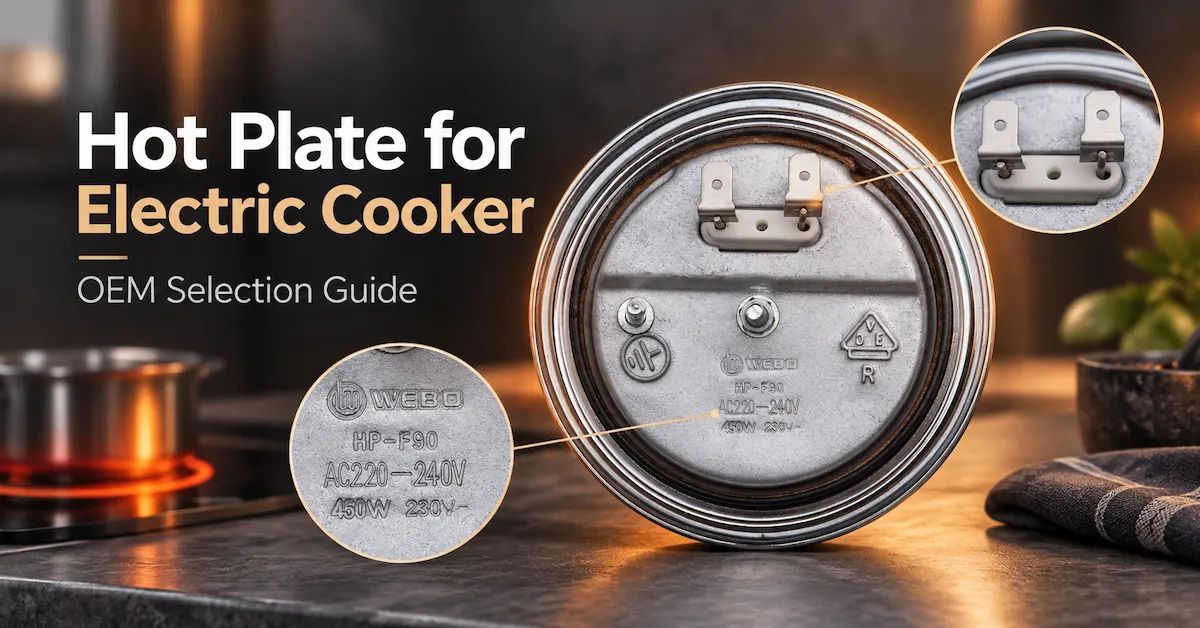



A hot plate for kitchen appliance development should be selected as part of a controlled product platform—not as a one-time component purchase. When a manufacturer sells several cooking-appliance models, each heating plate must match its own electrical and mechanical design while remaining traceable through purchasing, inspection, assembly, and future revisions.
For OEM engineering teams and global sourcing managers, the difficult question is often whether two products should share the same heating component. Standardizing an appropriate part can simplify inventory and factory training. Using one plate in appliances with different operating conditions, however, can create hidden thermal, electrical, or compliance problems. The decision requires evidence rather than visual similarity.
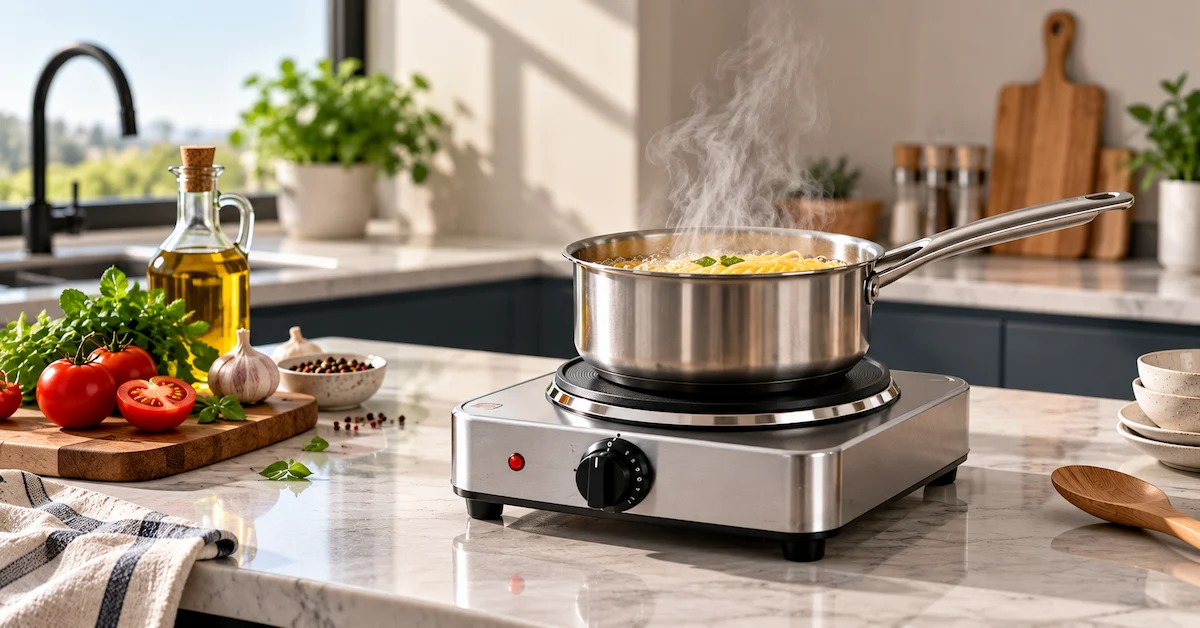
This guide explains how to develop a hot plate selection strategy across an appliance range, build a technical specification, manage multi-market variants, qualify component suppliers, and prepare an RFQ that results in a meaningful quotation. It is written for kitchen appliance manufacturers, private-label brand owners, contract manufacturers, and component distributors.
1. Where Does a Hot Plate Fit Within a Kitchen Appliance Portfolio?
A solid electric hot plate generates heat through electrical resistance and transfers it to cookware through its heated surface. In component form, it may be integrated into conventional electric stoves, compact cooking appliances, tabletop units, and certain replacement-part programs. Its role is different from the role of a complete, ready-to-use cooker.
The same appliance company may develop a basic single-zone product, a larger dual-zone model, and a regional version intended for a different electricity supply. Although the products belong to one brand, they may not be able to share one heating-plate specification.
The first responsibility of the product team is to distinguish platform-level decisions from model-level decisions. Platform decisions include approved component suppliers, documentation format, traceability policy, and change-control process. Model-level decisions include plate size, rated voltage, power, mounting details, thermal clearances, and control integration.
2. Build an Application-to-Component Matrix Before Selecting a Model
WEBO publicly presents 90mm, 110mm, and 145mm hot plate categories. Its catalog provides product references such as HP-F90, HP-F110, and HP-F145. These names are suitable for preliminary discussions, but they are not substitutes for the latest approved drawings and data sheets.
| Kitchen-appliance program | Potential plate category | Primary integration question | Approval evidence |
|---|---|---|---|
| Small single-zone cooking product | 90mm or 110mm for evaluation | Does the heating zone support the intended cookware and housing? | Assembly drawing and loaded cooking test |
| Larger single-zone cooker | 145mm for evaluation | Can the enclosure and controls tolerate the selected electrical and thermal load? | Thermal mapping and electrical review |
| Multi-zone stove product | One or more sizes, subject to design | Do simultaneous zones exceed total appliance or component limits? | Combined-load and abnormal-operation testing |
| Aftermarket component program | Existing approved specification | Is replacement compatibility confirmed beyond diameter? | Drawing, ratings and interface comparison |
The listed applications are design-screening examples, not verified performance claims for individual WEBO models. An appliance's final choice also depends on allowable operating temperatures, control strategy, regional electrical supply, and required product approvals.
Separate form factor from engineering performance
Diameter establishes only part of the physical interface. A successful design also controls the heating assembly's total height, support geometry, terminal position, wiring space, and contact with the appliance structure. Two nominally identical diameters can have different installation envelopes. Request a dimensioned drawing before considering a part interchangeable.
3. Create One Master Specification with Controlled Variants
For a multi-model kitchen appliance range, a master specification is more valuable than several disconnected emails and product photos. It describes the common requirements that apply to every approved heating plate, while a variant table identifies what changes from model to model.
The master specification should cover documentation revisions, traceability, acceptable appearance, test methods, packaging protection, and the engineering-change procedure. A separate part-specific record should establish the actual electrical and physical limits.
| Specification field | Information required | Why it matters across models |
|---|---|---|
| Part number and revision | Unique code with controlled version | Prevents mixed or obsolete components |
| Nominal diameter and geometry | Full drawing with critical tolerances | Protects assembly interchangeability |
| Rated voltage and power | Approved values and test conditions | Distinguishes regional electrical variants |
| Terminal configuration | Connection diagram and physical details | Controls harness compatibility |
| Surface and materials | Approved finish and relevant specifications | Supports consistent appearance and durability |
| Inspection limits | Defined characteristics and acceptance method | Makes repeat-order checks comparable |
| Packaging and identification | Label, carton and protection requirements | Reduces variant mixing in global distribution |
A practical naming system might use an internal appliance-platform code plus a unique heater-part code and revision. Do not assume that a supplier's marketing name alone identifies all electrical options. The buyer and manufacturer should agree on a controlled cross-reference for every approved configuration.
4. Manage Electrical Variants Without Creating Inventory Errors
Appliance brands serving several regions may need different voltage configurations. A visually identical heating surface does not establish electrical compatibility. For a resistive element, rated power depends on applied voltage and operating resistance; the component must be qualified for the intended supply and control circuit.
Instead of ordering a vague “universal hot plate,” identify the exact approved variant for each target market. Distinct labels, purchase-order part numbers and incoming checks can reduce the risk of mixing incompatible heaters.
For multi-zone appliances, the combined electrical load matters as much as the rating of a single plate. Engineers should review wiring, switches, energy regulators, protective devices, conductor temperatures, and abnormal operating conditions at system level. A plate that passes component screening can still be unsuitable for the complete appliance.
WEBO also lists Rotary Switch and related controls within its product portfolio. These can be relevant categories to discuss during a coordinated sourcing project, but their use with a particular plate requires matching electrical ratings and circuit documentation.
5. Design for Assembly: Reduce Line Errors, Not Just Piece Price
The most economical component is not always the one with the lowest quoted unit price. A heating plate that demands manual wire bending, unusual tools, or repeated adjustment can slow assembly and increase defect opportunities.
Design-for-assembly reviews should ask whether operators can identify the correct variant quickly, reach fasteners safely, connect terminals without excessive force, and inspect the finished assembly consistently. If two similar heating plates require different installation procedures, the work instructions should explain those differences.
Prototype assemblies should use production-intent wiring and housings. A convenient laboratory fixture may conceal clearance problems that appear on the actual production line.
6. Validate the Full Kitchen Appliance, Not Only the Heating Component
For a hot plate for kitchen appliance manufacturing, approval should combine component verification with final-appliance testing. A supplier can provide dimensions, electrical data and component test evidence. The brand or finished-appliance manufacturer must determine whether the integrated product satisfies the applicable requirements.
Tests depend on the appliance type, destination market, and relevant standards. For instance, the IEC 60335 series contains distinct requirements for different household and similar electrical appliance categories. The applicable part and edition must be selected for the actual finished product; a component supplier's general certification statement is not a substitute.
| Validation stage | Recommended check | Typical problem detected |
|---|---|---|
| Component receipt | Identity, dimensions, electrical properties | Wrong variant or uncontrolled change |
| Assembly trial | Mounting, terminal access, wiring clearance | Interference and rework |
| Cooking performance | Defined cookware load and repeatable test method | Unsuitable heating result |
| Thermal evaluation | Nearby surfaces, controls and enclosure temperatures | Unacceptable local heat accumulation |
| Normal and abnormal operation | Standard-driven finished-appliance assessment | Insufficient safeguards |
| Pilot production | Assembly yield, identification, shipping inspection | Batch inconsistency or packaging damage |
Do not assume a larger heater is automatically faster, a smaller one is automatically more efficient, or a component bearing a safety mark makes the entire appliance compliant. All such conclusions require defined measurements and documentation.
7. A Six-Gate Component Approval Process for Global Appliance Programs
- Gate 1 — Requirements freeze: Define target appliance models, electrical supply, intended cookware, mechanical envelopes and export markets.
- Gate 2 — Supplier technical review: Compare the available catalog reference against controlled drawings and identify any customization requiring feasibility assessment.
- Gate 3 — Representative samples: Receive identified samples and verify agreed dimensions, electrical characteristics and appearance.
- Gate 4 — Appliance integration: Conduct loaded thermal, control-system and applicable safety evaluation in finished-product prototypes.
- Gate 5 — Pilot build: Test manufacturing repeatability, incoming inspection, packaging identification and assembly work instructions.
- Gate 6 — Production release: Approve the part revision, quality plan, change-notification rules, commercial terms and requalification triggers.
This approval sequence is a recommended operating model; it is not a guaranteed WEBO service-level agreement. Each project should confirm the actual scope of supplier engineering support, testing responsibility, sample terms and production schedule.
Qualifying a Hot Plate for Several Appliance Models?
Send WEBO a product-family matrix showing your appliance models, candidate plate sizes, target voltage, rated power, mounting drawings and estimated annual demand. Request a model-by-model feasibility review rather than one generic quote.
8. Protect Repeat Orders with Change Control and Traceability
Long-term sourcing problems often begin after a successful launch. A supplier changes a terminal, a purchasing team substitutes a similar part, or a warehouse ships an older revision. The appliance may still operate during a quick check, while downstream assembly or certification consequences emerge later.
Create an agreed change-notification rule for any modification affecting geometry, rated electrical characteristics, materials, thermal behavior, terminal design or identification. Decide in advance which changes require new samples, technical review, testing or formal approval.
Traceability should be proportionate to risk. At minimum, the purchasing system should connect the shipped component to its agreed part number and revision. For higher-risk programs, lot identification, inspection records and defined retention periods may be appropriate.
Distributor programs need additional care because their products may be installed in multiple appliance families. A fitment or compatibility claim should be tied to verified product specifications, not merely shared appearance or diameter.
9. Compare Suppliers Using Total Program Cost
The relevant buying metric for an appliance brand is the cost of a qualified, delivered, assembled, and supportable component—not only its price at the factory gate.
Include sampling and validation expenditure, packaging, freight, duties, inspection, factory assembly effort, rework, warranty exposure, and the risk of an unplanned revision. Some values will be estimates until pilot production provides more reliable data.
Consider a hypothetical price comparison: Supplier A charges less per plate but requires extra assembly handling and produces more identification errors. Supplier B costs slightly more per plate but meets the approved interface without rework. Without measuring those downstream costs, a unit-price comparison cannot tell procurement which offer is better.
It is also useful to identify items that should not be commonized. A low-cost attempt to use the same plate in two thermally different appliances can create more risk than maintaining two controlled part numbers.
10. What WEBO Can Contribute to the Sourcing Discussion
GUANGDONG WEBO TECHNOLOGY CO., LTD, established in 1998, publishes an appliance-component portfolio including hot plates, ceramic radiant heaters, tubular heating elements, induction coils, ceramic glass and related controls. The company's About Us page explains its manufacturing background; specific product certifications and performance claims should still be verified for the chosen model and target market.
For a multi-product kitchen appliance program, the practical value of this portfolio is the opportunity to begin a coordinated technical conversation about related heating components. This does not mean every component or customization request is automatically suitable for every finished appliance.
Review the Hot Plate category to shortlist published models, consult the complete product range for adjacent categories, and share your exact BOM and drawing requirements through WEBO's contact page.
11. RFQ Checklist for Kitchen Appliance Brand Owners
A good RFQ should describe the full product program, even if the buyer expects to order only one heating component. This helps the supplier distinguish current needs from future variants without assuming that every part can be standardized.
| RFQ item | Buyer information to provide |
|---|---|
| Product-family map | Appliance models, intended uses and launch order |
| Component references | Candidate catalog numbers, existing approved parts or samples |
| Technical data | Drawings, diameter, voltage, power, terminals and mounting |
| Market and compliance | Destination countries, applicable requirements and requested documents |
| Development scope | Standard component or proposed modification, sample quantities and approval plan |
| Commercial demand | Initial order, estimated annual volume and forecast variability |
| Supply controls | Revision labeling, packaging, inspection and change-notification requirements |
Request model-specific data sheets, confirmation of available configurations, technical feasibility, quotation terms, MOQ and lead time. Those details depend on the project and should not be invented or assumed from a general company introduction.
12. Frequently Asked Questions
Can one hot plate be used across several kitchen appliance models?
Possibly, but only when the electrical rating, mechanical interface, thermal environment, controls and appliance-level validation support each use. Sharing a nominal diameter is not enough to establish interchangeability.
How should an OEM select a hot plate for kitchen appliance production?
Start with an application matrix. Identify the appliance model, cookware, voltage, required performance, housing, control arrangement and destination market. Compare candidate parts with drawings, then test them in representative assembled appliances.
What is the difference between a master specification and a part drawing?
A master specification defines common quality, documentation and change-control rules. A part drawing establishes the approved dimensions, interfaces and revision of a specific component. Multi-model sourcing benefits from both.
Does a product certification apply to every WEBO hot plate?
Not automatically. Request current documentation that identifies the applicable model, standard, certificate scope and destination market. Finished kitchen appliances have separate compliance responsibilities.
What should buyers send to obtain an accurate OEM quotation?
Send the intended appliance models, drawings, candidate size, voltage, rated power, terminal requirements, approval expectations, forecast volume, packaging needs and requested market documentation. Ask the supplier to confirm model feasibility and current commercial terms.
Conclusion
Selecting a hot plate for kitchen appliance programs is a platform-management decision as much as a component-selection decision. The strongest sourcing approach establishes controlled specifications and quality practices across the product family while qualifying each heating-plate variant for its actual electrical, mechanical, thermal and regulatory conditions.
For OEM manufacturers, distributors and brand owners, the immediate next step is to create an appliance-to-component matrix, identify the drawings and tests needed for approval, and send a complete project RFQ. Explore WEBO hot plate products and contact WEBO to discuss candidate models, sampling and sourcing requirements.