


How to Choose a Rotary Switch Exporter for Global Appliance Projects
Selecting a rotary switch exporter is an important sourcing decision for appliance brands, distributors, and international purchasing teams. Although rotary switches are relatively small components, they directly influence appliance operation, user experience, and product reliability.
For global buyers, choosing an exporter is not only about finding a company that can ship products internationally. A reliable exporter should understand the complete supply chain behind the product, including manufacturing capability, technical specifications, customization requirements, quality inspection, packaging, and delivery management.
A professional rotary switch exporter should help buyers answer several key questions:
- Does the supplier understand appliance control requirements?
- Can the product match electrical and mechanical specifications?
- Can the supplier support OEM and custom projects?
- Can production quality remain consistent across repeated orders?
- Can export processes be managed efficiently?
For appliance manufacturers and distributors, the ideal supplier relationship connects product development, manufacturing, and international delivery into one controlled process.
WEBO provides appliance control components for different applications. Buyers can review the rotary switch product category and evaluate available solutions according to their appliance requirements.
What Is a Rotary Switch Exporter and What Do They Provide?
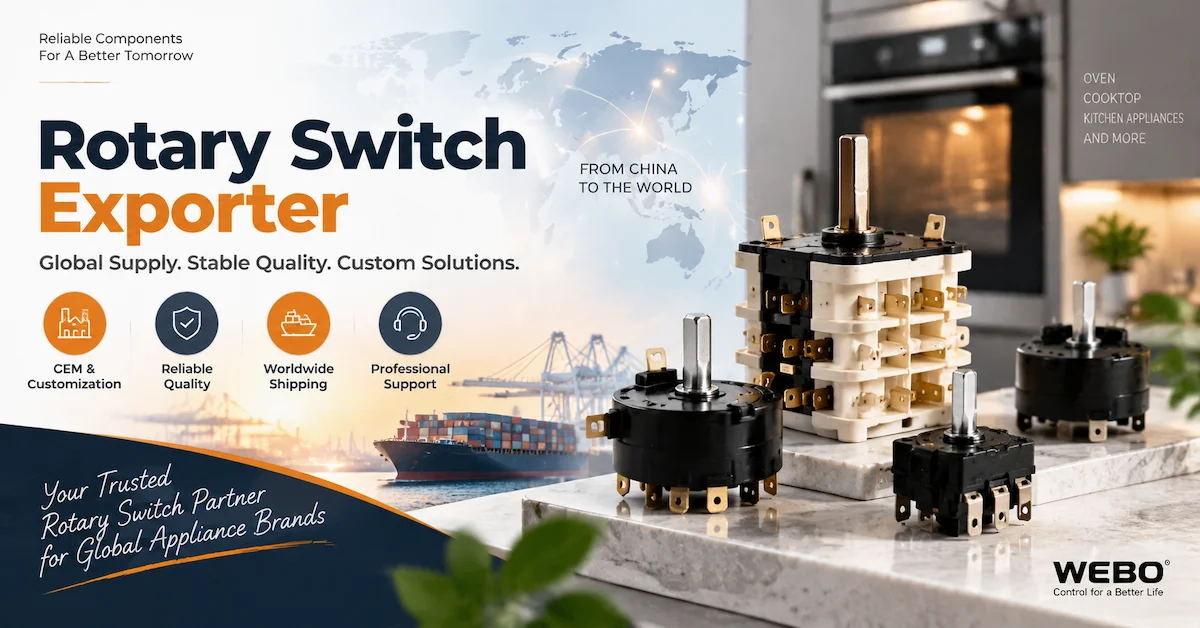
A rotary switch exporter is a supplier responsible for providing rotary switch products to international markets while managing production coordination, order preparation, export documentation, and shipment processes.
Unlike a simple trading company, an experienced exporter should understand both the product and the requirements of overseas buyers.
A professional rotary switch exporter typically supports:
| Service Area | Buyer Benefit |
|---|---|
| Product Selection | Helps choose suitable rotary switch solutions |
| Technical Communication | Reduces specification misunderstandings |
| Manufacturing Coordination | Supports stable production |
| Quality Inspection | Improves product consistency |
| Packaging Management | Protects products during transportation |
| Export Support | Simplifies international purchasing |
For OEM appliance brands, the exporter should also understand the relationship between the rotary switch and the final appliance system.
A switch used in an oven, cooking appliance, or heating equipment may require different specifications depending on:
- Electrical requirements
- Control functions
- Installation structure
- User operation frequency
- Environmental conditions
Why Global Buyers Work With Rotary Switch Exporters
International buyers often work with exporters because export-oriented suppliers understand the requirements of cross-border purchasing.
A suitable exporter can help buyers manage:
Product Consistency
For appliance manufacturers, every production batch must match the approved specification.
Important controls include:
- Product dimensions
- Electrical parameters
- Switching performance
- Appearance standards
- Packaging requirements
Communication Efficiency
International sourcing often involves multiple teams:
- Purchasing department
- Engineering department
- Quality department
- Logistics team
A capable exporter should be able to communicate technical information clearly between different parties.
Supply Chain Stability
Long-term buyers need more than a single shipment.
They need:
- Stable production
- Repeat-order consistency
- Clear product identification
- Controlled revisions
- Reliable delivery planning
Understand Rotary Switch Applications Before Importing
Before selecting a rotary switch exporter, buyers should define the intended application.
Different industries require different switch characteristics.
| Application | Typical Requirement |
|---|---|
| Kitchen Appliances | Reliable user control |
| Ovens | Function selection and temperature-related operation |
| Heating Equipment | Mode adjustment and operation control |
| Electrical Equipment | Mechanical switching functions |
A supplier experienced in appliance components can provide better recommendations because the switch must work together with the complete product design.
Rotary Switch for Appliances: Key Purchasing Factors
A rotary switch for appliances should be selected according to both technical and user requirements.
Buyers should evaluate:
Mechanical Compatibility
Important factors include:
- Shaft design
- Mounting structure
- Rotation angle
- Panel installation
- Knob compatibility
Mechanical compatibility determines whether the switch can be integrated into the appliance correctly.
Electrical Compatibility
Buyers should confirm:
- Rated voltage
- Rated current
- Contact structure
- Switching function
A switch that fits physically may still fail if it does not match the appliance electrical system.
Operational Experience
For consumer appliances, users interact directly with the rotary switch.
Important factors include:
- Smooth rotation
- Clear position selection
- Stable operation
- Consistent control feeling
Rotary Switch for Oven Applications
A rotary switch for oven applications requires reliable performance because ovens are frequently used and often involve multiple operating functions.
Oven manufacturers should consider:
| Evaluation Item | Buyer Consideration |
|---|---|
| Function Selection | Number of cooking modes |
| Electrical Performance | Compatibility with oven circuits |
| Mechanical Design | Control panel integration |
| Durability | Frequent daily operation |
| User Experience | Smooth and accurate adjustment |
A rotary switch exporter serving oven manufacturers should understand these requirements before recommending a product.
How a Rotary Switch Manufacturer Supports Export Buyers
A strong export relationship usually starts with manufacturing capability.
A qualified rotary switch manufacturer should provide:
| Capability | Importance |
|---|---|
| Product Development | Supports application-specific requirements |
| Engineering Support | Helps solve technical problems |
| Production Management | Maintains quality consistency |
| Testing Process | Verifies product performance |
| Customization Ability | Supports OEM projects |
The exporter and manufacturer relationship is especially important because overseas buyers often cannot directly monitor every production stage.
A reliable supplier should provide clear information about:
- Product specifications
- Production status
- Sample approval
- Inspection results
- Shipment preparation
How to Evaluate an OEM Rotary Switch Supplier
An OEM rotary switch supplier should be evaluated based on both technical and commercial capability.
OEM buyers should review:
| Evaluation Area | Buyer Questions |
|---|---|
| Engineering Capability | Can the supplier understand product requirements? |
| Customization | Can the supplier modify products when needed? |
| Production Control | Can quality remain stable? |
| Communication | Can project information be managed clearly? |
| Export Experience | Can international orders be handled efficiently? |
OEM cooperation may include:
- Shaft customization
- Terminal adjustment
- Switching function changes
- Packaging customization
- Product identification requirements
The goal of OEM cooperation is creating a repeatable product solution rather than only completing one order.
How to Evaluate a Rotary Switch Wholesale Supplier China
Many global buyers search for a rotary switch wholesale supplier China when they need stable supply, competitive production costs, and OEM cooperation capability.
However, choosing a supplier should involve more than comparing quotations. A wholesale supplier must be able to support product consistency, export requirements, technical communication, and long-term cooperation.
Before selecting a supplier, buyers should evaluate:
| Evaluation Area | What Buyers Should Confirm |
|---|---|
| Product Capability | Available rotary switch models and application experience |
| Manufacturing Ability | Production capacity and process control |
| Quality Management | Inspection standards and testing procedures |
| Customization Support | Ability to handle OEM requirements |
| Export Experience | International shipment and documentation ability |
| Communication | Technical response and project management |
A reliable rotary switch wholesale supplier China should provide a complete purchasing process:
- Requirement confirmation
- Product recommendation
- Sample evaluation
- Order confirmation
- Production inspection
- Export preparation
- Shipment management
This process helps international buyers reduce uncertainty when purchasing appliance components overseas.
Custom Rotary Switch Export Projects: From Design to Production
A custom rotary switch project requires cooperation between the buyer and supplier from the beginning.
Unlike standard products, custom projects may involve changes to:
- Mechanical structure
- Shaft design
- Terminal configuration
- Switching positions
- Product appearance
- Packaging requirements
A professional rotary switch exporter should help manage the transition from product concept to finished component.
Requirement Analysis
The buyer should provide:
- Appliance application
- Product drawings
- Electrical requirements
- Installation conditions
- Quantity forecast
The supplier evaluates whether the existing design can meet requirements or whether modification is needed.
Engineering Review
The engineering team reviews:
- Switch structure
- Internal components
- Electrical performance
- Manufacturing feasibility
This stage helps identify potential production problems before samples are created.
Sample Approval
Samples should be reviewed based on:
- Appearance
- Dimensions
- Installation compatibility
- Switching operation
- Electrical performance
The approved sample becomes the reference for future production.
Mass Production Control
After approval, production should follow:
- Confirmed specifications
- Approved drawings
- Quality inspection requirements
- Packaging standards
This ensures repeat orders remain consistent with the original product.
Export Quality Control for Rotary Switch Products
Quality control is one of the most important factors when selecting a rotary switch exporter.
International buyers usually cannot inspect every production stage directly, so suppliers need clear quality management processes.
Material Inspection
Before production, suppliers should verify:
- Material quality
- Component consistency
- Supplier documentation
Assembly Inspection
During production, important checks include:
- Component assembly
- Terminal installation
- Mechanical structure
- Product consistency
Functional Testing
Rotary switches should be tested for:
- Rotation performance
- Switching accuracy
- Electrical connection
- Mechanical operation
Final Inspection Before Shipment
Before export, confirm:
- Product quantity
- Specification accuracy
- Packaging condition
- Shipment identification
WEBO provides company information and certification details through its certification information page. Buyers can review available information and confirm project-specific documentation requirements.
International Packaging Requirements for Rotary Switch Exporters
Packaging is an important part of international component supply because rotary switches must maintain product quality during transportation.
A professional exporter should consider:
| Packaging Factor | Purpose |
|---|---|
| Individual Protection | Prevent product damage |
| Product Separation | Avoid contact damage |
| Label Identification | Support inventory management |
| Carton Protection | Improve shipping safety |
| Quantity Control | Simplify receiving inspection |
For overseas buyers, packaging should match:
- Shipping distance
- Transportation method
- Warehouse conditions
- Customer requirements
Clear packaging standards help reduce receiving problems and improve supply chain efficiency.
Shipping and Export Documentation Management
A reliable rotary switch exporter should understand international purchasing requirements.
Export support may include:
- Commercial documents
- Product identification
- Packing information
- Shipment coordination
- Delivery communication
Buyers should confirm:
- Product model information
- Quantity details
- Packaging list
- Shipping schedule
- Required documents
Good export management reduces delays caused by unclear information.
How an Electric Rotary Switch Supplier Supports Global Buyers
An electric rotary switch supplier should understand both product functions and international application requirements.
For electrical component buyers, important considerations include:
Electrical Specification Matching
Confirm:
- Voltage
- Current
- Contact configuration
- Switching function
Application Matching
Confirm:
- Appliance type
- Operating conditions
- Installation requirements
Supply Capability
Evaluate:
- Production stability
- Repeat-order capability
- Communication efficiency
A supplier that understands electrical applications can help buyers avoid incorrect product selection.
Rotary Selector Switch Manufacturer Evaluation Guide
A rotary selector switch manufacturer should provide solutions for applications requiring multiple operating selections.
Buyers should evaluate:
| Selection Factor | Why It Matters |
|---|---|
| Position Selection | Determines available functions |
| Contact Reliability | Influences product performance |
| Mechanical Design | Ensures installation compatibility |
| Production Control | Maintains batch consistency |
| Customization Ability | Supports special requirements |
For appliance brands, the supplier should understand the relationship between the selector switch and the complete control system.
How to Reduce Risks When Importing Rotary Switches
International purchasing involves several risks:
| Risk | Recommended Solution |
|---|---|
| Specification Differences | Use controlled drawings and specifications |
| Quality Variation | Confirm inspection requirements |
| Delivery Delays | Plan production and shipping schedules |
| Product Changes | Require approval before modifications |
| Communication Issues | Maintain clear technical documents |
A professional rotary switch exporter should help buyers manage these risks through structured communication.
Prepare a Complete Inquiry Before Contacting a Rotary Switch Exporter
A detailed inquiry improves supplier response quality.
Buyers should provide:
Product Information
- Rotary switch application
- Required functions
- Product specifications
- Technical drawings
Commercial Information
- Order quantity
- Target market
- Delivery requirements
- Packaging requirements
Customization Information
- Product changes
- Branding requirements
- Special packaging needs
A complete inquiry allows the supplier to provide a more accurate proposal.
How WEBO Supports Rotary Switch Export Projects
For international buyers, selecting the right supplier means finding a partner that understands both product manufacturing and export requirements.
WEBO provides appliance control components for different applications. Buyers can review the WEBO rotary switch product category to understand available rotary switch solutions.
For project discussions, buyers can submit product requirements through the WEBO contact page.
Providing application details, specifications, and quantity requirements helps evaluate:
- Product suitability
- Customization options
- Production planning
- Supply cooperation
Global Rotary Switch Sourcing Strategy for Appliance Buyers
For international appliance brands and distributors, sourcing from a rotary switch exporter requires a long-term supply strategy rather than a one-time purchase decision.
A successful sourcing process should balance:
- Product suitability
- Manufacturing capability
- Quality consistency
- Export experience
- Cost control
- Supply stability
Many purchasing problems happen because buyers focus only on the initial quotation and overlook technical communication, production control, and future order requirements.
A professional sourcing strategy should include the following stages:
| Sourcing Stage | Buyer Objective |
|---|---|
| Requirement Definition | Clearly define application and specifications |
| Supplier Evaluation | Compare manufacturing and technical capability |
| Sample Verification | Confirm product compatibility |
| Order Approval | Establish production standards |
| Shipment Management | Ensure smooth international delivery |
| Repeat Order Control | Maintain product consistency |
This approach helps buyers create a stable supply chain instead of repeatedly searching for new suppliers.
How to Compare Different Rotary Switch Exporters
When comparing exporters, buyers should evaluate the complete value provided by each supplier.
A reliable rotary switch exporter should demonstrate:
Product Understanding
The supplier should understand:
- Appliance applications
- Electrical requirements
- Mechanical installation
- User operation requirements
A supplier that understands the final application can provide better recommendations.
Manufacturing Capability
Evaluate:
- Production process
- Quality inspection
- Manufacturing consistency
- Production planning
A factory-backed exporter usually has stronger control over product quality and customization.
Export Experience
International supply requires experience with:
- Overseas communication
- Packaging requirements
- Shipping coordination
- Documentation preparation
Export capability helps reduce problems after production is completed.
Buyer Checklist Before Selecting a Rotary Switch Supplier
Before placing an order, buyers can use the following checklist:
| Checklist Item | Confirm Before Purchase |
|---|---|
| Product Application | Does the switch match the appliance? |
| Technical Specification | Are electrical and mechanical details confirmed? |
| Sample Approval | Has the final sample been approved? |
| Quality Standard | Are inspection requirements defined? |
| Packaging | Is export packaging suitable? |
| Delivery Plan | Is the production schedule clear? |
| Future Orders | Can repeat production maintain consistency? |
This checklist helps purchasing teams avoid common sourcing problems.
How Rotary Switch Exporters Support OEM Appliance Brands
OEM appliance brands often require more than standard component supply.
A capable exporter should support:
Product Adaptation
Examples include:
- Shaft adjustment
- Terminal changes
- Function modification
- Installation adjustments
Brand Requirements
OEM projects may require:
- Product identification
- Packaging customization
- Model management
- Documentation support
Long-Term Cooperation
Stable OEM partnerships require:
- Clear communication
- Controlled product versions
- Consistent production
- Continuous improvement
For appliance brands, the value of a rotary switch exporter is not only supplying components but supporting the entire product lifecycle.
The Role of Technical Communication in Export Projects
Technical communication is one of the most important factors in international component purchasing.
Before production, buyers and suppliers should confirm:
- Product drawings
- Electrical specifications
- Functional requirements
- Installation conditions
- Inspection standards
Poor communication can lead to:
- Incorrect product selection
- Sample delays
- Production changes
- Additional costs
A professional supplier should provide clear answers and maintain accurate technical records throughout the project.
Managing Repeat Orders and Product Consistency
For distributors and appliance manufacturers, repeat orders are often more important than the first shipment.
A stable rotary switch supply requires:
- Approved samples
- Product specifications
- Revision records
- Inspection requirements
- Packaging standards
When product changes are needed, suppliers and buyers should confirm:
- What changed
- Why the change is needed
- Whether samples require approval
- When the updated version starts production
This prevents different versions of the same product from entering the supply chain.
How to Build a Long-Term Relationship With a Rotary Switch Exporter
A successful supplier relationship depends on cooperation from both sides.
Buyers should provide:
- Accurate requirements
- Timely feedback
- Clear approval decisions
- Forecast information
Suppliers should provide:
- Technical support
- Production transparency
- Quality consistency
- Delivery communication
Long-term cooperation allows both sides to improve efficiency and reduce unnecessary costs.
Frequently Asked Questions
1. What does a rotary switch exporter do?
A rotary switch exporter supplies rotary switch products to international buyers while supporting product coordination, export preparation, packaging, and shipment management.
A reliable exporter should also understand manufacturing, technical requirements, and OEM project needs.
2. How do I choose the right rotary switch exporter?
Evaluate:
- Product capability
- Manufacturing experience
- Quality control
- Customization support
- Export experience
- Communication efficiency
The supplier should match both your product requirements and long-term business goals.
3. Can a rotary switch exporter support OEM projects?
Yes. Many exporters support OEM projects involving product adjustments, specifications changes, custom structures, and packaging requirements.
Buyers should confirm the supplier’s engineering and production capabilities before starting development.
4. What applications use rotary switches?
Rotary switches are commonly used in:
- Ovens
- Kitchen appliances
- Heating equipment
- Electrical control systems
The correct switch depends on the appliance design and control requirements.
5. What is the difference between a rotary switch exporter and manufacturer?
A manufacturer focuses on production, while an exporter manages international sales and delivery processes.
Many professional suppliers combine both manufacturing and export capabilities to provide a complete solution.
6. Why should buyers work with a rotary switch manufacturer instead of a trading company?
A manufacturer may provide:
- Better technical communication
- More customization options
- Better production visibility
- Stronger quality control
However, buyers should always evaluate the actual capabilities of each supplier.
7. Can rotary switches be customized?
Yes. A custom rotary switch may include changes to:
- Structure
- Shaft design
- Terminals
- Functions
- Packaging
Customization requirements should be confirmed before production.
8. What should I prepare before requesting a quotation?
Prepare:
- Application information
- Product specifications
- Drawings
- Quantity requirements
- Delivery requirements
- Customization needs
Detailed information helps suppliers provide accurate proposals.
9. How can I verify rotary switch quality before bulk orders?
Use:
- Sample approval
- Specification confirmation
- Functional testing
- Inspection requirements
- Production verification
A clear approval process reduces quality risks.
10. How can I contact WEBO for rotary switch export projects?
Buyers can review the WEBO rotary switch product category and submit project details through the WEBO contact page.
Conclusion
Choosing a rotary switch exporter requires evaluating more than product price and shipping capability. Global appliance buyers should consider manufacturing strength, product compatibility, OEM support, quality control, export experience, and long-term supply reliability.
A professional exporter should help buyers move from product requirements to stable production through clear communication, sample approval, controlled manufacturing, and reliable delivery management.
For appliance control projects, review the WEBO rotary switch products and submit your requirements through the WEBO contact page to discuss rotary switch specifications, OEM customization options, and export supply solutions.