


What Does a Tube Heating Element ODM Supplier Actually Do?
A tube heating element ODM supplier is most valuable when the buyer knows the equipment, heating objective, installation space, target power, and market requirements but does not yet have a completely frozen heater design.
In WEBO's current tube heating element supplier guidance, OEM and ODM are treated differently. OEM is suited to buyers providing fixed drawings, existing samples, product specifications, and defined requirements, while ODM is positioned for projects where buyers need assistance with product recommendation, design adjustment, sample production, performance testing, and packaging solutions.
That distinction matters.
With OEM sourcing, the central question is often:
“Can the supplier manufacture this approved design consistently?”
With ODM development, the question becomes:
“Can the supplier help turn our heating requirement into a practical product design that can be sampled, tested, manufactured, and supplied repeatedly?”
For appliance manufacturers, industrial-equipment companies, importers, and private-label brands, ODM support can therefore reduce the amount of heater-specific engineering work that must be completed internally before approaching a supplier.
Who Should Work With an ODM Tubular Heating Element Supplier?
ODM cooperation is particularly useful when a company has a defined application but still needs assistance selecting or modifying the heating component.
Typical buyers may include:
- Appliance brands developing a new oven or grill
- Water-heating equipment manufacturers
- Commercial kitchen-equipment companies
- Industrial oven manufacturers
- Drying-system manufacturers
- Air-heating equipment companies
- Food-processing machinery manufacturers
- Private-label appliance brands
- Importers developing proprietary product lines
- Product-development teams without an internal heater specialist
- Procurement teams replacing an unavailable legacy heater
- Companies adapting an existing appliance for a new market
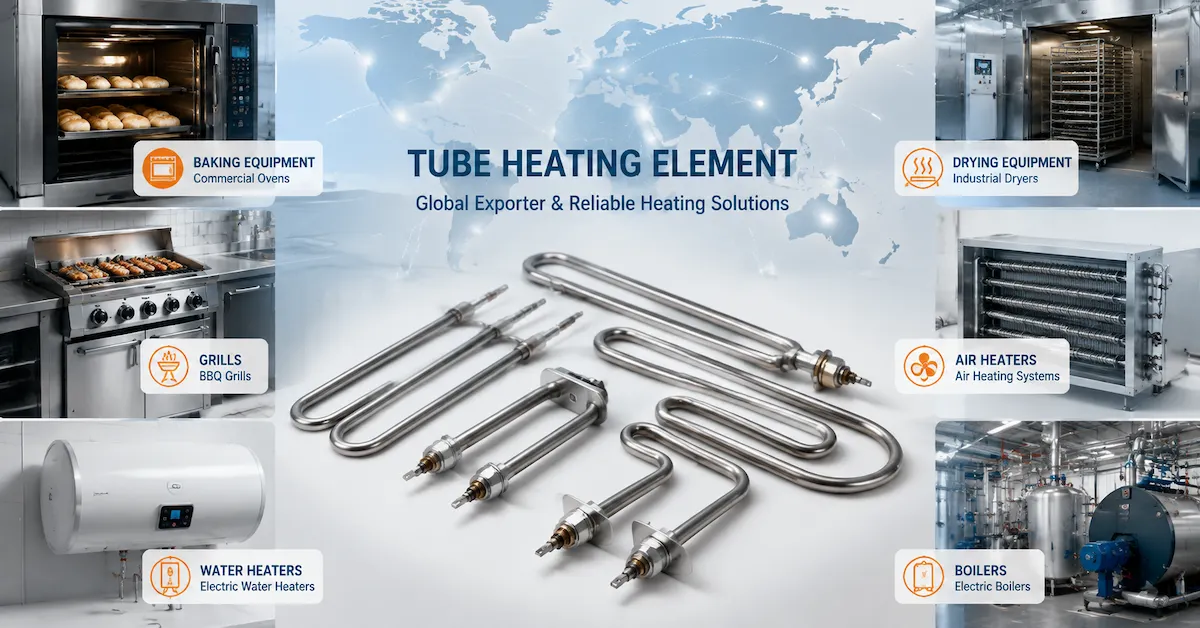
WEBO's existing tubular-heater content lists applications including electric ovens, baking equipment, grills, water heaters, boilers, drying machines, heating tanks, industrial ovens, food-processing machinery, and air-heating equipment.
When ODM May Not Be Necessary
ODM is not automatically the best sourcing model for every project.
A standard product may be more efficient if an existing tube heating element already meets:
- Required dimensions
- Voltage
- Power
- Tube shape
- Terminal layout
- Mounting method
- Operating environment
OEM may also be more appropriate when your engineering team has already completed the design and requires a supplier to manufacture strictly according to an approved drawing.
The value of ODM is highest when design selection and manufacturing development still need to happen together.
Start With the Heating Requirement, Not the Tube Shape
One of the most useful differences between an ODM project and a simple catalog purchase is that development can begin with the application rather than a finished heater drawing.
Instead of telling the supplier:
We need this exact U-shaped heater.
A buyer can provide:
We are developing a forced-air drying chamber with a defined installation area, supply voltage, target heating output, operating cycle, and airflow condition.
That gives the supplier more context for evaluating the heating-element configuration.
Information to Prepare Before ODM Development
| Project Input | What the Buyer Should Provide |
|---|---|
| Equipment type | Oven, grill, water heater, dryer, air heater, industrial machine |
| Heating medium | Air, water, liquid, enclosed chamber or heated surface |
| Voltage | Electrical supply of the finished equipment |
| Target heating output | Required heater power or system target |
| Installation space | Available length, width, depth and clearances |
| Operating conditions | Temperature, airflow, moisture, corrosion and duty cycle |
| Mounting requirement | Bracket, flange, thread or custom mounting |
| Electrical connection | Preferred terminal position and wiring arrangement |
| Target market | Destination country or region |
| Expected quantity | Prototype, trial order and projected bulk demand |
| Existing references | Appliance drawing, CAD, photographs or previous heater sample |
| Packaging | Standard export or private-label requirement |
WEBO's supplier guide similarly asks buyers to confirm tube material, diameter, length, voltage, power, shape, terminal type, operating temperature, insulation performance, and surface treatment before purchasing.
The more clearly the equipment conditions are defined, the easier it becomes to evaluate possible heater designs.
What Should an ODM Supplier Help Define?
An ODM supplier should not make the product-development process mysterious.
The project should gradually convert general heating requirements into controlled specifications.
Tube Geometry
Possible design decisions include:
- Straight or formed tube
- U-shaped geometry
- W-shaped geometry
- Circular configuration
- Double-U configuration
- Custom bend layout
- Heated length
- Cold-zone length
- Bend radius
- Terminal direction
WEBO's current Tube Heating Element range includes tube-heater products and custom-shaped configurations for several appliance and industrial applications. Buyers can review the Tube Heating Element product category before starting a completely new configuration.
Electrical Requirements
Important parameters may include:
- Rated voltage
- Required power
- Resistance target
- Terminal arrangement
- Insulation requirements
- Connection method
These parameters should be evaluated together with the geometry and heating environment rather than independently.
Metal-sheathed tubular heating elements generally use a resistance heating coil electrically insulated from the surrounding metal tube by compacted granular material such as MgO. Kanthal's technical guidance describes this typical tubular-element construction and shows that allowable surface loading varies according to element design and application.
This is one reason why simply increasing wattage without considering heated surface area and operating conditions is not a sound ODM approach.
Material Selection Should Be Application-Driven
A professional ODM process should define why a material is being selected.
The outer tube must operate in the actual environment of the finished equipment.
Important considerations can include:
- Temperature
- Air exposure
- Moisture
- Water immersion
- Chemical exposure
- Oxidation
- Mechanical loading
- Food-processing environment
- Cost target
The correct material is therefore not always the most expensive alloy.
It is the material that meets the required operating conditions with an appropriate engineering and commercial margin.
Internal Heating Material
Resistance-heating alloy selection also affects the element design.
The resistance conductor must provide the required electrical resistance while operating within an appropriate thermal range. Kanthal identifies resistance alloys such as Nikrothal and Kanthal grades for different types of electrical heating-element construction.
For buyers, the key ODM question is not necessarily which alloy name sounds best.
The better question is:
“Has the supplier defined and controlled the resistance material appropriate for this design?”
Common Applications for ODM Tube Heating Elements
Different equipment types create different design priorities.
| Application | Typical Buyer Priority | ODM Design Focus |
| Electric oven | Even heating-zone coverage | Shape, position, terminals, mounting |
| Electric grill | Heat distribution near cooking surface | Geometry, wattage, fixing |
| Water heater | Direct liquid heating | Sheath, flange, sealing, immersion length |
| Boiler | Reliable repeated heating | Fitting, power, material, installation |
| Air heater | Heat transfer to moving air | Tube layout, airflow, surface load |
| Drying machine | Controlled chamber heating | Heating area, mounting, airflow |
| Industrial oven | Process consistency | Geometry, power distribution, durability |
| Food equipment | Equipment-specific heating | Material, cleaning environment, mounting |
| Custom machinery | Limited installation space | Full geometry and electrical integration |
WEBO's current product information includes W-shaped tubular elements for electric furnaces and ovens, while its broader supplier content covers water heating, industrial ovens, drying equipment, air heating, food-processing machinery, and customized equipment.
ODM Tube Heating Element Development Process
A structured development sequence helps prevent technical changes from becoming production problems.
Step 1: Application Review
The buyer explains the finished equipment and heating objective.
This stage should clarify:
- What must be heated?
- How quickly?
- In what environment?
- Within what space?
- At what voltage?
- Under what operating cycle?
The goal is to define the problem before defining the product.
Step 2: Existing Solution Review
The ODM supplier evaluates whether the project can use:
- A standard existing heater
- A modified existing heater
- A new custom configuration
Adapting an existing platform can sometimes reduce development work compared with creating a completely new design.
Step 3: Design Adjustment
This is where ODM differs most clearly from strict build-to-print OEM production.
WEBO's current tube-heater supplier page specifically lists product recommendation and design adjustment as part of its ODM approach.
Possible adjustments may involve:
- Element length
- Tube shape
- Voltage
- Power
- Terminal position
- Mounting structure
- Tube material
- Packaging
Step 4: Drawing and Specification Confirmation
Once a workable design direction has been selected, both buyer and supplier should document it.
A controlled specification may identify:
- Product drawing
- Revision number
- Dimensions
- Tolerances
- Material
- Electrical rating
- Terminals
- Mounting
- Marking
- Packaging
This becomes increasingly important as the project moves from prototype to bulk manufacturing.
Step 5: Sample Production
WEBO identifies sample production as one of its ODM support activities.
Samples allow both parties to test whether the proposed design works in practice.
Step 6: Performance Validation
Testing should match the purpose of the sample.
Depending on the project, buyers may evaluate:
- Installation compatibility
- Heating response
- Electrical characteristics
- Temperature distribution
- Mounting
- Terminal access
- Interaction with control components
- Continuous operating behavior
WEBO's current supplier guide lists installation compatibility, heating performance, electrical safety, temperature response, and continuous operation among possible sample-evaluation areas.
Step 7: Design Revision
Not every first prototype should automatically become a mass-production design.
If testing reveals:
- Poor heat-zone coverage
- Terminal interference
- Mounting difficulty
- Excessive local temperature
- Dimensional conflict
- Assembly problems
the design should be revised before approval.
Step 8: Final Approval
After testing, freeze the accepted:
- Drawing
- Electrical specification
- Materials
- Terminals
- Mounting
- Labeling
- Packaging
This approved configuration should become the basis for production.
Step 9: Bulk Manufacturing
The supplier then shifts from development to production repeatability.
This is where manufacturing discipline becomes as important as design capability.
What Quality Controls Matter in an ODM Project?
The exact inspection plan should depend on the project, but buyers should define which characteristics are critical before bulk production.
Incoming Material Control
WEBO's current tube-element supplier guidance identifies checks on items such as stainless-steel tube, resistance wire, insulation materials, and terminals as relevant quality-control areas.
For an ODM program, material specifications should remain linked to the approved product design.
Dimensional Inspection
Important dimensions may include:
- Overall length
- Tube diameter
- Bend geometry
- Terminal position
- Mounting points
- Flange dimensions
- Critical clearances
The drawing should indicate which tolerances matter most to assembly.
Electrical Testing
Depending on the design, testing may include:
- Resistance value
- Power output
- Insulation performance
- Electrical-safety-related checks
WEBO lists resistance, power, insulation performance, and electrical safety among its current tube-heater QC considerations.
Functional Verification
A supplier can verify component behavior, but the buyer should also validate the element in the actual or representative finished equipment.
The complete appliance determines factors such as:
- Airflow
- Control logic
- Nearby materials
- Ventilation
- User operating cycles
- Heat accumulation
Component approval and appliance-level validation are therefore related but not identical activities.
OEM vs ODM Tube Heating Element Supply
The two sourcing models overlap, but their starting points differ.
| Factor | OEM | ODM |
| Starting point | Buyer-owned specification | Buyer application or target requirement |
| Drawing | Usually provided by buyer | May be developed or adjusted with supplier |
| Existing sample | Often used as production reference | May be used as a starting point |
| Product recommendation | Limited requirement | More important |
| Design adjustment | Buyer-led | Supplier participation is greater |
| Sample development | Used to verify buyer design | Used to develop and refine solution |
| Engineering communication | Build-to-print focused | Application and design focused |
| Best suited for | Mature designs | New or adapting projects |
WEBO's own current content describes OEM as suitable when buyers provide technical drawings, existing samples, specifications, and fixed requirements, while ODM is suited to buyers needing assistance selecting and modifying the heating solution.
That distinction should guide how a buyer prepares the inquiry.
What Affects ODM Development Cost?
ODM pricing cannot be evaluated from unit price alone.
Development and production cost may be influenced by:
- New versus existing design
- Tube material
- Tube diameter
- Overall length
- Number of bends
- Flange or mounting structure
- Terminal design
- Resistance specification
- Tooling
- Prototype quantity
- Number of revisions
- Testing requirements
- Certification requirements
- Packaging
- Order volume
For this reason, buyers should separate:
Development cost
from:
Mass-production unit cost
when reviewing quotations.
A slightly higher development cost may be commercially reasonable if it reduces unnecessary tooling, assembly problems, redesign, or supplier changes later.
What Affects ODM Project Lead Time?
There should not be one universal lead-time number for all ODM heating-element projects.
Timing depends on factors including:
- Whether an existing design can be modified
- Material availability
- Drawing complexity
- Tooling
- Sample quantity
- Number of design revisions
- Buyer testing time
- Required documentation
- Trial-production requirements
WEBO currently publishes support for sample development and bulk production but does not state one universal ODM project lead time on the relevant supplier page.
Buyers should therefore request separate schedules for:
- Technical review
- First sample
- Revised sample if needed
- Pilot order
- Mass production
This is more useful than asking only, “What is your lead time?”
Common Risks in Tube Heating Element ODM Projects
Unclear Application Requirements
If the supplier does not know the actual operating environment, design decisions may be based on incomplete assumptions.
Provide equipment and operating conditions early.
Letting the Supplier Guess Critical Requirements
ODM does not mean transferring every engineering responsibility to the supplier.
The buyer still needs to define the finished equipment, target performance, regulatory market, installation limits, and acceptance criteria.
Approving Appearance Instead of Performance
A tube heater can visually match the drawing but still fail the equipment requirement.
Prototype approval should include functional validation.
No Revision Control
Once multiple sample rounds exist, it becomes easy for teams to reference different drawings.
Use a clear revision number for every approved change.
Undefined Critical Materials
If a critical sheath, resistance material, terminal, or insulating material can change without approval, production consistency becomes harder to control.
Moving to Mass Production Too Early
Do not convert an unfinished prototype into a bulk order merely to save development time.
Resolve major technical issues first.
Comparing Suppliers Only by Unit Price
Two ODM quotations may not include the same:
- Material
- Design work
- Tooling
- Testing
- Packaging
- Inspection
- Support
Compare scope as well as price.
How to Evaluate a Tube Heating Element ODM Supplier
A capable ODM supplier should be able to discuss your application before presenting a final product recommendation.
Ask whether the supplier supports:
Application Analysis
Can the team understand how the heater will actually be used?
Product Recommendation
Can an existing design be adapted instead of starting from zero?
Design Adjustment
Can tube shape, voltage, wattage, terminal layout, mounting, and dimensions be evaluated?
Drawing Review
Will technical requirements be documented before sampling?
Prototype Development
Can the supplier produce controlled development samples?
Performance Testing
What does the supplier test internally, and what should the buyer test in the equipment?
Production Quality Control
How are materials, dimensions, electrical characteristics, appearance, and packaging controlled?
Change Management
How are future design or material changes handled?
Bulk Supply
Can approved prototypes be converted into repeat production?
Export Packaging
Will terminals and formed tubes be protected adequately during transport?
These questions are much more informative than simply asking whether the company “supports customization.”
Why Consider WEBO as a Tube Heating Element ODM Supplier?
GUANGDONG WEBO TECHNOLOGY states that it was established in Yangjiang, Guangdong, in 1998. Its current About Us page reports approximately 50,000 m² of plant space, more than 500 workers, ISO 9001 and ISO 14001 management standards, and product certifications including VDE, TUV, UL, CE, and RoHS.
The company's current main product categories include Hot Plate, Ceramic Heater, Tube Heating Element, Cast Iron Pan Support, Induction Coil, Ceramic Glass, Rotary Switch, and Energy Regulator.
For tubular-heater projects specifically, WEBO's current supplier page lists:
- Product selection
- Technical consultation
- Drawing review
- Sample development
- Performance testing
- OEM and ODM support
- Bulk production
- Export packaging
- Long-term supply cooperation
Its ODM section further identifies product recommendation, design adjustment, sample production, performance testing, and packaging solutions as relevant ODM services.
Buyers can first review WEBO's Tube Heating Element products, compare existing configurations, and then submit application information through the WEBO contact page.
What Should You Include in an ODM RFQ?
An effective inquiry should allow the supplier to understand both the technical problem and commercial target.
Include:
- Product application
- Heating medium
- Voltage
- Target power
- Installation dimensions
- Operating conditions
- Preferred tube material if defined
- Mounting method
- Terminal requirements
- Existing drawings
- Reference samples
- Destination market
- Prototype quantity
- Expected annual or batch volume
- Certification requirements
- Packaging requirements
- Target development schedule
If some of these parameters are still unknown, identify them as open design items rather than guessing.
That tells the ODM supplier where technical input is actually required.
FAQ
1. What is a tube heating element ODM supplier?
In the sourcing model used by WEBO's current tube-heating guidance, an ODM supplier helps buyers select and modify a heating solution rather than only manufacturing to fixed buyer specifications. Services may include product recommendation, design adjustment, sample production, performance testing, and packaging support.
2. What is the difference between OEM and ODM tube heating elements?
OEM generally starts with a buyer's established drawing, sample, or fixed specification. ODM is more suitable when the buyer has an application requirement but needs supplier participation in selecting or modifying the heater design.
3. Can an ODM supplier modify an existing tubular heater?
Yes, when the existing design provides a suitable starting point and the required modifications are manufacturable. Dimensions, shape, voltage, power, terminals, mounting, and packaging are among the customization areas listed in WEBO's current supplier guidance.
4. What information should I provide before ODM development?
Provide the equipment application, heating medium, voltage, target power, installation space, operating conditions, mounting, terminals, market, quantity, and any existing drawings or samples.
5. Is a technical drawing required at the beginning?
Not necessarily if the project begins from an application requirement. However, a controlled drawing or equivalent technical specification should normally be established before final sample approval and production.
6. Why is prototype testing important?
Prototype testing allows the buyer to verify installation compatibility, heating behavior, electrical characteristics, and interaction with the actual equipment before committing to bulk production.
7. Can an ODM project use an existing WEBO heating element?
Potentially. Reviewing existing products first can determine whether a current design can be adapted. Buyers can explore the WEBO Tube Heating Element category before requesting a new configuration.
8. What quality checks should I discuss with the supplier?
Discuss incoming-material checks, dimensional inspection, resistance and power verification, insulation performance, heating tests, appearance, identification, and packaging according to the actual product requirements. WEBO lists these areas among its current tube-heater QC considerations.
9. What factors affect ODM pricing?
Design complexity, materials, dimensions, bends, terminals, mounting structures, prototypes, tooling, testing, packaging, certification requirements, and production quantity can all affect project cost.
10. How can I start a tube heating element ODM project with WEBO?
Review the Tube Heating Element product range, then provide application requirements, dimensions, voltage, power, target market, drawings or reference samples, and expected quantity through the WEBO contact page. WEBO's current supplier information states that it supports product selection, design adjustment, samples, performance testing, ODM cooperation, and bulk production.
Conclusion
Selecting a tube heating element ODM supplier is most valuable when your company has a clear heating requirement but still needs technical support converting that requirement into a practical component.
The process should move logically from application analysis to product recommendation, design adjustment, specification confirmation, prototype development, testing, design freeze, and controlled mass production.
For appliance brands and industrial-equipment manufacturers, the strongest ODM supplier is not simply the factory offering the lowest heater price. It is the supplier that can help reduce design uncertainty while maintaining clear specifications, controlled quality, and repeatable production.
WEBO currently supports product selection, technical consultation, drawing review, sample development, performance testing, OEM/ODM cooperation, bulk production, and export packaging for tube-heating projects. Buyers developing a new or modified heating application can review WEBO Tube Heating Elements and contact WEBO with project requirements for evaluation.