


What Should International Buyers Expect From a Tube Heating Element Exporter?
A tube heating element exporter is not only a company that ships products overseas. For global buyers, a reliable exporter should provide a complete supply solution that combines manufacturing capability, technical understanding, quality control, export experience, and international communication.
For heating components, export capability is especially important because tubular heating elements are often customized according to:
- Equipment design
- Voltage requirements
- Heating application
- Installation dimensions
- Terminal structure
- Target market standards
A supplier may produce heating elements locally, but international buyers need additional capabilities such as:
- Export packaging
- Product documentation
- International shipping coordination
- Technical communication
- Batch consistency
- After-sales support
For appliance manufacturers, industrial equipment companies, and distributors, choosing the correct exporter can directly affect:
- Product launch schedules
- Production stability
- Import costs
- Customer satisfaction
- Long-term supply reliability
WEBO provides tube heating elements for international markets and supports product selection, technical consultation, customization, sample development, testing, bulk production, and export packaging. (WEBO Tube Heating Element)
Tube Heating Element Exporter vs Manufacturer: What Is the Difference?
Many buyers search for exporters because they need a supplier that understands international purchasing requirements.
A manufacturer focuses mainly on:
- Production
- Engineering
- Manufacturing process
- Quality control
An exporter must additionally handle:
- International orders
- Export documents
- Packaging requirements
- Shipping coordination
- Overseas customer communication
In many cases, the strongest supplier is a manufacturer that also has export experience.
This combination allows buyers to communicate directly with the production source while receiving international sourcing support.
| Supplier Type | Main Capability | Suitable Buyer |
|---|---|---|
| Local distributor | Product resale | Small replacement purchases |
| Trading company | Supplier coordination | Buyers needing sourcing assistance |
| Manufacturer | Production and engineering | OEM and bulk buyers |
| Manufacturer exporter | Production + international delivery | Global procurement projects |
For B2B buyers, a manufacturer exporter can reduce communication layers and improve control over:
- Product specifications
- Production changes
- Quality requirements
- Delivery planning
Who Needs a Tube Heating Element Exporter?
Tube heating element exporters mainly serve companies that purchase heating components internationally.
Typical customers include:
Appliance Manufacturers
Applications:
- Electric ovens
- Grills
- Cooking equipment
- Commercial kitchen appliances
These customers usually require:
- Stable supply
- Consistent dimensions
- Electrical compatibility
- Production repeatability
Industrial Equipment Manufacturers
Applications:
- Industrial ovens
- Drying systems
- Heating chambers
- Process equipment
These buyers often need:
- Custom designs
- High reliability
- Engineering support
- Long-term supply agreements
Importers and Distributors
Importers usually focus on:
- Competitive pricing
- Export experience
- Documentation
- Packaging
- Delivery reliability
They may purchase heating elements for:
- Regional distribution
- Spare parts business
- Equipment maintenance markets
OEM and Private Label Brands
These customers need:
- Customized products
- Branding support
- Packaging solutions
- Product consistency
What Applications Use Exported Tube Heating Elements?
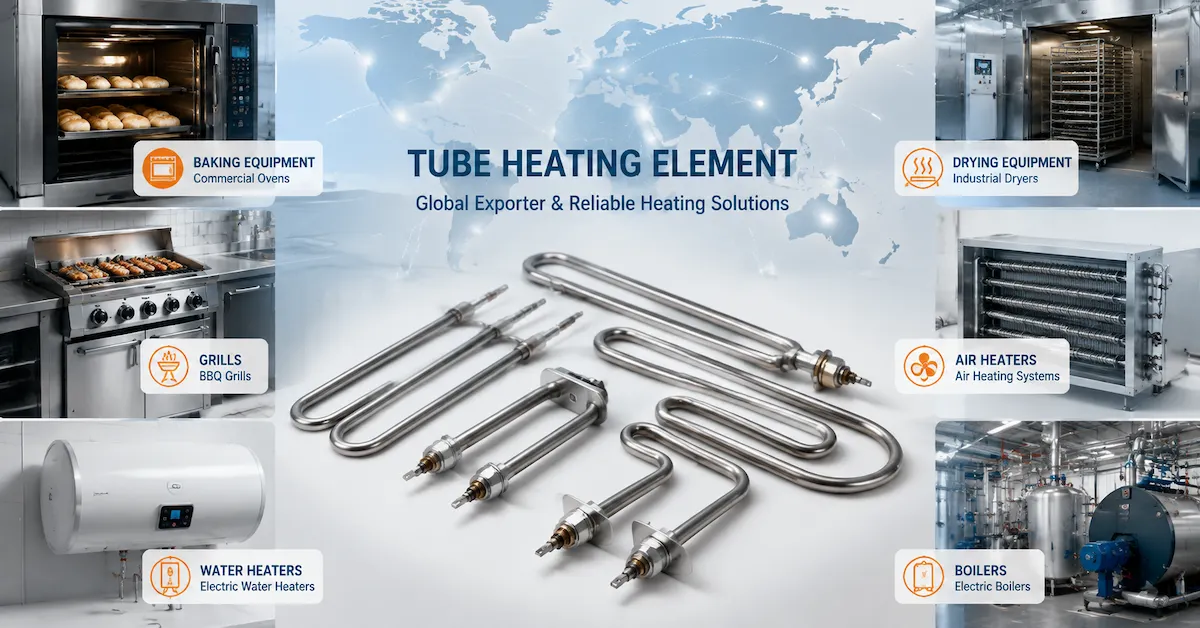
Tube heating elements are widely used because they can be customized into different shapes and specifications.
| Application | Equipment Examples | Main Requirements |
|---|---|---|
| Baking equipment | Commercial ovens, bakery ovens | Stable heating, uniform temperature |
| Electric ovens | Household and commercial ovens | Correct dimensions and power |
| Grills | BBQ equipment, cooking machines | High-temperature durability |
| Water heating | Water heaters, boilers | Corrosion resistance and sealing |
| Drying equipment | Industrial dryers | Continuous heating stability |
| Air heaters | Air circulation systems | Heat transfer efficiency |
| Industrial equipment | Process machines | Custom geometry and reliability |
WEBO's tube heating element products include applications for electric furnaces, ovens, water heaters, boilers, air heaters, industrial ovens, drying machines, and other heating systems. (WEBO Tube Heating Element)
Why Export Buyers Need Technical Support
Buying heating elements internationally is different from purchasing standard hardware components.
A heating element directly affects the performance of the final equipment.
Before ordering, buyers should confirm:
- Required voltage
- Required wattage
- Heating area
- Tube diameter
- Element shape
- Mounting structure
- Terminal position
- Operating temperature
- Heating environment
A professional exporter should be able to understand these requirements and communicate them with the manufacturing team.
Key Technical Specifications to Confirm Before Importing
Before requesting a quotation, buyers should prepare technical information.
Electrical Specifications
Important parameters include:
Voltage
The heating element must match the electrical system of the equipment.
Incorrect voltage selection may result in:
- Insufficient heating
- Excessive power consumption
- Safety problems
- Equipment failure
Wattage
Power determines heating output.
However, wattage should not be selected independently.
It must match:
- Element size
- Heating environment
- Application requirements
- Temperature target
Resistance
Resistance value affects electrical performance and should remain consistent between production batches.
Mechanical Specifications
Buyers should confirm:
- Tube diameter
- Overall length
- Heated length
- Bend shape
- Mounting position
- Terminal location
- Flange dimensions
- Thread size if applicable
Even a small dimensional difference can create assembly problems in finished equipment.
Material Requirements
Material selection depends on:
- Working temperature
- Heating medium
- Corrosion exposure
- Operating environment
Common considerations include:
- Stainless steel sheath
- Heat-resistant alloy materials
- Insulation materials
- Resistance wire materials
Metal-sheathed tubular heating elements typically use a resistance coil surrounded by electrical insulation material such as magnesium oxide (MgO). Kanthal describes this construction as a common design approach for electric appliance heating elements. (Kanthal Electric Appliance Elements)
Why Product Specification Accuracy Matters in Export Orders
International orders usually involve longer production and shipping cycles.
If specifications are unclear before production, problems may appear after delivery:
- Incorrect installation size
- Wrong terminal direction
- Different heating performance
- Assembly delays
- Additional replacement costs
A reliable exporter should confirm the specification before production instead of relying only on product photos or verbal descriptions.
How to Evaluate a Tube Heating Element Exporter
A professional exporter should be evaluated from several perspectives.
Manufacturing Capability
Check:
- Factory ownership
- Production experience
- Product range
- Engineering support
- Production process
A supplier with direct manufacturing capability usually has better control over customization and quality.
Export Experience
Important questions:
- Which countries does the supplier export to?
- Can they support international documentation?
- Do they understand different market requirements?
- Can they arrange export packaging?
Quality Management
Ask about:
- Incoming material inspection
- Production inspection
- Electrical testing
- Final inspection
- Batch tracking
WEBO states that it operates under ISO 9001 and ISO 14001 management systems and provides heating components for international markets. (WEBO About Us)
Export Process: What International Buyers Should Know
A reliable tube heating element exporter should have a clear export workflow that reduces communication problems and delivery risks.
A professional international sourcing process usually includes:
- Technical requirement confirmation
- Product quotation
- Sample development (if required)
- Sample approval
- Bulk production
- Quality inspection
- Export packaging
- Shipping arrangement
- Document preparation
- After-sales communication
Each stage affects the final purchasing experience.
For industrial heating components, export success depends not only on manufacturing but also on whether the supplier can manage international supply requirements.
Step 1: Technical Requirement Confirmation
Before quotation, the exporter should collect sufficient product information.
A complete inquiry should include:
- Product application
- Equipment type
- Voltage
- Wattage
- Tube diameter
- Heating length
- Element shape
- Terminal design
- Mounting method
- Material requirements
- Quantity
- Destination country
If the buyer provides an existing sample or drawing, the supplier can evaluate whether the product can be manufactured directly or requires modification.
For custom projects, technical confirmation should happen before price comparison.
Step 2: Sample Development and Approval
For OEM and custom heating-element projects, samples help verify whether the design meets the equipment requirements.
Sample evaluation may include:
Mechanical Compatibility
Check:
- Overall dimensions
- Installation position
- Mounting holes
- Terminal direction
- Clearance with other components
Electrical Performance
Check:
- Voltage
- Wattage
- Resistance
- Insulation performance
Heating Performance
Check:
- Heating speed
- Temperature distribution
- Working stability
The sample stage reduces the risk of discovering problems after international shipment.
Step 3: Bulk Production Control
After sample approval, the exporter should maintain consistency between the approved sample and mass production.
Important control points include:
- Raw material specifications
- Production parameters
- Product dimensions
- Electrical characteristics
- Surface condition
- Packaging requirements
A controlled production process is especially important for overseas buyers because replacement and corrective actions may require additional transportation time.
Export Packaging Requirements for Tube Heating Elements
Packaging is often underestimated when sourcing long metal heating components.
A good export package should protect against:
- Bending deformation
- Terminal damage
- Surface scratches
- Moisture exposure
- Transportation impact
Common Packaging Considerations
Individual Protection
Depending on the product, packaging may include:
- Protective sleeves
- Plastic bags
- Foam protection
- Separators
Outer Carton Protection
Export cartons should consider:
- Product length
- Weight
- Stacking requirements
- Shipping distance
Special Protection for Bent Elements
W-shaped, U-shaped, and custom-bent heating tubes require additional protection because incorrect loading pressure may affect:
- Shape accuracy
- Mounting compatibility
- Installation performance
WEBO's tube heating element supplier information includes export packaging as part of its supply support process. (WEBO Tube Heating Element Supplier Guide)
International Shipping Considerations
A tube heating element exporter should understand different shipping requirements.
Common shipping methods include:
| Shipping Method | Suitable For | Buyer Consideration |
|---|---|---|
| Express | Samples and urgent small orders | Higher transportation cost |
| Air Freight | Medium-volume urgent shipments | Faster delivery |
| Sea Freight | Bulk production orders | Lower cost, longer transit |
| Consolidated Shipment | Smaller importers | Flexible purchasing |
The best shipping method depends on:
- Order quantity
- Delivery schedule
- Product value
- Destination country
- Inventory requirements
Export Documents Buyers May Need
International buyers usually require commercial documents to complete import procedures.
Common documents include:
Commercial Invoice
Used for:
- Customs declaration
- Payment processing
- Import documentation
Packing List
Provides:
- Carton information
- Quantity
- Product description
- Weight information
Shipping Documents
Depending on shipping method:
- Bill of lading
- Air waybill
- Courier documentation
Product Documents
Depending on the market and application:
- Product specification sheet
- Test reports
- Quality documents
- Certification-related documents
The exact documentation requirement depends on:
- Destination country
- Product type
- Import regulations
- Customer requirements
Certification and Compliance Considerations
International buyers should confirm compliance requirements before production.
Possible requirements may relate to:
- Electrical safety
- Material restrictions
- Environmental regulations
- Finished equipment standards
For example, the EU RoHS Directive restricts certain hazardous substances in electrical and electronic equipment. Buyers should confirm whether the supplied component and application require RoHS-related documentation. (European Commission RoHS)
For appliance applications, IEC 60335-1 provides general safety requirements for household and similar electrical appliances, but the final compliance requirement depends on the complete appliance design and applicable product standard. (IEC 60335-1)
A supplier certificate list alone does not automatically guarantee compliance for every finished product.
Cost Factors When Importing Tube Heating Elements
International buyers should evaluate total sourcing cost instead of only unit price.
The final purchasing cost may include:
| Cost Factor | Impact |
|---|---|
| Product specification | Material and design complexity |
| Tube material | Different materials affect cost |
| Customization | Tooling and development requirements |
| Quantity | Production efficiency |
| Packaging | Export protection requirements |
| Testing | Inspection and validation needs |
| Shipping | Distance and transportation method |
| Import requirements | Customs and documentation |
A lower initial quotation may create higher total costs if it causes:
- Installation problems
- Quality failures
- Replacement shipments
- Production delays
How to Reduce Risks When Buying From a Tube Heating Element Exporter
1. Confirm Technical Details Before Ordering
Avoid ordering based only on:
- Product photos
- Previous models
- General descriptions
Confirm:
- Dimensions
- Electrical parameters
- Materials
- Application requirements
2. Request Samples Before Bulk Orders
Samples allow buyers to verify:
- Product fit
- Heating performance
- Assembly compatibility
3. Define Quality Requirements Clearly
Agree on:
- Inspection points
- Acceptance criteria
- Testing requirements
- Packaging standards
4. Choose a Manufacturer With Export Experience
A supplier with international experience is more familiar with:
- Customer communication
- Export documents
- Packaging requirements
- Shipping coordination
5. Maintain Specification Control
For repeat purchases, maintain:
- Approved drawings
- Product specifications
- Sample references
- Revision records
This helps prevent unexpected product changes.
How to Compare Different Tube Heating Element Exporters
When comparing suppliers, evaluate more than price.
| Evaluation Category | Questions |
|---|---|
| Factory Capability | Does the supplier manufacture directly? |
| Product Experience | Do they produce similar heating elements? |
| Engineering Support | Can they review designs? |
| Customization | Can they modify specifications? |
| Quality Control | What inspections are performed? |
| Export Ability | Do they support international shipments? |
| Documentation | Can they provide required documents? |
| Communication | Can technical requirements be understood? |
| Delivery | Can they support repeat orders? |
The best exporter is usually the one that reduces purchasing uncertainty.
Why Choose WEBO as a Tube Heating Element Exporter?
GUANGDONG WEBO TECHNOLOGY was established in 1998 in Yangjiang, Guangdong.
According to WEBO's company information:
- Established in 1998
- Manufacturing area approximately 50,000㎡
- More than 500 employees
- International market experience
- ISO 9001 and ISO 14001 management systems
WEBO's heating-related product portfolio includes:
- Hot Plate
- Ceramic Heater
- Tube Heating Element
- Cast Iron Pan Support
- Induction Coil
- Ceramic Glass
- Rotary Switch
- Energy Regulator
For tube heating element projects, WEBO supports:
- Product selection
- Technical consultation
- Drawing review
- Sample development
- Performance testing
- OEM/ODM customization
- Bulk production
- Export packaging
(WEBO Tube Heating Element Supplier Guide)
Buyers can review the Tube Heating Element product category and provide:
- Application information
- Product drawing
- Sample
- Electrical requirements
- Quantity requirements
- Destination market
through the WEBO contact page.
FAQ
1. What is a tube heating element exporter?
A tube heating element exporter supplies tubular heating components to international customers and supports overseas purchasing requirements such as documentation, packaging, shipping coordination, and customer communication.
2. What is the difference between a manufacturer and an exporter?
A manufacturer focuses on production capability, while an exporter additionally manages international order requirements, logistics coordination, and export documentation.
3. What information should I provide when requesting a quote?
Provide application, voltage, wattage, dimensions, shape, terminal requirements, quantity, destination market, and any drawings or samples.
4. Can a tube heating element exporter provide customized products?
Yes. Many exporters that operate with manufacturing capability can support customization including shape, size, voltage, wattage, terminals, mounting structures, and packaging.
5. What applications use tube heating elements?
Common applications include ovens, grills, water heaters, boilers, drying equipment, air heaters, and industrial heating systems.
6. How should I evaluate a China tube heating element exporter?
Evaluate:
- Manufacturing capability
- Engineering support
- Quality control
- Export experience
- Documentation
- Packaging
- Communication
7. What documents are usually required for importing heating elements?
Common documents may include commercial invoice, packing list, shipping documents, specifications, and applicable quality or compliance documents.
8. How can I avoid quality problems when importing heating elements?
Reduce risk by confirming specifications, approving samples, defining QC requirements, and selecting experienced manufacturers.
9. Can exporters support OEM and ODM projects?
Yes. Manufacturers with engineering capability can support OEM production and ODM development depending on project requirements.
10. How can I contact WEBO for tube heating element export cooperation?
Review WEBO's Tube Heating Element products, then submit your application details, drawings, samples, and quantity requirements through the contact page.
Conclusion
Selecting the right tube heating element exporter is an important step for international buyers who need reliable heating components.
A successful export partnership depends on more than product availability. Buyers should evaluate manufacturing capability, technical support, quality control, export experience, documentation, packaging, and long-term supply stability.
For appliance manufacturers, industrial equipment companies, distributors, and importers, working with a manufacturer-exporter can simplify communication and reduce sourcing risks.
WEBO provides tube heating elements and related heating components with support for customization, testing, bulk production, and international supply.
Companies looking for a reliable tube heating element exporter can review WEBO's product range and contact the team with their technical requirements for evaluation and quotation.