


What Should You Expect From a Tube Heating Element OEM Manufacturer?
A tube heating element OEM manufacturer should do more than reproduce the visible shape of a heater. For appliance brands and industrial equipment manufacturers, successful OEM development requires the electrical specification, heating environment, tube geometry, terminals, mounting structure, materials, and production tolerances to work together.
That makes OEM sourcing fundamentally different from buying a standard replacement component.
A professional OEM project normally starts with an application requirement, technical drawing, existing sample, or target specification. The manufacturer then evaluates manufacturability, develops samples, verifies critical characteristics, and establishes a controlled specification for repeat production.
Metal-sheathed tubular elements typically contain a resistance heating coil electrically insulated from the surrounding metallic sheath by compacted insulating material such as magnesium oxide. This construction allows electrical energy to be converted into heat while maintaining insulation between the conductor and sheath. Kanthal's technical guide to electric appliance elements describes this common tubular-element structure.
For OEM buyers, therefore, the real question is not simply “Can you manufacture this shape?” It is “Can you reproduce the required electrical, mechanical, thermal, and quality characteristics consistently at production scale?”
Who Needs an OEM Tubular Heating Element?
OEM manufacturing is most relevant when a standard catalog element cannot fully meet the equipment design.
Typical buyers include:
- Electric oven manufacturers
- Commercial cooking-equipment companies
- Electric grill manufacturers
- Water-heating equipment brands
- Boiler manufacturers
- Air-heating system manufacturers
- Drying-equipment companies
- Food-processing machinery manufacturers
- Industrial oven builders
- Laboratory-equipment companies
- Appliance OEM/ODM companies
- Importers developing private-label equipment
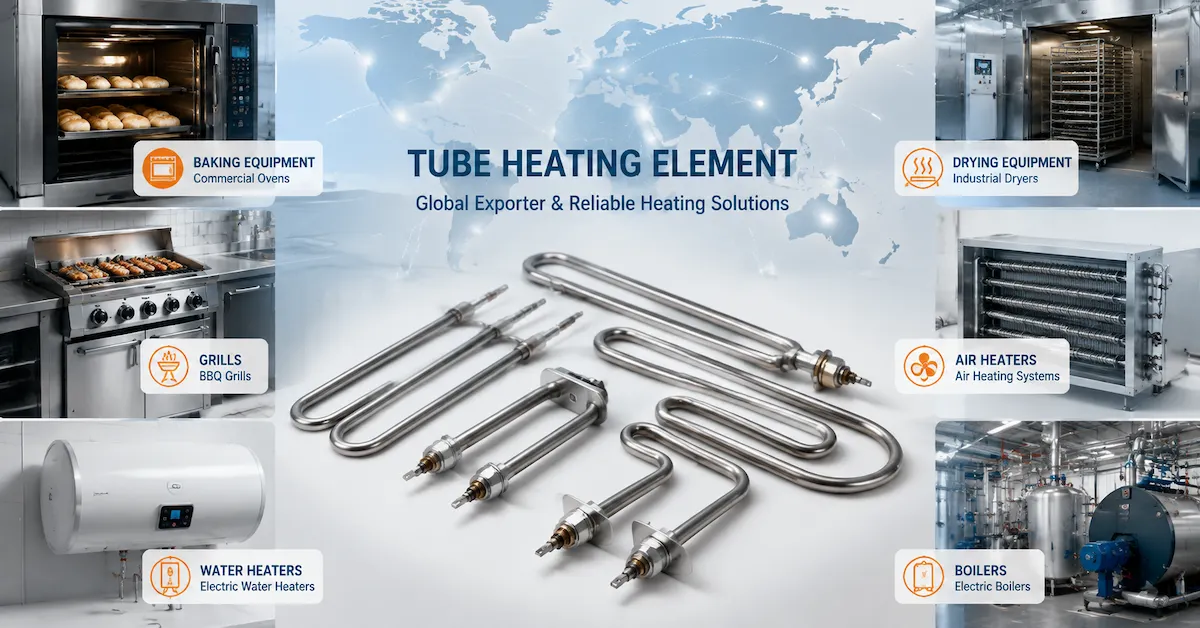
WEBO's current tube-heating range reflects several of these application directions. For example, its TL-002 tube heating element is described as a customizable W-shaped design for electric furnaces and ovens, while the TL-023 uses a double-U configuration for applications including air heaters, industrial ovens, and drying equipment.
When a Standard Heating Element May Be Better
OEM development is not always necessary.
A standard element may be more practical when:
- Existing dimensions already fit the equipment
- Standard voltage and wattage meet the design
- Terminal positions are compatible
- No special mounting structure is required
- The application does not require unique materials
- Order volumes do not justify additional development
Using an existing model can reduce development complexity.
OEM becomes more valuable when dimensional, electrical, thermal, mounting, or market requirements differ from standard products.
Start OEM Development With the Application, Not the Drawing
A technical drawing is important, but a drawing alone does not explain how the heater will operate.
Before manufacturing a sample, the supplier should understand the application.
An oven heating element, for example, operates under different conditions from an immersion water heater or forced-air heater. The surrounding medium changes how heat leaves the element and therefore affects design decisions.
Information Buyers Should Provide
| OEM Requirement | Information to Provide |
|---|---|
| Application | Oven, grill, water heater, air heater, dryer, industrial equipment |
| Heating medium | Air, water, oil, metal surface or enclosed chamber |
| Rated voltage | Electrical supply of the finished equipment |
| Target wattage | Required electrical heating output |
| Element geometry | Length, width, bends, radius and heated area |
| Tube diameter | Required outer diameter |
| Mounting | Brackets, flange, thread or fixing points |
| Terminal design | Type, spacing, orientation and connection |
| Operating environment | Temperature, moisture, corrosion and airflow |
| Target market | Country or region where equipment will be sold |
| Order quantity | Prototype, trial order and expected production volume |
| Existing reference | Drawing, CAD data, heater sample or appliance assembly |
Providing this information before requesting a quotation reduces the risk of developing a heater that looks correct but does not match the actual equipment.
Which Specifications Must Be Frozen Before Sample Production?
OEM drawings should identify the parameters that directly affect installation and function.
Electrical Specifications
At minimum, confirm:
- Rated voltage
- Rated power
- Target resistance where applicable
- Electrical connection method
- Grounding requirements where relevant
- Insulation requirements
- Intended control method
Voltage and wattage should never be selected independently from the element design and operating environment.
A higher wattage in the same physical heating area increases the thermal load on the element surface. Appropriate surface loading depends on the heater construction and application, which is why engineering review is more reliable than simply copying a wattage from another product. Kanthal's heating-element guidance similarly treats surface loading as dependent on element type and operating conditions.
Mechanical Specifications
The drawing should also identify:
- Overall length
- Heated length
- Cold-zone dimensions
- Tube diameter
- Bend locations
- Bend radius
- Flange dimensions
- Thread size if applicable
- Bracket position
- Terminal length
- Terminal direction
- Critical tolerances
For appliance production lines, even a small dimensional mismatch can create assembly problems if mounting holes, terminals, or bends interfere with surrounding components.
Material Selection Should Follow the Operating Environment
The metal sheath is not merely an external cover. It is part of the thermal and environmental design of the element.
Possible material considerations include:
- Operating temperature
- Oxidation conditions
- Water exposure
- Corrosive environment
- Food-equipment requirements
- Mechanical strength
- Manufacturing process
- Target cost
WEBO currently lists different tubular-element configurations across oven, water-heating, air-heating, and industrial applications, illustrating why material and construction should be matched to the project rather than specified generically.
Resistance Heating Material
The internal resistance wire is another critical engineering component.
Resistance-heating alloys are selected according to properties such as electrical resistivity, temperature capability, oxidation behavior, and operating environment. Kanthal's resistance-material handbook documents multiple resistance-heating alloys intended for electrical appliances and heating applications. The technical handbook is available here.
For an OEM buyer, the practical requirement is simple: the manufacturer should define the material specification rather than leaving critical materials uncontrolled between batches.
OEM Tube Shape Is More Than a Visual Design
Tubular heaters are often bent into application-specific geometries.
Common configurations include:
| Tube Design | Typical OEM Application | Main Design Concern |
| U-shaped | Ovens, appliances, process heating | Width, length and mounting |
| W-shaped | Electric ovens and furnaces | Heat-zone coverage |
| Circular | Cookers and compact heating zones | Diameter and terminal location |
| Double-U | Air heaters and dryers | Airflow and heating-area coverage |
| Flange-mounted | Water and liquid heating | Flange, sealing and immersion length |
| Multi-tube assembly | Ovens and larger heating systems | Power distribution and mounting |
| Custom bent design | OEM machinery | Geometry and tolerance control |
WEBO's existing range includes W-shaped, circular, U-shaped, double-U, and multi-tube configurations, giving OEM buyers several starting points before completely new tooling or geometry is considered.
The WEBO Tube Heating Element range can therefore be used to determine whether an existing structure can be adapted before starting a fully customized design.
A Practical Tube Heating Element OEM Development Process
A structured process prevents specification changes from appearing late in the project.
Step 1: Requirement Confirmation
The buyer sends:
- Application
- Drawing or reference sample
- Voltage
- Wattage
- Dimensions
- Installation requirements
- Annual demand
- Target market
Step 2: Drawing and Manufacturability Review
The manufacturer reviews whether the proposed heater can be produced consistently.
This stage should identify possible issues involving:
- Tight bend geometry
- Insufficient installation clearance
- Terminal interference
- Flange dimensions
- Unsupported tolerances
- Material availability
- Assembly access
WEBO currently describes drawing review, technical consultation, sample development, testing, OEM/ODM support, bulk production, and export packaging among the services associated with its tube-heating-element supply.
Step 3: Technical Specification Confirmation
Both parties should confirm the parameters that will define the sample.
Avoid relying only on email descriptions.
A controlled specification can include:
- Drawing number
- Revision
- Material
- Voltage
- Wattage
- Resistance requirement
- Dimensions
- Tolerances
- Terminal type
- Marking
- Packaging
Step 4: Prototype or Sample Production
The OEM manufacturer produces samples using the approved specification.
The objective at this stage is not simply to produce a visually correct part. The sample must also fit the actual equipment and satisfy electrical and thermal requirements.
Step 5: Buyer Validation
OEM buyers should test samples inside the intended product whenever possible.
Important questions include:
- Does it install without modification?
- Are the terminals accessible?
- Does the element interfere with other components?
- Is the heating zone correctly positioned?
- Does the control system operate as expected?
- Are temperatures acceptable in surrounding components?
- Are electrical characteristics within the agreed specification?
Step 6: Design Revision if Required
Changes should be incorporated into an updated drawing or specification.
Do not approve mass production based on an obsolete sample or verbal modification.
Step 7: Golden Sample Approval
Once the heater passes validation, the final approved sample and drawing become the production reference.
Step 8: Trial Production or Mass Production
The supplier moves from development into controlled manufacturing.
Critical characteristics should remain consistent with the approved reference.
What Should Be Tested Before Mass Production?
The correct test plan depends on the heater and finished equipment, but OEM buyers should agree on what is checked before production approval.
Dimensional Inspection
Possible controls include:
- Overall geometry
- Tube diameter
- Bend location
- Mounting-hole location
- Flange size
- Terminal position
- Critical tolerances
Electrical Verification
Depending on the product specification and applicable requirements, testing may include:
- Resistance measurement
- Power verification
- Insulation resistance
- Dielectric withstand testing
- Leakage-related checks where applicable
- Grounding continuity where applicable
For household and similar electrical appliances, IEC 60335-1 provides general appliance-safety requirements; however, the applicable requirements depend on the finished appliance and relevant product-specific part of the IEC 60335 series. A component heater should therefore not be treated as proof that the final appliance is automatically compliant. IEC 60335-1 information is available from the IEC.
Functional Heating Test
The purpose is to confirm that the heater performs as expected under an agreed test setup.
For OEM projects, the buyer's appliance-level validation remains particularly important because the supplier cannot reproduce every final-system condition from component testing alone.
Why Production Consistency Matters More Than a Perfect Prototype
One of the largest OEM sourcing risks appears after the sample is approved.
The prototype may work correctly, but repeat orders can fail if uncontrolled changes occur in:
- Resistance wire
- Sheath material
- Tube dimensions
- Insulation
- Terminals
- Welding
- Bend geometry
- Flanges
- Suppliers of critical materials
For this reason, OEM buyers should establish change control.
If a critical material, structure, electrical value, or production process changes, the buyer should know whether revalidation is required.
This is especially important for appliance brands that use the same heating element over several product generations.
OEM vs Standard Tube Heating Elements
| Factor | Standard Element | OEM Tube Heating Element |
| Dimensions | Existing specification | Designed around equipment |
| Shape | Fixed | Customizable |
| Voltage/power | Existing ratings | Project-specific |
| Terminals | Standard | Can be matched to wiring |
| Mounting | Existing design | Can be adapted |
| Development time | Lower | Higher |
| Sample validation | Basic fit confirmation | Project-specific validation |
| Engineering involvement | Limited | Higher |
| Best for | Replacement/common applications | New appliances and proprietary systems |
The OEM route makes sense when technical compatibility creates more value than simply buying an existing heater at the lowest price.
What Affects OEM Tube Heating Element Cost?
A responsible manufacturer cannot give an accurate OEM quotation from the keyword “tube heater” alone.
Cost is influenced by factors such as:
- Sheath material
- Tube length
- Diameter
- Number and complexity of bends
- Resistance material
- Flange or fitting
- Terminal structure
- Welding requirements
- Custom brackets
- Tooling
- Testing
- Certification requirements
- Order volume
- Packaging
Buyers should therefore compare quotations based on the same drawing and specification.
A lower quotation for a different material or inspection requirement is not a meaningful cost comparison.
Common OEM Sourcing Risks Buyers Should Avoid
Copying Only the External Shape
Two elements can look almost identical while having different electrical characteristics.
Verify the internal specification as well as dimensions.
Approving Samples Without Testing in the Appliance
Bench testing does not reveal every installation, airflow, thermal, or control-system issue.
Validate the sample in the final or representative equipment.
Leaving Critical Dimensions Without Tolerances
The supplier cannot control a dimension consistently if the drawing does not define what is critical.
Changing the Design Without Revision Control
Every accepted modification should be reflected in the current specification.
Assuming Certification Applies Automatically
A supplier may hold certifications or management-system certificates, but applicability must be confirmed for the exact component and finished product.
Selecting the Lowest Unit Price Before Design Freeze
Early quotations can change when materials, terminals, testing, tooling, or packaging requirements become clear.
Technical definition should come before final commercial comparison.
How to Evaluate a Tube Heating Element OEM Manufacturer
For a serious OEM project, ask more than “Are you a factory?”
Evaluate whether the manufacturer can support:
- Application review
- Drawing review
- Existing-sample matching
- Custom dimensions
- Voltage and wattage requirements
- Tube-shape development
- Terminal customization
- Mounting customization
- Sample production
- Technical testing
- Batch quality control
- Specification revision management
- Trial orders
- Bulk production
- Export packaging
- Repeat-order supply
If your priority is broader supplier comparison rather than OEM engineering development, WEBO's existing guide on how to choose a tube heating element manufacturer covers general manufacturer-selection criteria.
Why Consider WEBO for Tube Heating Element OEM Projects?
GUANGDONG WEBO TECHNOLOGY states that it was established in 1998 in Yangjiang, Guangdong, with a manufacturing site of about 50,000 square meters. Its current product portfolio covers Hot Plate, Ceramic Heater, Tube Heating Element, Cast Iron Pan Support, Induction Coil, Ceramic Glass, Rotary Switch, and Energy Regulator.
For tube-heating projects, WEBO currently lists technical consultation, product selection, drawing review, sample development, performance testing, OEM/ODM support, bulk production, export packaging, and long-term supply cooperation.
Buyers can first review the Tube Heating Element product category and then submit drawings, existing samples, electrical requirements, application details, and projected quantities through the WEBO contact page.
FAQ
1. What information does a tube heating element OEM manufacturer need?
Provide the application, heating medium, voltage, wattage, dimensions, tube diameter, shape, mounting method, terminal configuration, operating environment, quantity, target market, and any available drawing or reference sample.
2. Can an existing tube heating element sample be copied for an OEM project?
An existing sample can be useful for dimensional and structural reference, but the manufacturer should also confirm electrical ratings, materials, operating conditions, and critical performance requirements rather than copying appearance alone.
3. Can the tube shape be customized?
Tubular heating elements can be formed into different geometries when the proposed dimensions and bend requirements are manufacturable. W-shaped, U-shaped, circular, double-U, flange-mounted, and other formed configurations are already represented in WEBO's current product range.
4. Can voltage and wattage be customized?
OEM projects can be developed around project-specific electrical requirements when the proposed rating is compatible with the heater geometry, material, heating medium, and operating conditions. These parameters should be technically reviewed together rather than independently.
5. Why is a drawing review necessary before sampling?
Drawing review helps identify bend limitations, terminal interference, mounting conflicts, unclear tolerances, and other manufacturability issues before time and money are spent on samples.
6. What should buyers test on an OEM sample?
Check installation fit, electrical characteristics, terminal compatibility, mounting, heating performance, interaction with the control system, and relevant appliance-level safety conditions.
7. What is a golden sample?
A golden sample is the final approved physical reference used together with the controlled drawing and specification to define acceptable production output.
8. What affects OEM development lead time?
Development time can be influenced by design complexity, materials, tooling, number of revisions, sample quantity, testing requirements, and whether an existing product can be modified. A project-specific schedule should be confirmed with the manufacturer rather than assuming one standard lead time.
9. Does an OEM heating element require certification?
Requirements depend on the component, finished equipment, destination market, and applicable standards. Buyers should identify compliance requirements early because material or construction decisions can affect the certification path.
10. How can I request an OEM tube heating element quotation from WEBO?
Send your drawing or existing sample together with application, voltage, wattage, dimensions, mounting details, terminal requirements, quantity, destination market, and testing requirements through the WEBO contact page.
Conclusion
Choosing a tube heating element OEM manufacturer is ultimately an engineering and supply-chain decision.
The strongest OEM process moves in a controlled sequence: define the application, confirm electrical and mechanical requirements, review the drawing, develop samples, validate them in the equipment, freeze the specification, control production, and manage future design changes.
For appliance manufacturers and industrial-equipment companies, this process reduces the risk of incorrect dimensions, unsuitable materials, electrical mismatch, uncontrolled revisions, and inconsistent repeat orders.
WEBO provides a range of tube heating elements and supports drawing review, sample development, testing, OEM/ODM projects, and bulk manufacturing. Buyers developing a new heating system can contact WEBO with project drawings and technical requirements for evaluation.