


TL;DR: Selecting an electric hot plate OEM manufacturer requires more than matching a nominal diameter and rated wattage. For appliance manufacturers, successful sourcing depends on controlling mounting dimensions, electrical characteristics, thermal performance, production variation, and engineering changes. Buyers should approve an eight-document technical package, validate production-intent samples, and compare total ownership costs before releasing bulk orders.
A common problem in electric cooker manufacturing is discovering that a heating plate which appears compatible in a catalog cannot be assembled consistently on the production line. Two nominally 145mm hot plates may have different overall heights, terminal positions, mounting structures, or electrical characteristics.
These differences can increase assembly time, require design modifications, and create unexpected quality costs.
The solution is a structured OEM qualification process that connects engineering specifications with manufacturing controls and purchasing agreements.
WEBO, officially GUANGDONG WEBO TECHNOLOGY CO., LTD, was established in 1998 and manufactures electric heating elements and related appliance components. Its product range includes solid hot plates, ceramic radiant heaters, tubular heating elements, induction coils, and electrical control components.
WEBO publishes hot plate products in 90mm, 110mm, and 145mm nominal diameter categories. These provide starting points for OEM product evaluation, although exact electrical ratings, tolerances, and application compatibility must be confirmed through current technical documentation.
This guide explains the engineering decisions and procurement controls that matter when moving from initial component selection to repeatable mass production.
How Do OEM Hot Plate Sourcing Options Compare?
Appliance manufacturers generally choose between purchasing an existing heating plate, adapting a standard component, or developing a project-specific configuration.
Each approach involves different technical, commercial, and qualification requirements.
| Evaluation factor | Standard hot plate | Modified standard component | Project-specific OEM component |
|---|---|---|---|
| Product geometry | Existing dimensions | Limited changes subject to feasibility | Defined by approved project requirements |
| Electrical ratings | Available configurations | Potential adjustments | Project-specific rating review |
| Terminal arrangement | Existing layout | Possible modification | Controlled by engineering drawing |
| Mounting compatibility | Must fit existing design | May improve compatibility | Designed around approved interface |
| Development work | Typically less | Additional technical review | Potentially extensive |
| Tooling requirements | May use existing tooling | Depends on modification | Project-dependent |
| Sample qualification | Required for application approval | Required after changes | Required before release |
| Production consistency | Based on existing specification | Controlled modified revision | Controlled OEM specification |
| Main procurement risk | Incorrect component selection | Uncontrolled changes | Development cost and qualification complexity |
| Best suited for | Compatible mature designs | Appliance upgrades | New or specialized appliance programs |
A standard component is often the most practical option when it already meets the required electrical, mechanical, and thermal conditions.
Customization becomes more valuable when it solves a documented integration problem.
However, requesting customization without first evaluating standard components can introduce unnecessary development costs.
Engineering recommendation: Choose the least complex component configuration that satisfies all mandatory requirements—not simply the option with the lowest quoted unit price.
Key Takeaways for OEM Appliance Buyers
-
Dimensional compatibility comes first. Nominal diameter does not establish mounting, terminal, or overall envelope compatibility.
-
Electrical specifications must be verified. Rated voltage, wattage, resistance, and control compatibility should be documented for the exact model.
-
Heating performance is a system property. Cookware, heat transfer, enclosure design, and control strategy influence the finished appliance.
-
Samples and production batches require different checks. A passing engineering sample does not prove repeatable manufacturing capability.
-
OEM approvals need controlled documents. Drawings, test records, inspection plans, and revision history protect repeat orders.
-
Total procurement cost matters more than unit price alone. Rework, inspection, tooling, and warranty exposure can outweigh initial savings.
What Should Buyers Know About WEBO's Electric Hot Plate Manufacturing Portfolio?
WEBO manufactures electric heating components for appliance-related applications and international B2B customers.
According to its company information, WEBO was established in Yangjiang, Guangdong Province, China, in 1998.
The company reports a manufacturing facility of approximately 50,000 square meters and more than 500 employees. It also describes quality-management practices associated with ISO 9001 and ISO 14001.
These are company-published background details. Product-specific production capacity, certifications, and testing arrangements should be verified separately.
Available electric hot plate categories
WEBO publishes three nominal diameter categories.
| Product reference | Nominal diameter | Potential OEM application | Information required for approval |
|---|---|---|---|
| HP-F90 | 90mm | Compact heating-zone development | Voltage, wattage, dimensions, mounting |
| HP-F110 | 110mm | Small electric cooker applications | Electrical rating, terminals, thermal behavior |
| HP-F145 | 145mm | Larger contact-heating zones | Overall envelope, power, cookware compatibility |
The application descriptions are preliminary engineering considerations, not guaranteed model capabilities.
For example, HP-F145 is listed within WEBO's 145mm category, but its publicly available product information does not specify every relevant tolerance, electrical rating, or qualification requirement.
Buyers evaluating the model should request its current engineering drawing and technical specification.
Review the WEBO Hot Plate Product Range or the HP-F145 product reference for an initial sourcing discussion.
Why a multi-component portfolio can matter
WEBO also lists ceramic heaters, tubular heating elements, induction coils, ceramic glass, rotary switches, and energy regulators.
This range may be relevant to manufacturers developing several appliance platforms.
However, these technologies serve different functions and should not be assumed interchangeable.
An OEM supplier evaluation should remain focused on the exact component and application being purchased.
Why Do Hot Plate Mounting Tolerances Cause Assembly Failures?
One of the most important engineering challenges in electric hot plate OEM production is managing dimensional variation.
A heating plate must fit inside an appliance even when both the component and the surrounding housing are manufactured near their permitted tolerance limits.
Checking only the nominal dimensions can conceal interference risks.
Nominal diameter versus actual assembly clearance
Suppose an appliance uses a circular opening designed around a nominal 145mm heating plate.
The heating plate may have dimensional variation, and the housing opening may also vary.
The combined effect determines whether the components fit.
For a simplified circular assembly:
Minimum radial clearance = (minimum housing opening diameter − maximum hot plate diameter) ÷ 2 − maximum positional offset
This formula is a basic geometric screening method. Real assemblies may also require allowance for thermal expansion, mounting features, coatings, and other sources of variation.
Illustrative tolerance example
Consider a hypothetical appliance design with the following dimensions:
| Parameter | Illustrative engineering value |
|---|---|
| Housing opening diameter | 146.0 ± 0.3mm |
| Hot plate external diameter | 145.0 ± 0.4mm |
| Maximum positional offset | 0.20mm |
| Minimum housing opening | 145.7mm |
| Maximum hot plate diameter | 145.4mm |
The worst-case radial clearance is:
(145.7 − 145.4) ÷ 2 − 0.20 = −0.05mm
The negative result indicates a potential interference condition in this simplified worst-case scenario.
These numbers are illustrative only. They are not WEBO manufacturing tolerances or recommended production dimensions.
The example demonstrates why a nominally compatible component can still fail to fit.
Which dimensions should be treated as critical?
| Critical feature | Potential assembly problem | Recommended engineering control |
|---|---|---|
| External diameter | Interference with housing | Controlled diameter tolerance |
| Overall height | Incorrect heating surface position | Height measurement |
| Mounting points | Fastener or bracket misalignment | Position and datum control |
| Terminal orientation | Wiring interference | Terminal location inspection |
| Underside geometry | Contact with internal components | Complete installation-envelope review |
| Surface profile | Unintended contact or movement | Applicable profile or flatness checks |
| Mounting stability | Assembly movement | Retention and assembly verification |
How should OEM buyers prevent these defects?
Begin with a drawing that identifies the critical dimensions and datums.
Then compare the maximum and minimum permitted dimensions of the heating plate and surrounding parts.
Finally, perform physical assembly trials using representative production-intent samples.
Where dimensional capability is important, the buyer may request statistical process data for defined characteristics.
A supplier should not claim a specific tolerance capability unless it can support that claim with appropriate measurements.
Procurement decision: Reject or redesign a proposed component if the worst-case fit cannot satisfy the appliance's approved assembly requirements.
How Do Voltage and Wattage Affect OEM Hot Plate Compatibility?
Electrical matching is another critical sourcing decision.
A heating plate must operate within the appliance's intended electrical architecture.
The relevant characteristics include rated voltage, rated power, resistance behavior, terminal configuration, insulation requirements, and control compatibility.
Understanding rated electrical power
For a simplified predominantly resistive heating load:
Power (W) ≈ Voltage (V) × Current (A)
The approximate equivalent operating resistance can be calculated as:
Resistance (Ω) ≈ Voltage² (V²) ÷ Power (W)
Consider a hypothetical 1,000W heating component operating at 230V.
Its approximate operating current would be:
1,000 ÷ 230 = 4.35A
Its equivalent operating resistance would be approximately:
230² ÷ 1,000 = 52.9Ω
These calculations are illustrative, not published WEBO model specifications.
Actual cold resistance and operating resistance may differ because component resistance can change with temperature.
Why nominal power alone is insufficient
Two heating plates with identical rated wattage may behave differently inside a finished cooker.
Potential differences include heating surface geometry, thermal mass, contact conditions, mounting arrangements, and heat losses.
The control system also influences actual operation.
For example, an energy regulator that changes average power input may produce a different response from an electronically controlled system.
Therefore, performance should be verified using the complete appliance.
Electrical specification comparison
| Engineering requirement | Information to request | Verification approach |
|---|---|---|
| Rated voltage | Model-specific rating | Supplier specification |
| Rated power | Wattage and permitted variation | Controlled electrical measurement |
| Resistance | Test condition and allowable range | Resistance inspection |
| Terminal configuration | Type and position | Drawing and assembly check |
| Electrical insulation | Applicable performance requirements | Relevant testing |
| Control compatibility | Switching and regulation requirements | System validation |
| Thermal response | Heating performance under load | Finished-appliance test |
Engineering recommendation: Do not substitute one hot plate for another based only on matching diameter and wattage.
Verify electrical and mechanical compatibility together.
How Should Heating Performance Be Validated Before Mass Production?
Heating performance should be evaluated under representative operating conditions.
A component may perform satisfactorily during a simple bench test while producing different results when installed in an appliance.
The surrounding housing, cookware, controls, and mounting structure all affect heat transfer.
Heating response
The engineer should define the intended heating task and measure how the appliance responds under specified conditions.
Tests should use consistent supply voltage, cookware, load, ambient conditions, and control settings.
Temperature distribution
A heating plate may exhibit temperature differences across its surface.
However, the relevant question is whether the complete cooker provides acceptable cooking performance.
Uniform surface temperature is not always the same as uniform heat transfer to cookware.
Repeated operation
A component may be exposed to repeated heating and cooling throughout its service life.
Qualification testing should evaluate relevant operating cycles and identify changes that could affect performance or durability.
Housing temperature
Heat produced by the component can transfer into the surrounding appliance.
Designers should measure relevant internal and external temperatures under the applicable operating and safety test conditions.
Thermal qualification checklist
| Test | Measurement focus | Main purpose |
|---|---|---|
| Heating response | Defined temperature or cooking-performance target | Assess thermal output |
| Cookware loading | Representative cookware and load | Verify application suitability |
| Control cycling | Temperature and electrical response | Check control compatibility |
| Thermal distribution | Relevant measurement positions | Identify undesirable variation |
| Repeated heating | Performance over defined cycles | Evaluate reliability |
| Enclosure temperature | Relevant internal and accessible locations | Support thermal safety assessment |
| Terminal temperature | Electrical connection conditions | Evaluate connection suitability |
The test plan should establish acceptance criteria before testing.
Results should then be compared with the same criteria across candidate products.
This approach provides more reliable purchasing evidence than comparing advertised heating speed without standardized test conditions.
Which Materials and Manufacturing Controls Influence Hot Plate Reliability?
Material selection and component construction influence the heating element's electrical, thermal, and mechanical behavior.
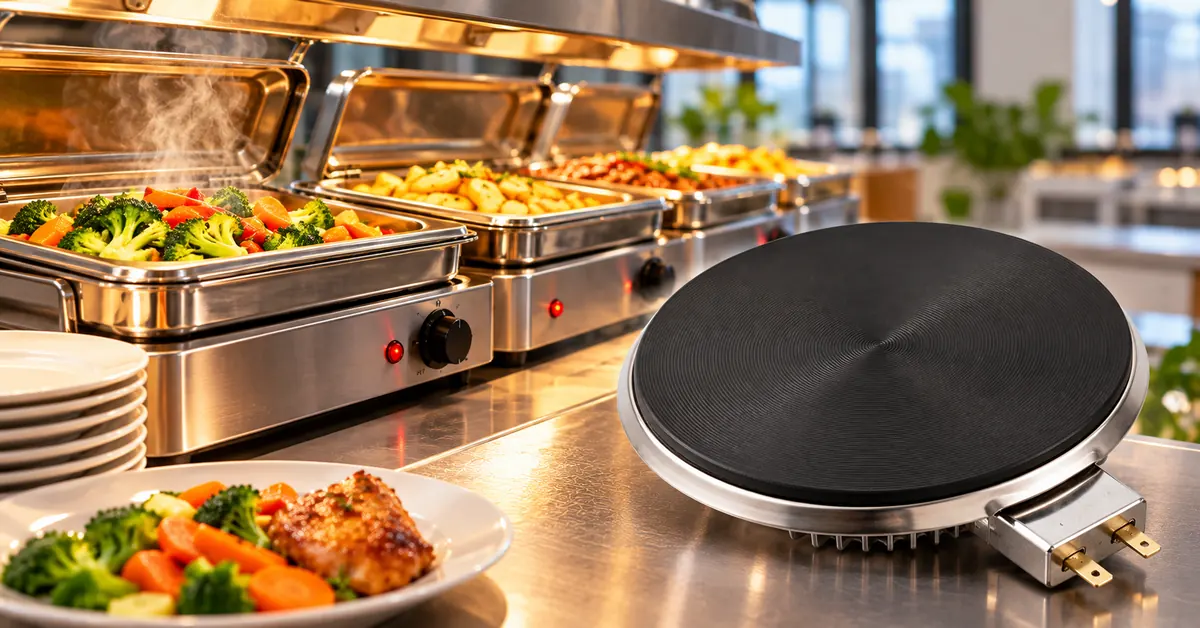
A solid hot plate may include a metal heating surface, internal resistance-heating structure, insulating materials, electrical terminals, and supporting components.
The exact materials and manufacturing methods must be confirmed for each model.
Heating surface construction
The surface should remain suitable under the intended cookware loads and heating cycles.
Relevant considerations include material properties, surface condition, dimensional stability, and the applicable operating environment.
Electrical insulation
The insulation system must support the component's electrical requirements under specified conditions.
Insulation performance should be assessed using appropriate tests.
Terminal reliability
Terminals combine electrical and mechanical functions.
Their location, construction, and connection method must be compatible with the finished appliance.
Incorrect terminal geometry can cause assembly problems even if the heating plate otherwise fits.
Surface treatment
Where surface treatments or coatings are used, the buyer should establish relevant acceptance criteria.
These may relate to appearance, durability, or environmental exposure.
Material change control
A proposed change to terminal materials, heating structures, insulation, or surface treatment can affect the approved design.
The buyer and manufacturer should agree on which changes require notification, testing, and formal approval.
Key purchasing principle: Manufacturing consistency depends on controlling the approved product construction—not merely reproducing its appearance.
How Can OEM Manufacturers Control Quality Across Production Batches?
The transition from prototype approval to bulk production introduces manufacturing variation.
A passing engineering sample does not automatically establish long-term process capability.
For OEM programs, quality control should connect product specifications with inspection methods, traceability, and corrective action.
Incoming inspection
Materials and purchased components should be checked against the relevant approved requirements.
In-process control
Critical dimensions and electrical characteristics may need monitoring during production.
The appropriate frequency depends on the characteristics and their risks.
First-article inspection
First-article inspection helps verify that an initial production-intent component conforms to the approved specification.
It can include dimensions, electrical characteristics, product identification, and other critical requirements.
Production inspection
The supplier and buyer should agree on final acceptance criteria.
Where statistical sampling is appropriate, the sampling plan should reflect the product's risk and contractual requirements.
Batch traceability
Traceability helps identify which product configuration and manufacturing information relate to a delivered batch.
It can support investigation if a defect is discovered.
Recommended production control matrix
| Production stage | Recommended control | Buyer value |
|---|---|---|
| Incoming materials | Verify specified inputs | Reduce material variation |
| Initial production | First-article inspection | Confirm production-intent conformity |
| In-process manufacturing | Monitor critical characteristics | Detect variation early |
| Final inspection | Verify approved requirements | Reduce shipment defects |
| Packaging | Confirm protection and identification | Prevent transport and inventory errors |
| Repeat orders | Maintain part number and revision | Protect compatibility |
| Nonconformance | Document investigation and disposition | Reduce recurring problems |
What certification evidence should buyers request?
WEBO's website refers to ISO 9001 and ISO 14001 management systems and several international product certification schemes.
However, general company statements should not be used as proof that every heating plate has the same certification scope.
Buyers should request documentation tied to the exact product and its intended destination market.
For many household and similar portable cooking appliances, IEC 60335-1 and the relevant parts of IEC 60335-2-9 provide important safety references.
The applicable editions, national requirements, and conformity responsibilities depend on the completed product.
The finished appliance manufacturer remains responsible for its applicable compliance assessment.
How Do Standard and Customized Hot Plates Compare in Total Cost?
Unit price is only one part of the purchasing decision.
An OEM project may also involve tooling, development, sample qualification, quality inspection, assembly labor, packaging, and transportation.
The correct comparison is therefore total project cost rather than quoted component price alone.
Standard components
When an existing component meets the appliance's technical requirements, it may avoid some development and tooling expenses.
However, it must still be qualified for the intended product.
Modified standard components
A change in mounting, terminals, or electrical characteristics may improve compatibility.
The benefit should be weighed against additional engineering and qualification requirements.
Project-specific components
A custom configuration may be justified when the intended product cannot use an available standard component.
The buyer should confirm the feasibility, tooling requirements, development responsibilities, and production plan.
Total cost comparison
A practical sourcing model is:
Total procurement cost = component purchasing + tooling + validation + inspection + assembly losses + logistics + warranty-related costs
Consider a purely hypothetical comparison of two suppliers delivering 10,000 components.
| Cost assumption | Supplier A | Supplier B |
|---|---|---|
| Unit component price | $4.20 | $4.35 |
| Order quantity | 10,000 | 10,000 |
| Component purchase cost | $42,000 | $43,500 |
| Assumed assembly rejection rate | 2.0% | 0.5% |
| Expected rejected components | 200 | 50 |
| Assumed handling/rework cost per rejected component | $10 | $10 |
| Handling/rework cost | $2,000 | $500 |
| Combined illustrative cost | $44,000 | $44,000 |
These figures are hypothetical and do not represent WEBO prices, defect rates, or production performance.
They show that a lower unit price can be offset by higher manufacturing losses.
Actual sourcing decisions should also consider replacement materials, line interruptions, quality investigations, and any additional qualification expenses.
When is customization worth the additional cost?
Customization is easier to justify when it eliminates a documented problem, such as repeated assembly interference or an incompatible electrical interface.
Before approving tooling or design changes, buyers should estimate the expected benefit over the anticipated purchasing volume.
A custom component should create measurable value, not simply offer a different specification.
How Should OEM Buyers Approve a Supplier in Three Steps?
A structured approval process helps engineering, quality, and procurement teams work from the same information.
Step 1: Confirm technical compatibility
Action: Review the appliance design, component drawings, electrical requirements, and intended operating conditions.
Decision rule: Do not proceed if the component has unresolved mechanical, electrical, or thermal incompatibility.
The outcome should be an agreed preliminary specification for sample evaluation.
Step 2: Validate production-intent samples
Action: Inspect samples against the approved specification and test them within a representative finished appliance.
Decision rule: Advance only when mandatory test results meet the defined acceptance criteria.
A physical sample should be linked to the appropriate drawing and revision.
Where design changes are required, the updated configuration should be reassessed.
Step 3: Establish production and supply controls
Action: Agree on manufacturing specifications, inspection procedures, packaging, traceability, commercial terms, and change-management responsibilities.
Decision rule: Authorize bulk production only after the necessary technical and commercial approvals are complete.
This process provides a clear path from initial RFQ to repeat purchasing.
What Documents Should Be Approved Before an OEM Hot Plate Order?
A practical technical approval package contains eight core documents.
| Required document | Main purpose | Procurement benefit |
|---|---|---|
| Application brief | Define intended appliance requirements | Prevent incorrect product selection |
| Controlled engineering drawing | Specify geometry and tolerances | Protect assembly compatibility |
| Electrical specification | Define voltage, power, and relevant electrical characteristics | Avoid rating mismatches |
| Material and construction specification | Establish approved component design | Control product changes |
| Sample approval record | Identify accepted samples | Create an approval reference |
| Qualification report | Record required test evidence | Support engineering decisions |
| Production quality plan | Define inspection and traceability | Improve batch consistency |
| Supply and change-control agreement | Govern commercial and technical revisions | Protect repeat orders |
These documents represent a recommended OEM approval framework.
The exact documents and responsibilities should be agreed between the customer and supplier for each project.
A complete approval package helps prevent purchasing, engineering, and production teams from working from different assumptions.
Engineering Scenario: Preventing a 145mm Hot Plate Assembly Problem
The following scenario demonstrates how an appliance manufacturer can apply the evaluation framework.
This is an illustrative engineering example, not a documented WEBO customer project.
The engineering challenge
An electric cooker manufacturer is developing a product with a nominal 145mm heating zone.
The purchasing team identifies a candidate solid hot plate with the appropriate nominal diameter.
However, during design review, the team discovers that the available component information does not fully describe the underside mounting geometry and terminal position.
Approving the part based only on nominal diameter could create problems during assembly.
Engineering assessment
The project team takes three actions.
1. Establish controlled dimensions
The engineer requests the complete component envelope, mounting dimensions, and terminal locations.
These are compared with the appliance housing drawing.
2. Verify electrical characteristics
The team confirms the intended voltage, wattage, resistance characteristics, and connection arrangement.
The proposed component must remain compatible with the cooker controls and electrical design.
3. Conduct assembly and thermal trials
Representative samples are installed into the intended housing.
The engineers evaluate mounting, wiring access, cookware stability, heating behavior, and relevant enclosure temperatures.
Production decision
If the component meets the defined criteria, it can advance toward pilot production and commercial approval.
If it fails, the team must decide whether to modify the appliance, investigate a feasible component change, or select another heating technology.
What should the buyer measure?
| Project objective | Suggested measurement |
|---|---|
| Reliable installation | Assembly success against approved geometry |
| Electrical compatibility | Ratings and test results |
| Heating performance | Controlled cooking or thermal tests |
| Repeatability | Results from representative production-intent parts |
| Production efficiency | Assembly time and rework records |
| Supply consistency | Approved revisions and batch inspection results |
The value of this approach is that technical compatibility is established before the buyer commits to large purchase quantities.
It can also help buyers distinguish necessary customization from changes that add cost without improving performance.
Why Consider WEBO for an Electric Hot Plate OEM Project?
WEBO's manufacturing background and electric heating component portfolio make it a relevant company for buyers seeking solid hot plates and related appliance components.
The company's published advantages include its establishment in 1998, international customer markets, heating element product range, and stated quality-management systems.
For a real OEM project, these company characteristics provide useful context, but the purchasing decision should still rely on model-specific technical evidence.
Areas for technical discussion
Potential inquiries may include:
-
Available 90mm, 110mm, and 145mm hot plate models
-
Rated electrical specifications
-
Mechanical drawings and mounting compatibility
-
Engineering samples
-
Feasible OEM modifications
-
Relevant quality and certification documents
-
Packaging and product identification
-
Bulk quotation and repeat-order arrangements
The exact availability and commercial conditions should be confirmed for each project.
Learn more about WEBO's manufacturing background or explore the broader WEBO Appliance Component Catalog.
What Should Buyers Include in an OEM RFQ?
To obtain a meaningful technical and commercial response, prepare the following information:
| RFQ field | Buyer information |
|---|---|
| Company and destination market | Company name, country, target markets |
| Finished appliance | Electric cooker, stove, or replacement application |
| Candidate model | HP-F90, HP-F110, HP-F145, or requested configuration |
| Mechanical requirements | Diameter, mounting, overall dimensions |
| Electrical requirements | Voltage, power, terminals |
| Operating conditions | Duty cycle and cookware application |
| Quality requirements | Tests, inspection, documentation |
| Project stage | Prototype, pilot, or mass production |
| Customization | Required modifications |
| Quantity | Sample requirements and annual forecast |
| Packaging | Labeling, cartons, handling |
| Commercial request | Price, MOQ, tooling, and delivery terms |
A detailed RFQ allows the manufacturer to evaluate compatibility more effectively than a general request for the lowest possible price.
Developing an electric cooker or qualifying an alternative heating component supplier?
Share your technical drawing, electrical specifications, projected order quantity, and target market with WEBO to begin a project-specific feasibility discussion.
View WEBO Electric Hot Plate Products
Contact WEBO for OEM Technical Review and Quotation
Frequently Asked Questions
1. What does an electric hot plate OEM manufacturer produce?
An electric hot plate OEM manufacturer produces heating plate components according to agreed technical requirements.
These may include dimensions, rated voltage, wattage, terminal arrangements, mounting structures, and identification requirements.
The manufacturer and buyer should establish approved specifications before mass production.
2. What hot plate sizes are available from WEBO?
WEBO publishes nominal 90mm, 110mm, and 145mm hot plate categories.
Its product references include HP-F90, HP-F110, and HP-F145.
Buyers should obtain the current technical specifications before determining suitability.
3. Can an electric hot plate be customized for OEM appliance production?
Customization may be possible depending on technical feasibility.
Potential requirements include mechanical dimensions, electrical characteristics, terminal arrangements, and packaging.
Some modifications may require additional development, tooling, and qualification.
The available scope should be confirmed with WEBO.
4. How can buyers verify hot plate mounting tolerances?
Buyers should obtain a controlled drawing identifying critical dimensions and datums.
They should then evaluate the combined variation of the component and appliance housing.
Representative assembly trials are needed before approval.
Where appropriate, production measurement data can support the evaluation.
5. Does identical wattage mean two hot plates are interchangeable?
No.
Two heating plates with the same nominal wattage may differ in resistance behavior, surface construction, dimensions, terminal arrangements, and thermal response.
The complete electrical and mechanical interface must be checked.
Interchangeability should be established through verified specifications and application testing.
6. What is the difference between an engineering sample and a production-intent sample?
An engineering sample helps evaluate whether a proposed design may meet the requirements.
A production-intent sample represents the approved configuration manufactured using the intended production process.
Both can support qualification, but production approval also requires appropriate quality and process controls.
7. What quality documents should OEM buyers request?
Useful documents may include controlled drawings, electrical specifications, applicable material information, sample approval records, test reports, inspection criteria, and product identification requirements.
The exact package depends on the application and contract.
8. How can buyers evaluate the true cost of an OEM hot plate?
Calculate more than the quoted unit price.
Include tooling, technical validation, inspection, logistics, assembly losses, and relevant warranty-related costs.
Compare suppliers using the same approved component specification.
9. Do WEBO hot plates have international product certifications?
WEBO's website references various management systems and product certification schemes.
However, buyers must verify which documents apply to the exact heating plate model and intended market.
General company statements do not establish certification for every component or completed appliance.
10. How can I request a bulk OEM electric hot plate quotation?
Prepare the intended application, required dimensions, voltage, wattage, drawings, destination market, sample quantity, and purchasing forecast.
Include any required customization or technical documentation.
Submit this information through the WEBO Contact Page for project-specific discussion.
Conclusion
Choosing an electric hot plate OEM manufacturer requires an engineering-driven sourcing process that connects technical specifications, dimensional compatibility, electrical performance, manufacturing quality, and commercial planning.
A nominally compatible heating plate may still create assembly or operating problems if mounting tolerances, terminal positions, and electrical characteristics are not properly controlled.
For appliance manufacturers, the most reliable approach is to define critical product requirements, approve controlled drawings, test representative components, and establish clear production quality requirements before bulk purchasing.
A complete OEM approval package also reduces uncertainty during repeat orders by defining the accepted configuration and the conditions for engineering changes.
WEBO, established in 1998, manufactures electric heating elements and related appliance components. Its published hot plate range includes HP-F90, HP-F110, and HP-F145, providing product references for initial OEM evaluation.
Actual model suitability, customization feasibility, certification documentation, production arrangements, and commercial terms must be confirmed for each project.
For buyers seeking consistent manufacturing quality and reduced sourcing risk, technical compatibility should always be established before selecting a supplier on price.
Planning an electric cooker project, developing a custom heating plate, or evaluating an alternative OEM supplier?
Share your component drawing, electrical specifications, assembly requirements, destination market, and forecast quantity with WEBO for a technical and commercial review.
Explore WEBO Electric Hot Plate Products or Request an OEM Manufacturing Quotation to begin your next sourcing project.