


What Should You Actually Check in an Induction Coil Factory?
A polished sample tells you that a factory can make one acceptable induction coil.
It does not tell you whether the 5,000th coil will still match it.
That distinction matters to appliance manufacturers. Once an induction cooktop enters mass production, an uncontrolled change in winding construction, ferrite arrangement, connector, sensor, or electrical parameter can become a line-stop issue rather than a small component problem.
For that reason, an induction coil factory should be evaluated around three questions:
- Can the factory make the required coil?
- Can it measure the characteristics that matter?
- Can it keep those characteristics stable from one production lot to the next?
The third question is often the most important.
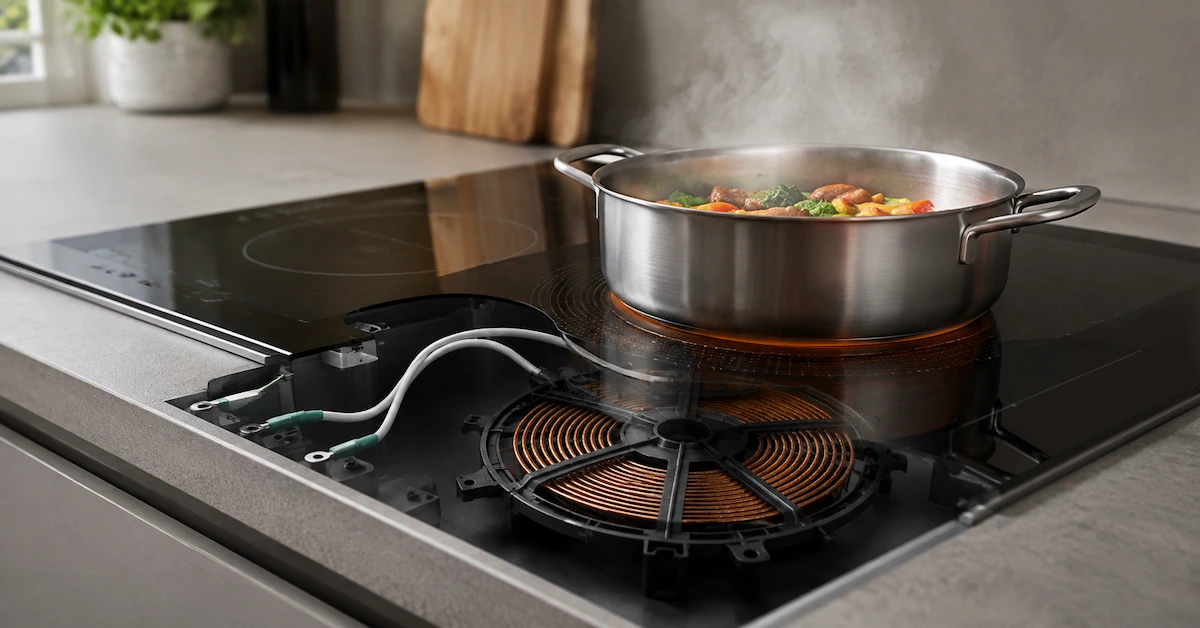
Induction cooking does not use the coil as an isolated heater. STMicroelectronics describes an induction cooking element as part of an L-C resonant system, with power controlled through the alternating current flowing through the cooking element.
That is why appearance alone is a poor basis for factory approval.
Who Usually Needs to Audit an Induction Coil Factory?
A direct factory review makes the most sense when the project involves recurring production rather than occasional replacement parts.
Typical buyers include:
- Induction cooktop manufacturers
- Built-in hob brands
- Portable cooker manufacturers
- Commercial induction equipment companies
- Kitchen appliance OEM/ODM businesses
- Component importers
- Appliance parts distributors
- Sourcing offices
- Quality engineers
- Procurement managers
The questions also change according to the buyer.
A purchasing manager may ask about MOQ and lead time.
An engineer may care more about inductance, winding geometry and ferrite configuration.
A quality engineer will usually ask a different question:
What stops production from drifting away from the approved sample?
A good factory visit should answer all three.
Start the Factory Audit With the Approved Specification
Walking through production without knowing what needs to be controlled is not very useful.
Before an audit, prepare a one-page specification summary.
| Control Item | What Buyer Should Define |
|---|---|
| Application | Induction hob,cooker or commercial unit |
| Coil outer diameter | Drawing requirement |
| Coil inner diameter | If applicable |
| Inductance | Nominal value and tolerance |
| Resistance | Requirement if controlled |
| Winding | Approved conductor specification |
| Turn count | If design-controlled |
| Ferrite | Quantity,shape and arrangement |
| Overall height | Installation limit |
| Lead wires | Length and routing |
| Connector | Exact model/interface |
| Sensor | Type and value if included |
| Mounting | Hole, bracket or carrier layout |
| Drawing revision | Current approved revision |
| Packaging | Required protection method |
If the supplier cannot connect its manufacturing controls back to these requirements, the audit has already uncovered a weakness.
Follow the Material From Incoming Inspection to Finished Coil
One useful factory-audit method is simple: follow one component through the plant.
Start with incoming material. Then trace what happens until the finished induction coil is packed.
This exposes gaps that brochures usually hide.
Winding Conductor
The coil winding is not something buyers should approve based on a vague description such as “high-quality copper.”
Ask the factory to identify the controlled winding specification.
Depending on the design, that can include:
- Conductor material
- Strand construction
- Overall conductor size
- Insulation
- Supplier or approved material code
- Incoming identification
- Lot traceability
For high-frequency induction applications, conductor construction matters because AC behavior is different from ordinary low-frequency wiring.
The audit question is therefore not simply:
“Is this copper?”
It is:
“How do you make sure the winding material used next month is the same specification that we approved today?”
That answer is much more valuable.
Look Closely at the Winding Process
Two coils can share the same outside diameter and still behave differently.
Turn count, winding geometry, spacing and conductor placement all influence the finished component.
During a factory assessment, ask how the winding process controls:
- Number of turns
- Coil diameter
- Winding position
- Coil thickness
- Lead exit position
- Winding fixation
- Operator or machine setup
- First-piece approval
Do not assume automation automatically means consistency.
A machine running the wrong program will repeat the wrong result very efficiently.
Ask how the factory verifies setup after:
- Product changeover
- Tool adjustment
- Maintenance
- Material change
- New production lot
That question separates process control from equipment marketing.
Ferrite Is Not a Minor Accessory
The ferrite arrangement deserves its own audit point.
Infineon describes flat pancake coils as common in induction cookers and notes that ferrite bars are typically used to improve magnetic-field confinement and alignment.
That gives procurement teams a practical reason to control ferrite rather than treating it as a visually similar black component.
Check:
- Ferrite quantity
- Ferrite dimensions
- Position
- Orientation
- Material specification where defined
- Broken or chipped pieces
- Fixing method
- Adhesive condition if adhesive is used
A seemingly small layout change may alter the magnetic behavior of the assembly.
For an OEM appliance program, ferrite arrangement should therefore be part of the controlled product definition.
Ask to See How Electrical Parameters Are Tested
This is one of the most important parts of an induction coil factory audit.
A finished coil can look correct and still be electrically outside the approved specification.
Inductance
If inductance is a controlled characteristic, the factory should be able to explain:
- Target value
- Tolerance
- Test equipment
- Measurement condition
- Sampling frequency or test frequency
- Record method
- Reaction to an out-of-spec result
Do not stop after seeing an LCR meter on a table.
Ask an operator:
“What happens if this reading fails?”
You learn much more from the answer.
Resistance and Continuity
Depending on the design, resistance and continuity checks can help detect:
- Incorrect conductor
- Connection faults
- Termination problems
- Process abnormalities
Again, the value of the test depends on whether acceptance criteria are documented.
Insulation-Related Tests
Where required by the approved design or appliance safety plan, the factory may also need to perform appropriate insulation or dielectric checks.
The important point is not to demand a generic test voltage copied from another product.
The test condition should come from the relevant engineering specification.
A Factory Should Control More Than the Coil Winding
OEM induction coil assemblies may also include:
- Lead wires
- Connector
- Temperature sensor
- Supporting structure
- Ferrite
- Fasteners
- Insulation components
Each introduces another possible mismatch.
For example, a correct coil with the wrong connector is still unusable on your production line.
Your factory audit should therefore verify whether component identification prevents mix-ups between similar models.
That becomes especially important when one factory produces several coils with nearly identical diameters.
Sample Approval Is Only the Beginning
Many sourcing problems start with a sentence like this:
“But the sample was good.”
That can be completely true.
The sample can be good while mass production is unstable.
The reason is straightforward: prototype production often receives extra attention. Regular production has to survive normal operators, normal material lots, changeovers, higher output and delivery pressure.
Before moving from sample approval to bulk production, confirm what will be frozen.
A sensible production baseline includes:
- Approved drawing
- Drawing revision
- Inductance requirement
- Winding specification
- Ferrite arrangement
- Connector
- Sensor
- Critical dimensions
- Reference sample where appropriate
- Inspection standard
If those items live only in email conversations, the project is harder to control.
Ask One Important Question About Change Control
Here is a useful factory-audit question:
“Which changes would you make without asking us?”
Listen carefully.
Changes to the following may require buyer review depending on the product:
- Winding conductor
- Conductor supplier or specification
- Turn count
- Winding configuration
- Ferrite material
- Ferrite arrangement
- Sensor
- Connector
- Carrier structure
- Critical dimensions
- Manufacturing process
Not every change requires a complete requalification.
But the supplier and buyer should agree in advance on which changes require notification, samples or revalidation.
That single discussion can prevent months of later argument.
Factory Audit Checklist for an Induction Coil Buyer
Use this during an onsite or remote assessment.
| Factory Area | What to Verify | Red Flag |
|---|---|---|
| Incoming materials | Material ID and inspection | Similar materials stored without control |
| Winding | Turns, geometry,setup control | Process depends only on operator memory |
| Ferrite assembly | Layout and fixing | No controlled reference |
| Leads/connectors | Correct part identification | Mixed connectors on line |
| Electrical QC | Inductance/resistance criteria | Equipment exists but no limits |
| Dimension QC | Drawing-linked inspection | Checking dimensions not on drawing |
| First-piece check | Approval after setup/changeover | Production starts without verification |
| Final inspection | Defined acceptance criteria | Pure visual judgment |
| Traceability | Lot/batch identification | Finished goods cannot be traced |
| Change control | Buyer notification process | Material substitutions made freely |
| Packaging | Coil/ferrite/lead protection | Parts move or rub in transit |
| Records | Inspection and revision records | No retrievable production history |
This table is more useful than asking whether the factory has “strict QC.”
Almost every factory will say yes.
The audit should show what “strict” actually means.
How Should an Induction Coil Factory Handle Nonconforming Parts?
Finding a defect is not proof of a bad factory.
Failing to control it can be.
Ask how nonconforming material is:
- Identified
- Separated
- Recorded
- Reviewed
- Reworked or scrapped
- Prevented from returning to normal stock
Then ask a second question:
Does a repeated failure trigger process investigation?
If ten coils fail the same inductance check, simply removing those ten pieces is not enough.
The factory should determine whether the problem came from:
- Wrong material
- Incorrect winding setup
- Turn-count error
- Process drift
- Measuring method
- Operator mistake
- Fixture or equipment issue
For repeat OEM orders, corrective action matters more than cosmetic inspection reports.
Do a Short Production Trial Before the Large Order
For a new induction cooker program, moving directly from several engineering samples to a large purchase order can create unnecessary risk.
A pilot lot gives both sides more information.
It can reveal:
- Production repeatability
- Assembly fit
- Electrical distribution
- Packaging problems
- Connector mistakes
- Labeling issues
- Inspection bottlenecks
More importantly, the buyer can test units selected from a real production batch rather than carefully prepared engineering samples.
That makes pilot production an important bridge between R&D approval and commercial supply.
How Should Buyers Evaluate Production Capacity?
Factory size is useful context, but it is not the same as available capacity for your project.
Ask for project-specific information.
Questions Worth Asking
- What is the normal output for this coil family?
- What is available capacity during our planned season?
- Which process is the bottleneck?
- How long does material preparation take?
- What is prototype lead time?
- What is pilot-order lead time?
- What is mass-production lead time?
- How is urgent demand handled?
- How much forecast visibility is preferred?
A factory with large total output can still have a long lead time if the relevant winding line is fully booked.
Likewise, a smaller production cell may be perfectly suitable for a stable OEM program.
Capacity should be evaluated against your demand profile, not a single impressive factory-wide number.
What WEBO's Published Factory Information Tells Buyers
WEBO states that GUANGDONG WEBO TECHNOLOGY CO., LTD was established in 1998 in Yangjiang, Guangdong. Its website reports approximately 50,000 m² of plant area, more than 500 workers, and customers across Europe, Asia, Africa and America.
The company lists induction coils together with hot plates, ceramic heaters, tube heating elements, cast iron pan supports, ceramic glass, rotary switches and energy regulators.
Buyers evaluating this product family can review the existing WEBO Induction Coil and the broader Induction Coil product category before sending drawings or samples.
One point deserves care: WEBO's public site provides overall company scale, but it does not publish a universal monthly output or one fixed lead time for every induction coil model.Those numbers should therefore be confirmed for the actual specification and order volume rather than inferred from total factory size.
How Should Buyers Review Factory Certifications?
WEBO states that it implements ISO 9001 and ISO 14001 and lists VDE, TUV, UL, CE and RoHS certifications within its broader product portfolio.
For a specific OEM induction coil, procurement teams should still verify:
- Exact certificate
- Covered model
- Scope
- Voltage or rating where applicable
- Current validity
- Destination-market requirement
- Whether customization changes applicability
- Whether the complete cooktop requires separate certification
This is important because a factory's certificate wall and an individual customized product are not the same thing.
Ask for the document that applies to your project.
Standard Coil, Modified Platform or New OEM Design?
Not every order should start from zero.
| Project Route | Suitable When | Buyer Input | Main Risk |
|---|---|---|---|
| Existing coil | Appliance can accept current design | Required compatibility data | System mismatch |
| Modified platform | Existing coil is close | Drawing + changed parameters | Uncontrolled revision |
| New OEM design | Proprietary platform | Full technical package | Development time |
| Sample-based replacement | Legacy component exists | Sample + key specifications | Hidden original parameters |
A direct induction coil factory should be able to tell the buyer when customization adds value and when it merely adds cost.
That is a useful sign of technical maturity.
What Can Be Customized for an OEM Project?
Depending on technical feasibility, an OEM discussion may cover:
- Coil diameter
- Inner opening
- Winding geometry
- Turn count
- Electrical target
- Ferrite configuration
- Lead-wire length
- Connector
- Sensor
- Mounting points
- Supporting structure
The buyer should avoid changing several variables at once without retesting the finished appliance.
Infineon's induction-cooking material explains that heating behavior depends on the interaction among magnetic field, coil, cookware and coupling conditions rather than on the coil alone.
That is why the final validation belongs in the actual appliance platform.
What Does an Induction Coil Really Cost?
The answer is rarely contained in copper weight alone.
Quotation differences may come from:
- Winding conductor
- Copper usage
- Coil diameter
- Turn count
- Ferrite quantity
- Ferrite specification
- Connector
- Sensor
- Supporting parts
- Assembly labor
- Electrical inspection
- Fixtures
- Packaging
- Order quantity
A cheaper quote may simply exclude controls that another quote includes.
Before comparing two factories, place their quotations against the same technical specification.
Otherwise, it is not a price comparison.
It is a product comparison disguised as a price comparison.
The Costs That Do Not Appear on the Quotation
Component buyers often spend more money fixing procurement mistakes than they save during negotiation.
Hidden costs can include:
- Extra sample rounds
- Engineering time
- Production-line stoppage
- Sorting
- Rework
- Air freight
- Replacement shipments
- Customer complaints
- Certification retesting
- Delayed product launch
For a long-running appliance program, a slightly lower component price has limited value if the factory cannot hold the approved specification.
Consistency is part of cost.
Factory, Manufacturer or Supplier: Which Article Should a Buyer Read?
These three searches look similar, but they represent different stages of evaluation.
If your main concern is engineering development and product design, see the Induction Coil Manufacturer Guide.
If your main concern is commercial supply, lead time and repeat purchasing, see the Induction Coil Supplier Guide.
If you are preparing for factory qualification, pilot production or a larger OEM order, the factory-audit process in this article should be the priority.
Keeping these decisions separate helps purchasing teams avoid evaluating every potential partner with the same checklist.
What Should You Send the Factory Before Asking for a Quote?
A useful RFQ should allow the factory to identify technical and commercial risks early.
Technical Package
Send what you already have:
- Appliance type
- 2D drawing
- 3D data where relevant
- Current coil sample
- Coil dimensions
- Inductance target and tolerance
- Resistance requirement if defined
- Winding specification
- Ferrite arrangement
- Sensor specification
- Lead length
- Connector
- Mounting points
- Appliance platform information
Do not invent a missing specification.
Mark it as an open item and ask for technical review.
Commercial Package
Also include:
- Sample quantity
- Pilot quantity
- First mass-production order
- Estimated annual demand
- Destination market
- Project timing
- Packaging requirement
A clear RFQ allows the factory to give a meaningful response instead of an attractive but incomplete price.
Buyers can send drawings, samples and projected quantities through WEBO Contact for project evaluation.
FAQ
1.What should I check when visiting an induction coil factory?
Check material identification, winding controls, ferrite assembly, electrical testing, dimensional inspection, traceability, first-piece approval, nonconforming-product control, change management and packaging.
2. How can I tell whether a factory can maintain coil quality in mass production?
Do not judge from a prototype alone. Review the approved specification, process controls, inspection records, pilot production, traceability and how the factory handles material or process changes.
3. Which electrical parameter should buyers pay particular attention to?
Inductance is often an important controlled parameter for an induction cooking coil because the coil operates within a resonant system. The exact requirements and measurement conditions should come from the approved appliance design.
4. Is coil diameter enough for factory production?
No. Two coils with similar diameter may differ in winding construction, turns, inductance, ferrite layout, resistance, connector and other characteristics.
5.Why should ferrite be checked during a factory audit?
Ferrite is used in induction cooking coil assemblies to help confine and align the magnetic field. Its material, quantity and arrangement can therefore be relevant to product performance.
6. Should buyers run a pilot order before bulk production?
For a new or customized project, a pilot lot is highly useful because it tests normal production repeatability rather than only prototype capability.
7. Can an induction coil factory customize my existing design?
Customization may cover dimensions, winding, electrical parameters, ferrite layout, leads, connectors, sensors and mounting features when technically feasible. The revised design should be validated in the intended appliance.
8. How should I compare two induction coil factory quotations?
First normalize the technical scope. Check whether both quotations use the same winding specification, ferrite, connector, sensor, testing, packaging and quality requirements. Only then compare price.
9.What information is needed for an induction coil factory quote?
Provide the application, drawing or sample, dimensions, electrical targets, ferrite requirements, leads/connectors, order quantity, destination market and project schedule.
10. How can I discuss an OEM induction coil project with WEBO?
Review the WEBO Induction Coil, then send your existing sample, drawings, electrical requirements, annual forecast and delivery plan through the WEBO contact page.
Conclusion
An induction coil factory should not be approved because the workshop looks busy or because the first sample works.
For an OEM buyer, the stronger evidence is more practical:
Can the factory identify the approved material? Can it control winding and ferrite placement? Can it measure the required electrical parameters? Can it trace a production lot? And if something changes, will the buyer know before thousands of units are produced?
Those questions turn a factory visit into a real sourcing decision.
A sensible path is:
Specification review → factory audit → engineering sample → appliance validation → pilot production → specification freeze → controlled mass production.
WEBO manufactures heating and appliance components and lists induction coils among its core product families. Buyers preparing a new induction cooktop program or evaluating an alternative production source can review the WEBO Induction Coil and submit their drawings, samples, specifications and expected order volume for technical and commercial review.