



What Buyers Really Need From a Rotary Switch Custom Manufacturer
Choosing a rotary switch custom manufacturer is not simply a matter of finding a switch that looks similar to an existing component. For appliance OEMs, product engineers, sourcing teams, and private-label brands, the real challenge is ensuring that the switch matches the electrical function, mechanical interface, installation space, user-control design, production requirements, and long-term supply expectations of the final appliance.
A rotary switch may be small, but it can sit at a critical point between the user interface and the appliance circuit. Differences in position sequence, shaft geometry, terminal direction, mounting structure, operating torque, or electrical configuration can create assembly problems even when two switches appear almost identical from the outside.
For that reason, the best custom rotary switch project starts with the appliance requirement rather than the switch catalog.
The practical sourcing question is not:
“Can you make this switch?”
It is:
“Can you manufacture a switch that performs the required electrical function, fits the appliance mechanically, can be validated before production, and remains consistent across future orders?”
Buyers evaluating a new appliance project can review WEBO's current product range to understand how rotary switches fit within a broader portfolio of heating and cooktop components.
What Is a Custom Rotary Switch?
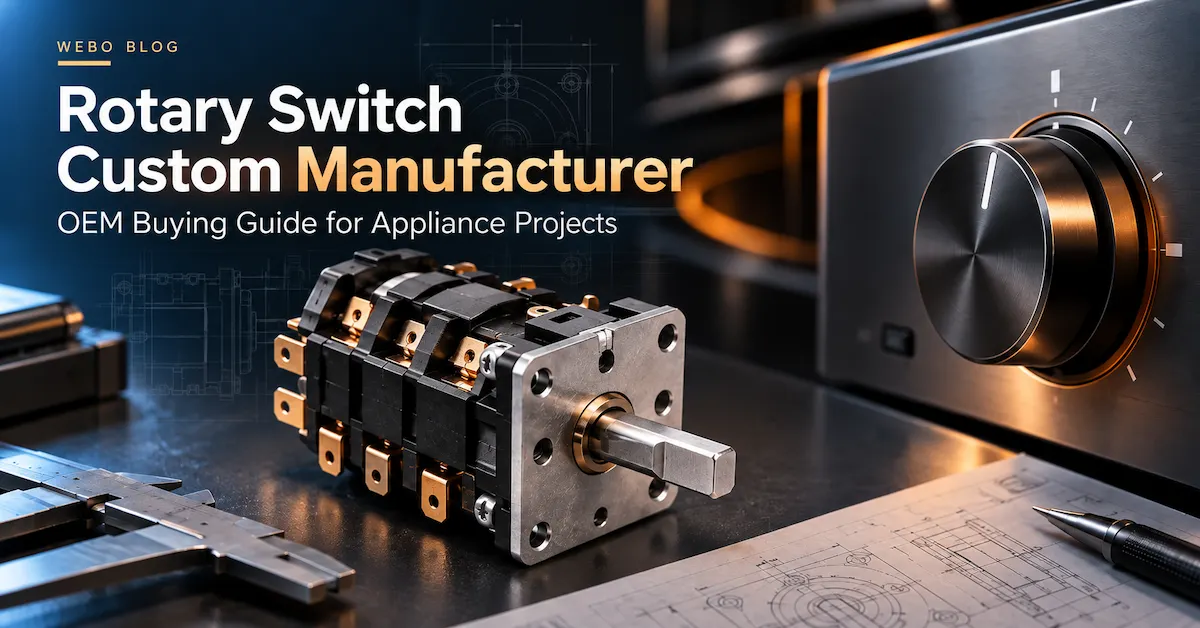
A custom rotary switch is an electromechanical switching component whose electrical or mechanical characteristics are selected or modified to fit a specific product application.
Customization may involve relatively simple changes, such as adjusting a shaft length, or more complex requirements involving:
- switch positions;
- electrical contact sequence;
- terminal layout;
- shaft geometry;
- indexing angle;
- panel mounting;
- knob interface;
- operating feel;
- material requirements;
- packaging;
- inspection criteria;
- or application-specific testing.
Not every customized project requires a completely new switch architecture.
In many OEM applications, the lowest-risk approach is to start with an existing switch platform and modify only the parameters that affect compatibility. This can simplify sampling, reduce tooling exposure, and make future repeat production easier to control.
A professional custom rotary switch manufacturer should therefore help determine whether a project requires:
- an existing standard switch;
- a modified standard platform;
- or a more extensively customized solution.
That decision should be made before tooling, sample approval, or mass-production planning.
Who Typically Needs a Rotary Switch Custom Manufacturer?
Custom switch projects are most relevant to companies manufacturing repeat-production equipment rather than buyers looking for a single replacement component.
Typical buyers include:
- electric cooktop manufacturers;
- portable electric stove manufacturers;
- countertop appliance companies;
- oven manufacturers;
- heating appliance OEMs;
- kitchen appliance brands;
- commercial cooking equipment companies;
- appliance ODM manufacturers;
- importers developing proprietary product lines;
- engineering teams qualifying alternative components;
- and sourcing departments building second-source supply.
These buyers often need more than a compatible switch.
They need a repeatable manufacturing specification.
That specification must remain stable when:
- the product moves from sample to pilot production;
- production volume increases;
- another factory line is introduced;
- a repeat order is placed months later;
- tooling is maintained;
- an approved material needs review;
- or engineering changes are introduced.
This is why supplier selection should focus on specification control and manufacturing repeatability rather than unit price alone.
Why Rotary Switch Sourcing Is More Technical Than It Looks
A rotary switch often looks mechanically simple.
There is a shaft, housing, terminals, and several indexed positions.
The hidden complexity is inside the switching logic and the way the component interacts with the appliance.
Two switches with similar dimensions can have different:
- contact arrangements;
- terminal assignments;
- OFF positions;
- number of active positions;
- switching sequences;
- shaft orientation;
- shaft length;
- indexing angles;
- mounting interfaces;
- operating torque;
- or electrical behavior.
For an OEM project, those differences matter.
A switch can pass a visual inspection and still fail during appliance assembly.
It can fit into the panel while producing the wrong electrical state.
It can have the correct position count but place the OFF position at the wrong angle.
It can operate electrically while creating interference between its terminals and the wire harness.
It can fit the switch bracket but place the knob too far from the front panel.
The purpose of working with a rotary switch custom manufacturer is to identify those risks before they become production problems.
Start With Appliance Function Before Discussing Switch Dimensions
A good RFQ should begin with what the appliance needs the switch to do.
Before asking for dimensions or pricing, define the functional requirement.
Questions the Buyer Should Answer First
- What type of appliance will use the switch?
- What electrical function does each switch position perform?
- How many mechanical positions are needed?
- Is there a defined OFF position?
- Does each position activate one circuit or several circuits?
- Does the switch control a heating load directly?
- Is it acting as a selector for another control system?
- Does the switch need clockwise and counterclockwise stops?
- Is the front-panel marking already fixed?
- Is there an existing knob that must be retained?
These questions help separate true engineering requirements from assumptions.
Why This Matters for Cooktop and Heating Appliances
In a heating appliance, several knob-operated components may appear similar to the end user.
However, a circuit selector and a power-control device do not necessarily operate in the same way.
Buyers should therefore define the required electrical behavior rather than simply requesting “a rotary switch for a stove.”
The appliance circuit should determine the switch specification.
Electrical Configuration Should Be Defined Before Customization Begins
One of the most important parts of a rotary switch RFQ is the contact configuration.
A product photo is rarely enough to define it.
Provide a Switching Table Whenever Possible
A simple table can communicate the intended electrical function clearly.
| Position | Electrical State | Intended Function |
|---|---|---|
| 0 | Required contacts open | OFF |
| 1 | Circuit A active | Setting 1 |
| 2 | Defined circuit combination | Setting 2 |
| 3 | Defined high-output combination | Setting 3 |
The exact configuration will depend on the appliance.
The purpose of the table is not to prescribe a universal circuit. It is to prevent the supplier from guessing.
Provide the Circuit Diagram
If the appliance design is available, include the relevant circuit information.
This allows the manufacturer to review:
- terminal relationships;
- switching sequence;
- simultaneous contacts;
- OFF-state requirements;
- and whether the proposed platform can reproduce the intended behavior.
For OEM development, this is much safer than choosing a component from appearance alone.
Voltage, Current, and Load Type Need to Be Evaluated Together
Electrical ratings should never be reduced to one number.
A buyer should identify:
- nominal voltage;
- operating current;
- AC or DC conditions;
- type of connected load;
- expected operating environment;
- and relevant abnormal or startup conditions.
Different loads place different demands on switching contacts.
A heating load, motor circuit, lamp load, transformer, or electronic control circuit should not automatically be treated as equivalent.
The exact switch design must therefore be matched to the real electrical duty.
Do Not Copy Ratings From an Unverified Product Page
For WEBO's rotary switch category, specific current, voltage, endurance, terminal, and position data should be confirmed from the project datasheet or technical drawing rather than assumed from generic online information.
This is especially important for custom projects.
A valid OEM specification should define the requirements for the exact model being supplied.
Position Count Is Only One Part of the Selection Process
Buyers often begin with statements such as:
“We need a four-position rotary switch.”
That is not enough information.
The manufacturer also needs to understand:
- which position is OFF;
- whether all positions are electrically active;
- direction of rotation;
- angular spacing;
- stop position;
- and how the shaft orientation corresponds with the knob.
Why Indexing Angle Matters
Imagine that the industrial design team has already printed control markings around the knob.
If the final switch detent positions do not align with those markings, several downstream changes may become necessary.
The buyer may need to modify:
- knob tooling;
- front-panel graphics;
- control markings;
- shaft orientation;
- or the switch itself.
This is avoidable if the rotary positions are confirmed early.
Contact Sequence Can Affect Appliance Behavior
The electrical state at each stable position is important, but the transition between positions may also matter.
Depending on the circuit, the designer may need to define whether:
- one contact opens before another closes;
- two circuits overlap temporarily;
- or all relevant contacts remain isolated during a transition.
There is no universal answer.
The correct behavior depends on the appliance circuit.
This is why a professional custom manufacturer should ask for functional information rather than simply reproducing the external dimensions of an old switch.
Shaft Geometry Is a Critical OEM Interface
The shaft connects the internal control component with the visible user interface.
Small dimensional errors can become obvious once the appliance is assembled.
Shaft Specifications May Include
- total shaft length;
- usable shaft length;
- diameter;
- D-flat dimensions;
- flat orientation;
- spline geometry where applicable;
- threaded features;
- reference distance from mounting surface;
- and knob engagement depth.
What Happens If Shaft Dimensions Are Wrong?
If the shaft is too long, the knob may stand too far above the panel.
If it is too short, the knob may not engage fully.
If the flat orientation is wrong, the control indicator may point to the wrong function.
If diameter tolerance is poorly controlled, knob fit can vary between production batches.
These are small dimensional details with direct effects on perceived product quality.
Use the Knob as Part of Sample Validation
If the appliance already has a finished knob, the buyer should consider sending:
- the knob sample;
- knob drawing;
- or relevant CAD geometry
during technical review.
The manufacturer can then evaluate the switch-to-knob interface rather than relying only on nominal shaft dimensions.
Operating Torque Influences User Experience
The operating feel of a rotary switch deserves more attention than it usually receives.
A switch is one of the components the user repeatedly touches throughout the life of an appliance.
A poorly controlled switching feel can create the impression of a low-quality product even when the electrical function is correct.
Buyers Should Evaluate
- rotation smoothness;
- detent definition;
- torque consistency;
- stop position;
- shaft play;
- knob feel;
- and consistency between samples.
If torque is too low, positions may feel vague.
If torque is too high, the switch can feel difficult to operate and may increase stress on the knob.
For appliance brands, tactile consistency is part of product quality.
Terminal Layout Must Match the Real Assembly
Terminal selection should be reviewed together with the appliance harness and available installation space.
Important Terminal Parameters
- terminal type;
- width;
- thickness;
- orientation;
- spacing;
- connection method;
- harness direction;
- and clearance from nearby components.
A switch can be electrically suitable yet mechanically unusable if its terminals point toward:
- a housing wall;
- insulation;
- a bracket;
- a heating element;
- another electronic component;
- or the wrong direction for the wire harness.
Terminal Assignment Must Also Be Controlled
For multi-position switches, every terminal needs a clearly defined electrical role.
The final drawing or specification should make it possible for production and QC teams to verify that the switch corresponds with the approved configuration.
Panel Mounting Should Be Treated as Part of the Switch Specification
A custom switch is not fully defined until its mounting relationship with the appliance is understood.
Relevant questions include:
- What is the panel thickness?
- Is the switch mounted directly to the panel?
- Is a bracket used?
- Is a threaded bushing required?
- Is there an anti-rotation feature?
- What rear clearance is available?
- Are mounting holes already fixed?
- Does the switch need to align with another component?
A 2D installation drawing can prevent many misunderstandings.
For crowded appliances, a 3D layout can be even more useful.
Operating Environment Matters for Heating Appliance Applications
Rotary switches used near heating components may experience conditions that are very different from ordinary room-temperature electronics.
The manufacturer should understand the environment in which the component will operate.
Useful Environmental Information Includes
- expected surrounding temperature;
- distance from heating elements;
- enclosure ventilation;
- grease exposure;
- cooking vapor;
- humidity;
- installation orientation;
- and adjacent materials.
The component should ultimately be validated in the real appliance assembly.
A switch working correctly on an open test bench does not prove that it will behave identically once surrounded by hot components, insulation, wiring, and restricted airflow.
How Should Mechanical and Electrical Life Be Evaluated?
Statements such as “long service life” are not meaningful without test conditions.
Buyers should ask what the manufacturer means by endurance.
Mechanical Endurance
Mechanical endurance focuses on the physical operation of the switch mechanism.
This may include:
- rotation cycles;
- detent wear;
- shaft stability;
- mechanical stop integrity;
- and other physical changes.
Electrical Endurance
Electrical endurance evaluates performance while the component switches under defined electrical conditions.
A switch can remain mechanically operable while its electrical performance changes.
For that reason, OEM buyers should define endurance requirements according to the real appliance duty.
Ask for the Test Conditions
When reviewing a durability statement, ask:
- What load was used?
- What voltage?
- What cycle count?
- What switching frequency?
- At what temperature?
- What was the acceptance criterion?
- Was the test mechanical, electrical, or both?
This creates a much more useful engineering discussion than simply asking how many cycles a switch can achieve.
Standard Rotary Switch vs Modified Platform vs Fully Custom Design
Customization should solve a real engineering problem.
It should not be used simply because “custom” sounds more professional.
| Factor | Standard Product | Modified Existing Platform | More Extensive Custom Design |
|---|---|---|---|
| Development complexity | Low | Medium | Higher |
| Initial cost | Lower | Moderate | Higher |
| Speed | Faster | Moderate | Longer |
| Shaft flexibility | Limited | Often possible | High |
| Terminal flexibility | Limited | Often possible | High |
| Circuit flexibility | Limited | Moderate | High |
| Tooling requirement | Usually low | Depends on modification | May be significant |
| Validation effort | Lower | Moderate | Higher |
| OEM differentiation | Low | Medium | High |
| Best for common appliance designs | Strong | Strong | Sometimes unnecessary |
| Best for proprietary design | Limited | Strong | Strong |
For many buyers, modifying an existing platform is the best balance.
It may allow the manufacturer to preserve a proven internal structure while adapting the interfaces that matter to the appliance.
What Information Should Be Included in a Rotary Switch RFQ?
A good RFQ reduces quotation errors and unnecessary sample revisions.
Application Information
Provide:
- appliance type;
- end use;
- target market;
- installation environment;
- whether the project is new development or replacement.
Electrical Information
Provide:
- nominal voltage;
- current or load information;
- load type;
- switching diagram;
- contact-state table;
- number of electrical positions.
Mechanical Information
Provide:
- switch envelope;
- panel dimensions;
- shaft geometry;
- mounting method;
- knob drawing;
- terminal direction;
- surrounding clearance.
Project Information
Provide:
- sample quantity;
- pilot order;
- estimated annual requirement;
- launch schedule;
- packaging requirement;
- certification expectations.
Existing Sample Information
If you already have a switch, send the physical sample when possible.
However, do not assume the sample alone communicates every requirement.
A worn component may no longer reflect the original dimensions, and reverse engineering may not reveal the full appliance-level performance requirement.
How Should a Rotary Switch Custom Manufacturer Develop Samples?
Sampling is not simply a step between quotation and mass production.
It is the point where the project specification becomes physical.
Requirement Review
The first stage should confirm whether enough information is available to proceed.
Important inputs may include:
- circuit;
- dimensions;
- application;
- existing sample;
- shaft;
- terminals;
- mounting;
- load;
- target quantity.
Missing information should be identified before sample production.
Technical Proposal
The manufacturer should determine whether the project can use:
- an existing model;
- an existing platform with modifications;
- or a more customized solution.
The buyer should understand this decision because it affects:
- cost;
- sample time;
- tooling;
- future revisions;
- and repeat-order risk.
Drawing Confirmation
Before sampling, the controlled characteristics should be documented.
The drawing does not need to contain unnecessary information, but it should clearly define the interfaces that affect function and assembly.
Sample Production
The sample should be sufficiently representative of the intended production design.
If prototype methods differ from eventual mass-production methods, the manufacturer should explain the difference.
Supplier-Side Checks
Before the sample is shipped, agreed control items should be reviewed.
Depending on the project, these may include:
- dimensions;
- terminal arrangement;
- contact state;
- switching sequence;
- shaft geometry;
- torque;
- appearance;
- mounting;
- and specified electrical checks.
Appliance-Level Validation
The buyer should install the sample in the real appliance.
This is where integration problems become visible.
Check:
- front-panel alignment;
- knob fit;
- wire routing;
- rear clearance;
- nearby components;
- electrical function;
- operating feel;
- temperature behavior.
This step should not be skipped for a high-volume OEM program.
Why a Golden Sample Matters
Once a switch is approved, the buyer and manufacturer should maintain a controlled reference.
A golden sample helps answer a basic question during future production:
“What exactly was approved?”
The golden sample should correspond with:
- the approved drawing;
- correct revision;
- approved electrical function;
- mechanical interfaces;
- materials or controlled specifications;
- and agreed appearance.
It is especially useful when:
- a repeat order is placed months later;
- production is transferred;
- a supplier reports a process change;
- or a quality dispute occurs.
Why Engineering Change Control Matters
A component is not truly controlled if changes can occur without review.
For repeat OEM production, buyers should ask the manufacturer how engineering changes are managed.
Changes That May Need Review
- material substitutions;
- contact component changes;
- shaft revision;
- terminal changes;
- housing modifications;
- supplier changes;
- tooling changes;
- process changes;
- or specification updates.
Not every change will affect performance.
But the buyer should know which changes require notification and approval.
A good change-control process reduces the risk of receiving a technically different product under the same part number.
Quality Control Should Focus on Critical Characteristics
A generic claim such as “strict quality control” is not enough.
The buyer should understand what is actually controlled.
Incoming Material and Component Control
Depending on the switch construction, this can involve components such as:
- molded insulating parts;
- contact materials;
- terminals;
- springs;
- shafts;
- mounting hardware.
Dimensional Inspection
Critical dimensions may include:
- shaft length;
- shaft diameter;
- mounting interface;
- terminal spacing;
- housing envelope;
- panel reference dimensions.
Functional Inspection
The switch should produce the correct contact state at every position.
For a multi-circuit switch, this is especially important.
Mechanical Inspection
Relevant checks can include:
- rotational movement;
- detent definition;
- stop position;
- shaft security;
- terminal retention;
- operating torque.
Electrical Inspection
The exact electrical inspection program depends on the project.
Potential areas may include:
- continuity;
- contact behavior;
- insulation;
- dielectric characteristics;
- switching performance;
- or other agreed tests.
Specific values should always come from the confirmed model specification rather than generic assumptions.
Common Rotary Switch Sourcing Problems and How to Prevent Them
Buying Based on Appearance
Risk
The switch looks identical but has a different circuit.
Prevention
Use a circuit diagram and switching table.
Ignoring Shaft Orientation
Risk
The knob pointer does not match the panel marking.
Prevention
Freeze shaft geometry and angular reference before approval.
Ignoring Terminal Direction
Risk
The harness or connector interferes with the appliance structure.
Prevention
Review the installed assembly rather than only the component drawing.
Using an Unverified Electrical Rating
Risk
The switch may not be suitable for the actual load.
Prevention
Evaluate voltage, current, load type, and final application together.
Approving Samples Outside the Appliance
Risk
Mechanical integration problems appear during pilot production.
Prevention
Test the component inside the real appliance.
No Revision Control
Risk
Different versions can enter production.
Prevention
Use revision-controlled drawings and documented sample approval.
No Golden Sample
Risk
The buyer has no physical reference for later batches.
Prevention
Retain an approved production reference.
Selecting Only by Unit Price
Risk
Hidden development and quality costs appear later.
Prevention
Compare total project risk, not only purchase price.
How to Evaluate a Rotary Switch Custom Manufacturer
A strong supplier evaluation should examine technical and commercial capability together.
Application Understanding
Ask whether the supplier can explain:
- how your switch functions;
- what each position does;
- which dimensions are critical;
- what information is still missing.
A quotation produced without technical questions may not mean that the requirement is understood.
Engineering Communication
Evaluate whether the supplier can review:
- circuit diagrams;
- switching tables;
- mechanical drawings;
- knob samples;
- existing switch samples;
- installation requirements.
For custom development, engineering communication can be more important than catalog size.
Modification Strategy
Ask:
“Which requirements can be achieved using your existing platform?”
This question can reveal whether the supplier is trying to minimize development risk.
Sample Revision Control
Ask how each sample revision is identified.
You should be able to link each sample with:
- drawing revision;
- change description;
- date;
- and approval status.
Manufacturing Consistency
Ask how the supplier controls:
- critical dimensions;
- functional positions;
- mechanical feel;
- repeat orders;
- approved materials;
- and process changes.
Long-Term Supply
OEM buyers should evaluate not only the first order but also the third, fifth, and tenth order.
The real supplier test is whether the same approved specification can be reproduced consistently.
A Procurement Scorecard for Comparing Rotary Switch Suppliers
| Evaluation Area | What to Ask | Procurement Value |
|---|---|---|
| Application understanding | Can the supplier explain the appliance function? | Reduces specification mistakes |
| Circuit review | Can switching logic be reviewed before sampling? | Prevents electrical mismatch |
| Mechanical engineering | Can shaft and mounting details be controlled? | Improves assembly fit |
| Customization strategy | Can an existing platform be adapted? | Reduces unnecessary development |
| Sample management | Are revisions documented? | Improves traceability |
| QC capability | What critical features are inspected? | Reduces incoming defects |
| Endurance validation | Are test conditions defined? | Makes life claims meaningful |
| Change control | Is approval required for important changes? | Protects repeat production |
| Documentation | Are drawings/specifications controlled? | Reduces version errors |
| Production repeatability | How are future orders kept consistent? | Supports long-term programs |
| Packaging | How are components protected in shipment? | Reduces logistics damage |
| Technical response | Can engineering questions be answered clearly? | Speeds project decisions |
This framework is more useful than comparing suppliers only on price and MOQ.
What Determines the Cost of a Custom Rotary Switch?
There is no single universal price for a custom switch.
Cost depends on the degree of modification.
Major Cost Drivers May Include
- existing platform availability;
- new tooling;
- contact configuration;
- number of positions;
- terminal construction;
- shaft design;
- mounting design;
- production volume;
- inspection requirements;
- endurance testing;
- packaging;
- and project-specific documentation.
A project requiring only a shaft change will usually have a different cost structure from a project requiring a new internal switching arrangement.
Compare Total Project Cost
For an appliance OEM, the cheapest unit price may not create the lowest total cost.
Potential downstream costs include:
- engineering rework;
- delayed product launch;
- rejected assemblies;
- harness redesign;
- new knob tooling;
- field failures;
- replacement inventory;
- supplier switching;
- and requalification.
A more useful commercial question is:
“Which configuration gives us the lowest total supply and engineering risk at our required production volume?”
How Can Buyers Reduce Development Time?
The fastest projects are usually the clearest projects.
Before contacting a rotary switch custom manufacturer, prepare as much of the following as possible:
- appliance application;
- existing switch sample;
- circuit diagram;
- switching table;
- voltage and load requirement;
- number of positions;
- shaft drawing;
- knob drawing or sample;
- panel and mounting dimensions;
- terminal requirements;
- environmental conditions;
- target durability;
- destination market;
- sample quantity;
- expected annual demand.
This allows the supplier to identify technical gaps quickly.
Repeated sample revisions often happen because one of these items was undefined at the beginning.
Manufacturer vs Trading Company for a Custom Switch Project
A trading supplier is not automatically unsuitable.
The right sourcing model depends on the project.
A Trading Supplier Can Be Appropriate When
- the switch is a standard catalog component;
- no customization is required;
- technical risk is low;
- the buyer only needs distribution or logistics support.
Direct Manufacturer Cooperation Becomes More Valuable When
- the circuit is proprietary;
- shaft modification is required;
- terminal layout must change;
- mounting is application-specific;
- multiple sample revisions are expected;
- engineering change control matters;
- annual volume is meaningful;
- repeat-order consistency is critical.
For OEM development, shorter communication between the appliance engineer and switch manufacturer can reduce ambiguity.
Why Appliance Component Experience Can Improve Custom Switch Development
Rotary switches are part of a larger system.
The final function can depend on:
- heating element;
- control circuit;
- appliance panel;
- wire harness;
- knob;
- mounting bracket;
- surrounding temperature;
- and final assembly.
A component supplier familiar with appliance integration may be better positioned to identify interface risks.
WEBO's product portfolio includes multiple heating and cooktop-related component categories, including rotary switches, hot plates, ceramic heaters, tube heating elements, induction coils, ceramic glass, cast iron pan supports, and energy regulators.
This wider component context can be useful when engineering discussions involve more than one part of the appliance system.
What Should Buyers Know About WEBO?
According to the company's current About Us page, GUANGDONG WEBO TECHNOLOGY CO., LTD was founded in 1998 in Yangjiang, Guangdong.
The company presents itself as a manufacturer serving heating-element and appliance-component applications, with products supplied to international markets.
Its current website lists:
- Hot Plate;
- Ceramic Heater;
- Tube Heating Element;
- Cast Iron Pan Support;
- Induction Coil;
- Ceramic Glass;
- Rotary Switch;
- Energy Regulator.
For a rotary switch project, these company-level facts are useful context, but they should not replace model-specific technical confirmation.
Buyers should still confirm the exact:
- electrical configuration;
- rating;
- dimensions;
- switch positions;
- terminal layout;
- shaft structure;
- validation requirement;
- applicable certification;
- and customization capability
for the model being developed.
That distinction is important in professional component procurement.
What Should You Send WEBO for a Rotary Switch Custom Project?
If you are preparing a new project, the inquiry should give the engineering team enough information to understand the application.
Recommended Technical Information
- appliance type;
- existing switch sample if available;
- switch drawing;
- circuit schematic;
- position/contact table;
- voltage;
- load;
- shaft dimensions;
- knob interface;
- panel thickness;
- mounting details;
- terminal requirement;
- surrounding temperature;
- target service-life requirement;
- destination market.
Recommended Commercial Information
- sample quantity;
- pilot quantity;
- estimated annual demand;
- planned launch date;
- packaging requirement;
- labeling requirement;
- delivery destination.
Providing this information helps separate standard-product inquiries from actual custom development.
Buyers can submit drawings and project requirements through the WEBO contact page.
Frequently Asked Questions About Custom Rotary Switch Manufacturing
What is a rotary switch custom manufacturer?
A rotary switch custom manufacturer produces or modifies rotary switching components around a customer's application requirements. Customization may involve electrical contact sequence, positions, shaft dimensions, terminal arrangement, mounting interface, operating characteristics, or packaging.
The exact scope depends on the switch platform and project.
Can a rotary switch be customized from an existing sample?
An existing sample can be useful for dimensional review and functional analysis.
However, a sample alone may not fully communicate:
- electrical load;
- intended switching sequence;
- appliance environment;
- endurance requirement;
- or original design tolerances.
For a reliable OEM replacement, combine the sample with drawings and functional information whenever possible.
Can the shaft length be customized?
Depending on the switch platform, shaft geometry may be one of the parameters that can be adapted.
Buyers should provide the exact required dimensions and, ideally, the knob interface.
The manufacturer should confirm feasibility for the selected switch design.
Can the terminal arrangement be customized?
Terminal changes may be possible depending on the product architecture.
Because terminal layout affects both the electrical connection and appliance assembly, buyers should provide harness direction and surrounding installation geometry.
Can the number of positions be customized?
Some switch platforms may support different position arrangements.
However, the buyer should define both:
- mechanical positions;
- and electrical contact state at each position.
The manufacturer must evaluate whether the requested combination can be achieved with the intended switch platform.
What is the difference between a rotary switch and an energy regulator?
They should not automatically be considered the same component.
A rotary switch commonly selects defined contact states or circuits. A power or energy-control device may regulate heating output using a different internal operating principle.
The correct component should be chosen from the appliance circuit requirement rather than the knob appearance.
What is the MOQ for a custom rotary switch?
MOQ depends on the product platform, level of customization, tooling, production method, commercial arrangement, and order forecast.
A modified standard model and a more extensively customized design may have very different MOQ structures.
The best way to obtain an accurate answer is to provide expected sample, pilot, and annual production quantities.
How long does custom switch development take?
Development time depends on:
- completeness of the specification;
- whether an existing platform can be used;
- tooling requirements;
- number of sample revisions;
- testing requirements;
- and buyer approval speed.
Providing complete drawings and circuit information at the beginning can reduce unnecessary development cycles.
How should a custom rotary switch sample be tested?
Testing should include both component-level and appliance-level validation.
Depending on the project, the buyer may need to verify:
- switching sequence;
- dimensions;
- shaft fit;
- knob alignment;
- terminal compatibility;
- mounting;
- operating torque;
- electrical function;
- endurance;
- and behavior in the final temperature environment.
How can buyers reduce risk when changing suppliers?
Do not approve a replacement switch based only on appearance.
Compare:
- contact logic;
- electrical conditions;
- positions;
- terminals;
- shaft geometry;
- mounting;
- torque;
- dimensional interfaces;
- testing;
- and final appliance performance.
Retain an approved drawing and golden sample before moving into mass production.
What makes a good rotary switch RFQ?
A good RFQ allows the manufacturer to understand the appliance before quoting.
At minimum, provide:
- application;
- circuit;
- voltage;
- load;
- switch positions;
- shaft information;
- mounting;
- terminals;
- project quantities.
The more accurately the requirement is defined, the easier it is to determine whether an existing platform or custom solution is appropriate.
A Ready-to-Use Rotary Switch RFQ Checklist
Product Application
Appliance:
Electric cooktop / heating appliance / oven / portable cooker / other
Project type:
New product / replacement / cost optimization / second source
Existing switch sample:
Available / unavailable
Electrical Requirement
Voltage:
Load/current:
Load type:
Number of positions:
OFF position:
Switching sequence:
Attach schematic or contact table
Mechanical Requirement
Shaft length:
Shaft diameter/profile:
Knob drawing/sample:
Available / unavailable
Panel thickness:
Mounting method:
Terminal type:
Terminal direction:
Environmental Requirement
Expected surrounding temperature:
Installation near heating source:
Yes / No
Other environment requirements:
Project Requirement
Sample quantity:
Pilot quantity:
Estimated annual quantity:
Required launch date:
Destination market:
Packaging requirement:
This type of RFQ provides a much stronger basis for technical evaluation than a photo accompanied by a request for the lowest price.
Conclusion
Choosing a rotary switch custom manufacturer should be treated as an engineering and supply-chain decision rather than a simple component-price comparison.
The switch must satisfy several requirements at the same time:
- correct electrical function;
- correct switching sequence;
- correct shaft and knob interface;
- correct panel mounting;
- correct terminal layout;
- appropriate electrical duty;
- predictable operating feel;
- application-level durability;
- stable manufacturing quality;
- and repeat-order consistency.
The most reliable project sequence is:
define appliance function → define circuit behavior → control mechanical interfaces → select the most appropriate switch platform → confirm drawings → develop samples → test samples in the real appliance → approve a golden sample → validate pilot production → freeze the specification → control future changes.
This approach helps prevent many of the problems that create expensive delays later, including incorrect contact sequences, shaft mismatch, terminal interference, knob misalignment, undocumented revisions, inconsistent repeat orders, and unclear compliance expectations.
For appliance OEMs, brands, engineering teams, and sourcing managers, the real value of a rotary switch custom manufacturer is not simply the ability to manufacture a component. It is the ability to convert an appliance requirement into a controlled, testable, repeatable supply specification.
WEBO's existing portfolio covers rotary switches together with multiple heating and cooktop-related components. Buyers can review the WEBO product range, learn more about the company through WEBO About Us, or submit a drawing, existing sample, circuit requirement, and expected order volume through the WEBO contact page for project evaluation.