


Why Global Buyers Choose a Tube Heating Element China Manufacturer
For appliance brands, industrial equipment manufacturers, importers, and distributors, selecting the right tube heating element China manufacturer is not only a sourcing decision but also a product-development decision.
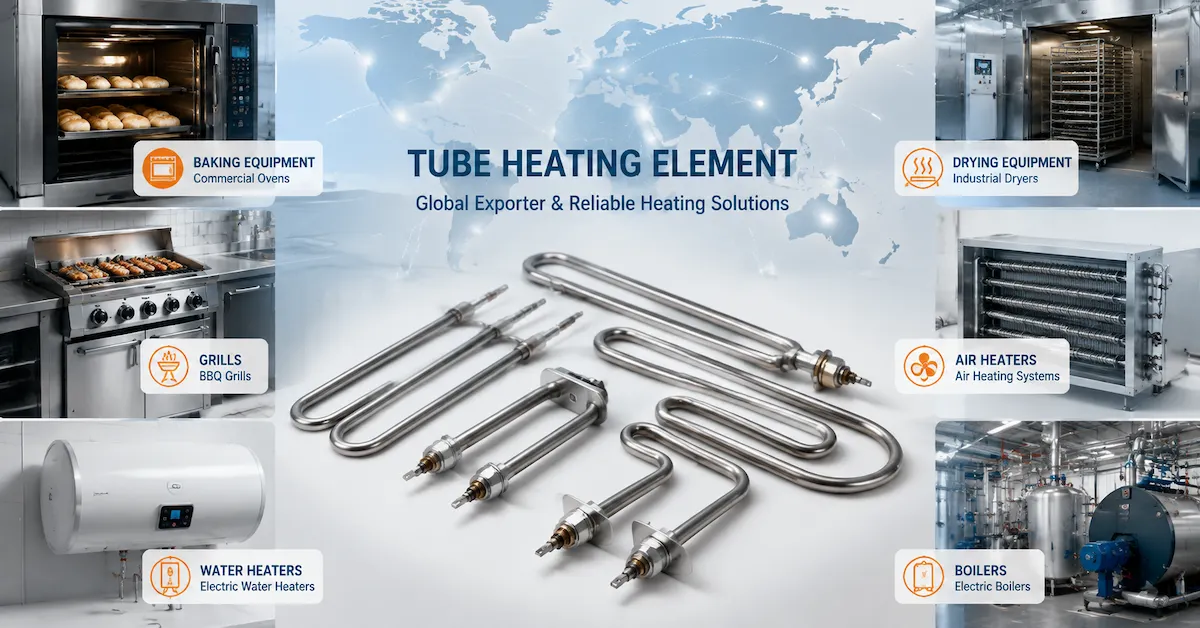
Tubular heating elements are widely used in equipment such as electric ovens, grills, water heaters, boilers, drying systems, industrial ovens, and air-heating equipment. Because these applications require different heating performance, installation structures, and environmental resistance, buyers need a manufacturer that understands both production and engineering requirements.
A qualified China manufacturer should provide more than competitive pricing. The supplier should be able to support:
- Product selection
- Technical consultation
- Drawing review
- Custom design
- Sample development
- Performance testing
- Quality control
- Bulk production
- Export packaging
WEBO positions its tube heating element business around these capabilities, providing tubular heating solutions for appliance and industrial applications, including customized product development and bulk manufacturing support. (WEBO Tube Heating Element)
For international buyers, the main challenge is not finding a factory that can produce a heating tube. The challenge is finding a manufacturer that can consistently produce the correct heating element for the intended equipment.
What Is a Tube Heating Element?
A tube heating element, also known as a tubular heating element, is an electric heating component that converts electrical energy into heat through a resistance conductor inside a protective metal tube.
A typical tubular heating element structure includes:
- Metal sheath
- Resistance heating wire
- Electrical insulation material
- Terminal connection
- Mounting components
The resistance wire generates heat, while the insulating material separates the electrical conductor from the external metal sheath and helps transfer heat outward.
Technical references from Kanthal explain that metal-sheathed tubular elements commonly use a resistance coil surrounded by compacted insulating material such as magnesium oxide (MgO), allowing electrical insulation and efficient heat transfer. (Kanthal electric appliance elements)
This structure allows tube heating elements to be adapted for different environments, including:
- Air heating
- Water heating
- Oven heating
- Food equipment
- Industrial heating systems
- Drying equipment
Who Should Source Tube Heating Elements From China?
A China manufacturer is especially suitable for buyers who require stable production capacity, customization support, and long-term supply.
Typical customers include:
Electric Appliance Manufacturers
Examples:
- Electric oven manufacturers
- Electric grill brands
- Portable cooker manufacturers
- Kitchen appliance companies
These buyers usually focus on:
- Heating performance
- Installation compatibility
- Stable batch quality
- Product safety
Industrial Equipment Manufacturers
Industrial buyers may require:
- Custom dimensions
- Special tube shapes
- Higher durability
- Specific mounting structures
Typical applications include:
- Industrial ovens
- Drying machines
- Heating chambers
- Process equipment
Importers and Distributors
Importers usually need:
- Competitive production cost
- Export experience
- Stable delivery
- Complete documentation
- Consistent repeat orders
OEM and Private Label Brands
These buyers often need:
- Custom specifications
- Product modifications
- Packaging solutions
- Long-term cooperation
What Applications Use Tube Heating Elements?
A professional tube heating element manufacturer should understand different application requirements because the same heating tube design cannot fit every environment.
| Application | Typical Heating Requirement | Buyer Focus |
|---|---|---|
| Electric oven | Uniform chamber heating | Shape, wattage, temperature distribution |
| Electric grill | Direct surface heating | Heat coverage and durability |
| Water heater | Immersion heating | Sheath material, sealing, corrosion resistance |
| Boiler equipment | Continuous heating | Power stability and mounting |
| Air heater | Heat transfer through airflow | Surface load and airflow conditions |
| Drying equipment | Stable thermal output | Operating cycle and reliability |
| Industrial oven | Process temperature control | Custom geometry and durability |
WEBO's current tube heating element products include configurations designed for electric furnaces, ovens, water heaters, boilers, air heaters, industrial ovens, and drying equipment. (WEBO Tube Heating Element)
How to Evaluate a Tube Heating Element China Manufacturer
Choosing a supplier from China requires evaluating several areas beyond price.
1. Manufacturing Experience and Factory Capability
A reliable manufacturer should have experience producing heating elements for different applications.
Important evaluation points include:
- Years of manufacturing experience
- Production facilities
- Engineering team
- Quality-control system
- Production equipment
- Export experience
- Ability to support repeat orders
WEBO states that it was established in 1998 and operates a manufacturing facility of approximately 50,000 square meters with more than 500 workers. The company also states that it serves international markets and operates under ISO 9001 and ISO 14001 management systems. (WEBO About Us)
For buyers, factory scale is only one consideration. The more important question is whether the manufacturer has experience with the specific heating application.
2. Technical Support and Engineering Ability
A strong tube heating element manufacturer should not only accept orders but also help solve technical problems.
Before production, engineers should review:
- Application environment
- Required heating output
- Available installation space
- Electrical requirements
- Material selection
- Mounting structure
- Terminal position
This is particularly important for OEM and custom projects.
A supplier that only manufactures according to incomplete information may produce a component that looks correct but fails during installation or operation.
3. Product Customization Capability
Different equipment designs require different tube heating element structures.
Customization may include:
Shape Customization
Examples:
- U-shaped heating element
- W-shaped heating element
- Circular heating element
- Double-U configuration
- Custom bending design
Electrical Customization
Including:
- Voltage
- Wattage
- Resistance value
- Terminal configuration
Mechanical Customization
Including:
- Tube diameter
- Length
- Mounting bracket
- Flange
- Thread structure
- Installation position
A capable China manufacturer should be able to evaluate whether an existing design can be modified or whether a completely new development is required.
4. Material Selection Capability
Material selection directly affects heating performance and service reliability.
Important material considerations include:
Metal Sheath
The outer sheath protects the internal heating structure.
Selection depends on:
- Operating temperature
- Heating medium
- Corrosion environment
- Mechanical requirements
Possible materials may include stainless steel and other heat-resistant alloys depending on application requirements.
Resistance Wire
The resistance conductor determines electrical heating performance.
Important factors include:
- Electrical resistance
- Temperature capability
- Oxidation resistance
- Stability during repeated heating cycles
Insulation Material
MgO insulation is commonly used in metal-sheathed tubular heating elements because it provides electrical insulation while allowing heat transfer.
5. Quality Control System
Quality control is one of the most important differences between a reliable manufacturer and a simple trading supplier.
A professional tube heating element factory should control:
Incoming Materials
Checking:
- Metal tubes
- Resistance wire
- Insulation materials
- Terminals
- Supporting components
Production Process
Including:
- Tube preparation
- Filling insulation material
- Compression
- Bending
- Welding
- Terminal assembly
- Surface treatment
Final Inspection
Possible checks include:
- Dimensions
- Resistance
- Power output
- Insulation performance
- Appearance
- Terminal connection
- Packaging condition
WEBO's current technical content highlights incoming material inspection, electrical testing, dimensional checks, terminal inspection, heating verification, and final packaging inspection as relevant quality-control activities for tube heating elements. (WEBO supplier guide)
Why Choose a Tube Heating Element Manufacturer in China?
China has become an important sourcing location for heating components because many manufacturers have developed complete production systems covering material processing, component manufacturing, assembly, testing, and export supply.
However, international buyers should not select suppliers only because they are located in China. The key is evaluating whether the manufacturer has the engineering capability, quality system, and production control required for your application.
A qualified tube heating element China manufacturer should provide advantages in several areas.
1. Integrated Manufacturing Capability
A manufacturer with integrated production capability can better control:
- Material selection
- Production consistency
- Manufacturing tolerances
- Quality inspection
- Delivery schedules
For heating elements, this is especially important because the final performance depends on many connected factors:
- Resistance wire specification
- Insulation quality
- Tube material
- Compression process
- Bending accuracy
- Terminal assembly
- Electrical testing
When these processes are controlled internally, communication problems between different suppliers can be reduced.
2. Engineering Support for International Buyers
Many overseas buyers do not have specialized heating-element engineers internally.
A professional China manufacturer should be able to support:
- Product recommendation
- Technical evaluation
- Drawing review
- Sample improvement
- Manufacturing optimization
For example, when developing a new electric oven heating element, the supplier should consider:
- Heating area
- Installation space
- Power requirement
- Air circulation
- Terminal location
- Mounting structure
A supplier with engineering involvement can help prevent design problems before mass production.
3. Competitive Manufacturing Cost
Cost advantage is one reason many global companies source heating components from China.
However, the lowest quotation does not always represent the lowest total cost.
The actual project cost may include:
- Product price
- Tooling cost
- Sample development
- Testing cost
- Packaging
- Shipping
- Quality problems
- Rework risk
- Production delays
A reliable manufacturer helps reduce hidden costs by improving:
- First-sample accuracy
- Production consistency
- Quality stability
- Communication efficiency
How Does a Tube Heating Element China Manufacturer Develop Custom Products?
For OEM and ODM projects, a structured development process is essential.
Step 1: Requirement Analysis
The buyer provides project information including:
- Equipment application
- Heating environment
- Voltage
- Wattage
- Installation dimensions
- Quantity requirement
- Target market
The manufacturer analyzes whether the project should use:
- Existing standard product
- Modified product
- Completely customized design
Step 2: Technical Proposal
Based on the application, the supplier may recommend:
- Tube diameter
- Element shape
- Sheath material
- Terminal design
- Mounting structure
- Power configuration
The purpose is to create a practical heating solution rather than simply reproduce a physical appearance.
Step 3: Drawing Confirmation
Before producing samples, both parties should confirm:
- Product drawing
- Dimensions
- Material specification
- Electrical parameters
- Tolerance requirements
- Connection structure
A clear drawing reduces misunderstandings during production.
Step 4: Prototype Development
The supplier produces samples according to the approved specification.
The sample stage should verify:
- Mechanical installation
- Electrical performance
- Heating behavior
- Equipment compatibility
Step 5: Testing and Optimization
If the sample does not fully meet the application requirements, the design should be adjusted before production.
Possible optimization areas:
- Heating distribution
- Terminal position
- Tube shape
- Mounting method
- Power adjustment
- Material selection
Step 6: Mass Production
After sample approval, production moves into the manufacturing stage.
A controlled production process should maintain consistency in:
- Dimensions
- Electrical performance
- Materials
- Appearance
- Packaging
OEM vs ODM vs Standard Tube Heating Elements
Understanding different sourcing models helps buyers choose the correct cooperation method.
| Sourcing Type | Starting Point | Supplier Role | Best For |
|---|---|---|---|
| Standard Product | Existing catalog model | Manufacturing and supply | Replacement or common applications |
| OEM | Buyer drawing/specification | Manufacture according to requirements | Mature product designs |
| ODM | Application requirement | Design support + manufacturing | New products and modified solutions |
For companies developing new appliances, ODM can reduce engineering workload because the supplier participates earlier in the product-development process.
For companies with finalized drawings, OEM manufacturing may be more suitable.
Important Questions Before Selecting a China Tube Heating Element Supplier
Before placing an order, buyers should evaluate the supplier using a structured checklist.
Factory Capability Questions
Ask:
- How long has the company manufactured heating elements?
- Does it produce heating components directly?
- What applications does it currently support?
- Does it export internationally?
- Can it support repeat production?
Technical Questions
Ask:
- Can you review our drawing?
- Can you recommend a suitable design?
- Can you customize voltage and wattage?
- Can you modify terminals or mounting?
- Can you provide samples?
Quality Questions
Ask:
- What materials are controlled?
- What tests are performed?
- How are production batches inspected?
- How are changes managed after approval?
Supply Questions
Ask:
- What is the production process?
- How are repeat orders controlled?
- How is packaging handled?
- What information is required before quotation?
Common Mistakes When Buying Tube Heating Elements From China
Choosing Only Based on Price
A lower unit price may come from:
- Different materials
- Reduced testing
- Lower inspection standards
- Different specifications
Buyers should compare quotations based on identical technical requirements.
Providing Insufficient Technical Information
A supplier cannot correctly design a heater without understanding:
- Application
- Operating environment
- Installation limitations
- Electrical requirements
More complete information improves quotation accuracy.
Ignoring Sample Validation
A sample should be tested in the actual equipment whenever possible.
Component testing alone may not reveal:
- Installation conflicts
- Heat distribution problems
- Control-system issues
- Assembly difficulties
Failing to Control Product Changes
After approval, any changes involving:
- Material
- Dimensions
- Resistance
- Terminal structure
- Manufacturing process
should be reviewed before implementation.
Assuming Certifications Automatically Apply
Certification requirements depend on:
- Product type
- Electrical rating
- Market
- Finished equipment
Buyers should confirm documentation for the exact product model.
Tube Heating Element China Manufacturer Selection Checklist
| Evaluation Area | What Buyers Should Check |
|---|---|
| Manufacturing Experience | Years of heating-element production |
| Product Range | Tube heaters, hot plates, related components |
| Engineering Support | Drawing review and technical advice |
| Customization | Shape, size, voltage, power, terminals |
| Quality Control | Material inspection and production testing |
| Certification Support | Applicable market requirements |
| Production Capacity | Ability for repeat bulk orders |
| Communication | Technical response and project management |
| Packaging | Export protection and labeling |
| After-Sales Support | Long-term cooperation capability |
Why WEBO Is a Tube Heating Element China Manufacturer Worth Considering
GUANGDONG WEBO TECHNOLOGY was established in 1998 in Yangjiang, Guangdong. According to its current company information, WEBO operates approximately 50,000 square meters of manufacturing space, has more than 500 employees, and provides heating components and appliance-related products for international markets. (weboproducts.com)
WEBO's current product portfolio includes:
- Hot Plate
- Ceramic Heater
- Tube Heating Element
- Cast Iron Pan Support
- Induction Coil
- Ceramic Glass
- Rotary Switch
- Energy Regulator
For tube heating element projects, WEBO provides support including:
- Product selection
- Technical consultation
- Drawing review
- Sample development
- Performance testing
- OEM/ODM customization
- Bulk production
- Export packaging
(WEBO Tube Heating Element Supplier Guide)
Its tube heating element applications include:
- Electric ovens
- Grills
- Water heaters
- Boilers
- Air heaters
- Drying equipment
- Industrial heating systems
How to Request a Quote From a China Tube Heating Element Manufacturer
A detailed RFQ helps manufacturers provide a more accurate proposal.
Include:
- Product application
- Heating environment
- Voltage
- Wattage
- Tube dimensions
- Shape requirement
- Terminal structure
- Mounting method
- Material requirement
- Annual quantity
- Target market
- Certification requirements
- Packaging requirements
If available, provide:
- Product drawing
- CAD file
- Existing sample
- Appliance specification
You can review WEBO's tube heating element products and submit project details through the contact page.
FAQ
1. Why do global buyers choose a tube heating element China manufacturer?
Many international buyers choose China suppliers because of manufacturing capability, customization options, production capacity, and export experience. However, supplier selection should focus on technical ability and quality control rather than location alone.
2. What information should I provide when contacting a China heating element manufacturer?
Provide application details, voltage, wattage, dimensions, shape requirements, installation method, quantity, target market, and any drawings or samples.
3. Can Chinese manufacturers produce custom tube heating elements?
Yes. Many manufacturers support customization of dimensions, shape, electrical specifications, terminals, mounting structures, and packaging depending on production capability.
4. What applications use tubular heating elements?
Common applications include ovens, grills, water heaters, boilers, drying equipment, air heaters, and industrial heating systems.
5. How do I compare two tube heating element suppliers?
Compare:
- Technical capability
- Material specifications
- QC process
- Sample quality
- Production consistency
- Communication
- Total project cost
Do not compare only unit price.
6. What is the difference between OEM and ODM heating element supply?
OEM usually means manufacturing according to buyer-defined specifications, while ODM involves more supplier participation in product recommendation, design adjustment, and development.
7. What quality tests should a heating element supplier perform?
Testing depends on the product design but may include dimensional inspection, resistance testing, insulation checks, power verification, terminal inspection, and heating-performance evaluation.
8. Can a supplier customize heating element voltage and wattage?
Yes, but voltage and wattage must be evaluated together with element geometry, material, heating environment, and application requirements.
9. How can I reduce risks when sourcing heating elements from China?
Reduce risk by:
- Selecting experienced manufacturers
- Reviewing samples
- Confirming specifications
- Defining QC requirements
- Controlling design changes
- Testing products before mass production
10. How can I contact WEBO for tube heating element sourcing?
Buyers can review WEBO's Tube Heating Element products and send application details, drawings, samples, and quantity requirements through the WEBO contact page.
Conclusion
Choosing the right tube heating element China manufacturer requires evaluating more than production price. The ideal supplier should combine manufacturing experience, engineering support, customization ability, quality control, and reliable export capability.
For global buyers, a successful heating-element sourcing project starts with clear application requirements, continues through technical review and sample validation, and ends with stable mass production.
WEBO provides tube heating elements and related appliance heating components with support for product selection, customization, testing, and bulk supply. Companies developing new heating applications can contact WEBO with drawings, specifications, and project requirements for technical evaluation and quotation.