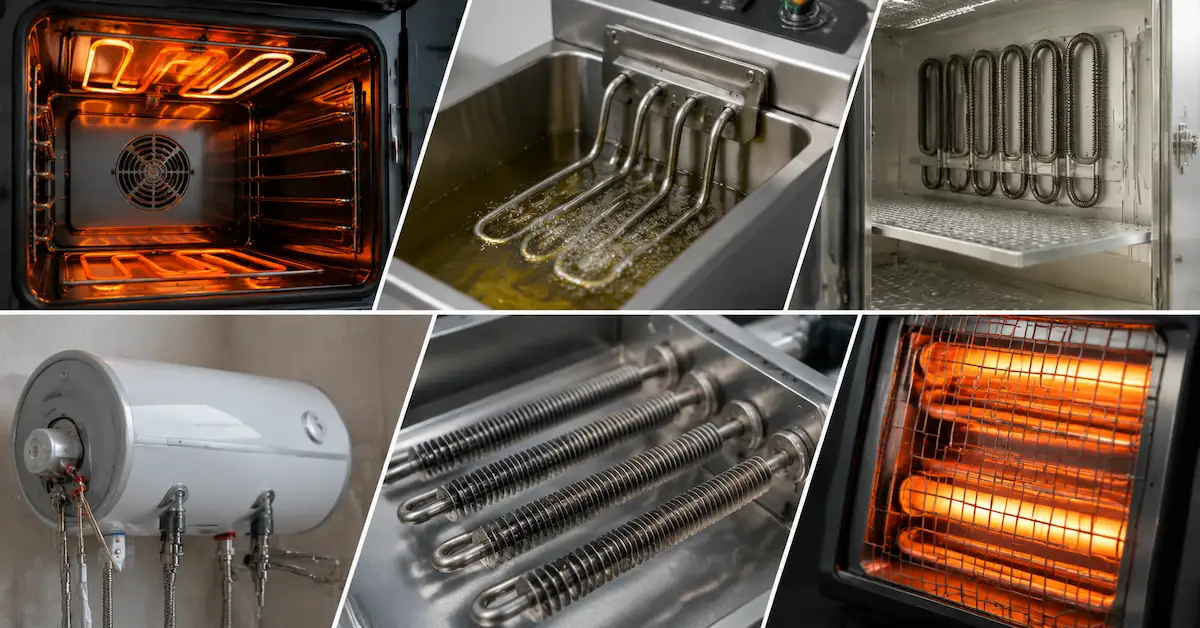
| 設定 |
主な利点 |
一般的なアプリケーション |
購入者優先 |
| W 字型要素 |
より広い加熱領域をカバー |
オーブン、電気炉 |
サイズと取り付け |
| 循環/ループ要素 |
コンパクトな暖房ゾーン範囲 |
オーブン、ホットプレート、家電 |
直径と端子位置 |
| U 字型要素 |
単純に形成された加熱経路 |
家電製品または工業用ヒーター |
長さとパワー |
| U 字型フランジ要素 |
タンク/ボイラーの直接設置 |
給湯、ボイラー |
フランジ、シーリング、腐食 |
| Double-U 要素 |
定義された領域内の加熱面積が拡大される |
空気加熱、乾燥、オーブン |
レイアウト、エアフロー、ワット密度 |
| カスタム成形チューブ |
独自の機器形状に適合 |
OEM 機械 |
描画精度 |
たとえば、購入者は WEBO のチューブ ヒーティング エレメントをレビューできます。カテゴリを現在の加熱管ポートフォリオの出発点として使用します。このサイトには、TL-002、TL-022、および TL-023。
管状発熱体の卸売業者を評価する方法
卸売購入者は、見積を一行ずつ比較するのではなく、さまざまな側面からサプライヤーを評価する必要があります。
1.技術レビュー能力
有力なサプライヤーは、カスタム プロジェクトを見積もる前に質問する必要があります。
役に立つ質問は次のとおりです。
- その要素はどの機器で使用されていますか?
- 加熱するのは空気、水、または金属表面ですか?
- 利用可能な電圧は何ですか?
- 必要なワット数は何ですか?
- 設置スペースとは何ですか?
- 使用温度は何度ですか?
- 取り付け寸法はどれくらいですか?
- 図面は利用できますか?
- 既存のサンプルは利用可能ですか?
- 最終製品はどの市場に参入しますか?
アプリケーションを理解せずに OEM ヒーターを見積もるサプライヤーは、回避可能なエンジニアリング リスクを引き起こす可能性があります。
2.サンプルからバルクまでの一貫性
卸売購入の場合、成功したサンプルが 1 つだけでは十分ではありません。
購入者は、次のような大量生産中にどの特性を制御し続ける必要があるかを確立する必要があります。
- 全体の寸法
- 曲げジオメトリ
- 電気抵抗
- 定格電力
- 端子寸法
- フランジの位置
- 表面状態
- パッケージ化方法
再現性は、アプライアンスの組立ラインや交換部品の販売業者にとって特に重要です。
3.品質管理文書
大量生産の前に、どのような検査が行われるのか、どのような合格基準が使用されるのかを確認してください。
製品とアプリケーションに応じて、品質計画には次のものが含まれる場合があります。
- 受入資材の検査
- 寸法検査
- 抵抗または電気的性能の検証
- 絶縁抵抗試験
- 該当する場合、絶縁/耐圧テスト
- 端末検査
- 表面検査
- 加熱の検証
- 最終梱包検査
正確な安全性テストと制限は、一般的なチェックリストからコピーするのではなく、発熱体の設計、完成した器具、仕向け市場、および適用される規格に従って合意する必要があります。
4.認証と市場互換性
コンポーネント証明書は、完成したアプライアンスが仕向地市場のすべての要件に準拠していることを自動的に意味するものではありません。
購入者は以下を確認する必要があります。
- どの証明書が正確なモデルに適用されるか
- 証明書が必要な電圧/電力をカバーしているかどうか
- ドキュメントが最新かどうか
- 最終アプライアンスに追加の認定が必要かどうか
- 材料または製造の変更が承認された建設に影響を与えるかどうか
WEBO の Web サイトには、同社が ISO 9001 および ISO 14001 管理システムに基づいて運営されており、その製品が VDE、TUV、UL、CE、RoHS などの認証を取得していると記載されています。購入者は、正確なモデルとプロジェクトに関連するドキュメントを要求する必要があります。
5.生産能力とリードタイムの透明性
サプライヤーの工場規模は参考になりますが、それだけで注文のリードタイムが決まるわけではありません。
購入者は以下について別途質問する必要があります。
- サンプルのリードタイム
- ツーリングのリードタイム
- トライアル注文のリードタイム
- 量産リードタイム
- Peak-season capacity
- Monthly capacity for the relevant product family
- Repeat-order planning
- Raw-material availability
WEBO states that its manufacturing operation was established in 1998, operates a plant of approximately 50,000 square meters, and employs more than 500 workers. Its site does not publish a specific monthly tube-heating-element capacity or universal lead time, so those figures should be confirmed per project rather than assumed.
What Affects Wholesale Tube Heating Element Pricing?
There is no useful universal wholesale price for every tubular heating element because the cost structure changes with specification.
Major cost drivers include:
- Sheath material
- Tube diameter
- Element length
- Number of bends
- Flange or threaded fitting
- Resistance wire specification
- Rated voltage
- Rated power
- Terminal structure
- Welding or brazing requirements
- Custom tooling
- Certification requirements
- Inspection requirements
- Order volume
- Packaging method
A standard existing design will generally have a different cost structure from a new OEM element requiring custom tooling, special materials, testing, and packaging.
For that reason, buyers should compare quotations based on an identical technical specification rather than comparing unit prices from different designs.
Common Risks When Buying Tube Heating Elements in Bulk
Specification Mismatch
A heater may physically resemble the original product but have different electrical characteristics.
Always confirm voltage, wattage, resistance, dimensions, terminal layout, and mounting.
Wrong Material for the Environment
A tube suitable for dry-air heating may not automatically be appropriate for water, corrosive liquids, food-processing environments, or high-temperature industrial service.
Sample and Production Differences
The approved sample should become the reference for mass production. Any material, terminal, dimension, or manufacturing change should be controlled.
Certification Assumptions
Never assume a supplier's general certification list automatically covers every element.
Confirm exact documents for the product and market.
Inadequate Export Packaging
Long heating tubes can be vulnerable to bending or terminal damage during transport.
Packaging design should account for product geometry, quantity, stacking, and export handling.
A Practical OEM and Wholesale Development Process
For custom projects, a structured development process reduces errors before mass production.
Step 1: Send Application Requirements
Provide:
- Equipment type
- Voltage
- Wattage
- Dimensions
- Quantity
- Market
- Operating environment
Step 2: Submit Drawing or Existing Sample
A technical drawing is preferred when dimensions and tolerances are critical.
Existing samples can also help the supplier understand shape, flange, terminal, and mounting requirements.
Step 3: Supplier Engineering Review
The supplier evaluates whether:
- A standard model is suitable
- An existing model can be modified
- A new design is required
Step 4: Confirm Commercial Terms
At this stage, confirm:
- Sample cost
- Tooling cost if applicable
- Estimated bulk price
- MOQ
- Packaging
- Development schedule
Step 5: Sample Development and Testing
The buyer should verify both electrical performance and mechanical compatibility in the actual equipment.
Step 6: Freeze the Approved Specification
Final drawings, dimensions, materials, electrical values, terminals, labels, and packaging should be documented.
Step 7: Trial or Mass Production
Production should follow the approved reference.
Step 8: Final Inspection and Export Packaging
Confirm inspection records and packaging requirements before shipment.
Why Consider WEBO for Wholesale Tube Heating Element Projects?
GUANGDONG WEBO TECHNOLOGY was established in 1998 in Yangjiang, Guangdong. Its current website states that the company operates approximately 50,000 square meters of manufacturing space, employs more than 500 workers, serves markets across Europe, Asia, Africa, and America, and manages its operations under ISO 9001 and ISO 14001.
Its broader heating-component portfolio currently includes Hot Plate, Ceramic Heater, Tube Heating Element, Cast Iron Pan Support, Induction Coil, Ceramic Glass, Rotary Switch, and Energy Regulator, which makes the company relevant to appliance buyers sourcing several related heating and control components.
For a tube heating element inquiry, buyers should send the application, voltage, power, dimensions, shape, quantity, terminal requirements, mounting details, certification requirements, and any available drawings or samples through the WEBO contact page.
FAQ
1. What should I send to a tube heating element wholesale supplier for a quotation?
Provide the application, voltage, wattage, dimensions, tube shape, mounting method, terminal type, quantity, destination market, certification needs, and packaging requirements. A technical drawing or existing sample is especially useful for OEM projects.
2. Can tube heating elements be customized for OEM equipment?
Yes, tubular elements can be produced in different shapes, dimensions, electrical ratings, terminal configurations, and mounting arrangements when the manufacturer's production capabilities support the design. WEBO's current product information also references multi-specification customization for certain tube-heating products.
3. What applications use tubular heating elements?
Common applications include ovens, grills, hot plates, immersion heaters, water-heating equipment, air heaters, dryers, and industrial heating equipment.
4. How do I choose between a standard and custom heating element?
Choose a standard model when its voltage, wattage, dimensions, mounting, terminals, and operating environment already match your equipment. Use an OEM design when one or more critical parameters require modification.
5. Which material is best for a tube heating element?
There is no single material that is best for every application. Sheath selection depends on temperature, corrosion environment, heating medium, oxidation conditions, mechanical requirements, and cost.
6. Why is watt density important when selecting a tubular heater?
Watt density describes the heat load applied over the element surface. Excessive loading for a particular application can increase element temperature and reduce design margin, so it should be evaluated together with airflow, immersion conditions, surface area, materials, and operating temperature. Industry guidance shows that appropriate surface loads vary by heating-element design and application.
7. What quality tests should I ask a wholesale supplier about?
Ask the supplier to define dimensional inspection, electrical-performance checks, insulation testing, terminal inspection, surface inspection, heating verification, and any safety tests required by the applicable specification or finished-appliance standard.
8. Does a CE, UL, VDE, or TUV certification apply to every heating element from the same supplier?
Not necessarily. Certification scope can depend on the exact construction, model, electrical rating, and application. Buyers should request documents for the actual component being purchased rather than relying only on a general supplier certification list.
9. What factors affect bulk tube heating element prices?
Material, dimensions, power, tube shape, number of bends, fittings, terminals, tooling, certification, inspection requirements, order quantity, and packaging can all affect quotation structure.
10. How can I request a wholesale tube heating element quote from WEBO?
Review the WEBO Tube Heating Element range, then send your application, drawings, voltage, wattage, dimensions, quantity, certification requirements, and packaging needs through the contact page.
Conclusion
Choosing the right tube heating element wholesale supplier requires more than comparing catalogs and unit prices. The most reliable sourcing process starts with the application and then verifies voltage, wattage, dimensions, materials, terminal design, mounting, quality testing, certification scope, sample approval, production consistency, packaging, and long-term supply capability.
For appliance manufacturers, industrial equipment companies, importers, distributors, and OEM buyers, a technically qualified supplier can help reduce compatibility errors and simplify repeat purchasing.
WEBO provides tube heating elements alongside a broader range of appliance heating and control components. Buyers developing a new project or sourcing a bulk replacement program can contact WEBO with drawings, samples, application requirements, and target order quantities for technical review and quotation.
GUANGDONG WEBO TECHNOLOGY
Guangdong Webo Technology Co。、Ltdは、広東省のYangjiangと呼ばれる南部の美しい都市にあり、1998年に設立されました。暖房要素の製造における25年の経験により、世界中の顧客に高品質の製品を提供しています。