


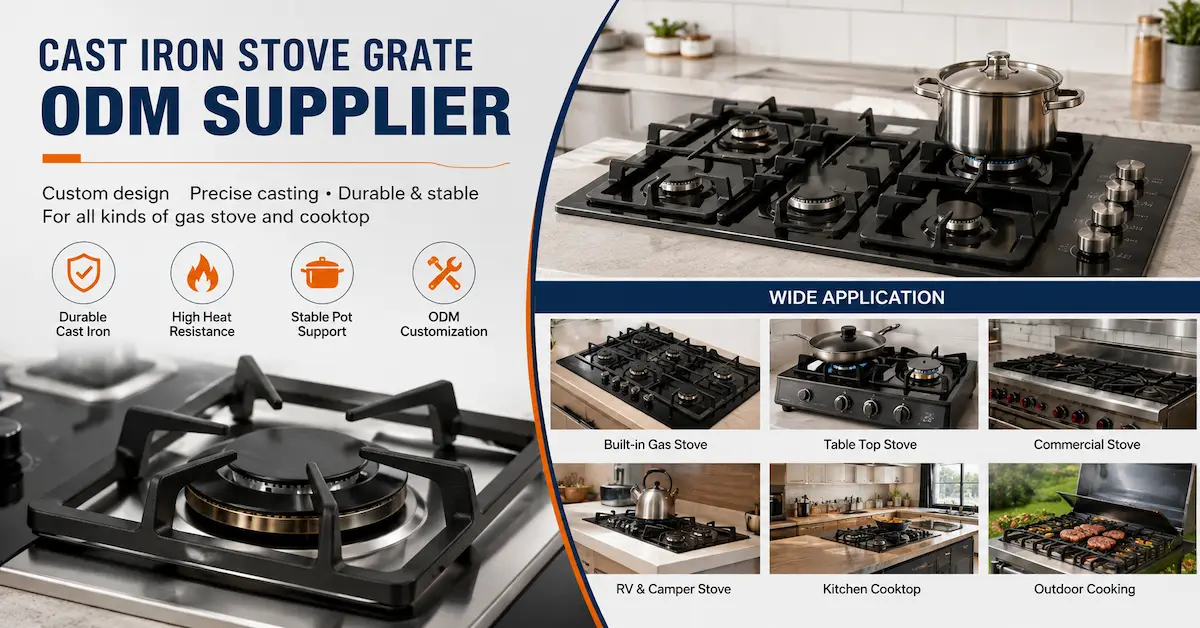
When Does a Cast Iron Stove Grate ODM Supplier Make Sense?
Not every gas stove project starts with a finished drawing.
Sometimes a buyer has a burner layout, a cooktop concept and a target selling price, but the grate geometry is still open. Another buyer may have an old grate sample that needs to fit a redesigned appliance. A private-label brand may know the appearance it wants but need help determining whether that shape is practical for casting and mass production.
Those are the situations where a cast iron stove grate ODM supplier can add more value than a simple build-to-print source.
The supplier's role may include helping the buyer move from:
product requirement → feasible grate concept → sample → validated specification → production
That is different from strict OEM production, where the buyer normally provides a relatively mature drawing or sample and expects the manufacturer to reproduce it.
For procurement teams, understanding that difference prevents one of the most common project mistakes: asking for ODM support while sending only a unit-price target.
ODM Is Not the Same as OEM
The two terms are often mixed together in sourcing discussions.
A practical distinction is:
| Project Type | Buyer Usually Provides | Supplier Role | Best For |
|---|---|---|---|
| OEM | Controlled drawing or approved sample | Manufacture to defined requirements | Mature appliance |
| ODM | Product brief, layout,sample or partial specifications | Help refine product direction | New or modified appliance |
| Standard supply | Existing supplier model | Supply existing product | Low-development project |
A stove grate ODM project does not mean the supplier should design the entire gas appliance.
The appliance manufacturer still controls safety, burner performance, finished-product compliance and final validation.
The grate supplier's contribution should stay within an agreed scope.
For example:
- Grate geometry
- Casting feasibility
- Contact-point arrangement
- Cookware-support structure
- Manufacturing tolerances
- Surface finish
- Tooling feasibility
- Packaging
Define that scope early.
Otherwise, both sides may believe the other party owns an important design decision.
Start With a Product Brief, Not “Send Your Catalogue”
A useful ODM inquiry should describe the finished appliance before discussing grate price.
Send the supplier information such as:
| Project Information | Example |
|---|---|
| Appliance | Built-in gas hob |
| Burner count | 2, 3, 4 or 5 burners |
| Burner layout | Drawing or dimensional layout |
| Target cookware | Small saucepan to large stockpot |
| Grate format | Individual,paired or full-width |
| Existing sample | Available / unavailable |
| Target appearance | Matte, enamelled or specified finish |
| Installation envelope | Maximum dimensions and height |
| Market | EU, North America, Middle East, etc. |
| Forecast volume | Pilot + annual estimate |
| Development stage | Concept, prototype or redesign |
That gives the supplier enough context to ask useful questions.
A request saying only:
“Need custom cast iron stove grate, please quote.”
usually leads to one of two outcomes: a vague price or several rounds of unnecessary clarification.
Neither moves the project forward.
Which Parts of a Stove Grate Can Be Developed in an ODM Project?
The exact scope depends on the appliance and manufacturing feasibility.
Overall Geometry
Different cooktops may use:
- Individual burner grates
- Double-burner supports
- Continuous grate systems
- Special-shaped supports
WEBO's current Cast Iron Pan Support range groups products into Single Burner, Double Burner and Cast Iron Grate Grids.
An ODM discussion can begin by determining whether an existing format is close enough to adapt before creating a completely new geometry.
Burner Opening
The opening around the burner needs to work with the burner position and appliance structure.
It cannot be selected from appearance alone.
Cookware Contact Points
A pan support must hold cookware securely without interfering with burner function or appliance layout.
The project team should examine:
- Number of support points
- Support height
- Contact area
- Small-pan stability
- Large-pan clearance
Feet and Locating Features
The underside of the grate may require:
- Feet
- Locating points
- Pads
- Recesses
- Alignment features
These affect how the component sits on the cooktop.
A visually attractive top surface will not solve an incorrect locating structure underneath.
Existing Platform or New Tooling?
This decision can have a large effect on both development cost and lead time.
Before opening new tooling, ask the ODM supplier to determine whether a current platform can be adapted.
| Development Route | Suitable Situation | Cost Exposure | Development Risk |
|---|---|---|---|
| Existing product | Layout already compatible | Lower | Lower |
| Existing design modification | Similar burner geometry | Medium | Medium |
| New tooling | Unique appliance architecture | Higher | Higher |
| Sample-led redevelopment | Legacy part without complete CAD | Variable | Medium–High |
An existing product is not automatically the best choice.
Forcing an almost-correct grate onto a new stove can create:
- Poor alignment
- Unstable cookware
- Incorrect spacing
- Assembly interference
But starting every project with new tooling is equally inefficient.
A useful ODM supplier should help determine which route is commercially sensible.
What Should Be Frozen Before Tooling Begins?
ODM projects become expensive when tooling starts before important decisions are settled.
Before tooling approval, both sides should confirm at least:
- Overall geometry
- Critical dimensions
- Burner-center relationships
- Height
- Contact points
- Locating features
- Material requirement
- Surface-treatment direction
- Drawing revision
- Expected production quantity
It is also worth distinguishing:
dimensions critical to appliance fit
from:
dimensions that can use normal casting tolerances.
Not every dimension deserves the same inspection effort.
Making every number extremely tight can increase manufacturing cost without improving the appliance.
Material Selection Should Be a Specification, Not a Marketing Phrase
Cast iron is widely used for stove grates because it combines rigidity, load-bearing capability and suitability for repeated cooking heat.
But “cast iron” is not a complete engineering specification.
The buyer and supplier should agree on the material requirement appropriate to the project.
ASTM A48/A48M-22, for example, is an active standard covering gray iron castings for general engineering applications where tensile strength is an important consideration. It classifies castings according to tensile strength and also addresses visible casting conditions such as adhering sand, scale, cracks and hot tears.
That does not mean every WEBO stove grate automatically complies with ASTM A48/A48M-22.
If a buyer requires an ASTM grade or another material standard, it should be written into the project specification and confirmed with the supplier.
For higher-temperature gray-iron applications, ASTM also maintains A319, which covers certain gray iron castings used at elevated temperatures. Again, applicability should be determined for the actual product rather than copied automatically into an RFQ.
Surface Finish Is Part of the Product Design
For visible gas-appliance components, surface treatment affects more than appearance.
Buyers may need to discuss:
- Color
- Texture
- Coating or enamel direction
- Edge appearance
- Surface uniformity
- Cleaning expectations
- Heat-cycle performance
The sample approval should define what “acceptable” actually looks like.
Statements such as:
“surface must look good”
are difficult to inspect consistently.
Instead, agree on approved samples, photographs, defect criteria or other measurable references where possible.
How Should an ODM Sample Process Work?
One sample should not carry the whole project.
A stronger process separates development into stages.
First Sample: Fit and Concept
The first sample answers basic questions:
- Does it fit the stove?
- Are burner locations correct?
- Is cookware stable?
- Does the geometry look right?
- Are locating points correct?
Do not spend too much time debating small cosmetic details before these fundamentals work.
Revised Sample: Design Correction
If the first unit reveals problems, document the changes.
Avoid instructions such as:
“move this slightly.”
Use a revised drawing or dimensional note.
That makes the development history traceable.
Final Sample: Approval Reference
Once the design works, freeze:
- Drawing
- Revision
- Material
- Surface requirements
- Critical dimensions
- Approved appearance
- Packaging where relevant
The final approval sample then becomes a production reference rather than merely another prototype.
Test the Grate on the Actual Appliance
A grate can look excellent on a table and still perform poorly on a cooktop.
Sample evaluation should take place on the intended appliance or a representative fixture.
Check:
- Correct seating
- Rocking
- Burner clearance
- Cookware stability
- Small cookware
- Heavy cookware
- Neighboring burner clearance
- Knob or panel interference
- Heating cycles
- Cleaning and handling
Gas stove manufacturers should also perform whatever finished-appliance safety and compliance testing applies to their product and market.
The component supplier should not replace that responsibility.
What Quality Controls Matter After ODM Development?
Once a design reaches production, the objective changes.
During development the question is:
Can we make the design work?
During mass production it becomes:
Can we keep making the same approved product?
Incoming Material
Verify the controlled material specification rather than relying only on generic material naming.
Casting Inspection
Inspection may consider:
- Cracks
- Incomplete filling
- Excessive flash
- Surface irregularities
- Distortion
- Other project-defined casting defects
Critical Dimensions
Dimensions affecting assembly and function deserve particular attention.
These may include:
- Overall length and width
- Burner opening
- Height
- Feet locations
- Contact-point positions
Flatness and Seating
A grate that rocks on the cooktop can create immediate user complaints.
That makes seating behavior particularly important for stove applications.
Surface Inspection
Approved appearance standards should be applied consistently rather than judged differently by each inspector.
Sample-to-Production Drift Is the Risk to Watch
ODM projects tend to involve more development decisions than ordinary catalogue purchasing.
That makes revision control especially important.
Suppose the third sample is approved, but production accidentally follows the second drawing.
The material may be correct.The casting quality may be good. The factory may still produce thousands of unusable components.
For that reason, the buyer should confirm:
- Final drawing number
- Final revision
- Approved sample ID
- Tooling reference
- Material
- Surface specification
- Inspection plan
Ask the supplier how obsolete revisions are removed from production.
It is a simple question with a large commercial impact.
Who Owns the Tooling and Design?
This topic is often left until too late.
Before paying development or tooling charges, clarify:
- Who pays for tooling?
- Who owns the tooling?
- Can tooling be used for another customer?
- Where is it stored?
- How is maintenance handled?
- What happens after a long period without orders?
- Can the buyer obtain tooling records?
- Who owns buyer-provided drawings?
- How are confidential designs handled?
These are commercial questions, not merely engineering questions.
They matter especially when a brand plans to use the grate for several years.
How ODM Development Cost Should Be Evaluated
ODM quotations should usually be divided mentally into two buckets:
development cost
and
mass-production cost.
Development cost may include:
- Engineering work
- Tooling
- Fixtures
- Prototype production
- Sample revisions
- Special testing
Production cost may depend on:
- Casting weight
- Material
- Geometry
- Surface treatment
- Finishing
- Inspection
- Packaging
- Order quantity
A supplier with the lowest unit price may not have the lowest project cost.
Conversely, a high tooling quotation is not automatically evidence of superior capability.
Ask what each charge actually covers.
Why Part Weight Matters
Cast iron components are relatively heavy.
That affects more than raw-material consumption.
Weight can influence:
- Unit cost
- Packaging
- Carton strength
- Pallet configuration
- Freight
- Handling
During ODM development, unnecessary material can increase long-term cost across thousands of pieces.
But aggressive weight reduction can create structural or casting problems.
Design optimization should therefore consider both geometry and manufacturing practicality.
What Determines ODM Lead Time?
There should not be one universal answer.
Project timing depends on:
- Whether an existing design can be adapted
- Drawing complexity
- Tooling requirement
- Number of prototypes
- Sample revisions
- Surface-treatment development
- Buyer validation time
- Pilot production
- Material availability
Ask the supplier to break the timeline into:
- Requirement review
- Design proposal
- Tooling
- First sample
- Revision
- Final approval
- Pilot production
- Mass production
A single statement such as “30-day lead time” hides too much information for a development project.
ODM Supplier Evaluation Checklist
Before nominating a supplier, procurement teams can use a simple scorecard.
| Evaluation Area | Question to Ask |
|---|---|
| Product experience | Does the supplier produce comparable stove components? |
| Design participation | Can it review incomplete project requirements? |
| Existing platforms | Can existing grates be adapted? |
| Casting feasibility | Are design risks identified before tooling? |
| Tooling control | Are ownership and maintenance clear? |
| Sampling | Is there a documented revision process? |
| QC | Are critical characteristics inspected? |
| Change control | Will material/process changes be communicated? |
| Pilot production | Can a trial lot be run before scale-up? |
| Capacity | Can repeat volume be supported? |
| Export packaging | Are heavy castings adequately protected? |
| Communication | Are engineering questions answered clearly? |
The useful supplier is not necessarily the one that says yes to everything.
Sometimes the better answer is:
“That geometry will be difficult to cast consistently. We recommend changing this area.”
That kind of early objection may save far more money than unquestioning acceptance.
Common ODM Project Mistakes
Treating ODM as Free Engineering
Supplier engineering still requires time and resources.
If the project has no expected volume or commercial direction, development may not be sustainable for either side.
Starting Tooling Too Early
A fast tooling start looks productive until the appliance layout changes.
Freeze important interfaces first.
Changing Requirements Without Revision Records
Verbal changes create confusion quickly.
Use controlled drawings.
Approving Appearance but Ignoring Fit
A grate is a functional appliance component before it is a visual detail.
Skipping Pilot Production
A few hand-finished samples do not demonstrate normal production consistency.
Buying Only on Unit Price
A lower unit price cannot compensate for repeated tooling changes, rejected batches or assembly problems.
Why Consider WEBO for a Cast Iron Stove Grate Development Project?
WEBO currently lists Cast Iron Pan Support as one of its main appliance-component categories, with Single Burner, Double Burner and Cast Iron Grate Grids product groupings.
The company states that it was founded in 1998 in Yangjiang, Guangdong, operates approximately 50,000 m² of plant space, employs more than 500 workers and supplies customers across Europe, Asia, Africa and America. It also states that ISO 9001 and ISO 14001 management standards are implemented.
WEBO already publishes cast iron stove grate OEM guidance covering drawing review, tooling, critical dimensions, revision control, trial production and repeat orders.
However, WEBO's currently indexed cast-iron pages do not clearly publish a separate, detailed ODM service scope specifically for cast iron stove grates.
For this reason, buyers needing genuine ODM participation should confirm with WEBO exactly which services are available for the proposed project, such as:
- Existing-design recommendation
- Geometry adjustment
- Drawing development
- Tooling development
- Sample iterations
- Surface development
- Pilot production
That confirmation is better than assuming that the word “ODM” automatically includes every engineering service.
Buyers can review the WEBO Cast Iron Pan Support range before discussing a new development.
What Should You Send in an ODM RFQ?
For a useful first discussion, provide as much real project information as possible.
If You Have a New Stove Design
Send:
- Cooktop drawing
- Burner layout
- Burner dimensions
- Target grate style
- Installation envelope
- Target cookware
- Surface requirement
- Destination market
- Forecast volume
If You Have an Existing Sample
Send:
- Physical sample if practical
- Overall dimensions
- Problems with the current design
- Changes required
- Appliance photos/drawings
- Annual quantity
If You Only Have a Product Concept
Explain:
- Appliance type
- Number of burners
- Target price level
- Target market
- Required appearance
- Planned launch date
- Expected production volume
Do not invent technical details simply to make the RFQ look complete.
A good ODM supplier should help identify the information still missing.
FAQ
1. What is a cast iron stove grate ODM supplier?
A cast iron stove grate ODM supplier supports buyers that need more than build-to-print production. Depending on the agreed scope, the supplier may help evaluate existing designs, casting feasibility, dimensions, tooling, samples and production requirements before the final grate specification is frozen.
2. What is the difference between an ODM supplier and an OEM manufacturer?
OEM normally begins with a relatively defined buyer drawing or sample. ODM involves greater supplier participation in developing or adapting the product before production.
3. Do I need a complete drawing to start an ODM project?
Not always. A burner layout, appliance drawing, reference sample and dimensional requirements may be enough to start an initial feasibility discussion. A controlled drawing should normally exist before final production approval.
4. Can an existing stove grate be modified instead of creating new tooling?
Potentially. The supplier should compare the existing geometry with the new appliance requirements before recommending modification or completely new tooling.
5. What should be checked on a cast iron grate sample?
Check fit, burner clearance, seating, cookware stability, critical dimensions, surface quality and interaction with the actual stove. The appliance manufacturer should also complete relevant finished-product tests.
6.How do I control quality after the final sample is approved?
Freeze the drawing revision, material, critical dimensions, surface requirements and approved reference sample. Agree on inspection criteria and change-control rules before mass production.
7. What affects cast iron stove grate ODM cost?
Tooling, product weight, geometry, material requirements, surface treatment, sample revisions, inspection, packaging and order volume can all influence project cost.
8. Why should tooling ownership be discussed before development?
The tooling may support several years of repeat production. Ownership, maintenance, storage, exclusivity and end-of-life arrangements should therefore be agreed before significant investment.
9. Is ASTM A48 automatically required for a stove grate?
No. ASTM A48/A48M is a gray iron casting specification for general engineering applications. Whether it is appropriate depends on the buyer's technical requirements. It should not be assumed to apply automatically.
10.How can I start a cast iron stove grate project with WEBO?
First review the WEBO Cast Iron Pan Support products. Then prepare your appliance layout, drawings or reference samples, key dimensions, expected quantity, surface requirements and target market. For an ODM-type project, confirm the required design-development scope with WEBO before tooling begins.
Conclusion
The real value of a cast iron stove grate ODM supplier is not that it can put “ODM” on a quotation.
It is whether the supplier can help turn an incomplete but commercially real gas-stove requirement into a component that can actually be cast, fitted, tested and reproduced.
The strongest projects usually follow a disciplined sequence:
Product brief → existing-platform review → design refinement → tooling decision → sample validation → revision control → pilot production → mass production.
For appliance brands, importers and gas stove manufacturers, this approach makes the development cost easier to understand and reduces the risk of discovering fit, tooling or production problems after the order has already become expensive to change.
WEBO currently offers a broad Cast Iron Pan Support range and has established manufacturing operations for appliance components. Buyers considering an ODM-style stove grate project should begin with the existing product platform, then confirm the precise design, tooling, sample and customization responsibilities needed for their new appliance before requesting a final production quotation.