


What Should a Ceramic Glass OEM Manufacturer Deliver?
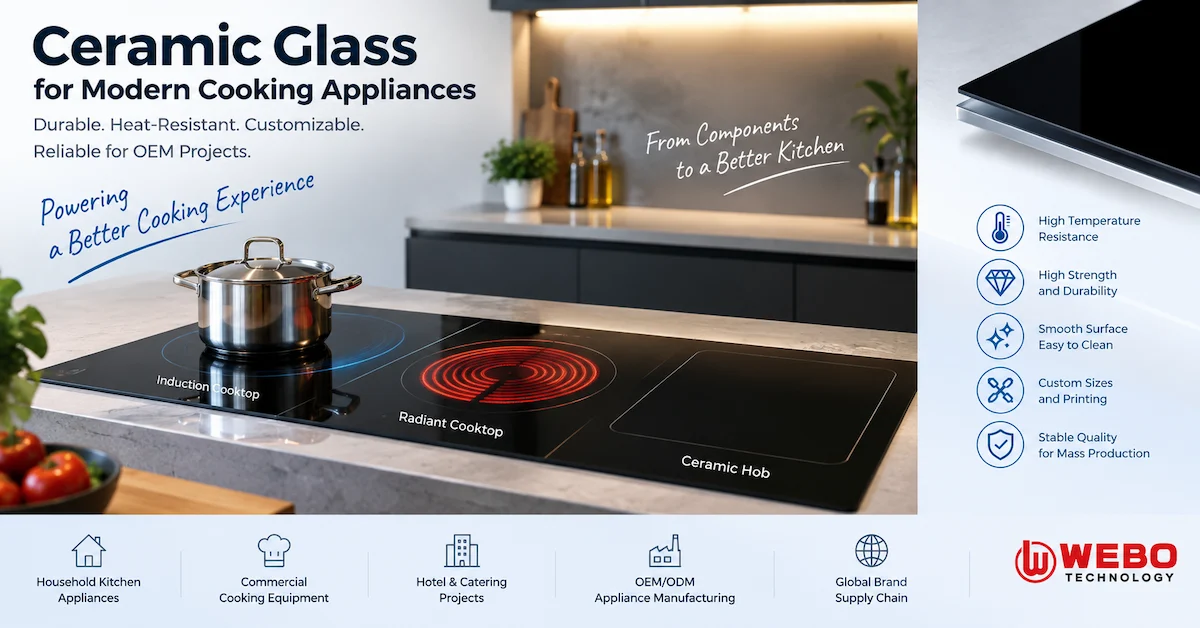
For a custom cooktop project, approving the appearance is not the same as approving the component. Choose a ceramic glass OEM manufacturer that will agree on material identity, manufacturing scope, drawing requirements, sample verification, and change control before production starts. The deliverable should be an approved panel specification—not simply a black surface carrying your logo. This guide is for appliance brands, cooktop manufacturers, and engineering-led sourcing teams developing a defined product, rather than homeowners seeking an unidentified replacement panel. WEBO lists ceramic glass in its product range; review the available options against your application before treating any design feature as confirmed.
Choose Between an Existing Panel, OEM Production, and Design Support
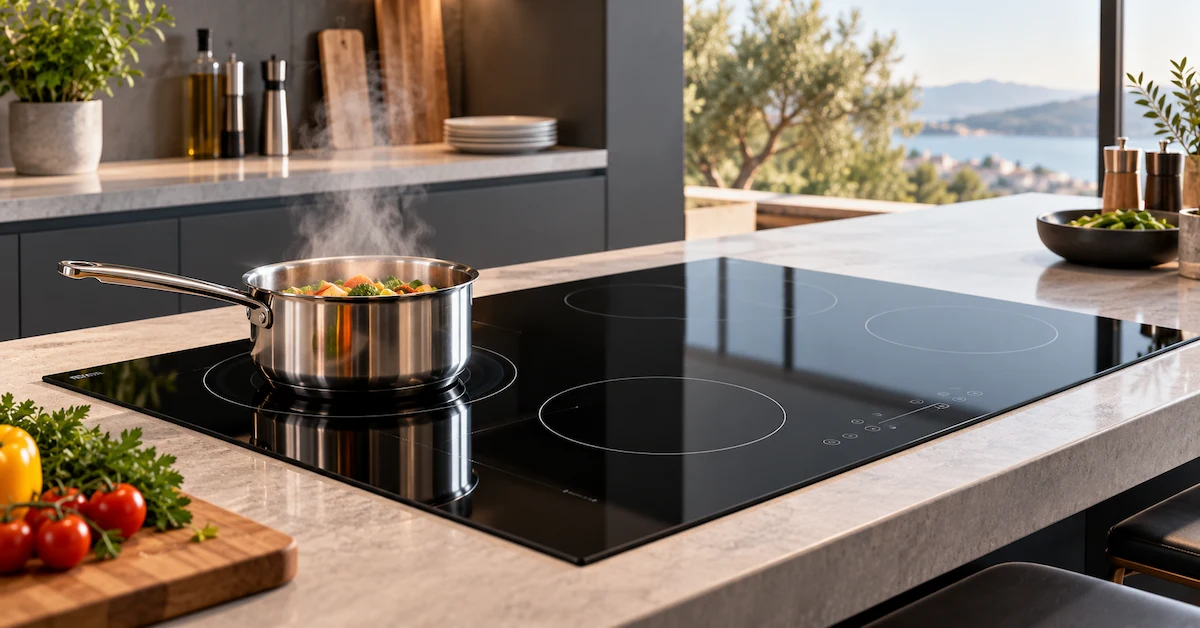
Decide how much of the design is already established. When your drawing, material requirements, artwork, and installation are fixed, structure the inquiry around manufacturing to that specification. When only the desired appearance or appliance concept exists, request development assistance and agree who will resolve the unfinished engineering. An existing panel may be the better starting point when it already meets the project requirements. Customization should address a real difference in geometry, interfaces, branding, or application—not become an additional development exercise without a clear benefit. The comparison below describes project routes, not WEBO model numbers or confirmed service packages.
| Project Route | Buyer’s Starting Point | Potential Value | Main Approval Requirement |
|---|---|---|---|
| Existing panel selection | A defined application that may fit an available panel | Limits the scope of new development | Confirm material, dimensions, interfaces, and application suitability |
| Decoration-focused customization | An acceptable panel design with new graphics | Differentiates branding without intentionally changing geometry | Review artwork placement and any affected display or control areas |
| Drawing-based OEM panel | Controlled drawings and performance requirements | Aligns the component with a specified appliance design | Approve feasibility, samples, inspection criteria, and production revision |
| Development-assisted project | A concept with unresolved specifications | Allows panel and appliance requirements to be developed together | Assign design responsibilities and validate the completed configuration |
Confirm the Material Before Approving the Manufacturing Route
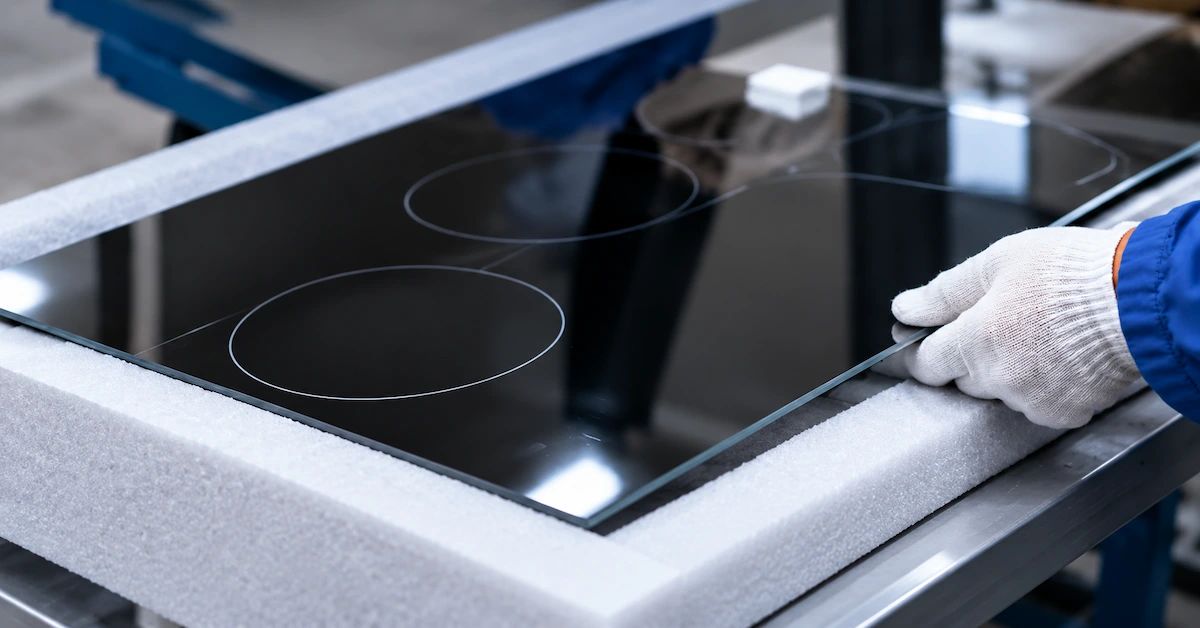
Glass-ceramic is associated with low thermal expansion and resistance to heat, but those general properties do not identify the grade appropriate for a particular cooktop. WEBO’s ceramic glass material overview discusses these characteristics. Obtain grade-specific documentation before translating them into project requirements. Ask the ceramic glass OEM manufacturer to identify the material source and explain its scope: original material production, panel processing, decoration, inspection, or coordinated supply. Do not infer that every operation is performed in-house. Request a manufacturability review covering the proposed outline, thickness, edge profile, openings, decoration, and installation interfaces. Record any limitations or suggested changes before approving samples, and require authorization for material substitutions rather than accepting “equivalent glass” without review.
Build One Drawing Package for the Panel and Its Interfaces
Treat the mechanical drawing, artwork, and appliance assembly drawing as related documents with matching revisions. Define a common origin and reference edges so that panel dimensions, printed symbols, display openings, and mounting features are measured from an agreed location. Specify which surface faces the user and which direction represents the front of the appliance. A drawing that describes the panel alone leaves important interface questions unanswered; include the support frame and relevant heating or control layout. Use the following specification template to organize the review. Its entries are proposed project requirements, not published WEBO numerical specifications; values and acceptance limits must be agreed for the actual design.
| Specification Item | What to Define | Approval Evidence |
|---|---|---|
| Material | Grade, source, and substitution procedure | Material documentation linked to the supplied panel |
| Geometry | Outline, thickness, corner radii, flatness, and dimensional limits | Controlled drawing and measurement report |
| Reference system | Drawing origin, reference edges, orientation, and measurement method | Common references across panel, artwork, and assembly drawings |
| Edge treatment | Required profile and acceptable edge condition | Detailed drawing and inspected sample |
| Holes or cutouts | Size, position, geometry, and feasibility | Supplier review and dimensional verification |
| Decoration | Graphics, colors, placement limits, and print orientation | Approved artwork and appearance reference |
| Display and control areas | Window positions, visibility requirements, and control layout | Evaluation with the intended electronics and assembly |
| Mounting interface | Supports, clearances, gasket or bonding arrangement | Assembly review and fit verification |
| Operating conditions | Heating system, expected use, cleaning, and test requirements | Agreed validation plan and results |
| Production identity | Part number, document revisions, labels, and packaging | Approved production specification package |
Review Printing, Display Windows, and Control Alignment Together
Do not approve graphics solely from a screen rendering. Review burner markings, logos, display windows, and control symbols on a physical sample installed in the intended appliance. For display areas, define what must remain visible and evaluate it with the selected display, relevant brightness settings, and agreed viewing conditions. For touch-control layouts, involve the electronics team in approving the complete panel-and-control arrangement; do not treat a printed icon as proof of functional performance. Also agree on appearance-inspection conditions, including lighting, viewing distance, orientation, and acceptable variation. Give the ceramic glass OEM manufacturer these requirements with the artwork, rather than introducing them after a sample has already been accepted for its color or overall appearance.
A Hypothetical Alignment Check
Consider a one-dimensional example with permitted print-to-panel deviation of ±0.25 mm, panel-to-frame deviation of ±0.20 mm, and display-to-frame deviation of ±0.35 mm. Adding the adverse deviations gives a worst-case relative alignment error of 0.80 mm. If the proposed window allows only 0.60 mm of margin in that direction, this illustrative design does not accommodate the full tolerance combination. The team would need to revise the margin, the tolerance allocation, or the locating arrangement before approval. These numbers demonstrate a review method, not WEBO manufacturing capabilities or measured results. The practical question is whether the assembled design remains acceptable when individually compliant parts meet at their permitted limits.
Evaluate the Panel with the Heating and Mounting System
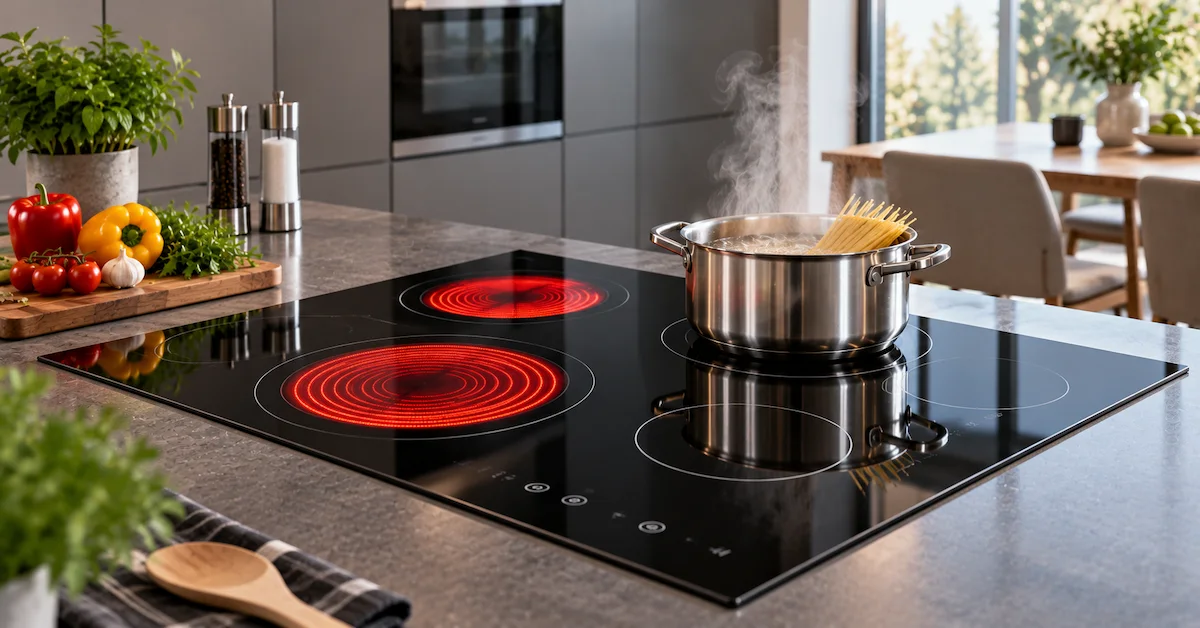
Keep the heating configuration visible throughout development. For an induction cooktop, include the induction coil, electronics, mounting structure, and panel arrangement in the design review. For a radiant cooktop, include the heater position, clearances, and temperature-control requirements alongside the ceramic heater options. Individual component listings do not establish that a particular combination has been validated. Specify residential or commercial operation, anticipated duty, cleaning conditions, and installation constraints before setting the verification plan. WEBO’s radiant heating specification guide provides related application-selection context. Ask the ceramic glass OEM manufacturer and appliance engineering team to identify which checks concern the panel and which require the complete assembly.
Use Separate Approvals for Appearance, Function, and Production
Organize sampling around three decisions. An appearance sample establishes graphics, orientation, color, and visible workmanship; record any features that are not production-representative. A functional prototype evaluates the specified material and geometry within the intended appliance, using an agreed test plan. A pilot build then checks parts made through the proposed production route, including inspection and packaging. Do not allow a signature approving the logo to authorize a change in material or release unrestricted bulk production. For each stage, record the sample identification, document revisions, completed checks, remaining issues, and approval owner. Ask whether samples use the intended processing and decoration methods, and document differences. Release the next stage only after its agreed conditions are met, rather than relying on the broad phrase “sample approved.”
Define Workmanship and Quality Evidence Before Production Release
Give the ceramic glass OEM manufacturer inspection criteria that can be applied consistently. Identify critical dimensions and define acceptable edge condition, surface appearance, print placement, and other relevant workmanship features. Agree how measurements will be taken and how uncertain or disputed results will be reviewed. Request the project-specific evidence needed for thermal exposure, mechanical loading, cleaning resistance, or other agreed evaluations without assigning arbitrary pass limits. Separate routine delivery inspection from design-validation testing. WEBO’s company and certification information is a starting point for supplier background review. Request documents covering the proposed material or component rather than assuming that a general company statement applies to every panel. Check report identification, test conditions, covered configuration, results, and acceptance criteria before relying on the evidence.
Freeze the Design and Keep Changes Traceable
After approval, collect the material specification, panel drawing, artwork, inspection criteria, sample records, and packaging requirements into one released document set. Assign responsibility for approving mechanical, cosmetic, and functional changes. For an illustrative branding update, moving a logo within an otherwise unchanged approved area and moving a printed display boundary are different proposed changes; review each against the functions and interfaces it could affect rather than assigning both the same “artwork only” status. Record the old and new revisions, approval decision, any additional verification, and the production point at which the change takes effect. Specify how remaining inventory will be identified or handled. The aim is to make a later shipment reproducible without depending on someone remembering an email discussion.
Separate Development Charges from Production Pricing and Lead Time
Request a quotation that distinguishes sample preparation, artwork setup, special processing or fixtures, validation work, packaging development, and unit pricing. Identify which charges are one-time and which may recur after a revision. Discuss ownership, confidentiality, permitted use, and retention of customer drawings, artwork, and any paid tooling before committing to development. For timing, ask the ceramic glass OEM manufacturer to separate feasibility review, sampling, customer testing, revision, pilot production, and bulk production. Confirm which approved inputs start each stage and request capacity information for the actual configuration and proposed schedule. Agree what happens when customer testing or design changes move a milestone. WEBO-specific processing limits, sample charges, minimum quantities, capacity, and delivery dates require project confirmation rather than assumptions based on this guide.
Prepare an OEM Cooktop Panel Inquiry for WEBO
WEBO’s published portfolio includes ceramic glass alongside heating and control components, offering a starting point for a component-level project discussion. Review the WEBO product range, then submit the appliance application, panel drawing, assembly interfaces, artwork, target market, sample needs, and expected production quantities. Identify the requirements that are fixed and those still open to engineering review. Request a response that separates confirmed options, proposed changes, and unresolved technical questions. This approach helps evaluate WEBO as a ceramic glass OEM manufacturer against a defined project rather than an unrestricted promise of customization. For an existing design, include the current revision; for a new design, describe the functional outcome and name the team responsible for approving the final specification.
Frequently Asked Questions
1. What distinguishes an OEM panel from a standard catalog panel?
For this project framework, an OEM panel is supplied against the buyer’s approved specification, which may define unique geometry, decoration, or interfaces. A catalog panel starts from an existing design. Both still need confirmation against the intended appliance.
2. Can WEBO work from a CAD drawing or a physical sample?
Submit the available files or sample details through the project inquiry and request feasibility confirmation. A physical reference should be supported by requirements for material, dimensions, decoration, and performance; appearance alone does not define the complete production specification.
3. Can custom graphics and display windows be included?
Present the artwork and display layout for review. Ask which decoration options are available and what sample verification is required. Treat material, printing, display visibility, and control performance as related approval questions rather than assuming every design can be supplied.
4. How should panel thickness and dimensional tolerances be selected?
Agree them through the appliance design and supplier feasibility review. Review the permitted variations across the panel, frame, and related components together. Do not adopt a catalog thickness or tolerance without assessing the actual installation and verification requirements.
5. Can one panel design cover several cooktop models?
Evaluate the proposed shared design against each model’s heating layout, mounting structure, controls, and graphics. Document any common requirements and variant-specific checks before approval. A shared outline should be treated as a starting point for review, not automatic interchangeability.
6. What should be confirmed before paying for OEM development?
Agree on the development scope, deliverables, sample quantity, revision process, charges, and responsibilities. Clarify ownership and permitted use of drawings, artwork, and tooling, and identify what additional testing or customer information is needed before production can be released.
7. How many sample rounds should be planned?
Determine the stages from the design’s maturity and the agreed verification plan. Separate appearance review from functional and production approval. Ask what each sample round covers and how changes will affect cost, timing, and the need for additional samples.
8. Does a sample test report cover all future panel variations?
Check the report’s stated scope rather than assuming coverage. Compare the tested configuration with the proposed material, geometry, decoration, and application. Ask the responsible technical reviewer to determine whether a change needs further evaluation.
9. What needs to be completed before bulk production starts?
Release the approved material specification, drawings, artwork, inspection criteria, sample records, and packaging requirements. Close outstanding technical issues or document agreed restrictions. Confirm commercial terms, schedule, and the revision that the production order authorizes.
10. How do I request a ceramic glass OEM quotation from WEBO?
Use the WEBO contact page to send drawings, application details, artwork, sample needs, quantities, and timing. Request confirmation of available material and processing options, development terms, inspection documentation, and the proposed approval sequence.
Conclusion
Selecting a ceramic glass OEM manufacturer means establishing how a custom panel moves from a drawing to an approved, repeatable production component. Resolve material identity, geometry, artwork, and appliance interfaces together; separate appearance approval from functional validation; and document the production version before placing bulk orders. The strongest project brief makes both requirements and open questions visible. To review your cooktop panel design, send WEBO your OEM project requirements with the drawings, operating conditions, artwork, and quantity plan so that technical scope, samples, and production terms can be discussed against the same specification.