


Why Choosing the Right Ceramic Glass Supplier Matters
For induction cooktop manufacturers and appliance brands, ceramic glass is a critical component that affects both product performance and customer experience.
A suitable ceramic glass supplier should provide more than a finished glass panel.
The supplier should help buyers maintain:
- Stable product specifications
- Consistent surface quality
- Reliable production capacity
- Predictable delivery schedules
- Flexible customization support
Unlike ordinary glass components, ceramic glass used in kitchen appliances needs to perform under repeated heating conditions.
A supplier failure can create problems beyond the component itself.
Potential consequences include:
- Production delays
- Assembly issues
- Customer complaints
- Additional inspection costs
- Appliance launch delays
Therefore, supplier selection should focus on long-term supply reliability rather than only initial quotation price.
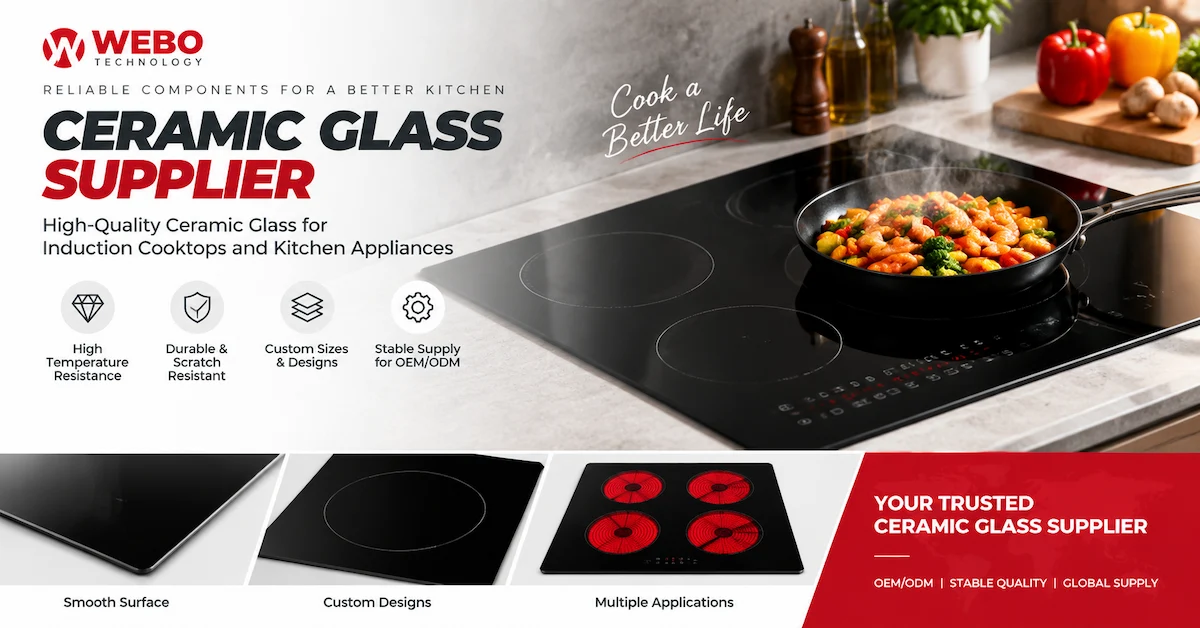
Who Usually Needs a Ceramic Glass Supplier?
Different buyers have different supplier requirements.
Induction Cooktop Manufacturers
These companies typically purchase ceramic glass for:
- Built-in induction hobs
- Portable induction cookers
- Electric cooktops
- Commercial cooking equipment
Their main concerns include:
- Stable dimensions
- Consistent appearance
- Large-volume supply
- Quality documentation
Kitchen Appliance Brands
Private-label brands often need suppliers that can support:
- Product customization
- New model development
- Packaging requirements
- Production flexibility
Appliance Distributors
Distributors usually focus on:
- Reliable inventory
- Multiple product options
- Export capability
- Competitive purchasing terms
OEM/ODM Appliance Companies
These buyers may require:
- Engineering communication
- Sample development
- Customized specifications
- Long-term cooperation
Ceramic Glass Supplier vs Manufacturer: Which One Should You Choose?
The terms are often used interchangeably, but they represent different purchasing relationships.
| Factor | Manufacturer | Supplier |
|---|---|---|
| Production control | Direct | May vary |
| Custom development | Strong | Depends on source |
| Technical support | Usually direct | Depends on team |
| Inventory flexibility | Limited by production plan | Often stronger |
| Supply coordination | Production-focused | Buyer-focused |
| OEM projects | Suitable | Depends on capability |
For large appliance programs, the ideal partner is usually a supplier with direct manufacturing capability.
This allows buyers to communicate with both:
- Production teams
- Commercial teams
without unnecessary information loss.
What Specifications Should Buyers Confirm With a Ceramic Glass Supplier?
A quotation is only meaningful when suppliers are comparing the same requirements.
Before requesting prices, buyers should define:
| Specification | Why It Matters |
|---|---|
| Glass size | Determines appliance fit |
| Thickness | Influences strength and design |
| Shape | Affects processing feasibility |
| Openings | Ensures assembly compatibility |
| Edge treatment | Influences safety and appearance |
| Surface finish | Controls final appearance |
| Printing requirements | Supports branding |
| Quantity | Determines production planning |
| Packaging | Reduces transportation risk |
A supplier should review these details before confirming final pricing.
How Should Buyers Evaluate Ceramic Glass Quality?
A professional supplier should have clear quality control procedures.
Dimension Accuracy
Check:
- Length
- Width
- Thickness
- Hole positions
- Edge dimensions
Dimensional consistency is important because ceramic glass must fit precisely into the finished appliance.
Surface Inspection
Common inspection points include:
- Scratches
- Chips
- Cracks
- Printing defects
- Surface contamination
Because ceramic glass is visible to end users, appearance standards should be defined clearly.
Edge Quality
Edge processing affects:
- Assembly safety
- Product appearance
- Breakage risk
The supplier should have controlled edge-processing methods.
Packaging Inspection
For international shipments, packaging is part of quality control.
Review:
- Individual protection
- Separation method
- Carton strength
- Transportation protection
How Can Buyers Reduce Ceramic Glass Supply Risks?
A reliable sourcing process should identify risks before mass production.
Risk 1: Different Suppliers Quote Different Specifications
Two suppliers may quote “ceramic glass” but provide different:
- Materials
- Thickness
- Processing
- Inspection standards
Solution:
Create a unified specification sheet.
Risk 2: Sample Quality Does Not Represent Production
A good prototype does not automatically mean stable mass production.
Solution:
Confirm:
- Production sample approval
- Inspection criteria
- Batch control method
Risk 3: Delivery Problems During Peak Demand
Appliance production schedules often depend on component availability.
Solution:
Discuss:
- Production capacity
- Lead time
- Forecast planning
- Material preparation
Risk 4: Uncontrolled Product Changes
A supplier changing material or processing methods without notice can affect appliance performance.
Solution:
Establish change-control requirements.
What Should a Ceramic Glass Supplier Provide for OEM Projects?
OEM buyers usually need more than standard supply.
Possible support includes:
- Custom dimensions
- Special shapes
- Printing
- Edge processing
- Packaging customization
- Prototype support
A good supplier should review the project before production.
Recommended information includes:
- Appliance drawings
- Glass specifications
- Target market
- Annual demand
- Required delivery schedule
This allows the supplier to evaluate feasibility.
How Does Ceramic Glass Sampling Work?
A structured sampling process helps avoid unnecessary delays.
Initial Sample Review
The buyer should check:
- Dimensions
- Appearance
- Surface quality
- Appliance fit
Engineering Validation
The sample should be tested together with the intended appliance.
Check:
- Assembly compatibility
- Heating operation
- User interaction
- Product appearance
Final Approval
Before mass production, confirm:
- Final drawing
- Material specification
- Inspection criteria
- Packaging method
The approved sample becomes the production reference.
How Should Buyers Compare Ceramic Glass Suppliers?
Price should not be the only comparison factor.
Use a supplier evaluation checklist.
| Evaluation Area | Buyer Question |
|---|---|
| Experience | Has the supplier served appliance projects? |
| Product range | Can it support required specifications? |
| Quality control | Are inspection methods documented? |
| Customization | Can it handle OEM requirements? |
| Capacity | Can it support future demand? |
| Communication | Can technical issues be solved quickly? |
| Delivery | Are lead times realistic? |
| Export | Can packaging meet international shipping needs? |
A supplier that understands your application can often reduce development problems later.
What Factors Affect Ceramic Glass Supplier Pricing?
Ceramic glass pricing depends on multiple factors.
Material Specification
Different requirements affect cost:
- Thickness
- Size
- Material type
Processing Requirements
Additional processes may include:
- Cutting
- Grinding
- Polishing
- Drilling
- Printing
Order Quantity
Pricing usually differs between:
- Prototype quantities
- Trial orders
- Regular production volumes
Packaging Requirements
Export protection may increase cost but reduce transportation damage.
Customization
Special shapes and designs require additional engineering and processing.
A lower quotation should always be compared against the same technical scope.
Why Consider WEBO as a Ceramic Glass Supplier?
WEBO provides ceramic glass and related kitchen appliance components for global B2B customers.
Its product portfolio includes:
- Ceramic Glass
- Induction Coil
- Hot Plate
- Ceramic Heater
- Tube Heating Element
- Cast Iron Pan Support
- Rotary Switch
- Energy Regulator
For induction cooktop buyers, ceramic glass is closely connected with other heating components.
Buyers can review:
WEBO Ceramic Glass Products
https://www.weboproducts.com/products/ceramic-glass-cates
Related product:
WEBO Induction Coil
https://www.weboproducts.com/product/induction-coil-2
By working with a supplier familiar with multiple appliance components, buyers can simplify technical communication during product development.
What Information Should Be Included in a Ceramic Glass RFQ?
A complete inquiry helps suppliers provide accurate feedback.
Technical Information
Include:
- Appliance type
- Glass dimensions
- Thickness
- Shape drawing
- Openings
- Surface requirements
- Printing requirements
- Edge requirements
Commercial Information
Provide:
- Sample quantity
- Trial order quantity
- Annual forecast
- Destination market
- Packaging requirements
- Expected delivery date
A detailed RFQ helps both sides evaluate whether the project is suitable.
FAQ
1. What does a ceramic glass supplier provide?
A ceramic glass supplier provides ceramic glass panels for appliance applications and may support customization, processing, packaging, and production coordination.
2. How do I choose a ceramic glass supplier?
Evaluate product capability, quality control, customization support, delivery reliability, production capacity, and technical communication.
3. What information should I provide when requesting ceramic glass pricing?
Provide drawings, dimensions, thickness, surface requirements, quantity, application, packaging needs, and delivery expectations.
4. Can ceramic glass suppliers customize products?
Many suppliers can support customized dimensions, shapes, printing, edge processing, and packaging depending on their manufacturing capability.
5. Why is ceramic glass important for induction cooktops?
Ceramic glass provides a durable surface designed for repeated heating cycles and appliance use.
6. Should buyers test ceramic glass samples?
Yes. Samples should be evaluated with the intended appliance to confirm fit and performance.
7. What quality issues should buyers check?
Important checks include dimensions, surface defects, edge quality, printing accuracy, and packaging protection.
8. How can buyers avoid supplier quality problems?
Use clear specifications, approve samples, define inspection standards, and establish change-control requirements.
9. Can ceramic glass suppliers also provide induction coils?
Some appliance-component suppliers provide both ceramic glass and induction coils, which can simplify sourcing.
10. How can I start cooperation with WEBO?
Review WEBO Ceramic Glass products, prepare your technical requirements, and contact WEBO with drawings, quantities, and project details.
Conclusion
Choosing the right ceramic glass supplier is an important step for induction cooktop manufacturers and appliance brands.
A reliable supplier should provide:
- Stable quality
- Accurate processing
- OEM support
- Reliable delivery
- Long-term production capability
The best sourcing approach is:
Define requirements → evaluate suppliers → approve samples → validate products → freeze specifications → begin mass production
This process helps reduce supply risks and creates a more stable production relationship.
WEBO supplies ceramic glass and related kitchen appliance components for global customers. Buyers developing induction cooktops or other heating appliances can review WEBO ceramic glass solutions and discuss product requirements, customization options, and long-term supply plans.
Contact WEBO for ceramic glass sourcing:
https://www.weboproducts.com/contact-us