


What Is a Gas Stove Pan Support?
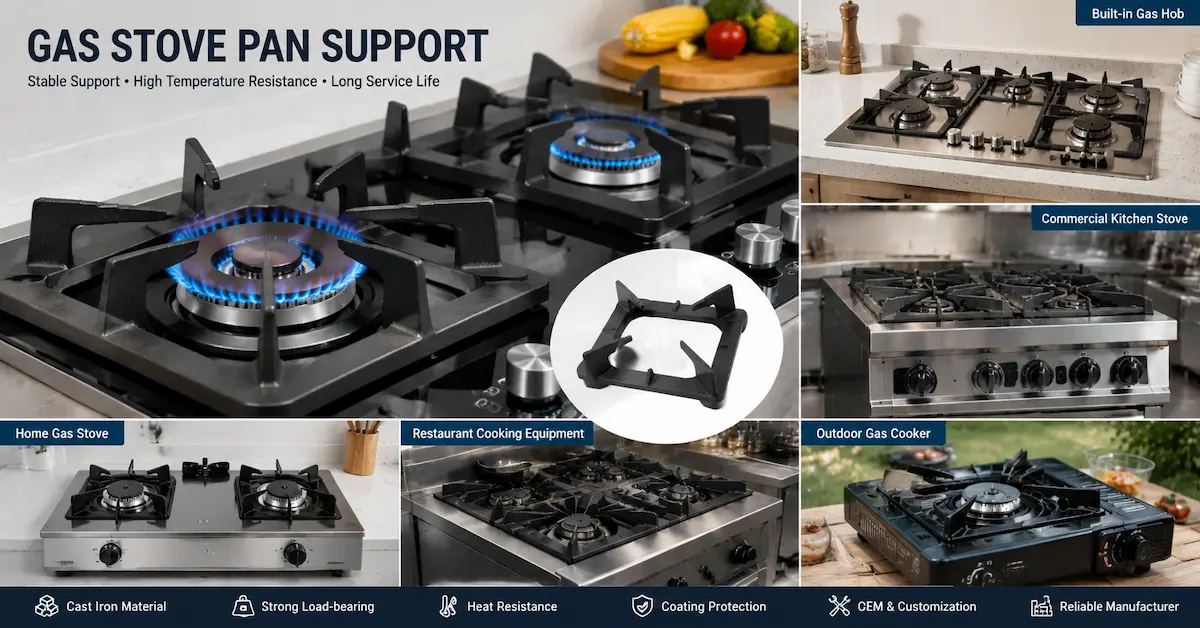
A gas stove pan support, also known as a burner grate or gas stove trivet, is a key component installed above gas burners to support cookware and maintain stable cooking conditions.
Although it appears to be a simple metal component, the pan support directly affects:
- Cooking stability
- Heat transfer efficiency
- User safety
- Product appearance
- Long-term durability
For gas appliance manufacturers, choosing the right gas stove pan support manufacturer is important because the component must match:
- Burner layout
- Stove design
- Weight requirements
- Heat exposure
- Surface finishing
- Assembly structure
A professional manufacturer should not only produce the casting but also understand appliance integration requirements.
WEBO's product portfolio includes Cast Iron Pan Support together with other kitchen appliance components such as Hot Plate, Ceramic Heater, Tube Heating Element, Rotary Switch, and Energy Regulator, providing appliance manufacturers with related component sourcing options.
(WEBO Products)
Who Needs a Gas Stove Pan Support Manufacturer?
A professional pan support manufacturer mainly serves B2B buyers who require stable production and customization.
Gas Stove Manufacturers
Gas appliance manufacturers are the primary customers.
Typical products include:
- Built-in gas hobs
- Freestanding gas cookers
- Kitchen ranges
- Commercial gas stoves
Their requirements usually include:
- Accurate dimensions
- Stable casting quality
- Consistent appearance
- Long-term supply capability
Kitchen Appliance Brands
Private-label and appliance brands often need:
- Custom designs
- Product matching
- Packaging support
- Reliable production
They may work with manufacturers to develop components for new stove models.
Importers and Distributors
Importers usually focus on:
- Competitive pricing
- Production reliability
- Export experience
- Product consistency
Common purchasing requirements:
- Bulk orders
- Multiple models
- Replacement parts
- Regional distribution
Replacement Parts Suppliers
Aftermarket suppliers need:
- Compatible dimensions
- Durable materials
- Stable inventory
- Cost-effective sourcing
They usually require products compatible with different stove brands and models.
Common Applications of Gas Stove Pan Supports
Gas stove pan supports are widely used in residential and commercial cooking equipment.
| Application | Product Example | Buyer Requirements |
|---|---|---|
| Home gas stove | Kitchen cooker | Appearance, durability, safety |
| Built-in gas hob | Integrated kitchen appliance | Precise dimensions |
| Commercial kitchen stove | Restaurant equipment | Heavy load capacity |
| Outdoor gas cooker | Camping and outdoor cooking | Heat resistance |
| Catering equipment | Professional cooking systems | Long service life |
For manufacturers, the pan support design must match the burner structure and intended cooking environment.
Why Cast Iron Is Commonly Used for Gas Stove Pan Supports
Many gas stove pan supports use cast iron because it provides several advantages for high-temperature cooking environments.
High Temperature Resistance
Gas burners generate significant heat during operation.
Cast iron can maintain structural stability under repeated heating cycles.
Important benefits:
- Good heat resistance
- Stable mechanical strength
- Long service life
Strong Load-Bearing Capability
Cookware can be heavy, especially in:
- Commercial kitchens
- Large cooking systems
- Professional ranges
A strong cast iron structure helps maintain:
- Pot stability
- Cooking safety
- Long-term durability
Good Heat Retention
Cast iron has good thermal characteristics, helping maintain stable heat distribution around the cookware support area.
Suitable for Complex Shapes
Casting allows manufacturers to produce:
- Multi-leg supports
- Decorative designs
- Burner-specific structures
- Custom shapes
This flexibility makes cast iron suitable for OEM stove component development.
Gas Stove Pan Support Structure and Design Considerations
A professional manufacturer should evaluate more than the external appearance.
Important design factors include:
Size and Dimension
The pan support must match:
- Burner diameter
- Stove surface layout
- Mounting position
- Cooking area
Incorrect dimensions may cause:
- Unstable cookware placement
- Poor appearance
- Assembly problems
Weight Capacity
The support should handle different cookware loads.
Design considerations:
- Material thickness
- Support structure
- Contact points
- Leg design
Burner Compatibility
Different burners require different support structures.
Examples:
- Single burner support
- Double burner support
- Multi-burner grate
The manufacturer should consider:
- Flame position
- Heat distribution
- Pan stability
Surface Treatment
Surface finishing affects:
- Appearance
- Corrosion resistance
- Cleaning performance
Possible treatments include:
- Enamel coating
- Protective finishing
- Surface treatment according to customer requirements
Types of Gas Stove Pan Supports
| Type | Application | Main Advantage |
|---|---|---|
| Single burner support | Compact cookers | Space saving |
| Double burner support | Household stoves | Balanced support |
| Three-burner grate | Larger hobs | Wider cooking area |
| Four-burner support | Kitchen ranges | Commercial-style cooking |
| Custom cast iron grate | OEM projects | Exact equipment matching |
A professional manufacturer should be able to adjust:
- Shape
- Size
- Weight
- Burner position
- Surface treatment
according to customer requirements.
Manufacturing Process of Gas Stove Pan Supports
A reliable gas stove pan support manufacturer should have a controlled production process.
1. Material Preparation
The process begins with:
- Cast iron material selection
- Material inspection
- Composition control
Material quality affects:
- Strength
- Heat resistance
- Product durability
2. Mold Development
For customized products, mold design is a key step.
The manufacturer evaluates:
- Product structure
- Casting feasibility
- Wall thickness
- Surface details
OEM customers usually provide:
- Drawing
- Existing sample
- Product specification
The manufacturer then develops or modifies the mold.
3. Casting Process
Casting forms the basic pan support structure.
Important controls include:
- Casting temperature
- Material consistency
- Surface quality
- Structural integrity
4. Surface Processing
After casting, products may require:
- Grinding
- Cleaning
- Surface treatment
- Coating
This improves:
- Appearance
- Surface quality
- User experience
5. Inspection and Packaging
Before shipment, manufacturers should check:
- Dimensions
- Surface condition
- Structural quality
- Packaging protection
For export customers, packaging is especially important because cast iron components are heavy and can damage surrounding products if not properly protected.
OEM Customization Process for Gas Stove Pan Supports
For appliance brands and stove manufacturers, OEM customization is often required because different gas stove models have different:
- Burner layouts
- Cooking areas
- Product designs
- Installation structures
- Market requirements
A professional gas stove pan support manufacturer should provide a complete development process.
Step 1: Requirement Analysis
The buyer provides basic project information:
- Gas stove model
- Burner arrangement
- Product dimensions
- Material requirements
- Surface finishing requirements
- Quantity requirement
- Target market
The manufacturer evaluates:
- Manufacturing feasibility
- Material selection
- Production process
- Estimated cost
Step 2: Drawing or Sample Review
OEM buyers can provide:
- CAD drawings
- Product samples
- Existing pan supports
- Stove assembly drawings
The manufacturer reviews:
- Overall dimensions
- Mounting position
- Burner compatibility
- Structural strength
- Casting feasibility
A detailed technical review helps prevent problems before mold development.
Step 3: Mold Development
For customized pan supports, mold development is usually required.
The mold design affects:
- Product accuracy
- Surface quality
- Production efficiency
- Long-term consistency
Important considerations:
- Casting structure
- Wall thickness
- Support strength
- Surface details
- Production repeatability
Step 4: Prototype Production
Before mass production, samples should be produced for customer evaluation.
Customers should check:
- Fit on the gas stove
- Burner alignment
- Cooking stability
- Surface appearance
- Weight capacity
Step 5: Product Optimization
Based on testing results, adjustments may include:
- Dimension changes
- Structural reinforcement
- Surface improvement
- Weight optimization
Step 6: Mass Production
After approval, production moves into the manufacturing stage.
The supplier should maintain consistency in:
- Material quality
- Product dimensions
- Surface finishing
- Packaging
Quality Control Requirements for Gas Stove Pan Supports
Quality control is critical because pan supports experience:
- High temperature
- Heavy cookware loads
- Repeated heating cycles
- Daily mechanical stress
A reliable manufacturer should control quality throughout the production process.
Raw Material Inspection
Before production, materials should be checked for:
- Material consistency
- Casting suitability
- Structural reliability
Poor material quality may lead to:
- Cracking
- Deformation
- Reduced service life
Dimensional Inspection
Important measurements include:
- Overall size
- Burner opening position
- Support height
- Contact points
- Installation structure
Dimensional accuracy affects:
- Stove assembly
- Cooking stability
- Customer experience
Structural Inspection
Manufacturers should check:
- Casting defects
- Cracks
- Weak support areas
- Uneven structures
This is especially important for large commercial stove supports.
Surface Quality Inspection
Check:
- Surface smoothness
- Coating condition
- Appearance consistency
- Rust prevention
Surface problems may affect:
- Product appearance
- Cleaning experience
- Customer satisfaction
Load and Heat Resistance Evaluation
The pan support should withstand:
- Heavy cookware
- Continuous cooking cycles
- High-temperature environments
Testing requirements depend on:
- Product design
- Customer specification
- Final application
Packaging Inspection
Because cast iron products are heavy, packaging should prevent:
- Impact damage
- Surface scratches
- Coating damage
- Transportation issues
Export packaging should consider:
- Product weight
- Shipping distance
- Stacking conditions
How to Choose a Gas Stove Pan Support Manufacturer?
Selecting the right supplier requires evaluating more than product price.
1. Manufacturing Experience
Check:
- Years of production experience
- Main product categories
- Customer industries
- Export markets
A manufacturer experienced in appliance components usually understands:
- Product integration
- Quality expectations
- Production consistency
2. Casting Capability
For cast iron pan supports, evaluate:
- Casting technology
- Mold capability
- Production equipment
- Surface processing
A strong casting capability supports:
- Complex designs
- Stable production
- Custom projects
3. Customization Ability
A qualified supplier should support:
- New designs
- Existing product modification
- Different sizes
- Different burner layouts
- Surface treatment options
4. Quality Management
Ask:
- What inspections are performed?
- How are defects controlled?
- How are production batches managed?
- How are customer specifications maintained?
5. Export Experience
For overseas buyers, export capability matters.
Evaluate:
- International shipping experience
- Export packaging
- Documentation support
- Communication ability
Gas Stove Pan Support Cost Factors
The price of a pan support depends on multiple factors.
| Cost Factor | Impact |
|---|---|
| Material | Cast iron quality affects cost |
| Product weight | More material increases cost |
| Size | Larger structures require more resources |
| Mold | Custom designs may require tooling |
| Surface treatment | Coating affects cost |
| Quantity | Larger orders reduce unit cost |
| Packaging | Export protection affects cost |
Buyers should compare quotations based on the same specifications.
A cheaper product may use:
- Different material
- Different weight
- Different surface treatment
- Lower inspection requirements
Therefore, total value is more important than initial unit price.
Common Problems When Buying Gas Stove Pan Supports
Choosing Based Only on Appearance
Two products may look similar but differ in:
- Material strength
- Weight
- Heat resistance
- Manufacturing quality
Ignoring Burner Compatibility
A pan support must match:
- Burner size
- Stove structure
- Cooking requirements
Not Confirming Dimensions
Incorrect dimensions may cause:
- Unstable cookware
- Assembly problems
- Customer complaints
Skipping Sample Approval
For OEM projects, sample validation is important before bulk production.
Ignoring Export Packaging
Heavy cast iron components require proper protection during transportation.
Why Consider WEBO as a Gas Stove Pan Support Manufacturer?
GUANGDONG WEBO TECHNOLOGY was established in 1998 in Yangjiang, Guangdong.
According to WEBO's company information, the company operates a manufacturing facility of approximately 50,000 square meters, has more than 500 employees, and provides appliance-related components for international markets.
(WEBO About Us)
WEBO's appliance component portfolio includes:
- Cast Iron Pan Support
- Hot Plate
- Ceramic Heater
- Tube Heating Element
- Induction Coil
- Ceramic Glass
- Rotary Switch
- Energy Regulator
This product combination allows appliance manufacturers to source multiple kitchen appliance components from one supplier.
For gas stove pan support projects, buyers can discuss:
- Product specifications
- Existing designs
- Custom requirements
- Bulk supply needs
- Export requirements
through the WEBO contact page.
FAQ
1. What is a gas stove pan support?
A gas stove pan support is a metal component placed above gas burners to support cookware and maintain stable cooking during operation.
2. What material is commonly used for gas stove pan supports?
Cast iron is commonly used because of its heat resistance, strength, durability, and suitability for high-temperature cooking environments.
3. Can a gas stove pan support be customized?
Yes. Manufacturers can customize dimensions, shapes, burner layouts, surface treatments, and packaging according to customer requirements.
4. Who buys gas stove pan supports from manufacturers?
Typical buyers include:
- Gas stove manufacturers
- Kitchen appliance brands
- Importers
- Distributors
- Replacement parts suppliers
5. What information should I provide for an OEM quotation?
Provide:
- Drawing or sample
- Stove model
- Dimensions
- Burner layout
- Material requirements
- Surface treatment
- Quantity
6. How is the quality of cast iron pan supports controlled?
Quality control may include:
- Material inspection
- Dimensional inspection
- Casting inspection
- Surface inspection
- Packaging inspection
7. Are gas stove pan supports suitable for commercial kitchens?
Yes. Heavy-duty cast iron supports are commonly used in commercial cooking equipment because they can support heavier cookware and withstand frequent heating cycles.
8. How long does OEM development take?
Development time depends on:
- Product complexity
- Mold requirements
- Sample revisions
- Customer approval process
The supplier should confirm the schedule according to the specific project.
9. What affects gas stove pan support pricing?
Main factors include:
- Material
- Weight
- Size
- Mold cost
- Surface treatment
- Quantity
- Packaging
10. How can I contact WEBO for gas stove pan support sourcing?
Buyers can review WEBO's appliance component range and submit product requirements through the WEBO contact page.
Conclusion
Choosing the right gas stove pan support manufacturer requires evaluating manufacturing capability, casting quality, customization ability, quality control, and export experience.
For appliance brands and kitchen equipment manufacturers, the ideal supplier should provide more than a metal component. A reliable manufacturer should help ensure that the pan support matches the stove design, performs safely under high temperatures, and remains consistent throughout long-term production.
WEBO provides cast iron pan supports and other kitchen appliance components with support for OEM cooperation, customization, and bulk supply.
Companies looking for a reliable gas stove component partner can review WEBO's product range and contact the team with drawings, samples, and project requirements for evaluation.