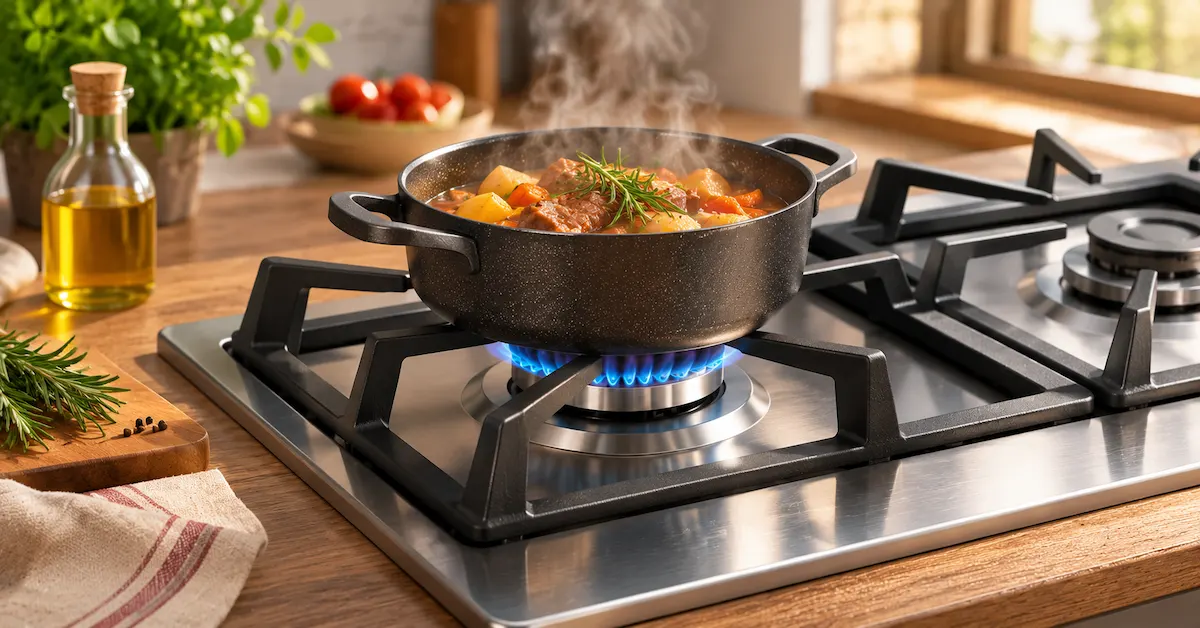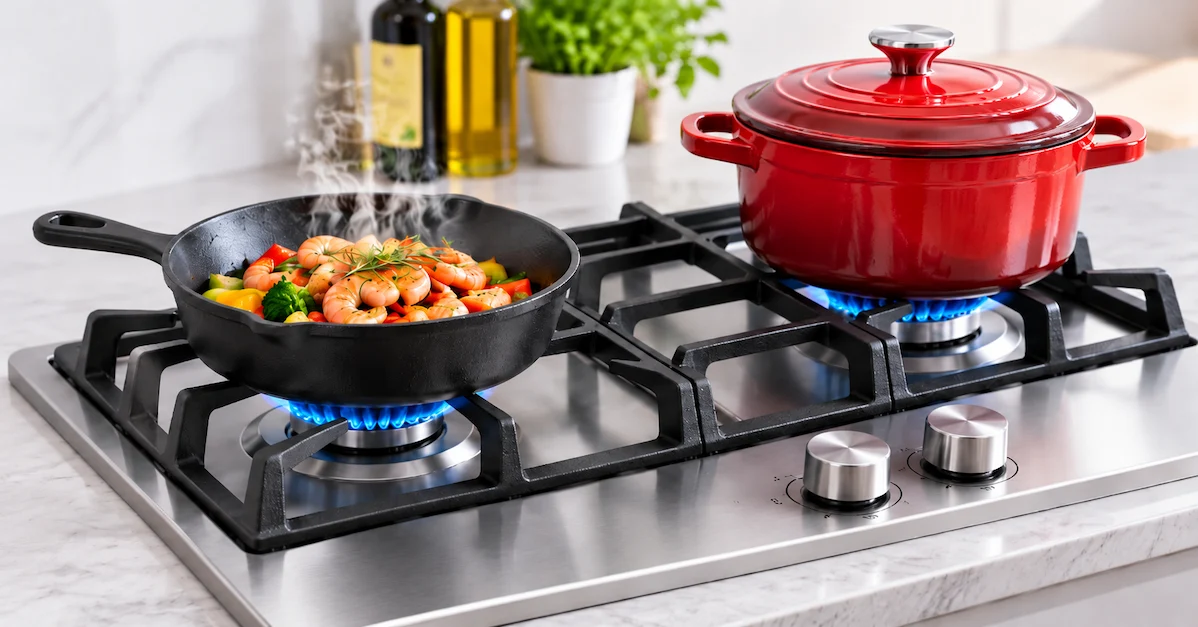



Quick Answer: In a cast iron grate grids manufacturer vs supplier comparison, choose based on the component's design maturity and purchasing requirements. A manufacturer with direct engineering access may be preferable for developing custom grate geometry, while a capable supplier or distributor may be more suitable for purchasing established models across several SKUs. The right choice depends on technical fit, quality evidence, order structure, total cost, and support for future purchases.
Gas hob manufacturers and appliance-parts importers often encounter similar-looking cast iron grate products from different sources.
One company advertises factory manufacturing. Another describes itself as an international supplier. Both may offer single-burner supports, double-burner grates, or grid-style gas cooktop components.
However, these sourcing options are not necessarily equivalent.
For an OEM developing a new cooking appliance, the critical challenge may be designing grate geometry around a specific burner arrangement.
For a distributor serving replacement-parts dealers, the main challenge may be finding correctly identified components that can be purchased and supplied consistently.
This distinction changes how buyers should evaluate quotations, technical documentation, sample requirements, and commercial conditions.
WEBO, officially GUANGDONG WEBO TECHNOLOGY CO., LTD, is a China-based supplier of heating elements and cooking appliance components established in 1998.
Its published product portfolio includes Cast Iron Pan Support, with Single Burner, Double Burner, and Cast Iron Grate Grids listed as product groupings.
This guide explains how international B2B buyers can select the sourcing arrangement that best fits their actual purchasing program.
Explore WEBO Cast Iron Pan Support Products.
Key Takeaways
-
Manufacturers and suppliers serve different roles: A manufacturer produces components, while a supplier sells or coordinates their supply. One company may perform both roles.
-
Custom designs require stronger engineering coordination: Burner layout, mounting points, casting geometry, and finish must be agreed before production.
-
Standard-model purchasing prioritizes identification: Accurate drawings, model references, packaging, and repeat-order consistency matter.
-
Grate format changes sourcing requirements: Single-burner, double-burner, and grid-style structures should not be treated as interchangeable.
-
Total purchasing cost matters: Unit price alone does not account for tooling, samples, inspection, logistics, and inventory risk.
-
Supplier selection should be evidence-based: Compare documented capabilities rather than factory labels or marketing claims.
1. What Are Cast Iron Grate Grids?
Cast iron grate grids are structural components used to support cookware above gas burners.
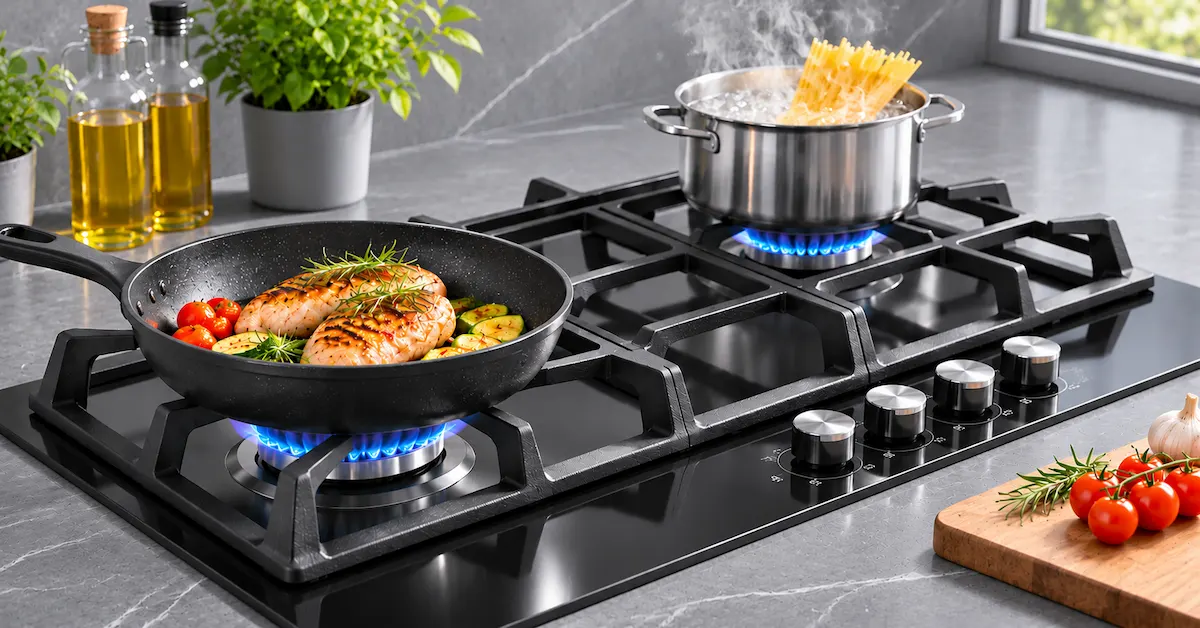
Depending on appliance design, they may take the form of individual burner supports, paired support structures, or more extensive grid-style arrangements.
Their main function is to provide a stable cooking-vessel support interface while maintaining the required position relative to the burner and cooktop.
They are distinct from electric heating plates, which generate heat through an electrical heating system.
Common Gas Stove Grate Configurations
| Grate configuration | Typical application | Main design consideration |
|---|---|---|
| Single-burner support | Individual gas burner | Locating feet and cookware support |
| Double-burner grate | Two-burner gas hob | Burner spacing and overall geometry |
| Multi-burner grate grid | Integrated or sectional gas cooktop support | Cross-burner alignment and stability |
| Replacement grate component | Existing appliance model | Exact part identification and fit |
The product name alone does not establish compatibility.
A grate should be selected according to the intended appliance's actual dimensions and operating requirements.
Who Should Read This Guide?
This comparison is particularly useful for gas stove OEM manufacturers developing new appliance platforms, purchasing managers sourcing custom components, importers managing established parts programs, and distributors handling several grate configurations.
It is less relevant to consumers purchasing a single unverified replacement part without an appliance model number or accurate dimensions.
2. Cast Iron Grate Grids Manufacturer vs Supplier: What Is the Difference?
The most important distinction is the role each company performs in the purchasing relationship.
A manufacturer may directly produce castings or coordinate several approved manufacturing operations.
A supplier may be that same manufacturer, an authorized distributor, a trading company, or an organization managing several production partners.
Direct Comparison
| Evaluation factor | Manufacturer-led sourcing | Supplier-led sourcing |
|---|---|---|
| Primary role | Manufacturing or managing production | Providing or coordinating supply |
| Technical development | May offer direct engineering interaction | Depends on engineering access |
| Standard product availability | Depends on active product range | May consolidate several sources |
| Customization | Depends on available manufacturing capabilities | Depends on manufacturing partners |
| Mixed-SKU orders | Depends on supplier's commercial arrangements | May suit multi-product purchasing |
| Quality documentation | May originate from the production operation | Must be obtained and controlled through the supply chain |
| Order management | Direct commercial relationship | May include coordination and consolidation |
| Best-fit project | Custom development or controlled production | Established models or distribution programs |
Neither business model guarantees lower costs or better quality.
The purchasing decision should reflect the actual product and the services required.
Can a Manufacturer Also Be a Supplier?
Yes.
A manufacturing company may produce products and sell directly to OEM buyers or distributors.
Similarly, a supplier may control final assembly or product development while purchasing particular castings from outside foundries.
The labels are not mutually exclusive.
Purchasing recommendation: Ask who performs the relevant manufacturing operations and who is responsible for delivering the agreed specification.
3. When Should Buyers Choose a Manufacturer for Custom Grate Grids?
Manufacturer-led sourcing can be particularly useful when a new appliance requires engineering changes to the grate structure.
For example, a gas hob OEM may develop a cooking surface with unusual burner spacing or a distinctive multi-burner arrangement.
A standard catalog component may not fit the design.
Common Customization Requirements
| Requirement | Engineering consideration |
|---|---|
| Overall grid dimensions | Appliance installation envelope |
| Burner opening positions | Compatibility with burner layout |
| Locating feet | Correct installation and stable seating |
| Support-arm geometry | Cookware positioning |
| Surface height | Distance between cookware and burner |
| Material requirements | Casting specification |
| Finish | Appearance and relevant operating conditions |
| Weight and structure | Handling and mechanical design |
A manufacturer or development partner should be able to review the proposed requirements and clarify whether the requested geometry is practical.
Why Early Engineering Communication Matters
Complex grate geometry may require several design iterations.
If the supplier cannot communicate relevant manufacturing limitations before tooling decisions are finalized, the OEM may incur avoidable modification costs.
However, direct manufacturer status alone does not prove engineering capability.
Buyers should evaluate the actual technical team, available documentation, and project-specific development process.
4. When Is a Supplier Better for Standard Grate Purchasing?
Supplier-led purchasing can be attractive when the buyer already knows the required component specifications.
This often applies to established appliance platforms, replacement-parts importers, and distributors purchasing multiple part numbers.
In these cases, the buyer may prioritize accurate part identification and reliable commercial service over extensive development support.
Examples of Supplier-Led Purchasing
| Buyer requirement | Potential supplier value |
|---|---|
| Several approved grate models | Coordinated mixed-model purchasing |
| Existing replacement components | Catalog and SKU identification |
| Regular international orders | Documentation and shipment coordination |
| Multiple appliance-parts categories | Consolidated sourcing discussions |
| Distributor packaging | Agreed labeling and carton requirements |
| Recurring replenishment | Commercial and delivery coordination |
These services depend on the individual supplier and should not be assumed.
Why Product Identification Matters
Different gas stove grates can share similar external shapes.
However, their locating features, support heights, and burner openings may differ.
An incorrect product match can create assembly problems or downstream returns.
For distributors, accurate identification may be more valuable than carrying a very large number of poorly documented models.
5. Which Grate Design Factors Change the Sourcing Decision?
A multi-burner grate project may involve different technical considerations from a single-burner support.
This makes the product's intended configuration an important part of the cast iron grate grids manufacturer vs supplier decision.
Technical Selection Matrix
| Characteristic | Single-burner support | Double-burner or grid-style support |
|---|---|---|
| Overall geometry | Localized around one burner | May span multiple burner positions |
| Mounting arrangement | Individual locating points | Multiple coordinated seating points |
| Dimensional control | Local fit and support geometry | Overall alignment and relative positions |
| Cookware support | One cooking zone | Multiple cooking positions |
| Handling | Individual component | May be larger or more complex |
| Packaging | Component-specific protection | May require additional dimensional protection |
| Application testing | Individual burner fit | Multiple zones and support positions |
These are engineering considerations, not verified performance differences between particular WEBO models.
Why Larger Grids Require Careful Evaluation
An extended grate structure can interact with several parts of the cooking surface.
The buyer should verify that the grate seats correctly, does not interfere with burners or other components, and supports the intended cookware.
Surface finish, dimensional variation, and handling requirements should also be assessed.
For a new appliance, these checks should be completed using the actual cooktop design or an approved representative fixture.
6. Which Material and Manufacturing Details Should Buyers Verify?
Cast iron is a broad material category.
Different iron specifications and casting methods may be suitable for different applications.
Buyers should not assume that every grate uses the same material grade.
Material and Production Checklist
| Item | What to confirm |
|---|---|
| Cast iron specification | Required material type and grade |
| Casting source | Actual manufacturing responsibility |
| Casting inspection | Relevant defect acceptance criteria |
| Dimensional control | Critical dimensions and tolerances |
| Surface preparation | Required appearance before finishing |
| Surface finish | Approved finish and quality criteria |
| Process changes | Notification and approval requirements |
| Identification | Part number and product revision |
Applicable Material Reference
ASTM A48/A48M-22(2026), Standard Specification for Gray Iron Castings, addresses gray iron castings used in general engineering applications where tensile strength is a principal consideration.
For buyers specifying gray cast iron, the standard can provide a relevant basis for discussing material requirements when it is appropriate to the actual component design.
However, it does not establish that all stove grate grids use gray iron conforming to ASTM A48/A48M.
WEBO's publicly available CIPS product listings do not provide sufficient evidence to assign a specific material grade or applicable ASTM classification to each model.
These requirements should be confirmed through project-specific documentation.
7. Which WEBO Cast Iron Pan Support Models Are Relevant?
WEBO publishes several cast iron pan support references that buyers can examine when preparing a sourcing inquiry.
Published WEBO Product References
| WEBO reference | Published product description | Main purchasing consideration |
|---|---|---|
| CIPS1-02 | Single-burner pan support | Individual burner geometry |
| CIPS2-12 | Two-burner pan support | Burner spacing and mounting |
| CIPS2-34 | Two-burner pan support | Support configuration and finish |
These models are useful published references, but they should not be presented as confirmed examples of every Cast Iron Grate Grids configuration.
WEBO separately lists Cast Iron Grate Grids as a product grouping, yet its public information does not provide enough verified model-level technical data to establish a complete grid-specific comparison.
What Should Buyers Request?
For a proposed model, request its current drawing, dimensions, material details, surface specification, application requirements, and commercial availability.
Do not rely on a nominal burner count to determine compatibility.
View the WEBO Cast Iron Pan Support Product Category for additional references.
8. How Should Manufacturer and Supplier Samples Be Compared?
Whether purchasing from a manufacturer or a commercial supplier, samples should be evaluated against the same approved technical requirements.
A good-looking sample alone does not demonstrate consistent production.
Sample Approval Checklist
| Evaluation | Purpose |
|---|---|
| Drawing comparison | Confirm correct dimensions |
| Seating inspection | Check installation stability |
| Burner clearance | Evaluate appliance integration |
| Cookware support | Check intended operating arrangement |
| Material documentation | Verify specified construction |
| Surface appearance | Confirm approved finish |
| Product identification | Establish correct revision |
| Representative operation | Assess relevant application behavior |
The OEM should define which tests are required for its appliance.
First Production-Lot Approval
After a sample is accepted, buyers should verify that the intended production process can reproduce the approved design.
For example, inspection results from the first production lot may be compared with approved dimensions and surface criteria.
Inspection frequency, sampling arrangements, and release requirements should be agreed before shipment.
A quality-management claim does not replace product-specific inspection evidence.
What About Product Certification?
The finished gas appliance may be subject to safety and performance requirements in its destination market.
A cast iron grate is a component within that appliance.
Company-level quality-management certifications or certifications associated with other products do not automatically establish conformity of every grate configuration.
Buyers should request applicable documentation rather than assuming universal certification.
9. How Do Order Volume and Development Costs Affect the Best Choice?
The cheapest initial quotation may not represent the most economical sourcing arrangement over the entire product program.
A custom grate may involve additional engineering and tooling expenses.
An established component may avoid those expenses but offer less design flexibility.
Illustrative Cost Comparison
| Cost factor | Custom manufacturer-led project | Established-model supplier project |
|---|---|---|
| Design engineering | May require development | May be limited |
| Tooling | Possible one-time charge | May not require new tooling |
| Sample iterations | May involve multiple revisions | Often focused on verification |
| Unit cost | Project-specific quotation | Product-specific quotation |
| Packaging | Defined for the project | Depends on distribution needs |
| Inspection | Approved OEM requirements | Agreed receiving and supply requirements |
| Minimum order | Depends on production arrangements | Depends on supplier terms |
Example: Tooling Break-Even Calculation
Consider two hypothetical purchasing options.
Option A: Custom production
-
One-time development and tooling cost: $2,400
-
Unit purchase price: $6.00
Option B: Existing component
-
No additional tooling charge
-
Unit purchase price: $8.00
The illustrative break-even quantity for the stated cost difference is:
$2,400 ÷ ($8.00 − $6.00) = 1,200 units
Beyond 1,200 units, Option A would have a lower combined tooling-plus-unit purchase cost under these simplified assumptions.
However, this comparison is meaningful only if both options satisfy the same approved functional requirements.
It excludes logistics, inspection, financing, taxes, quality risks, and other relevant project costs.
These figures are illustrative and do not represent WEBO quotations.
10. How Should Distributors Manage Grate Grid SKUs?
Distributors purchasing several established grate configurations need accurate product information.
A single internal SKU should identify one controlled product configuration.
When dimensions, surface treatment, mounting features, or other commercially significant characteristics change, the distributor should determine whether separate identification is required.
Recommended Product Identification Fields
| Field | Purpose |
|---|---|
| Supplier model | Factory ordering |
| Distributor SKU | Internal inventory management |
| Product description | Customer identification |
| Approved dimensions | Fit evaluation |
| Material and finish | Product differentiation |
| Drawing revision | Configuration control |
| Packaging quantity | Warehouse handling |
| Lot identification | Quality investigation |
When Is a GS1 GTIN Useful?
The GS1 guidance on Global Trade Item Numbers explains that GTINs uniquely identify trade items used in supply-chain activities.
For distributors supplying structured retail or wholesale networks, standardized identification can support ordering, inventory control, and fulfillment.
Not every industrial component requires a GTIN.
The buyer should confirm whether its customers require GS1 identifiers, internal SKUs, or another approved labeling system.
The selected manufacturer or supplier should be evaluated against those actual requirements.
11. How Should International Delivery Terms Be Compared?
International sourcing should account for transportation responsibilities and delivery conditions.
A manufacturer may quote under one delivery arrangement while a supplier offers another.
These quotations cannot be compared fairly without considering the associated costs and risks.
The International Chamber of Commerce Incoterms® 2020 rules provide standardized rules for allocating specified delivery obligations, costs, and risks.
Export Purchasing Checklist
| Commercial item | Buyer question |
|---|---|
| Incoterm | Which rule and named place apply? |
| Freight | Who arranges and pays for carriage? |
| Packaging | What protection is included? |
| Customs documents | Which party prepares required documentation? |
| Inspection | When and where is product acceptance performed? |
| Delivery schedule | What shipment date is agreed? |
| Claims | How are damage and nonconformities handled? |
Incoterms do not replace a complete sales contract or determine whether a component satisfies technical requirements.
The buyer should also confirm import rules applicable to the actual destination market.
12. Which Sourcing Route Fits Your Project?
A practical cast iron grate grids manufacturer vs supplier decision can be made by matching the buying situation to the capabilities required.
Recommended Sourcing Decision Matrix
| Project situation | Preferred starting option | Reason |
|---|---|---|
| New gas-hob platform with unique grate geometry | Engineering-capable manufacturer or development partner | Custom design coordination |
| Existing appliance with approved part specification | Qualified manufacturer or supplier | Controlled repeat production |
| Distributor buying multiple known part numbers | Supplier with suitable product identification and order management | Mixed-SKU purchasing |
| Large-volume proprietary grate design | Manufacturer-led or tightly controlled production arrangement | Product and process consistency |
| Small evaluation order | Supplier offering an appropriate sample arrangement | Lower initial commitment |
| Complex sourcing across several component categories | Accountable integrated supplier | Commercial coordination |
The matrix offers general purchasing guidance.
It is not a guarantee of service availability or performance by a particular business.
Why Consider WEBO?
WEBO was established in 1998 and publishes a range of cooking appliance components.
Its Cast Iron Pan Support category includes single-burner, double-burner, and grate grid groupings.
The company also discusses OEM-related manufacturing services on its website.
For a new purchasing project, buyers can begin by comparing WEBO's published grate references with the intended appliance design.
However, specific casting operations, customization feasibility, tooling requirements, inspection capabilities, MOQ, lead time, and commercial services must be confirmed directly.
Learn more about WEBO's Company Background.
13. What Should Be Included in a Manufacturer or Supplier RFQ?
A clearly written RFQ improves quotation accuracy and helps buyers compare different sourcing arrangements fairly.
RFQ Information Checklist
| Requirement | Information to provide |
|---|---|
| Buyer type | OEM manufacturer, importer, or distributor |
| Appliance application | Gas stove, built-in hob, or relevant cooking equipment |
| Grate configuration | Single, double, or grid-style support |
| Product reference | Existing model or buyer drawing |
| Dimensions | Critical geometry and tolerances |
| Material | Required specification |
| Surface finish | Appearance and relevant performance criteria |
| Installation | Burner layout and locating features |
| Validation | Sample and application-testing requirements |
| Order volume | Samples, initial order, annual forecast |
| Packaging | Protection, carton quantities, labels |
| Destination | Country and delivery location |
| Commercial conditions | Pricing, MOQ, tooling, and delivery terms |
Request a Project-Specific Quotation from WEBO
Looking for cast iron grate grids for an OEM gas stove project or an international parts distribution program?
Share your appliance design, grate configuration, dimensions, material requirements, expected order quantities, and preferred delivery terms.
Ask WEBO to confirm available product references, technical documentation, customization feasibility, and commercial arrangements for the selected project.
Explore WEBO Cast Iron Pan Support Products
Contact WEBO for Technical Evaluation and Quotation
14. Frequently Asked Questions
1. What is the main difference between a cast iron grate grids manufacturer and supplier?
A manufacturer produces components or manages a manufacturing operation. A supplier sells or coordinates their supply. One business may perform both functions, so buyers should verify the actual services and responsibilities.
2. Is buying directly from a manufacturer always cheaper?
No. Total cost depends on the product design, tooling, order volume, inspection, packaging, delivery, and purchasing arrangements. Direct sourcing does not guarantee the lowest overall cost.
3. When should an OEM choose custom cast iron grate grids?
Custom development may be appropriate when standard components cannot meet the required burner layout, mounting geometry, cookware-support arrangement, or appearance specification.
4. Can suppliers provide existing double-burner grate models?
Some suppliers offer established double-burner grates. WEBO publishes CIPS2-12 and CIPS2-34 as two-burner pan support references. Current specifications and availability should be confirmed.
5. Are grate grids interchangeable between gas stove models?
Not necessarily. Similar-looking products may have different dimensions, locating feet, support heights, and burner clearances. Compatibility must be verified for the intended appliance.
6. What material information should buyers request?
Request the specified cast iron material, applicable standards where relevant, material documentation, and any project-specific acceptance requirements.
7. How should buyers evaluate grate quality?
Use approved drawings, representative samples, dimensional measurements, appearance requirements, cookware-support tests, and appropriate finished-appliance evaluations.
8. What affects cast iron grate grid pricing?
Material, component size, casting complexity, finish, tooling, quality requirements, order quantity, packaging, and shipping arrangements can all influence pricing.
9. Can WEBO discuss custom grate grid projects?
WEBO publishes Cast Iron Pan Support products and describes OEM-related services. Feasibility for a particular custom grate geometry, material, finish, or order arrangement must be confirmed through project review.
10. How can I request a cast iron grate grid quotation?
Submit your appliance application, drawing or reference sample, required material and finish, expected purchasing quantity, packaging needs, and destination market through the WEBO Contact Page.
Conclusion
The most useful outcome of a cast iron grate grids manufacturer vs supplier comparison is identifying the sourcing route that best supports the intended product and purchasing model.
For gas stove OEMs developing new appliances, manufacturer-led sourcing or an engineering-capable production partner may offer advantages when the project requires custom grate geometry, technical review, and controlled development.
For importers and distributors purchasing established components, supplier-led sourcing may provide value through product identification, mixed-model purchasing, commercial coordination, and repeat-order management.
Neither option automatically guarantees lower cost, better quality, or faster delivery.
Buyers should evaluate the specific grate design, material requirements, inspection evidence, purchasing quantity, packaging, and delivery conditions before selecting a partner.
WEBO, established in 1998, publishes cast iron pan supports and related cooking appliance components. Its product references include CIPS1-02, CIPS2-12, and CIPS2-34, while Cast Iron Grate Grids is also listed as a product grouping.
The suitability, specifications, manufacturing arrangements, and availability of any selected grate must be verified for the project.
Planning a custom gas-hob grate project or looking for established cast iron grate components for international supply?
Review the WEBO Cast Iron Pan Support range and contact WEBO with your technical drawings, material requirements, order quantities, and target market to discuss the appropriate sourcing arrangement.