


Quick Answer: In a cast iron stove grate manufacturer vs supplier comparison, the manufacturer is the party responsible for making the grate, while a supplier is the party from which the buyer purchases it. A supplier may be the manufacturer, an authorized distributor, or a trading company coordinating one or more factories. For gas-stove OEM projects, choose the arrangement that offers clear accountability for drawings, tooling, casting, finishing, inspection, engineering changes, and claims—not simply the lowest quoted unit price.
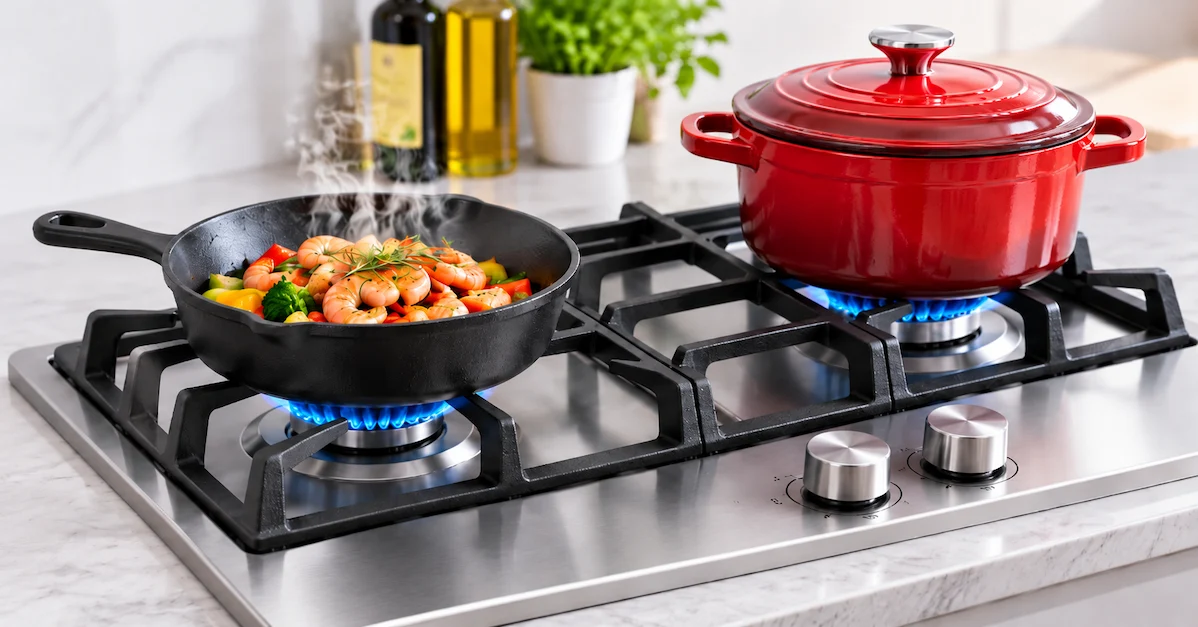
A cast iron stove grate, also described as a cast iron pan support or gas burner grate, supports cookware above a gas burner. It is not the burner itself, a barbecue cooking grid, or a solid electric hot plate.
For an appliance brand, poor seating, inaccurate burner clearance, surface defects, or an uncontrolled tooling change can cause difficulties even when the casting looks attractive. Importers face a different concern: the company issuing the invoice may not control the foundry, finish, or inspection process directly.
That is why comparing a cast iron stove grate manufacturer vs supplier should start with contractual and technical responsibilities. WEBO (GUANGDONG WEBO TECHNOLOGY CO., LTD), established in 1998, publishes a Cast Iron Pan Support range for appliance-component sourcing. Its product listings provide reference models, but do not establish that all casting and finishing operations occur inside WEBO-owned facilities.
Key Takeaways
-
A manufacturer may perform some operations itself and outsource others; it is not automatically a foundry owner.
-
A supplier can be a manufacturer, distributor, trading company, or integrated sourcing partner.
-
Direct production access can help with complex engineering changes, while a capable intermediary can add value through multi-factory coordination and consolidation.
-
For stove grates, fit, pot stability, burner clearance, material, finish, and batch identification matter more than promotional claims.
-
The best contract identifies one accountable party for defects, changes, tooling, and delivery.
1. What Is the Difference Between a Manufacturer and a Supplier?
The terms describe different positions in the supply chain, and they can overlap.
| Supply-chain role | What it typically does | What the buyer must verify |
|---|---|---|
| Direct manufacturer | Makes the grate or manages a defined manufacturing process | Which operations are internal; which are subcontracted |
| Foundry | Produces cast components | Material, mold, casting inspection, traceability |
| Finishing subcontractor | Performs specified coating or enamel treatment | Process control, appearance criteria, accountability |
| Trading company or distributor | Buys and resells products; may coordinate vendors | Access to technical records, claims handling, change communication |
| Integrated supplier | Contracts with buyer and manages multiple production stages | Who owns specifications and who approves external process changes |
The important distinction: a buyer can have a contract with a supplier that is not the foundry. Equally, buying directly from a company marketed as a factory does not prove it internally casts, machines, coats, packs, and tests every grate.
Ask for a process map instead of relying on the label “factory direct.”
2. When Should OEMs Choose a Manufacturer, a Supplier, or a Hybrid Arrangement?
The cast iron stove grate manufacturer vs supplier decision depends on the product's development stage and the amount of technical coordination required.
| Purchasing scenario | Often a useful starting route | Why |
|---|---|---|
| New gas-hob design with unique burner positions | Direct manufacturer or closely managed engineering supplier | Frequent drawing and sample decisions |
| Existing grate with approved drawings | Either, if specifications and change control are clear | Repeatability matters more than company label |
| Distributor buying multiple unrelated spare-part SKUs | Consolidating supplier or distributor | Mixed-product fulfillment and documentation |
| Frequent finish or geometry revisions | Production-access partner | Easier technical feedback and revision tracking |
| Multi-country purchasing with several factories | Accountable integrated supplier | Potential coordination and shipment consolidation |
| High-risk product with unclear process ownership | Neither until evidence is supplied | Unresolved responsibility is a sourcing risk |
A manufacturer is not automatically cheaper, and a trading supplier is not automatically less reliable. Commercial structure, engineering access, quality evidence, responsiveness, and total cost all matter.
Best-fit buyers: gas-cooker OEM sourcing managers, appliance engineers, supplier-quality engineers, and importers managing approved grate part numbers. This guide is not a substitute for finished gas-appliance testing or an assurance of universal replacement-part compatibility.
3. Who Actually Controls Casting, Surface Finishing, and Inspection?
A grate project may involve pattern or tooling development, casting, fettling, machining or surface preparation, finishing, inspection, and packaging. Not every design uses exactly the same operations.
To determine control, ask each bidder to complete a responsibility map.
| Process or decision | Evidence to request | Contract question |
|---|---|---|
| Drawing and revision | Approved drawing, revision history | Who authorizes a geometry change? |
| Tooling and patterns | Tooling register, maintenance responsibilities | Who owns and stores buyer-funded tooling? |
| Cast material | Controlled grade/specification, material records | Who approves a material substitution? |
| Casting | Foundry identity or controlled supplier process | Who investigates casting defects? |
| Finishing | Finish specification and sample standard | Who controls coating or enamel subcontractors? |
| Dimensional QC | Inspection plan and measurement reports | Who releases production lots? |
| Final shipment | Lot numbers, carton labels, packing records | Who accepts and resolves claims? |
A supplier that outsources casting can still perform well if it controls subcontractors and provides credible records. Conversely, an integrated factory that cannot identify approved revisions may present serious procurement risk.
The Change-Control Test
Ask: If the foundry changes, the enamel process changes, or a locating foot is redesigned, who tells us before the next shipment? The answer should identify a responsible person, approval route, and affected documentation—not merely promise “same quality.”
4. Which Technical Specifications Should Be in the RFQ?
A stove grate must be evaluated on the intended gas hob. Surface appearance alone cannot establish installation fit or cookware stability.
| Technical item | Why it matters | Buyer input |
|---|---|---|
| Burner layout and grate geometry | Avoids interference with burners and nearby components | Gas-hob layout drawing |
| Locating feet and seating points | Prevents rocking or misalignment | Contact surfaces and tolerances |
| Support-arm geometry | Supports the intended cookware range | Pan diameters and base profiles |
| Burner and flame clearance | Influences appliance operation and heat exposure | Approved appliance interface |
| Cast-iron grade | Defines material requirement | Designated specification or approval process |
| Surface finish | Affects appearance, cleaning and potential degradation | Coating/enamel specification and reference sample |
| Flatness, overall height and weight | Affects fit, handling and quality control | Critical dimensions and allowable limits |
| Packaging and labeling | Protects finished grates and identifies the correct part | Pack quantity, SKU, revision, lot |
If a supplier cannot give dimensions, material evidence, or the proposed surface treatment, request those details before assuming interchangeability.
Why Cast Iron Is Not a Complete Material Specification
Where gray iron is specified, ASTM A48/A48M-22(2026), Standard Specification for Gray Iron Castings, provides a material classification framework based on tensile strength for general engineering castings. Its applicability must be established for the actual grate design and purchase specification. The reference does not establish that any WEBO model uses a particular grade or complies with this standard.
5. Which WEBO Cast Iron Pan Support Models Can Buyers Compare?
WEBO publishes cast iron pan support references in single- and double-burner categories. These are useful starting points for a drawing-based inquiry rather than verified drop-in substitutes.
| Published WEBO reference | Public listing | Best initial question |
|---|---|---|
| CIPS1-02 | Single-burner cast iron pan support | Does the foot pattern fit the intended burner position? |
| CIPS2-12 | Two-burner cast iron pan support | Do overall geometry and burner spacing match? |
| CIPS2-34 | Two-burner cast iron pan support | What are its mounting and finish requirements? |
The listings do not provide enough verified detail to assign exact dimensions, load ratings, cast-iron grades, coating specifications, or production capacity. Request current drawings and datasheets. Public stock indications and displayed prices should not replace a project-specific commercial quotation.
For the complete category, see WEBO Cast Iron Pan Support.
6. Which Quality Standards and Tests Matter?
A reputable partner should explain how it controls incoming castings, critical dimensions, surface appearance, product identification, and nonconforming goods. The tests must be appropriate to the part and its final application.
Quality-System Evidence Is Not Product Certification
ISO 9001:2026, Quality Management Systems — Requirements, provides an organizational quality-management framework. It does not certify a particular grate's strength, finish, or suitability for a gas appliance. WEBO states that it implements ISO 9001, but buyers should verify the current certificate, scope, issuing body, and transition status rather than assume a specific certification edition.
Finished Gas-Appliance Requirements
For European domestic gas cooking appliances, Commission Implementing Decision (EU) 2024/2944 lists EN 30-1-1:2021+A1:2023 among harmonized standards, with stated restrictions. This is a finished-appliance context, not automatic stand-alone certification of a cast iron grate. The gas-appliance manufacturer must determine applicable tests and legal obligations for its destination market.
Practical Sample Approval
A buyer-defined evaluation plan may include seating and rocking checks, representative cookware stability, critical dimensions, surface acceptance, heat-cycle exposure where relevant, and post-test inspection. The supplier should be able to explain which results it can provide and which must be generated by the appliance OEM.
7. Why Can Factory-Direct Pricing Be Misleading?
An invoice unit price excludes several possible project costs: tooling, sample iterations, inspection, freight, packaging, coordination, inventory exposure, and claims handling.
Total sourcing cost = quoted goods cost + project-specific development and logistics costs + anticipated quality and coordination costs.
| Cost or risk | Direct-manufacturer route | Supplier/intermediary route |
|---|---|---|
| Factory unit price | May be more transparent | May include distribution margin |
| Engineering coordination | Potentially direct | Depends on supplier's technical access |
| Multiple part families | May need separate vendors | May be easier to consolidate |
| Tooling ownership | Must be negotiated | Must be negotiated and traced to custodian |
| Quality claims | Directly handled if contracted | One commercial contact may coordinate, but responsibility must be explicit |
| Export and documentation | Depends on manufacturer services | May be a core supplier capability |
The buyer should compare offers using identical drawings, finishing requirements, volumes, inspection criteria, packaging and delivery terms. A quotation that appears cheaper may not be cheaper once an unplanned remake, rejected lot, or delayed appliance launch is included.
8. What Should Contracts Say About Tooling, IP, and Quality Claims?
A key difference in the cast iron stove grate manufacturer vs supplier discussion is who has legal and operational authority when something changes.
Before paying for a mold or pattern, clarify who owns it, where it is stored, whether it can be used for another customer, who maintains it, and what happens if the supply relationship ends. Do not assume that paying a tooling charge automatically grants unrestricted ownership or transfer rights.
Define the approved drawing revision, reference sample, material, surface specification, part identification, inspection criteria, permitted subcontracting arrangements, and required change notifications.
For nonconforming goods, specify claim notification procedures, evidence, disposition, replacement or credit arrangements, and applicable shipping responsibilities. Buyers should have one accountable contractual counterparty, even where production activities are distributed among subcontractors.
9. How Should You Qualify Each Sourcing Option?
Use the same evidence-based scorecard for each candidate. The weights below are an illustrative buyer tool, not an industry standard or a WEBO audit result.
| Evaluation criterion | Example weight | Proof to request |
|---|---|---|
| Drawing and engineering control | 20% | Revision process and technical contact |
| Manufacturing and subcontractor transparency | 20% | Process map and supplier controls |
| Product quality and testing | 20% | Inspection methods and sample results |
| Change and tooling control | 15% | Ownership and approval clauses |
| Claims and commercial accountability | 10% | Written quality agreement |
| Supply planning and delivery | 10% | Model-specific capacity/lead-time proposal |
| Product communication and documentation | 5% | Complete RFQ response |
Decision rule: reject unresolved safety-critical or ownership gaps rather than allowing a good price score to compensate for them. For other criteria, compare evidence and risks against the specific project.
Two Illustrative Sourcing Decisions
New four-burner gas hob: The brand has custom grate geometry, potential tooling investment and frequent sample changes. Favor a partner with clear production-process access and accountable engineering change control—whether that organization calls itself a manufacturer or supplier.
Replacement-parts distributor: The buyer needs several established grate part numbers, reliable SKU labeling and consolidated deliveries. A capable distributor may be the more efficient commercial partner, provided it has reliable product identification, technical documentation and a defined claims channel.
These are hypothetical procurement scenarios, not documented WEBO customer cases.
10. How Can Buyers Approach WEBO About Stove Grates?
WEBO lists Cast Iron Pan Support among its appliance components and describes its business as manufacturing and supplying heating and cooking-appliance parts internationally. Buyers can use the published single-burner CIPS1-02 and two-burner CIPS2-34 references to start a specification discussion.
What remains to be confirmed: WEBO's public product pages do not identify the ownership of each casting or finishing operation, material grades, approved tooling arrangements, model-specific inspection results, MOQ, lead time, or available certificates. Those details belong in the RFQ rather than being assumed from the company's general profile.
RFQ Checklist for Manufacturers and Suppliers
Send the same brief to each prospective partner:
-
Gas-hob application, burner count and target market
-
2D/3D grate drawing or approved reference sample
-
Burner layout, mating surfaces and critical tolerances
-
Material grade or a request for documented material recommendation
-
Surface finish, appearance standard and cleaning requirements
-
Intended cookware range and required OEM validation
-
Tooling, pattern and confidentiality expectations
-
Sample quantity, first order and annual forecast
-
Inspection records, labeling and batch traceability requirements
-
Delivery destination, packaging, quotation terms, and desired timeline
Ask the supplier to distinguish confirmed capability, subcontracted work, and items requiring additional assessment.
Request an accountable sourcing proposal: Explore WEBO's Cast Iron Pan Supports, then contact WEBO with your drawings, project volumes and required quality documents. Request clarification of manufacturing scope, technical approval, tooling, and commercial responsibility before selecting a supplier.
11. Frequently Asked Questions
1. Is a cast iron stove grate manufacturer always the foundry?
No. A manufacturer may operate casting facilities, purchase castings, or subcontract particular operations. Ask for the actual production-process map and who controls the foundry relationship.
2. What is the difference between a factory and a trading supplier?
A factory may directly conduct manufacturing operations. A trading supplier typically manages purchase and resale, sometimes across several factories. Either arrangement can be appropriate if specifications and responsibilities are clear.
3. Which is better for a new OEM gas-hob design?
Choose a partner with reliable engineering access, tooling control, sample feedback and documented approval procedures. Direct production access may help, but the contractual arrangement matters just as much.
4. Can a supplier handle custom cast iron grates?
Potentially. Confirm whether it can manage drawings, tooling, sample iterations, casting and finishing contractors, inspection, and approved revisions. Do not assume “OEM support” includes every service.
5. Who should own custom stove grate tooling?
There is no universal answer. Ownership, storage, maintenance, exclusive use, access and transfer rights should be agreed in writing before tooling charges are paid.
6. What quality issues matter most for gas stove grates?
Fit, seating stability, cookware support, burner clearance, casting defects, surface treatment and consistent dimensions are common priorities. The final appliance still requires its own relevant testing.
7. Does ISO 9001 prove a grate meets gas-appliance standards?
No. ISO 9001 concerns management systems. Product-specific documentation and applicable finished-appliance safety assessment are separate matters.
8. Is ASTM A48 required for every cast iron pan support?
No. It is a specification for certain gray iron castings. Apply it only when appropriate to the actual material and agreed technical requirements.
9. Can WEBO supply both single- and double-burner grate references?
WEBO publishes CIPS1-02 as a single-burner reference and CIPS2-12/CIPS2-34 as two-burner references. Model availability, dimensions, material, finish and commercial terms require current confirmation.
10. How can I compare manufacturer and supplier quotations fairly?
Use one drawing revision, material and finish specification, order quantity, acceptance plan, packaging and delivery basis. Compare process accountability, tooling terms and the cost of addressing defects or changes—not just the quoted unit price.
Conclusion
The most useful outcome of a cast iron stove grate manufacturer vs supplier comparison is a clear answer to who makes the part, who controls the specification, and who is accountable when something goes wrong.
A direct manufacturer may provide closer access to production decisions. A competent intermediary may provide valuable sourcing coordination, multiple-SKU fulfillment and consolidated commercial support. Neither business model guarantees quality or a lower total cost.
For gas-hob OEMs, prioritize verified grate fit, cookware support, material and finishing requirements, tooling rights, revision control and finished-appliance validation. For importers and distributors, add product identification, traceability, packaging and claims management.
WEBO publishes cast iron pan supports for appliance applications. Start with its Cast Iron Pan Support range, then request a project-specific quotation. Ask WEBO to document its proposed manufacturing scope and contractual responsibilities so the decision is supported by evidence rather than labels.