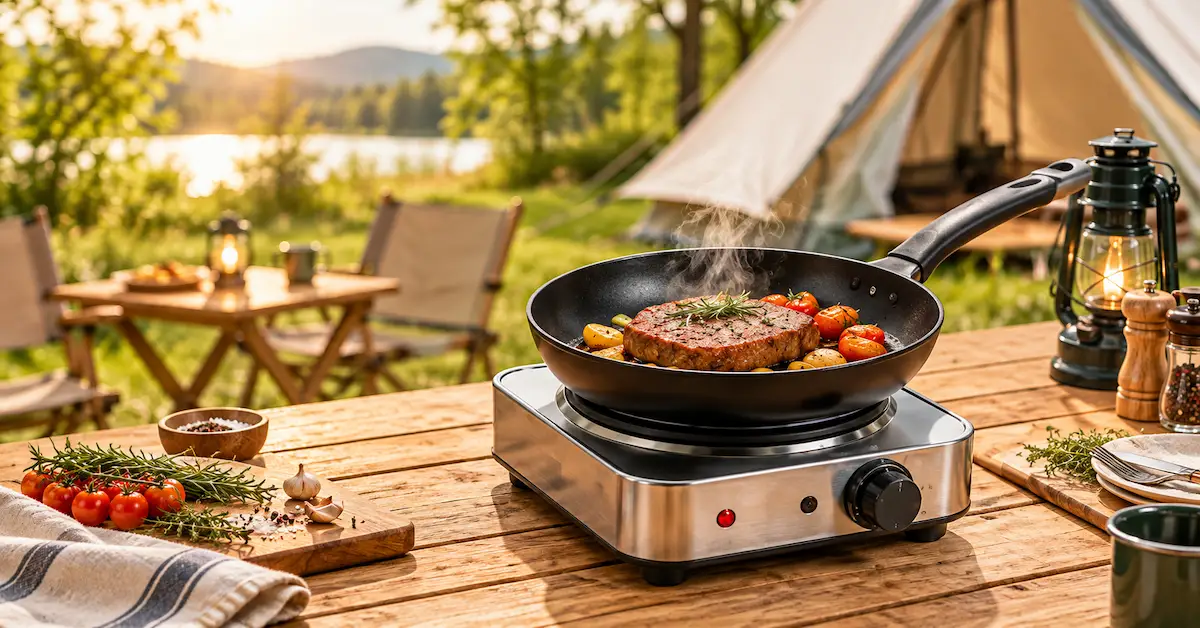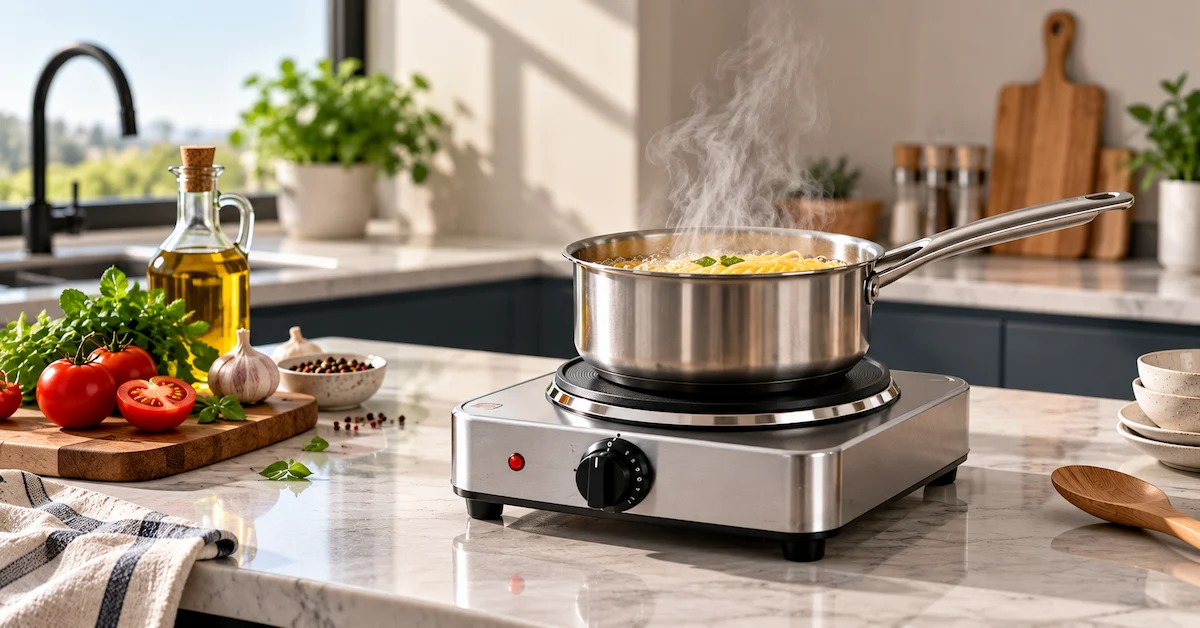



A hot plate for compact cooker manufacturing must satisfy three requirements simultaneously: it must deliver the intended cooking performance, fit consistently within a space-constrained appliance, and remain compatible with the electrical and thermal safety design across production batches.
For OEM appliance manufacturers, the most effective sourcing approach is to define critical dimensions, electrical ratings, mounting requirements, and acceptance criteria before approving the heating component. A plate that performs well as an individual sample may still create assembly defects, overheating risks, or unexpected production costs if these factors are not controlled.
WEBO, officially GUANGDONG WEBO TECHNOLOGY CO., LTD, offers solid hot plate components within its broader portfolio of electric heating elements and cooking appliance parts. Its published product range includes 90mm, 110mm, and 145mm hot plate categories, providing several starting points for compact electric cooker projects.
However, nominal diameter alone cannot confirm whether a particular model is suitable for a finished appliance. The complete engineering specification, including voltage, wattage, installation geometry, terminal arrangement, and relevant documentation, must be verified.
This guide explains how to turn heating component selection into a measurable OEM production process. It focuses on design for manufacturability (DFM), critical-to-quality characteristics, sample qualification, manufacturing consistency, procurement economics, and supplier communication.
For available product references, explore WEBO's Hot Plate product range.
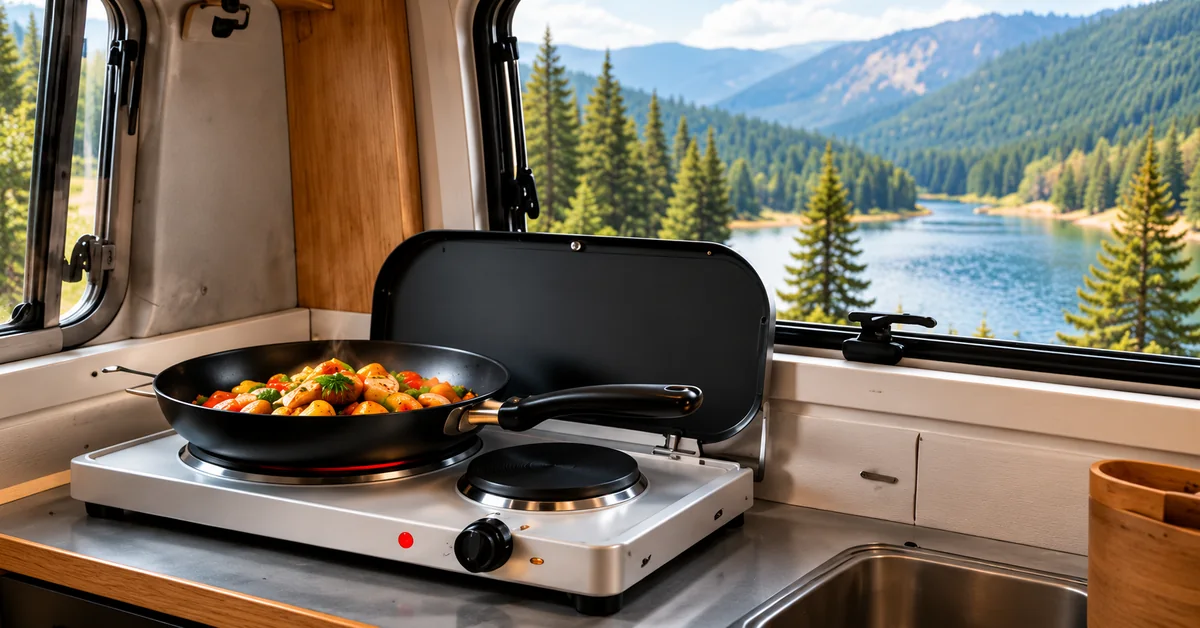
1. Why Compact Cooker Manufacturers Need a Production-Focused Hot Plate Strategy
Compact electric cookers are designed around limited installation space. Unlike larger cooking appliances, these products must accommodate the heating component, housing, controls, electrical connections, mounting structures, and supporting feet within a comparatively small enclosure.
Every millimeter of available space can affect assembly feasibility.
A component may satisfy a nominal diameter requirement but create an unexpected interference when installed. A terminal may extend toward a control switch. A fastening bracket may transfer heat into a temperature-sensitive housing section. A heating plate may sit slightly above or below the intended position, changing cookware contact or mechanical stability.
These problems become more expensive when discovered after tooling approval or production startup.
For that reason, compact cooker engineering should distinguish three separate objectives.
Product performance
The heating assembly must deliver the required cooking results under the intended electrical supply, cookware load, control settings, and operating conditions.
Assembly repeatability
Production operators must be able to install the component consistently without excessive adjustment, rework, or reliance on individual judgment.
Supplier consistency
Accepted production batches must conform to the agreed component specification, not simply resemble the original approved sample.
A sourcing decision that considers all three objectives is more valuable than choosing a component on nominal size and purchase price alone.
Practical OEM recommendation: Approve the heating plate as part of the finished appliance's controlled design, with documented critical dimensions, electrical characteristics, supplier responsibilities, and qualification evidence.
2. Who Should Source a Hot Plate for Compact Cooker Applications?
A compact cooker hot plate is primarily an appliance component. It should not be confused with a fully assembled, certified countertop cooking appliance.
The most suitable buyers are organizations responsible for integrating heating elements into finished equipment or distributing technically compatible replacement parts.
| Buyer type | Typical requirements | Main purchasing concern |
|---|---|---|
| Compact cooker OEM manufacturers | Standardized heating elements for appliance assembly | Dimensional consistency and stable production |
| Private label appliance brands | Product-specific components and development coordination | Design compatibility and reliable repeat supply |
| Electric cooker engineering teams | Verified electrical and mechanical characteristics | Thermal integration and prototype validation |
| Appliance sourcing managers | Competitive quotations and controlled specifications | Landed cost and supplier risk |
| Quality assurance departments | Inspection criteria and qualification records | Batch consistency and defect prevention |
| Replacement component importers | Compatible heating plates for existing appliances | Avoiding incorrect replacement parts |
When a solid hot plate may not be appropriate
Not every cooking appliance should use a solid contact-heating plate.
A product designed specifically for electromagnetic induction requires an induction heating system rather than a conventional resistive solid hot plate.
A glass-ceramic radiant cooktop may require a compatible radiant heating element beneath its cooking surface.
Equipment designed for continuous professional catering, unusually demanding duty cycles, corrosive environments, or specialized industrial processes may require different component specifications and qualification procedures.
WEBO also lists Ceramic Heater products and Induction Coil components. These categories serve different heating architectures and should not be treated as direct substitutes without engineering review.
For OEM procurement, the correct starting point is always the finished appliance's intended heating technology and performance requirement.
3. Define the Compact Cooker Application Before Selecting a Hot Plate
One of the most common product-development mistakes is allowing an available heating plate to determine the entire cooker design before the cooking application has been clearly defined.
Instead, manufacturers should establish the appliance's functional requirements first.
A compact cooker intended for occasional light cooking has different operating demands from equipment expected to perform repeated heating cycles throughout the day.
The external dimensions may appear similar, but the control strategy, thermal loading, and durability requirements can differ significantly.
Typical applications and their design priorities
| Compact cooker application | Primary design concern | Recommended verification |
|---|---|---|
| Small single-burner countertop cooker | Space efficiency and cooking performance | Heating output, mounting, enclosure temperature |
| Apartment kitchenette appliance | Compact dimensions and intended user operation | Stability, surface temperature, control accessibility |
| Temporary countertop cooking appliance | Portable structure and handling | Mechanical stability, cord protection, thermal management |
| Hospitality pantry equipment | Appropriate operation under the specified duty cycle | Heating repeatability and finished-appliance assessment |
| Compact dual-zone cooker | Multiple heating components in one enclosure | Combined electrical load and thermal interaction |
| Replacement cooker component | Compatibility with an established appliance | Exact drawing, electrical ratings, terminals, fit |
These are possible application categories, not confirmations that any particular WEBO model has been approved for them.
The finished-appliance manufacturer must also consider local usage restrictions, installation instructions, foreseeable misuse, and destination-market requirements.
Convert the application into engineering requirements
Before requesting samples, determine the intended cookware size, expected heating performance, available supply voltage, product dimensions, planned operating cycle, and allowable internal temperatures.
The procurement team should also identify the target market, anticipated production volume, and whether the project involves a completely new appliance or a modification to an existing design.
This information helps distinguish a feasible component option from a product that merely appears suitable in a catalog.
4. Design for Manufacturability: The Most Important Compact Cooker Integration Challenge
Design for manufacturability, or DFM, means designing a product so it can be produced consistently, efficiently, and with controlled quality.
For compact cooker manufacturers, DFM is particularly important because the heating element operates near multiple structural and electrical components.
A suitable hot plate must not only fit inside the product during prototype assembly. It must also accommodate normal manufacturing variation.
4.1 Control the complete component envelope
Nominal hot plate diameter is only one dimension.
A complete component drawing should identify the maximum external diameter, overall height, underside protrusion, mounting locations, terminal position, and any features that could interfere with the enclosure.
The drawing should also indicate tolerances and the reference surfaces used during measurement.
Consider two hot plates with the same nominal external diameter. Their underside constructions could be different enough that only one fits the available cooker cavity.
This difference may not be visible from a product photograph.
4.2 Define a clear datum system
A datum is a reference feature used to establish measurement and assembly relationships.
For a compact cooker, engineers may define the mounting surface as one reference and the center of the heating plate as another.
Terminal position and other critical features can then be controlled relative to these references.
Without a consistent datum scheme, different inspectors may measure the same feature from different locations and obtain results that are difficult to compare.
The supplier drawing and the appliance assembly drawing should use compatible references wherever possible.
4.3 Evaluate tolerance stack-up
Tolerance stack-up is the combined effect of dimensional variation from multiple components.
For example, a heating plate may be within its specified diameter tolerance while the surrounding cooker opening is near its minimum permitted dimension.
If the mounting position also shifts, the actual installation clearance can be smaller than expected.
For a simplified circular opening, engineers can begin with the relationship:
Minimum radial clearance = (minimum housing opening diameter − maximum plate diameter) ÷ 2 − maximum positional offset
This simplified calculation assumes the relevant features can be represented by circular geometry. A real design may also need allowances for thermal expansion, deformation, coatings, and additional positioning errors.
It does not establish a universally safe clearance value.
The engineering team should perform the calculation using the project's actual drawings and verify the result through physical assembly.
4.4 Design for repeatable assembly
A practical production design should allow the heating component to be installed in a consistent orientation.
Mounting points, terminal routing, fasteners, and supporting structures should minimize the possibility of incorrect installation.
Where appropriate, the design can use alignment features or poka-yoke principles to make assembly mistakes less likely.
The final objective is straightforward: a trained operator should be able to install a conforming component without bending terminals, forcing fasteners, or modifying the approved part.
5. Electrical Specifications That OEM Buyers Must Confirm
A heating plate cannot be selected solely through mechanical design.
Electrical characteristics determine how the component interacts with the appliance's power supply, wiring, switching devices, protection circuits, and thermal control system.
The critical parameters include rated voltage, rated power, operating current, resistance characteristics, insulation performance, terminal configuration, and the intended supply conditions.
Understanding voltage, wattage, and current
For a simplified predominantly resistive load operating at its specified rating:
Current (A) ≈ Power (W) ÷ Voltage (V)
Similarly:
Resistance (Ω) ≈ Voltage² (V²) ÷ Power (W)
For an illustrative 900W resistive load at 230V:
-
Approximate operating current: 3.91A
-
Approximate equivalent operating resistance: 58.8Ω
These values are illustrative calculations only, not published ratings for any WEBO hot plate.
Actual resistance can vary with material temperature and component construction. Cold resistance should not automatically be treated as identical to the calculated operating resistance.
This distinction matters when developing incoming inspection procedures.
Why electrical matching matters
If the proposed heating element draws more current than the appliance design allows, electrical components may be subjected to unsuitable loads.
If the heating component has a different operating resistance or thermal response from the original design, the cooker may behave differently under the same control settings.
Therefore, replacing one component with another requires more than matching nominal wattage.
Engineers must verify the complete electrical system and its protection strategy.
Recommended technical specification checklist
| Parameter | Information required from the buyer | Information to confirm with supplier |
|---|---|---|
| Heating technology | Solid resistive heating plate | Exact component construction |
| Nominal diameter | Required cooking-zone geometry | Published size and actual dimensions |
| Rated voltage | Appliance electrical specification | Available model rating |
| Rated wattage | Required cooking performance | Actual model rating and tolerance |
| Resistance | Applicable electrical design criteria | Measurement conditions and permitted range |
| Overall height | Maximum available installation envelope | Controlled drawing dimensions |
| Mounting interface | Hole positions, supports, fastening | Compatible mounting arrangement |
| Terminal configuration | Connector and wiring requirements | Terminal type, position, and orientation |
| Insulation performance | Project qualification requirements | Applicable test methods and results |
| Surface characteristics | Appearance and durability requirements | Material and finish specification |
| Product documentation | Target market and approval requirements | Available model-specific records |
| Packaging | Protection and identification needs | Proposed packing method |
WEBO's publicly available hot plate listings do not provide complete values for all these fields. Buyers should request the current datasheet and engineering drawing before treating a model as production-approved.
6. How to Prevent Thermal Problems in Small Cooker Housings
Thermal integration is a major engineering challenge in compact electric cookers.
The purpose of a heating plate is to generate heat, but that heat must be managed so it does not create unacceptable conditions elsewhere in the appliance.
Thermal energy can travel through several paths: conduction through brackets and fasteners, radiation toward nearby components, and convection through the internal air volume.
Each path needs consideration during design validation.
6.1 Protect temperature-sensitive components
Control switches, wiring insulation, connectors, plastic supports, and power-cord entry structures must remain within their applicable ratings during the specified operating and test conditions.
Placing a switch close to the heating plate may reduce product size but increase thermal exposure.
Moving the switch may improve one condition while creating a new assembly or wiring challenge.
The correct decision requires measurement in a representative finished appliance.
6.2 Verify heating behavior under realistic cookware loads
A heating plate's actual operating environment changes when different cookware is used.
Cookware material, base diameter, flatness, thermal mass, and contents can affect heat transfer.
A useful engineering test should define the cookware, initial conditions, load, supply voltage, control setting, and measurement method.
Results from different prototypes can then be compared fairly.
Without a consistent procedure, apparent differences in heating performance may come from the test conditions rather than from the components themselves.
6.3 Evaluate the underside and supporting surface
For countertop appliances, the underside of the housing and the external supporting surface are important parts of the thermal assessment.
The design team should measure relevant temperatures using the applicable finished-appliance standard and the intended installation conditions.
Thermal protection should not be evaluated solely by touching the housing or observing that the cooker continues operating.
Instrumented tests and documented acceptance criteria are more reliable.
6.4 Consider abnormal operation
Normal cooking tests do not represent every foreseeable operating condition.
An appropriate qualification program may need to consider abnormal control behavior, foreseeable misuse, unsuitable heat dissipation, and protective-device performance.
These assessments should be planned and conducted by qualified personnel according to the finished appliance's applicable safety requirements.
Key engineering principle: A suitable hot plate is not automatically a safe finished cooker. The complete appliance architecture determines the final operating result.
For related mechanical and thermal design considerations, see WEBO's existing portable stove hot plate design guide.
7. WEBO Hot Plate Models: Comparing HP-F90, HP-F110, and HP-F145
WEBO publishes three principal nominal diameter categories for its Hot Plate range: 90mm, 110mm, and 145mm.
These provide practical component references for initial OEM discussions.
However, the publicly listed information should not be mistaken for a complete engineering approval package.
Model comparison for compact cooker development
| WEBO model | Published diameter category | Potential design consideration | Critical information to request |
|---|---|---|---|
| HP-F90 | 90mm | Very limited cooking-zone space | Rated power, voltage, mounting height, cookware suitability |
| HP-F110 | 110mm | Intermediate compact cooking-zone layout | Terminal position, thermal behavior, mounting drawing |
| HP-F145 | 145mm | Larger cooking contact area within a compact appliance | Enclosure clearance, mounting structure, electrical rating |
The application descriptions above are preliminary engineering considerations, not verified operating claims or official compatibility approvals. Confirm current specifications, availability, and qualification requirements with WEBO.
HP-F90: Where installation space is especially limited
A 90mm nominal plate may be evaluated where the product architecture requires a small heating zone.
The main engineering question is whether the available contact area can meet the intended cooking task without compromising cookware stability or operating performance.
A smaller diameter does not necessarily provide a lower electrical load or better energy efficiency.
HP-F110: Balancing contact area and enclosure constraints
A 110mm nominal plate may be relevant to projects seeking an intermediate physical size.
For this category, procurement and engineering teams should focus on whether the complete plate assembly fits the enclosure and whether the intended cookware can be supported appropriately.
Electrical and thermal performance must still be confirmed through actual model data and finished-appliance testing.
HP-F145: When a larger heating zone is required
A 145mm nominal plate may offer a larger contact area for certain cooker designs.
However, it also requires appropriate space for mounting, wiring, heat management, and the surrounding enclosure.
Design teams should not assume that a larger plate automatically heats faster or delivers better efficiency.
The correct comparison must use verified electrical specifications and equivalent test conditions.
Selection recommendation
Start with the required cookware and cooking function, identify the feasible mechanical envelope, and then shortlist the corresponding nominal diameter.
Only after reviewing electrical and mechanical drawings should the project advance to prototype qualification.
8. Materials, Surface Finish, and Component Construction
Material selection affects heating behavior, durability, mechanical stability, surface appearance, and manufacturing consistency.
Solid hot plates are commonly associated with metal heating surfaces and integrated resistive heating structures. However, the exact material composition, heating structure, insulation design, and coating of a specific WEBO model should be confirmed through the supplier's technical documentation.
Heating surface and structural material
The heating surface needs to remain dimensionally and functionally suitable under its specified thermal conditions.
For product engineers, important questions include how the material responds to repeated heating, how the surface interacts with cookware, and whether the installation structure is affected by thermal expansion.
Surface treatment
Surface finish can affect appearance, corrosion behavior, handling, and the consistency of the finished product.
An OEM may also specify visual requirements for the exposed heating surface.
If coating performance is critical, buyers should establish acceptance criteria for appearance, adhesion, and relevant durability tests.
A supplier's general statement about quality should not replace application-specific evidence.
Terminals and connections
Electrical terminals deserve particular attention because they combine electrical function with mechanical assembly requirements.
The termination method should be compatible with the approved connector and wiring arrangement.
An incompatible terminal orientation can cause assembly interference even when the heating plate's nominal diameter is correct.
Connection reliability should be evaluated under the expected thermal and electrical operating conditions.
Thermal expansion and mounting
A heating component changes temperature repeatedly during operation.
The surrounding mounting structure must accommodate the resulting behavior without creating unacceptable mechanical stress or loss of retention.
This is another reason to approve the assembled cooker rather than relying only on an individual component drawing.
9. Critical-to-Quality Characteristics for Compact Cooker Hot Plates
Critical-to-quality characteristics, commonly abbreviated as CTQs, are the measurable properties that most directly affect product performance, assembly, or customer requirements.
For a compact cooker heating component, CTQs should be chosen through engineering risk assessment.
Not every dimension requires the same inspection frequency.
A cosmetic dimension with little influence on assembly may receive different controls from a terminal location that affects electrical clearance.
Recommended CTQ control matrix
| CTQ characteristic | Potential risk | Recommended evidence |
|---|---|---|
| External diameter | Interference with housing opening | Dimension inspection against controlled drawing |
| Overall height | Incorrect heating plate position | Height measurement and assembly verification |
| Mounting location | Fastener or support misalignment | Positional inspection |
| Terminal orientation | Wiring interference or connection difficulty | Drawing comparison and assembly check |
| Electrical resistance | Unexpected electrical behavior | Defined-condition electrical measurement |
| Insulation performance | Electrical safety risk | Applicable qualification and production tests |
| Surface appearance | Customer rejection or finish concern | Approved visual standards |
| Heating behavior | Inconsistent cooking results | Controlled performance test |
| Product identification | Wrong model installed or shipped | Model and batch traceability |
| Packaging protection | Damage during transport | Packaging verification |
The table is a recommended OEM quality-planning framework, not a claim that WEBO performs all listed inspections on every product.
Why measurement methods must be standardized
A CTQ is useful only when the measurement method is clearly defined.
For example, measuring overall height from different reference surfaces can produce incompatible results.
Electrical resistance measurement also requires appropriate test conditions.
The buyer and supplier should agree on the method, instruments, tolerances, and reporting format before approving production.
For high-risk dimensions, a measurement-system assessment may be appropriate to determine whether the inspection process itself is sufficiently reliable.
10. From Engineering Sample to Pilot Production: A Practical Qualification Plan
A successful prototype is an important milestone, but it is not proof that a product is ready for volume manufacturing.
Prototype parts may be assembled carefully by engineers. Production parts may later be installed by operators using fixtures, tools, and standardized work instructions.
The transition introduces additional variation.
A structured qualification process helps identify these risks before they affect customer deliveries.
Stage 1: Technical specification review
The OEM provides an appliance drawing, electrical requirements, expected cooking performance, market requirements, and estimated purchasing volumes.
The supplier confirms which existing component might be suitable and identifies information that requires further technical review.
No production specification should be approved solely from a photograph or nominal diameter.
Stage 2: Initial sample inspection
Engineering samples are inspected against the proposed drawing.
The team checks basic electrical characteristics, dimensions, mounting features, and product identification.
Any deviation should be recorded and resolved before proceeding.
Stage 3: Finished-appliance prototype validation
The heating plate is installed into a representative cooker.
Engineering personnel evaluate assembly, controls, cooking performance, temperatures, and other relevant functions.
The test plan should include acceptance criteria rather than relying on subjective observations.
Stage 4: Pilot production
A pilot run uses production-intent components, fixtures, assembly instructions, and inspection methods.
Its purpose is to determine whether the design can be manufactured repeatedly.
Pilot approval should consider both the finished product and the capability of the production process.
Stage 5: Production release
Once the design, qualification results, inspection plan, and commercial conditions are approved, the manufacturer can authorize the production configuration.
A controlled revision should identify which drawings, component versions, test criteria, and packaging requirements are valid.
Changes after approval should follow an agreed notification and requalification process.
Stage 6: Ongoing batch monitoring
Incoming inspections and production records help detect changes between batches.
When critical characteristics drift, procurement and quality teams should investigate before the variation causes assembly or field failures.
For large-volume programs, statistical process capability may be useful after the measurement system and production process are sufficiently stable.
The objective is repeatability, not simply passing one demonstration test.
11. Quality Assurance and Certification: What Buyers Should Actually Verify
Heating components are incorporated into electrical appliances, so quality and conformity evidence must be relevant to both the component and the final product.
WEBO's website describes a quality-management and product-certification background, including references to ISO 9001, ISO 14001, VDE, TÜV, UL, CE, and RoHS.
These references should be evaluated carefully.
Company management-system certification, component approval, conformity documentation, and finished-appliance compliance are different matters.
A certificate associated with one product family should not automatically be applied to another model.
Component-level documentation
Depending on the application, the buyer may request the current specification, controlled drawing, electrical test results, material declarations, relevant certificates, and traceability information.
The documents should clearly identify the product or model to which they apply.
Finished-appliance requirements
For many household and similar portable cooking appliances, the IEC 60335-2-9 series is a relevant international safety-standard reference. Its scope includes portable hotplates and related cooking equipment.
IEC 60335-1 provides general safety requirements for household and similar electrical appliances.
The applicable edition, national adoption, additional requirements, and conformity route depend on the product type and destination market. The responsible appliance manufacturer and its qualified compliance partners should confirm them.
Neither reference establishes that a particular WEBO heating plate or completed cooker has passed the relevant tests.
Questions to ask before approving a supplier
Ask whether the available documentation covers the exact model, construction, rating, and revision being purchased.
Request clarification when the certificate, label, technical specification, or product description contains inconsistent information.
For regulated products, obtain the necessary evidence before making conformity claims in product marketing or customer documentation.
12. How Production Consistency Affects Total Procurement Cost
The lowest component quotation is not always the least expensive sourcing decision.
A lower purchase price may be offset by additional assembly labor, rejected parts, production interruptions, or customer returns.
For an OEM manufacturer, it is more useful to consider the total cost of using the component.
A practical model is:
Total procurement cost = component cost + tooling allocation + logistics + inspection + assembly losses + rework + warranty-related costs
Each category should be estimated using actual purchasing and manufacturing data.
Assembly labor
If a heating component requires frequent adjustment during installation, the labor cost may rise.
Even a small additional operation can become significant over a large production quantity.
Scrap and rework
Dimensional inconsistencies or incorrect terminals can cause rejected parts or additional rework.
The financial effect depends on the defect rate, inspection process, and whether problems are discovered before or after assembly.
Supplier changes
Changing heating component suppliers may require new samples, tooling review, assembly trials, and additional qualification.
The apparent savings from a lower quotation must be considered alongside these transition costs.
Logistics and inventory
Packaging performance, production planning, transport arrangements, and reorder stability affect inventory requirements.
Large orders can reduce some purchasing costs but increase exposure to obsolete inventory if the design has not been finalized.
The best purchasing decision balances component price, engineering compatibility, production quality, and supply reliability.
13. OEM and ODM Customization for Compact Cooker Manufacturing
OEM and ODM cooperation can be valuable when a standard component does not fully match an appliance design.
However, customization should begin with a clearly defined engineering requirement rather than a general request for a different product.
Potential project discussions may involve nominal size, voltage, power, mounting geometry, terminal configuration, product identification, or packaging.
The feasibility of each modification must be confirmed with WEBO.
Mechanical customization
A buyer may need a specific installation interface to match an existing cooker housing.
The supplier should review the drawing and determine whether the change can be supported through an existing production configuration or requires additional development.
Electrical customization
Electrical requirements should be expressed through target voltage, power, operating conditions, and control compatibility.
The engineering team must assess the proposed change within the complete appliance design.
Product identification and packaging
OEM procurement may also require approved part numbers, batch identification, export carton markings, or customer-specific packaging.
These requirements should be documented in the purchase specification.
Customization can improve product integration, but every significant change should be reviewed for its effect on quality, cost, lead time, and qualification requirements.
Learn more about WEBO's product range through its heating element and appliance component catalog.
14. Supplier Production Capacity, Lead Time, and Repeat Orders
Production planning is especially important when a compact cooker enters a new market or experiences seasonal demand changes.
However, supplier capacity should be evaluated for the specific product and manufacturing process.
Overall factory size alone does not establish how many units of a particular hot plate can be produced within a given period.
WEBO states that it was established in 1998 and presents itself as a manufacturer serving international appliance markets.
For a real purchasing project, buyers should still request order-specific confirmation of manufacturing availability and commercial conditions.
| Procurement stage | Information to confirm |
|---|---|
| Initial inquiry | Available models and engineering specifications |
| Sample development | Sample feasibility, quantity, price, and timing |
| Tooling review | Whether tooling is required and who owns it |
| Pilot order | Minimum quantity and qualification conditions |
| Volume production | Capacity allocation and production scheduling |
| Repeat purchasing | Lead-time assumptions and forecast requirements |
| Engineering change | Notification, approval, and transition procedure |
| Export shipment | Packaging, shipping terms, and required documents |
No universal WEBO MOQ, manufacturing lead time, or production capacity is assumed in this table.
Reducing supply risk
Purchasing teams should communicate demand forecasts and changes to approved specifications as early as possible.
For critical programs, the supplier agreement should address product traceability, rejected goods, corrective action, and responsibility for engineering changes.
A strong long-term supply arrangement is based on clear expectations and measurable performance.
15. How to Compare Hot Plate Suppliers Beyond Unit Price
When evaluating a hot plate for compact cooker production, buyers should compare potential suppliers using the same technical and commercial criteria.
A quotation that omits important engineering information is not directly comparable with a detailed proposal.
Supplier evaluation framework
| Evaluation factor | Essential question | Purchasing value |
|---|---|---|
| Product compatibility | Can the supplier match the approved drawing? | Reduces assembly failure |
| Electrical characteristics | Are voltage and power ratings documented? | Supports reliable design |
| Dimensional control | Are critical tolerances clearly defined? | Improves production consistency |
| Sample verification | Can representative parts be evaluated? | Reduces qualification uncertainty |
| Technical documentation | Are current drawings and applicable records available? | Supports engineering approval |
| Quality coordination | How are nonconforming products handled? | Reduces repeat defects |
| Change management | How will product revisions be communicated? | Protects approved designs |
| Commercial transparency | Are prices, MOQ, tooling, and delivery terms clear? | Improves cost planning |
| Export requirements | Can packaging and shipment requirements be agreed? | Supports international procurement |
| Repeat supply | Can future orders follow the approved configuration? | Reduces supplier transition risk |
For new projects, a supplier's willingness to clarify engineering limitations is often more useful than an unsupported promise of universal compatibility.
Why technical communication matters
Procurement decisions frequently involve purchasing, engineering, production, and quality departments.
If each department receives different or incomplete information, the project can lose time during technical approval.
A shared specification package reduces ambiguity and allows commercial negotiations to proceed against the same product definition.
16. Preparing a Complete OEM RFQ for WEBO
A well-prepared request for quotation can make technical communication more efficient and reduce the number of follow-up questions.
Before contacting WEBO, prepare an RFQ that identifies the finished appliance, required heating component, expected production volume, and outstanding technical questions.
Compact cooker heating component RFQ template
| RFQ field | Buyer information to provide |
|---|---|
| Company and project | Company name, country, project reference |
| Appliance application | Compact countertop cooker or other specified appliance |
| Project status | New design, replacement part, or alternative supplier |
| Target model | HP-F90, HP-F110, HP-F145, or model to be recommended |
| Heating technology | Solid resistive hot plate |
| Nominal diameter | Required size and tolerance |
| Rated voltage | Required electrical rating |
| Target wattage | Required heating performance |
| Mechanical drawing | Overall dimensions, mounting and assembly envelope |
| Terminal requirement | Connector type, position, orientation |
| Operating conditions | Duty cycle, cookware, ambient environment |
| Quality requirements | Key characteristics, inspection and tests |
| Market requirements | Destination countries and required documentation |
| Sample quantity | Initial engineering sample requirement |
| Pilot quantity | Estimated trial production order |
| Annual demand | Forecast purchasing volume |
| Customization | Any nonstandard dimensions or features |
| Packaging | Identification, protection, labeling |
| Requested response | Technical proposal, quotation, MOQ, lead time |
The more complete the information, the easier it is for both parties to establish whether an existing component is suitable.
Request a technical quotation
Developing a compact electric cooker or qualifying an alternative heating component supplier?
Explore the WEBO Hot Plate product category, review the published model references, and submit your technical requirements for a project-specific discussion.
For a more effective inquiry, include your appliance drawing, required voltage, target wattage, estimated production quantity, and destination market.
Contact WEBO for OEM Hot Plate Specifications and Quotation
17. Frequently Asked Questions About Hot Plates for Compact Cookers
1. What is the most important factor when selecting a hot plate for compact cooker manufacturing?
The most important factor is compatibility with the complete appliance design.
Diameter, voltage, wattage, mounting, terminal configuration, and thermal behavior must be evaluated together.
A component that fits mechanically may still be electrically unsuitable, while a component with the correct electrical rating may create unacceptable enclosure temperatures.
For OEM projects, final selection should be based on controlled technical specifications and representative appliance testing rather than catalog dimensions alone.
2. Is a 90mm hot plate always better for a compact cooker than a 110mm plate?
No. A 90mm plate has a smaller nominal diameter, but that does not automatically make it the best option.
The appropriate size depends on cookware requirements, heating performance, enclosure geometry, and the complete appliance's electrical design.
A smaller heating surface may limit the intended cooking application, while a larger one may create packaging or thermal challenges.
Both options require verified specifications and application testing.
3. Can WEBO HP-F90, HP-F110, and HP-F145 be used in the same cooker design?
Not without further engineering review.
The three published model references belong to different nominal diameter categories.
Their mounting geometry, electrical ratings, terminal arrangements, and overall installation requirements should be compared using current product drawings.
Changing plate diameter may require modifications to the cooker housing, controls, or structural components.
Manufacturers should not approve interchangeability based only on product photographs or similar model names.
4. What documents should a supplier provide before OEM sample approval?
A buyer should request the current product specification, controlled drawing, electrical ratings, available material information, and relevant model-specific compliance records.
The project may also require inspection methods, approved sample identification, and a record of deviations.
Before production release, both parties should agree on the valid product revision and acceptance criteria.
The exact documentation package depends on the component, application, and commercial agreement.
5. How do manufacturers prevent hot plate assembly problems?
Assembly problems can be reduced through controlled dimensions, consistent datums, appropriate tolerance stack-up analysis, and representative trial assembly.
Critical features include overall diameter, installation height, mounting points, and terminal orientation.
The OEM should verify that conforming parts can be installed without forcing connections or modifying the approved design.
Pilot production is particularly useful for identifying problems that may not appear during individual engineering sample assembly.
6. Does a hot plate's rated wattage determine how quickly a compact cooker heats food?
Rated wattage is important, but it does not determine cooking performance by itself.
Heat transfer also depends on cookware properties, contact area, thermal losses, control behavior, and operating conditions.
Different components should be compared through standardized tests using equivalent cookware, electrical supply, and initial conditions.
A larger diameter or higher nominal rating should not automatically be interpreted as better cooking performance without supporting measurements.
7. What is the difference between a solid hot plate and a ceramic radiant heater?
A solid hot plate generally transfers heat to cookware through a heated contact surface.
A ceramic radiant cooktop system typically uses a radiant heating element beneath a compatible glass-ceramic cooking surface.
These systems have different mechanical integration, heating characteristics, control requirements, and construction details.
A manufacturer developing an appliance should choose the intended heating technology before comparing component suppliers.
The two component categories should not be assumed interchangeable.
8. Can a hot plate component certificate be used to certify an entire compact cooker?
No. Component documentation and finished-appliance conformity serve different purposes.
A hot plate may have applicable component-level test or certification records, but the complete cooker also includes wiring, controls, housing, mounting, protection devices, and user-accessible surfaces.
The finished appliance must be assessed according to its applicable market requirements.
Buyers should request exact model documentation and coordinate complete-appliance compliance with qualified technical or certification professionals.
9. Why is a pilot production run necessary if engineering samples already passed testing?
Engineering samples demonstrate whether a proposed design may work under controlled prototype conditions.
A pilot production run evaluates whether the design can be assembled repeatedly using the intended manufacturing process.
It can reveal fixture problems, operator-dependent assembly steps, dimensional variation, and inspection weaknesses.
For high-volume appliance production, identifying these issues before full-scale manufacturing can reduce scrap, rework, and production interruptions.
Pilot results should be reviewed against documented acceptance criteria.
10. How can overseas buyers obtain a reliable bulk quotation for compact cooker hot plates?
A useful quotation requires more than a model name and estimated quantity.
Buyers should provide the required diameter, voltage, wattage, application, technical drawing, target market, sample needs, estimated order volume, and packaging requirements.
The supplier can then review technical compatibility and clarify available models, customization feasibility, minimum order quantities, and delivery conditions.
For WEBO projects, buyers can submit these requirements through the official contact page.
Conclusion
Selecting a hot plate for compact cooker manufacturing is not simply a matter of finding the smallest heating plate or the lowest component price. The decision affects mechanical integration, electrical compatibility, thermal behavior, assembly efficiency, quality assurance, and long-term procurement performance.
For appliance manufacturers and OEM sourcing teams, the strongest approach is to define the finished cooker's requirements first, establish measurable critical-to-quality characteristics, compare candidate components using controlled specifications, and complete representative prototype and pilot-production validation.
WEBO's published Hot Plate range includes HP-F90, HP-F110, and HP-F145 within its 90mm, 110mm, and 145mm product categories. These models provide useful starting points for technical discussions, while actual suitability must be confirmed through current engineering documentation and application-specific evaluation.
By combining DFM principles, electrical and thermal verification, structured supplier qualification, and clear purchasing specifications, manufacturers can reduce the risk of late design changes and improve production repeatability.
Planning a compact electric cooker project, developing a new OEM appliance, or reviewing an alternative hot plate supplier? Share your required diameter, voltage, wattage, assembly drawings, target market, and purchasing forecast with WEBO.
Explore WEBO Hot Plate Products or Request a Technical Quotation from WEBO to discuss suitable model references, sample requirements, and your next sourcing decision.