


What Should an Induction Coil Manufacturer Provide Beyond a Coil?
A professional induction coil manufacturer should provide more than a flat copper winding that fits beneath a ceramic-glass cooktop.
For appliance manufacturers, the induction coil is part of a complete resonant heating system involving the inverter, resonant components, cookware, ferrite structure, glass-to-coil spacing, thermal management, and control system. A coil that looks physically correct can still create poor heating performance, excessive temperature rise, unexpected electrical loading, or control-system problems if its electrical characteristics do not match the appliance platform.
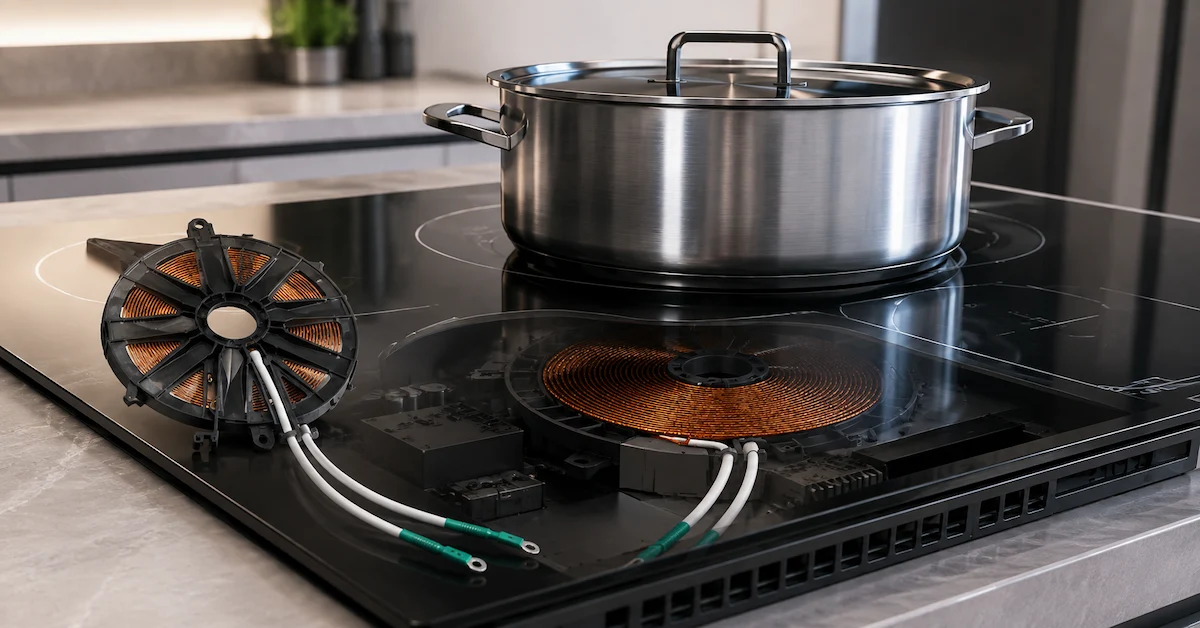
In induction cooking, the coil produces an alternating magnetic field. Ferromagnetic cookware couples with this field and is heated primarily through induced currents and associated losses. Technical literature on domestic induction systems notes that cooktop inductors commonly use multi-stranded Litz-type windings, with ferrite positioned below the coil to guide the magnetic field and reduce unwanted flux toward electronics beneath the assembly.
For B2B buyers, this means supplier selection should focus on four things:
- Electrical compatibility
- Thermal performance
- Manufacturing repeatability
- OEM development capability
The lowest-priced coil is not necessarily the lowest-risk component.
Who Should Work Directly With an Induction Coil Manufacturer?
Direct manufacturer cooperation is most valuable for companies integrating induction technology into finished equipment.
Typical buyers include:
- Induction cooktop manufacturers
- Built-in hob manufacturers
- Portable induction cooker brands
- Commercial induction equipment companies
- Kitchen appliance OEM/ODM companies
- Private-label appliance brands
- Component importers and distributors
- Product-development engineering teams
WEBO currently lists Induction Coil as one of its principal appliance-component categories alongside Hot Plate, Ceramic Heater, Tube Heating Element, Cast Iron Pan Support, Ceramic Glass, Rotary Switch, and Energy Regulator.
When Direct OEM Manufacturing May Not Be Necessary
A custom manufacturer may not be the most efficient sourcing route if you need:
- One replacement coil for a consumer appliance
- An exact spare part already available through an authorized replacement channel
- A small one-time quantity without technical drawings or system information
Direct manufacturing becomes more valuable when your company needs controlled specifications, repeat production, model development, or supply continuity.
Why You Should Not Specify an Induction Coil by Diameter and Wattage Alone
One of the most common RFQ mistakes is:
“We need a 200 mm induction coil, 2,000 W. Please quote.”
That is not enough information for reliable engineering evaluation.
Unlike a resistive heating element, the coil should not be treated as an independent component whose performance is fully defined by nominal wattage.
The coil works with the appliance's high-frequency power electronics and resonant circuit.
Important variables may include:
- Coil outer diameter
- Coil inner diameter
- Number of turns
- Winding geometry
- Inductance
- DC resistance
- Litz-wire construction
- Operating frequency range
- Ferrite configuration
- Coil-to-cookware distance
- Resonant circuit parameters
- Thermal environment
Changing one parameter can affect others.
For example, modifying turn count or coil geometry can change inductance, which can alter how the coil interacts with the inverter and resonant circuit.
That is why a capable induction cooktop coil manufacturer should ask for system information before finalizing a custom design.
What Technical Information Should Buyers Send Before Requesting a Quote?
A stronger RFQ reduces unnecessary sample rounds and makes supplier quotations more comparable.
| RFQ Item | What Buyer Should Provide | Why It Matters |
|---|---|---|
| Application | Built-in hob, portable cooker, commercial unit | Defines operating environment |
| Target power platform | System target,not coil alone | Helps define application |
| Outer diameter | Required coil envelope | Determines fit and heating zone |
| Inner diameter | Center opening where applicable | Affects winding geometry |
| Inductance | Target and measurement condition | Critical to resonant system |
| Turn count | If already defined | Influences electrical behavior |
| Litz wire | Existing spec or supplier review | Affects AC loss and thermal behavior |
| Ferrite layout | Drawing or required arrangement | Influences magnetic flux path |
| Coil height | Installation limit | Affects appliance packaging |
| Lead wires | Length and routing | Affects assembly |
| Connector | Type and pin arrangement | Must match electronics |
| Temperature sensor | Type/value if required | Supports thermal control |
| Mounting | Screw points, brackets,carrier | Determines assembly compatibility |
| Quantity | Prototype, pilot, annual demand | Supports commercial planning |
| Existing sample | If available | Helps comparison |
| Target market | Country/region | Supports compliance review |
If some specifications are unknown, mark them as open engineering items instead of guessing.
That gives the manufacturer a clear role in the development process.
Which Components Matter in an Induction Coil Assembly?
A cooktop induction coil assembly may contain more than the visible copper winding.
Litz Wire Winding
Litz wire consists of multiple individually insulated conductors arranged to reduce high-frequency AC losses compared with a single large conductor in appropriate high-frequency applications.
Induction cooktop engineering literature commonly describes planar inductors using twisted multi-strand or Litz-type conductors.
For procurement teams, important questions include:
- Copper or specified conductor material?
- Strand diameter?
- Strand count?
- Overall conductor cross-section?
- Insulation system?
- Winding consistency?
- Supplier-controlled specification?
Do not approve a component simply because the quotation says “copper Litz wire.”
The actual construction matters.
Ferrite Components
Ferrite is generally located beneath the induction winding to help direct magnetic flux toward the cooking vessel and limit undesired field exposure to electronics below.
Engineering studies show that ferrite coverage and position influence the electromagnetic behavior of the inductor-load system.
OEM buyers should therefore control:
- Ferrite geometry
- Number of pieces
- Placement
- Material specification where critical
- Adhesive or fixing method
Coil Support and Insulation Structure
The winding needs mechanical support and electrical/thermal separation from surrounding components.
The exact structure depends on the appliance design.
Buyers should review:
- Support material
- Temperature capability
- Dimensional stability
- Fixing method
- Clearance requirements
Temperature Sensor
Some induction-coil assemblies incorporate a thermistor or other temperature-sensing component depending on appliance design.
If included, define:
- Sensor type
- Nominal resistance
- Tolerance
- Location
- Cable length
- Connector
Do not assume sensor specifications are interchangeable between appliance platforms.
How Coil Geometry Affects the Finished Cooktop
The coil's physical geometry directly influences the magnetic heating area and how it interfaces with cookware.
A larger coil is not automatically better.
The correct geometry depends on:
- Pan size target
- Heating-zone diameter
- Cooktop glass design
- Power platform
- Winding pattern
- Distance to cookware
Heating-Zone Coverage
If the coil is too small relative to the cookware, heating may become concentrated.
If the design is poorly matched to the intended cookware range, customers may experience uneven heating behavior.
Installation Height
The distance between the induction coil and cookware matters.
In a finished appliance, this distance includes:
- Coil structure
- Supporting materials
- Air gap
- Glass-ceramic top
Even if two coils have identical outer dimensions, different installation stacks can produce different system behavior.
Existing Coil, Modified Coil, or Fully Custom Design?
Not every OEM project requires development from zero.
| Development Route | Best For | Development Risk | Typical Cost |
|---|---|---|---|
| Existing coil platform | Similar existing appliance | Lower | Lower |
| Modified platform | New dimensions or interface | Medium | Medium |
| Fully custom coil | Proprietary system design | Higher | Higher |
A professional manufacturer should first determine whether an existing design can meet the project requirement.
This can reduce:
- Development time
- Engineering effort
- Fixture cost
- Sample rounds
Before starting a completely new design, buyers can review WEBO's existing induction coil product as a reference for winding structure, assembly direction, and possible customization discussions. If an existing platform can be adapted to the required cooktop dimensions and electrical system, development time and unnecessary tooling may be reduced.
A Practical OEM Induction Coil Development Process
For new induction-cooking projects, a controlled development sequence reduces risk.
Step 1: Define the Appliance Platform
Provide:
- Appliance type
- Heating-zone size
- Electrical platform
- Target cookware
- Mechanical space
- Existing inverter information
- Target market
Step 2: Submit Drawings or Existing Samples
Useful references include:
- 2D coil drawing
- 3D installation data
- Existing coil sample
- Cooktop assembly drawing
- Connector drawing
- Ferrite layout
Step 3: Engineering Review
The supplier should evaluate:
- Coil geometry
- Winding feasibility
- Electrical targets
- Ferrite layout
- Mechanical mounting
- Sensor requirements
- Lead routing
Step 4: Freeze Prototype Specifications
Before sampling,document:
- Drawing number
- Revision
- Inductance target
- Resistance requirement
- Dimensions
- Wire specification
- Ferrite specification
- Sensor
- Leads/connectors
Step 5: Prototype Production
Prototype samples should be produced according to the controlled specification rather than an informal description.
Step 6: Test the Coil in the Actual Appliance Platform
This is critical.
A coil should not be approved solely from standalone dimensional inspection.
Buyer validation should evaluate:
- Startup behavior
- Heating performance
- Temperature rise
- Pan detection
- Different cookware sizes
- Continuous operation
- Control compatibility
- Abnormal conditions defined by the appliance test plan
Step 7: Approve the Final Reference
After validation,freeze:
- Drawing
- Electrical parameters
- Materials
- Ferrite arrangement
- Connector
- Sensor
- Packaging
Step 8: Move Into Pilot and Mass Production
The focus now shifts from design performance to repeatability.
What Quality Controls Should an Induction Coil Manufacturer Perform?
A buyer should define QC around the characteristics that actually affect appliance performance.
Dimensional Inspection
Typical checks can include:
- Outer diameter
- Inner diameter
- Overall height
- Mounting dimensions
- Lead position
- Connector orientation
Inductance Testing
Inductance is one of the most important parameters for compatibility with the resonant power stage.
The buyer should specify:
- Target inductance
- Tolerance
- Measurement frequency if required
- Test condition
Do not compare inductance values measured under undefined or different conditions.
Resistance and Continuity
Resistance testing can help identify:
- Incorrect conductor construction
- Connection problems
- Process inconsistencies
Insulation and Electrical Safety Checks
Depending on the coil assembly and applicable project requirements, testing may include:
- Insulation resistance
- Dielectric withstand
- Connection integrity
The actual test voltage and acceptance limits should come from the approved product or appliance specification, not a generic number copied from another product.
Temperature-Rise Evaluation
Electrical measurements alone are not sufficient.
Excessive temperature can result from:
- Conductor loss
- Poor winding layout
- Installation conditions
- Ferrite configuration
- System mismatch
The most meaningful evaluation is performed in a representative finished appliance under agreed conditions.
Ferrite and Assembly Inspection
Check:
- Ferrite position
- Missing/broken pieces
- Adhesive condition
- Winding fixation
- Cable routing
- Connector integrity
Sample-to-Mass-Production Consistency Is a Major Procurement Risk
A perfect prototype does not guarantee a stable production program.
For repeat orders,buyers should control:
- Wire specification
- Strand construction
- Number of turns
- Winding pattern
- Ferrite specification
- Ferrite layout
- Sensor
- Connector
- Adhesive/fixing process
- Critical dimensions
Use Change Control
Any significant change in these areas should trigger review:
- Conductor material
- Litz-wire supplier/specification
- Ferrite
- Sensor
- winding geometry
- connector
- support structure
If the change affects system performance, revalidation may be required.
This is especially important for appliance platforms intended to remain in production for several years.
Common Sourcing Mistakes When Choosing an Induction Coil Manufacturer
Mistake 1: Comparing Only Coil Diameter and Price
Two coils with the same diameter may have very different:
- Inductance
- conductor construction
- ferrite layout
- thermal behavior
Compare complete specifications.
Mistake 2: Asking for “2,000 W Coil” Without System Data
Power is a system-level result.
Give the supplier enough information about the induction platform.
Mistake 3: Approving the Sample Without Appliance Testing
Standalone inspection does not reveal all inverter, thermal, cookware, or control interactions.
Mistake 4: Leaving Inductance Tolerance Undefined
A nominal value without an agreed tolerance makes repeat production difficult to evaluate.
Mistake 5: Ignoring Ferrite Configuration
Ferrite should not be treated as a decorative accessory.
Its geometry and placement affect magnetic behavior.
Mistake 6: Assuming Certifications Apply Automatically
Company or product-family certifications do not automatically mean every customized induction coil is approved for every market or finished appliance.
Verify the exact scope.
What Affects Induction Coil Manufacturing Cost?
A professional quotation should reflect the actual technical specification.
Major cost factors include:
- Copper/Litz-wire construction
- Coil diameter
- Number of turns
- Ferrite material and quantity
- Carrier/support structure
- Sensor
- Lead wires
- Connector
- Assembly complexity
- Testing requirements
- Order volume
- Custom fixtures
- Packaging
Why the Cheapest Coil Can Be Expensive Later
A lower component price may create higher system cost if it leads to:
- Excessive coil temperature
- Unstable electrical parameters
- Extra engineering revisions
- Lower production yield
- appliance failures
- replacement shipments
For OEM buyers, total project risk is a better purchasing metric than unit price alone.
How to Evaluate an Induction Coil Manufacturer Before Tooling or Bulk Orders
Use a structured supplier review.
| Evaluation Area | Buyer Question |
|---|---|
| Application experience | Have you produced coils for comparable induction appliances? |
| Engineering support | Can you review coil and system requirements? |
| Wire control | Is the conductor specification documented? |
| Ferrite control | Is material and layout controlled? |
| Electrical QC | Are inductance and resistance tested? |
| Thermal evaluation | Can samples support appliance-level validation? |
| Customization | Can dimensions, leads and connectors be modified? |
| Revision control | How are engineering changes documented? |
| Production scale | Can approved samples be reproduced reliably? |
| Export support | Can packaging and international orders be supported? |
The supplier's ability to answer these questions clearly is often more important than an immediate price quotation.
Production Capacity and Lead Time: Ask for Project-Specific Numbers
Factory size alone does not tell you the lead time for your specific induction coil.
Ask separately for:
- Engineering review time
- Prototype lead time
- Revised-sample lead time
- Pilot-order lead time
- Production lead time
- Monthly capacity for your approved model
- Peak-season availability
WEBO states that it was established in 1998, operates approximately 50,000 square meters of manufacturing space, and employs more than 500 workers. Its website also states that its customer base spans Europe, Asia, Africa, and America.
However, the website does not publish a universal induction-coil monthly output or lead time. Those figures should therefore be confirmed for the specific project rather than assumed from overall factory size.
Quality Systems and Certification: What Buyers Should Verify
WEBO states that it implements ISO 9001 and ISO 14001 management systems and that products in its portfolio have obtained certifications including VDE, TUV, UL, CE, and RoHS.
For a custom induction-coil project, buyers should still verify:
- Which certificate applies
- Which exact model is covered
- Electrical rating scope
- Destination-market requirements
- Whether the finished cooktop requires separate approval
- Whether customization changes the certification scope
This avoids one of the most common B2B procurement mistakes: treating a supplier's general certificate list as automatic approval for every customized product.
Why Consider WEBO as an Induction Coil Manufacturer?
GUANGDONG WEBO TECHNOLOGY has manufactured heating and appliance components since 1998 and currently lists Induction Coil as a core product category alongside Hot Plate, Ceramic Heater, Tube Heating Element, Cast Iron Pan Support, Ceramic Glass, Rotary Switch, and Energy Regulator.
Its broader manufacturing profile gives appliance buyers the opportunity to discuss several related cooktop components within one supplier relationship.
View WEBO Induction Coil product
Explore WEBO appliance components
For OEM induction projects, the best inquiry is not simply:
“Please send your best induction coil price.”
A higher-quality RFQ includes the technical information required for meaningful evaluation.
What to Send WEBO for a Faster Induction Coil Quotation
Prepare the following before contacting the manufacturer:
Essential Engineering Information
- Appliance type
- Coil drawing
- Existing sample if available
- Outer and inner diameter
- Target inductance and tolerance
- Existing wire specification
- Ferrite structure
- Lead length
- Connector
- Sensor requirement
- Mounting points
- Inverter/platform information
Commercial Information
- Prototype quantity
- First production quantity
- Estimated annual volume
- Destination market
- Packaging requirement
- Target project schedule
If you already have a working induction cooker, supplying the existing coil and relevant system specifications can reduce uncertainty during supplier comparison.
Send an induction coil RFQ to WEBO
FAQ
1. What does an induction coil manufacturer produce?
An induction coil manufacturer produces coil assemblies used to generate the alternating magnetic field required by induction-heating appliances. Cooktop assemblies may include the winding, ferrite, support structure, cables, connector and sensor depending on design.
2.What type of wire is commonly used in induction cooktop coils?
Many cooktop inductors use multi-strand Litz-type copper conductors because high-frequency current creates skin and proximity effects that influence AC loss. The correct strand construction should be selected for the specific operating conditions.
3. Can induction coils be customized?
Yes. OEM projects may customize dimensions, winding geometry, electrical parameters, ferrite layout, leads, connectors, sensors and mounting structures when technically feasible.
4. What information is most important for an induction coil quotation?
Provide the appliance application, dimensions, inductance requirement, winding specification if available, ferrite arrangement, leads/connectors, sensor, quantity and relevant inverter information.
5. Is the wattage enough to specify an induction cooktop coil?
No. System power alone does not fully define the coil. Inductance, winding geometry, conductor construction, operating frequency and resonant-system compatibility also matter.
6.Why is ferrite used underneath an induction coil?
Ferrite helps shape and direct magnetic flux toward the cooking vessel and reduce unwanted magnetic field toward components beneath the coil.
7. What should buyers test on induction-coil samples?
Verify dimensions, inductance, resistance, mounting, connector compatibility and thermal behavior, then test the sample inside the actual or representative induction appliance.
8. How can buyers prevent batch inconsistency?
Use a controlled drawing and specification covering winding, conductor, ferrite, sensor, connector and critical dimensions, and establish change-control requirements for repeat production.
9. What affects induction coil pricing?
Major factors include Litz-wire construction, copper content, coil dimensions, turn count, ferrite, sensor, connectors, assembly complexity, testing and order quantity.
10. How can I start an induction coil OEM project with WEBO?
Start by reviewing WEBO's induction coil product, then prepare your coil drawing or reference sample, target inductance, dimensions, ferrite requirements, lead wires, connectors, estimated quantities, and project timeline. Submit these details to WEBO for technical evaluation and quotation.
Conclusion
Choosing the right induction coil manufacturer requires more than comparing diameter, nominal power and unit price.
For induction cooktop manufacturers, appliance brands and OEM buyers, the most important factors are electrical compatibility, Litz-wire specification, winding consistency, ferrite design, thermal performance, quality control and the manufacturer's ability to reproduce the approved design across mass-production batches.
A stronger sourcing process is:
Define the appliance → confirm electrical requirements → review the coil design → develop samples → test in the finished platform → freeze the specification → control mass production.
This approach reduces the risk of inductance mismatch, excessive temperature rise, connector incompatibility, uncontrolled material changes and sample-to-production differences.
WEBO provides induction coils as part of its wider kitchen-appliance and heating-component portfolio and supports global B2B customers with manufacturing and custom-supply requirements. Buyers developing a new induction cooktop or replacing an existing component platform can submit drawings, samples and projected order quantities for technical evaluation.