


What Should Buyers Expect From an Induction Coil Supplier?
A reliable induction coil supplier should provide more than an available coil at a competitive price.
For induction cooktop manufacturers and appliance brands, the supplier needs to help maintain the electrical, mechanical, thermal, and supply-chain consistency required for repeat production.
A qualified supplier should be able to support:
- Technical specification confirmation
- Existing-model selection
- Sample supply and validation
- Custom dimensions and interfaces
- Inductance and resistance control
- Ferrite and winding consistency
- Connector and sensor requirements
- Batch quality inspection
- Production planning
- Export packaging
- Repeat-order supply
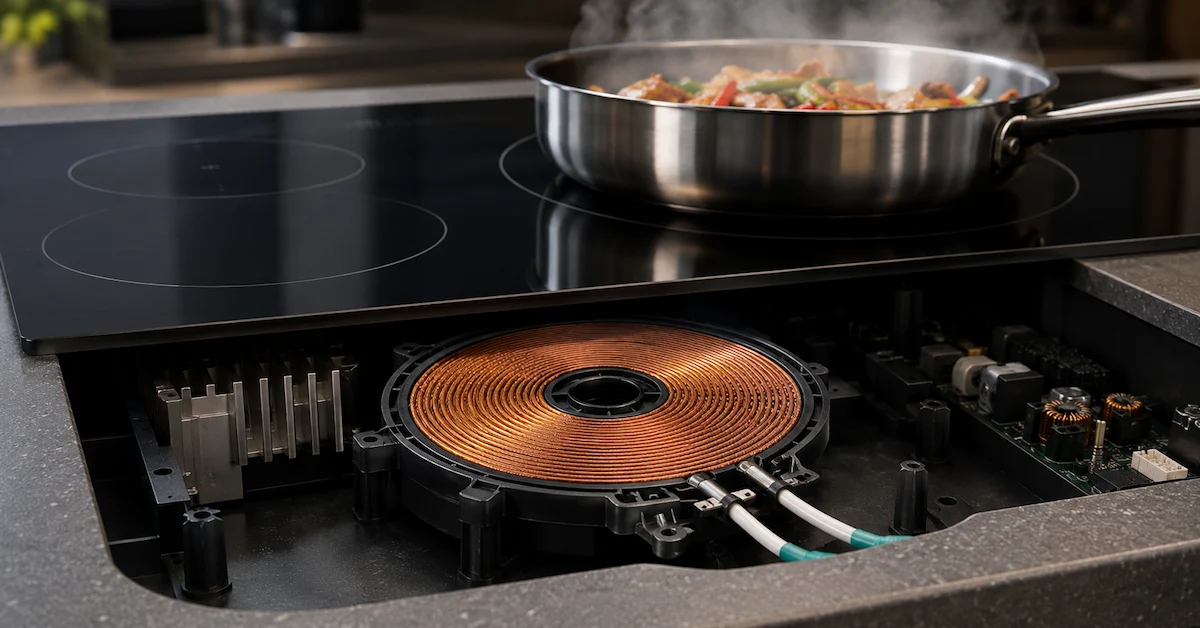
Induction cooking systems typically use a high-frequency alternating current through a coil to create a changing magnetic field, which induces heating in suitable cookware. The coil operates as part of a resonant power-conversion system rather than as an isolated heating component. STMicroelectronics specifically notes that resonant-switching topologies are typically used in induction cooking power converters.
That makes supplier selection different from buying a simple mechanical part.
The question is not only:
“Can this supplier deliver induction coils?”
It should also be:
“Can this supplier maintain the approved specifications across samples, bulk orders, and future repeat purchases?”
Who Typically Searches for an Induction Coil Supplier?
The keyword induction coil supplier has strong commercial-investigation and transactional intent.
Typical buyers include:
Induction Cooktop Manufacturers
They require coils for:
- Built-in induction hobs
- Tabletop induction cookers
- Multi-zone cooktops
- Kitchen appliance production
Their priorities usually include:
- Electrical compatibility
- Stable batch quality
- Production continuity
- Cost control
Appliance OEM and ODM Companies
These buyers may develop different appliance platforms for multiple customers.
They often need:
- Several coil dimensions
- Flexible customization
- Sample development
- Controlled repeat production
Private-Label Appliance Brands
Private-label buyers may rely more heavily on supplier technical support.
Important requirements include:
- Compatible component selection
- Stable supply
- Documentation
- Production responsiveness
Component Importers and Distributors
These buyers may purchase induction coils for:
- Regional appliance factories
- Replacement-part channels
- Component distribution
Their priorities often include:
- Multiple specifications
- Export packaging
- Reliable lead times
- Commercial flexibility
Supplier vs Manufacturer: Which Matters More for an Induction Coil Buyer?
The terms overlap,but buyer expectations are different.
| Area | Manufacturer Focus | Supplier Focus |
|---|---|---|
| Coil production | Core responsibility | Must understand source |
| Engineering | Design and process | Technical coordination |
| Samples | Prototype production | Sample availability and management |
| Bulk orders | Manufacturing | Supply scheduling |
| Documentation | Production records | Buyer-facing documentation |
| Logistics | Factory preparation | Delivery coordination |
| Repeat orders | Process consistency | Supply continuity |
| Commercial service | Secondary | Core requirement |
For long-term appliance production, an ideal partner combines both:
manufacturing control + professional supply service.
A supplier who communicates well but cannot control manufacturing creates risk.
A factory with good manufacturing but weak project communication can also create delays.
Do Not Source an Induction Coil From Wattage Alone
One of the weakest RFQs is:
“Please quote a 2,000 W induction coil.”
That does not define enough information for reliable supplier comparison.
An induction coil works with:
- The inverter
- Resonant capacitor
- Switching frequency
- Cookware load
- Ferrite arrangement
- Mechanical installation
- Control system
ON Semiconductor describes induction cooking as a system in which high-frequency current passes through a copper coil and the cookware behaves conceptually like the secondary side of a transformer.
Two coils marketed for similar nominal power can therefore differ substantially in:
- Inductance
- Coil diameter
- Number of turns
- Conductor construction
- Ferrite arrangement
- Resistance
- Thermal behavior
- Connector design
For procurement teams, the correct approach is to compare approved technical specifications, not product labels alone.
What Specifications Should You Send an Induction Coil Supplier?
A detailed RFQ helps the supplier quote the correct product and reduces unnecessary sample rounds.
| Specification | Buyer Input | Procurement Importance |
|---|---|---|
| Application | Built-in hob, tabletop cooker,commercial unit | Defines use environment |
| Coil outer diameter | Required size | Determines fit/heating zone |
| Inner diameter | If applicable | Defines geometry |
| Inductance | Target + tolerance | Key electrical parameter |
| Resistance | Target/limit if defined | Supports consistency control |
| Turn count | Existing specification if known | Influences coil behavior |
| Conductor | Existing wire specification | Controls loss and heat |
| Ferrite | Layout/specification | Influences magnetic field |
| Coil height | Maximum installation space | Mechanical compatibility |
| Leads | Length and routing | Assembly requirement |
| Connector | Exact interface | Production compatibility |
| Sensor | Type/value if used | Temperature monitoring |
| Mounting | Holes/brackets/carrier | Assembly compatibility |
| Quantity | Sample, trial, annual volume | Commercial planning |
| Target market | Destination region | Compliance planning |
If your engineering team has not finalized every item, mark them as open technical requirements.
A competent supplier should identify which specifications must be fixed before production.
Why Inductance Should Be Controlled in Supplier Qualification
Inductance is one of the most important parameters when matching a coil to an induction cooking platform.
It affects interaction with the resonant power stage and should therefore be:
- Defined
- Measured
- Toleranced
- Controlled between batches
A quotation that says only:
“induction cooker coil, 180 mm”
does not provide enough information for a production buyer.
Ask How Inductance Is Measured
Supplier comparisons become unreliable when:
- Different test frequencies are used
- Measurement conditions differ
- No tolerance is specified
Your approved specification should define the measurement method when this is technically necessary for the platform.
Why Winding Construction Matters
The winding is a critical part of the coil assembly.
In high-frequency applications, conductor construction influences AC losses and thermal behavior.
A supplier should be able to control specifications such as:
- Conductor material
- Strand construction
- Wire cross-section
- Turn count
- Winding pattern
- Insulation
- Lead termination
Avoid accepting:
“High-quality copper wire”
as the entire technical specification.
That wording is too vague for repeat B2B production.
Why Ferrite Layout Should Be Included in the Approved Specification
Ferrite components are commonly incorporated around or beneath induction cooking coils to manage the magnetic field.
Infineon's induction-cooking technical material describes flat “pancake” coils as common in cooktops and notes that ferrite bars are commonly used to improve magnetic-field confinement and alignment.
From a sourcing perspective, buyers should therefore control:
- Number of ferrite pieces
- Geometry
- Position
- Material requirement where applicable
- Fixing method
A supplier should not change ferrite arrangement casually between production batches.
Existing Coil or Custom Coil: Which Supply Route Is Better?
Not every purchasing project requires a fully customized induction coil.
| Supply Route | Best For | Development Effort | Procurement Risk |
|---|---|---|---|
| Existing supplier model | Similar appliance platform | Low | Low |
| Modified existing model | Different interface/specs | Medium | Medium |
| Fully custom coil | Proprietary cooktop design | High | Higher |
For buyers with flexible appliance layouts, adapting an existing product can sometimes reduce:
- Development time
- Prototype rounds
- Engineering cost
- Supply risk
WEBO currently lists Induction Coil among its core appliance-component products. Buyers can review the existing coil structure first and then determine whether a standard platform, modified configuration, or fully customized solution is more suitable for their induction cooktop project.
Buyers can first review the WEBO Induction Coil product before deciding whether an existing platform or a custom design is more appropriate.
A Better Induction Coil Supplier Qualification Process
Supplier approval should happen in stages rather than moving directly from quotation to bulk purchase.
Step 1: Submit a Complete RFQ
Provide:
- Application
- Drawings
- Existing coil sample
- Electrical requirements
- Mechanical dimensions
- Annual demand
This gives the supplier enough context to identify possible mismatches early.
Step 2: Compare Technical Compliance Before Price
Before comparing quotations, confirm whether each supplier is quoting the same:
- Coil geometry
- Inductance
- conductor specification
- ferrite arrangement
- connector
- sensor
- inspection level
Otherwise, the lowest quotation may simply represent a different product.
Step 3: Order Samples
Samples should be evaluated before bulk approval.
Inspect:
- Dimensions
- Connector
- Lead length
- Winding
- Ferrite
- General workmanship
Then proceed to electrical and appliance-level validation.
Step 4: Test Samples in the Actual Cooktop
This step is essential.
Supplier sample testing should include the actual or representative appliance platform.
Buyers should evaluate:
- Startup
- Pan detection
- Heating response
- Temperature rise
- Power stability
- Different cookware sizes
- Continuous operation
- Control-system compatibility
A coil can pass standalone inspection and still be unsuitable for the finished appliance.
Step 5: Freeze the Approved Specification
After validation, define:
- Drawing revision
- Inductance
- resistance
- winding construction
- ferrite arrangement
- connector
- sensor
- critical dimensions
- packaging
This becomes the reference for future production.
Step 6: Move to Trial Production
Before committing to large-volume production, a pilot lot can help confirm:
- Batch consistency
- Assembly fit
- Inspection method
- Packaging
- Production repeatability
Step 7: Approve Mass Supply
Mass production should be based on the approved specification—not simply on the original quotation.
What Quality Checks Should an Induction Coil Supplier Provide?
A strong QC plan connects inspection to actual buyer risk.
Dimensional Inspection
Control points may include:
- Outer diameter
- Inner diameter
- Height
- Mounting points
- Lead length
- Connector position
Inductance Testing
Confirm:
- Target value
- Tolerance
- Test conditions
Resistance and Continuity Testing
These checks can identify:
- Connection issues
- conductor inconsistencies
- assembly errors
Ferrite Inspection
Check:
- Correct quantity
- Correct placement
- Broken ferrite
- Fixing condition
Connector and Lead Inspection
Verify:
- Connector model
- Crimp or termination condition
- Lead routing
- Lead length
Sensor Inspection
Where a sensor is included:
- Sensor type
- nominal value
- position
- connector
should match the approved specification.
What Is the Biggest Risk in Repeat Induction Coil Orders?
One of the highest supply-chain risks is sample-to-production drift.
The first sample may work perfectly, but later production can change if the supplier does not control:
- Wire specification
- Turn count
- Ferrite source
- Ferrite layout
- Sensor
- Connector
- Adhesive
- Winding process
Require Change Control
A reliable supplier should not make significant material or structural changes without evaluating their effect.
For long-running cooktop programs, buyers should define when supplier changes require:
- Notification
- Engineering review
- New samples
- Revalidation
This is particularly important when multiple appliance models use the same coil platform.
How to Compare Induction Coil Suppliers
Use a supplier scorecard instead of comparing price only.
| Supplier Evaluation | What to Check |
|---|---|
| Product experience | Induction cooker/cooktop projects |
| Technical communication | Can supplier understand electrical specs? |
| Sample capability | Can they support validation? |
| Electrical QC | Inductance/resistance controls |
| Material control | Winding/ferrite consistency |
| Customization | Dimensions, leads, connectors, sensors |
| Change control | Production revision management |
| Bulk supply | Repeat-order capability |
| Packaging | Coil and lead protection |
| Export experience | International order handling |
The supplier should be able to answer these questions before receiving a long-term production nomination.
What Affects Induction Coil Supplier Pricing?
Several factors affect quotation differences.
Copper and Conductor Construction
Copper usage can vary with:
- Coil size
- turns
- conductor specification
Ferrite Quantity and Configuration
Different ferrite layouts can affect:
- Material usage
- assembly complexity
Connector and Sensor Requirements
Custom electrical interfaces increase component and assembly costs.
Testing Requirements
A quotation that includes controlled electrical inspection is not directly comparable with one that does not.
Order Volume
Sample, trial, and mass-production pricing may differ.
Packaging
Export orders may require stronger protection for:
- Coil structure
- Ferrite
- wires
- connectors
Why the Lowest Induction Coil Price Can Increase Total Procurement Cost
Purchasing departments should consider total cost of sourcing, not simply unit price.
A cheaper coil can become expensive if it results in:
- Additional sample rounds
- Production-line fitting problems
- Appliance overheating
- electrical mismatch
- unstable batch performance
- delayed launches
- replacement shipments
The correct procurement objective is:
lowest acceptable total risk and cost for the approved specification.
Lead Time and Supply Capacity: What Should Buyers Ask?
Do not assume that a supplier's total factory size equals available capacity for your exact product.
Ask separately about:
- Sample lead time
- Revised-sample lead time
- Trial-order lead time
- Bulk production lead time
- Monthly capacity for the selected coil
- Peak-season planning
- Material availability
WEBO states that it operates approximately 50,000 square meters of manufacturing space with more than 500 workers and serves customers across Europe, Asia, Africa, and America.
However, WEBO's website does not publish one universal induction-coil monthly capacity or production lead time. Those figures should therefore be confirmed according to the selected design, order quantity, and production schedule rather than assumed.
Certification and Compliance: Avoid a Common Buyer Mistake
WEBO states that it implements ISO 9001 and ISO 14001 management standards and lists VDE, TUV, UL, CE, and RoHS certifications across its product portfolio.
Buyers should still verify the applicability to the exact induction coil and finished appliance.
Ask:
- Which exact certificate covers this component?
- Which model is listed?
- Does customization affect the certificate scope?
- Does the final induction cooktop require separate testing?
- What documents are required in the destination market?
Company-level certification should not be treated as automatic finished-appliance approval.
When Is OEM Customization Worth Using?
Customization is valuable when standard supplier coils cannot match:
- Installation space
- Heating-zone dimensions
- Inductance target
- connector
- lead routing
- ferrite layout
- sensor
- mechanical support
Possible OEM adjustments include:
- Outer/inner diameter
- Number of turns
- winding configuration
- ferrite arrangement
- cable length
- connector
- sensor
- mounting
The final design should always be validated together with the appliance platform.
Why Consider WEBO as an Induction Coil Supplier?
GUANGDONG WEBO TECHNOLOGY was established in 1998 and currently supplies heating and appliance components including induction coils, hot plates, ceramic heaters, tube heating elements, cast iron pan supports, ceramic glass, rotary switches, and energy regulators.
For induction-cooking projects, buyers can first review the WEBO Induction Coil and compare its structure with their existing or planned appliance platform.
WEBO's broader appliance-component range is available through the WEBO product center.
Buyers evaluating WEBO as an induction coil supplier can first review the WEBO Induction Coil as a reference for product structure and application direction. For OEM projects, dimensions, inductance requirements, winding specifications, ferrite configuration, lead wires, connectors, and other parameters can then be discussed according to the target appliance platform.
What Should You Include in an Induction Coil RFQ?
For a faster and more useful quotation,send:
Technical Information
- Appliance type
- Coil drawing
- Existing sample
- Outer/inner diameter
- Target inductance
- Inductance tolerance
- Resistance requirement if defined
- Winding specification if available
- Ferrite layout
- Lead length
- Connector
- Sensor
- Mounting requirements
Commercial Information
- Sample quantity
- Trial quantity
- Mass-production quantity
- Estimated annual demand
- Destination country
- Packaging requirement
- Required delivery schedule
Avoid sending only:
“Need induction coil. Please send best price.”
A detailed RFQ makes it easier for both buyer and supplier to determine whether the product is technically and commercially suitable.
Buyers can contact WEBO for induction coil sourcing with drawings, samples, specifications, and projected quantities.
FAQ
1.What does an induction coil supplier provide?
An induction coil supplier provides coils for induction cooking or heating applications and may also support sample supply, specification matching, customization, bulk production coordination, quality control, packaging, and repeat orders.
2. How do I choose an induction cooktop coil supplier?
Evaluate technical compatibility, electrical QC, conductor and ferrite control, sample capability, customization, repeat-production consistency, lead time, and supply communication rather than comparing price alone.
3. Is coil diameter enough to match an induction cooktop?
No. Diameter is only one parameter. Inductance, resistance, turn count, winding construction, ferrite, connector, sensor, and compatibility with the resonant power system also matter.
4. Should I request induction coil samples before bulk ordering?
Yes. Samples should be inspected and then tested in the actual or representative induction appliance before bulk production approval.
5. Can an induction coil supplier customize connectors and lead wires?
OEM suppliers may support customized lead lengths, routing and connectors when technically feasible.These details should be documented in the approved specification.
6. Why is ferrite important in an induction coil assembly?
Ferrite is commonly used to improve magnetic-field confinement and alignment in induction cooking coil assemblies. Its placement and configuration should therefore be controlled.
7. What should be checked during incoming inspection?
Depending on the specification, buyers may check dimensions, inductance, resistance, ferrite condition, winding quality, lead length, connector, sensor, and identification.
8. What causes induction coil supplier prices to differ?
Pricing may vary because of conductor construction, copper usage, ferrite quantity, coil dimensions, connectors, sensors, testing, packaging, customization, and order quantity.
9. How do I reduce risk in repeat induction coil orders?
Use a controlled drawing, defined electrical specification, approved sample, inspection criteria, and supplier change-control requirements.
10.How can I request an induction coil quotation from WEBO?
Review the WEBO Induction Coil product and send your application, drawings or existing sample, electrical specifications, connectors, estimated quantity, and delivery requirements through the WEBO contact page.
Conclusion
Choosing the right induction coil supplier is primarily a question of technical compatibility and supply consistency.
For induction cooktop manufacturers, OEM appliance companies, private-label brands, and importers, the strongest supplier should be able to maintain the approved:
- Electrical parameters
- Coil dimensions
- winding specification
- ferrite configuration
- connector and sensor requirements
- production quality
while also supporting sample validation, bulk production, change control, packaging, and repeat orders.
The most effective procurement sequence is:
Define specifications → qualify the supplier → validate samples → freeze the approved design → verify trial production → control repeat supply.
This process helps reduce specification mismatch, unstable batches, production interruptions, and unnecessary engineering rework.
WEBO supplies induction coil solutions as part of its wider kitchen-appliance component portfolio. Buyers sourcing coils for new or existing induction cooktop programs can contact WEBO for technical and commercial evaluation with their drawings, specifications, samples, and projected order volumes.