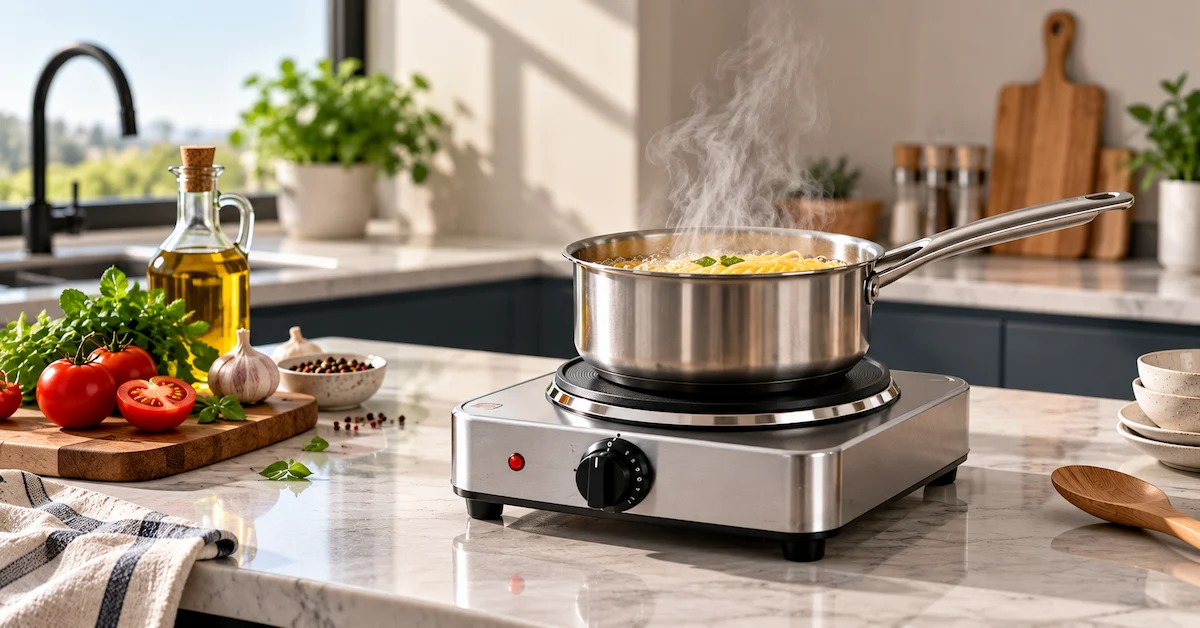



A hot plate for laboratory heater development must be evaluated as part of a complete heating system, not simply as an electrically powered metal surface. For laboratory equipment manufacturers, the critical decisions include temperature control, thermal uniformity, surface compatibility, electrical protection, mechanical integration, and qualification against the intended application.
A heating plate that performs adequately in a household cooking appliance is not automatically suitable for laboratory equipment. Laboratory applications may involve sensitive samples, repeated temperature cycles, chemical exposure, glassware, specialized containers, and demanding control requirements. These factors can create engineering challenges that conventional cooking equipment was not designed to address.
For OEM buyers, the practical approach is to establish the intended laboratory process, define measurable performance criteria, shortlist potentially compatible heating components, and validate the complete equipment design before production approval.
WEBO, formally GUANGDONG WEBO TECHNOLOGY CO., LTD, is a China-based manufacturer established in 1998. Its product portfolio includes electric hot plates, ceramic radiant heaters, tubular heating elements, and associated appliance components.
The company's published solid hot plate range includes HP-F90, HP-F110, and HP-F145, corresponding to nominal 90mm, 110mm, and 145mm product categories. These products provide references for preliminary heating component discussions.
However, WEBO's publicly available product listings do not establish that these specific models are approved for laboratory equipment, chemically resistant, or capable of precision temperature control. Their potential suitability must be investigated through model-specific documentation and application testing.
This guide is intended for laboratory instrument manufacturers, thermal design engineers, OEM product developers, and industrial procurement professionals evaluating possible heating component integration.
For available component references, visit WEBO's Electric Hot Plate Product Range.

1. What Is a Hot Plate for Laboratory Heater Applications?
A laboratory hot plate is a heating device designed to transfer thermal energy to laboratory vessels, samples, or other materials under defined operating conditions.
Depending on the equipment design, the heating system may include an electrical heating element, a heat-transfer surface, a temperature sensor, a control circuit, thermal protection devices, and an enclosure that protects users from electrical and thermal hazards.
Some laboratory hot plates also incorporate magnetic stirring, programmable temperature control, digital displays, or external temperature probes.
However, these features belong to the complete instrument architecture. They should not be attributed automatically to the heating element itself.
Heating component vs. complete laboratory instrument
A useful distinction exists between two different products.
Heating plate component: A resistive or otherwise electrically powered heating element intended for integration into another product.
Complete laboratory hot plate: A finished instrument incorporating the heating system, controls, enclosure, protection devices, operator interface, and application-specific features.
This distinction is particularly important when sourcing heating elements from general appliance component manufacturers.
A component supplier may manufacture a suitable electrical heating element without manufacturing a laboratory instrument that satisfies the required finished-equipment specifications.
For OEM buyers, component evaluation should therefore begin with a clearly defined integration and qualification process.
Why laboratory applications require additional evaluation
Laboratory equipment frequently depends on repeatable operating conditions.
A process may require stable sample temperature, uniform heating over a defined area, resistance to relevant cleaning chemicals, or controlled response after a temperature setpoint changes.
A component that generates heat efficiently is not necessarily able to satisfy these requirements without an appropriately designed control and heat-transfer system.
The engineering team must determine which performance characteristics belong to the heating element and which depend on other parts of the completed instrument.
2. Who Should Consider OEM Laboratory Heating Components?
The main commercial audience for laboratory heating components consists of companies that design, manufacture, or integrate laboratory equipment.
These buyers usually need engineering information and qualified manufacturing support rather than a standard retail hot plate.
| B2B buyer | Typical purchasing requirement | Main concern |
|---|---|---|
| Laboratory equipment manufacturers | Heating components for new instruments | System compatibility |
| OEM scientific instrument developers | Components meeting engineering specifications | Temperature stability and integration |
| Laboratory equipment distributors | Technically compatible replacement components | Correct model identification |
| Thermal system integrators | Heating components for specialized equipment | Thermal performance and control |
| Quality control equipment manufacturers | Repeatable heating systems | Measurement consistency |
| Research equipment developers | Components for prototype development | Feasibility and safety |
| Industrial procurement departments | Repeatable supply of approved components | Quality consistency and commercial risk |
These buyers have different decision-making priorities.
An engineering manager may prioritize temperature stability, thermal modeling, and component compatibility.
A purchasing manager may focus on quotation transparency, production availability, order quantities, and long-term supply.
A quality engineer may require controlled specifications, traceability, inspection records, and qualification evidence.
A successful supplier evaluation should address all three perspectives.
When a conventional solid hot plate is not appropriate
A standard cooking-oriented solid hot plate should not be assumed suitable for applications requiring laboratory-certified equipment, magnetic stirring, specified chemical resistance, precise closed-loop temperature regulation, or operation in potentially explosive atmospheres.
The same caution applies to medical, pharmaceutical, or analytical applications involving specialized regulatory requirements.
In these situations, a dedicated laboratory heating system or a specifically engineered heating module may be necessary.
End users purchasing equipment for direct laboratory operation should select suitable finished laboratory instruments with appropriate documentation, rather than installing an unqualified appliance heating component.
3. Common Laboratory Applications and Their Heating Requirements
Laboratory heating equipment supports several types of work, but individual applications can impose very different performance and safety requirements.
The most important engineering step is to identify what must actually be heated.
Is the equipment intended to heat a vessel surface, maintain a liquid temperature, warm a solid sample, or deliver energy through a separate thermal block?
These objectives should not be treated as interchangeable.
3.1 Sample preparation equipment
Sample preparation instruments may require controlled warming as part of a broader analytical workflow.
Relevant design parameters can include temperature stability, heat distribution, container geometry, and repeatability between operating cycles.
The complete system should be designed around the actual sample preparation method.
3.2 Educational laboratory heating equipment
Educational laboratories may use heating equipment for supervised demonstrations and routine experiments.
The equipment design should prioritize appropriate operator protection, understandable controls, and robust thermal management.
A heating component should not be selected only on the basis of cost because the final instrument must also address foreseeable use and misuse.
3.3 Quality control and materials laboratories
Quality control equipment may use controlled heating during sample conditioning or material evaluation.
For these systems, reproducibility can be particularly important.
A temperature difference between samples or operating cycles can affect test outcomes.
3.4 Industrial laboratory instruments
Manufacturers may develop specialized heating equipment for industrial testing or process development.
These applications can involve demanding operating cycles, unusual mechanical interfaces, or controlled heating profiles.
Component selection should be based on the actual duty cycle and environmental conditions.
Application suitability matrix
| Application | Important design requirement | Engineering evaluation |
|---|---|---|
| General sample warming | Controlled heat transfer | Surface and sample temperature testing |
| Sample preparation systems | Repeatable thermal conditions | Temperature stability and recovery |
| Educational laboratory equipment | Operator protection | Electrical and thermal safety evaluation |
| Materials testing instruments | Defined thermal profiles | Control accuracy and cycling tests |
| Quality control equipment | Repeatable operation | Measurement and calibration planning |
| Laboratory replacement components | Exact compatibility | Electrical, mechanical, and documentation review |
These scenarios illustrate possible laboratory heating requirements. They do not establish that an existing WEBO hot plate is approved for any specific laboratory procedure.
Applications involving flammable solvents, reactive chemicals, controlled atmospheres, or specialized containment require dedicated hazard assessment and suitably designed equipment.
4. How to Select the Right Laboratory Heating Plate
Selecting a heating plate begins with a technical specification rather than a catalog photograph.
The development team should determine the required heating method, temperature range, heating surface, electrical supply, expected thermal load, installation configuration, and operating environment.
These requirements determine whether a conventional solid heating element is worth evaluating.
4.1 Determine the temperature requirement
Three temperature values should be distinguished.
Heating surface temperature describes the temperature of the physical plate.
Vessel interface temperature describes the temperature where a vessel contacts or receives heat from the surface.
Sample temperature describes the temperature of the material being processed.
These values may differ considerably.
A sensor installed beneath a hot plate does not necessarily measure the temperature of the sample inside a laboratory vessel.
For precise sample heating, the instrument may require additional sensing and an appropriate control architecture.
4.2 Determine the required heating area
The heating surface must be compatible with the intended load geometry.
A smaller plate may suit a compact installation but may not distribute heat effectively across a large vessel.
A larger heating surface can introduce additional thermal inertia and enclosure design challenges.
The appropriate surface dimensions should be established through the intended process, not through an assumption that a larger or smaller plate is inherently better.
4.3 Define operating conditions
The engineering specification should identify the expected ambient temperature, operating duration, thermal cycles, installation orientation, and environmental exposure.
Equipment used repeatedly throughout the day may have different reliability requirements from equipment used occasionally.
Potential exposure to liquids, cleaning agents, or contamination must also be considered.
4.4 Define safety requirements before requesting samples
The buyer should identify applicable standards and destination-market requirements early in development.
This prevents a situation where a component is selected for cost or mechanical convenience but cannot support the final equipment's qualification needs.
5. Technical Specifications for Laboratory Heater Component Selection
A laboratory heater component specification should describe measurable requirements.
Generic descriptions such as "high performance," "precision heating," or "industrial quality" are not adequate substitutes for actual engineering data.
| Technical parameter | Why it matters | Information to confirm |
|---|---|---|
| Heating technology | Determines energy transfer and control requirements | Resistive, radiant, or other design |
| Rated voltage | Affects electrical compatibility | Model-specific voltage |
| Rated power | Influences available heating capacity | Wattage and tolerance |
| Electrical resistance | Supports electrical design | Resistance at defined test conditions |
| Plate diameter | Determines physical heating area | Nominal and actual dimensions |
| Overall height | Affects equipment enclosure | Controlled drawing dimensions |
| Heating surface material | Affects heat transfer and environmental compatibility | Exact material and finish |
| Temperature capability | Defines possible operating limits | Rated conditions and qualification data |
| Surface temperature distribution | Affects thermal uniformity | Measurement under stated load |
| Terminal configuration | Affects wiring and installation | Terminal drawing |
| Insulation performance | Supports electrical safety | Applicable test records |
| Thermal cycling durability | Affects repeated operation | Qualification requirements and results |
| Product identification | Supports traceability | Part number and revision |
| Certification documentation | Supports equipment assessment | Available model-specific records |
Not all listed parameters are published for the existing WEBO hot plate models.
For a serious OEM project, the buyer should request the current technical datasheet and controlled drawing before approving the component.
Electrical design calculation
For a simplified predominantly resistive heater operating at its specified rating:
Electrical power (W) ≈ Voltage (V) × Current (A)
The approximate equivalent operating resistance is:
Resistance (Ω) ≈ Voltage² (V²) ÷ Power (W)
For illustration, a hypothetical 500W resistive heater operating at 230V would have an approximate rated current of 2.17A and an equivalent operating resistance of 105.8Ω.
These values are purely illustrative and are not specifications for WEBO products.
Actual heater resistance may change with temperature, and power consumption can depend on the operating conditions and control method.
Engineering calculations should therefore be verified against actual component measurements.
6. Temperature Accuracy, Stability, and Uniformity: Three Different Requirements
One of the most important decisions in laboratory heater design is defining what temperature performance is required.
Temperature accuracy, stability, and uniformity are related, but they do not describe the same characteristic.
Temperature accuracy
Temperature accuracy describes how closely the measured or controlled temperature corresponds to the intended value, considering the measurement system and test method.
A controller displaying 100°C does not prove that every part of the heating surface or the laboratory sample is at 100°C.
Sensor location and calibration are essential.
Temperature stability
Temperature stability describes how consistently a temperature remains near the desired value over time under specified conditions.
A heating system can maintain an average temperature while still exhibiting significant short-term fluctuations.
For temperature-sensitive laboratory processes, these fluctuations may matter.
Temperature uniformity
Temperature uniformity describes how temperature varies across different positions in the heating area.
A plate may be stable at its central sensor position while its edges operate at different temperatures.
The instrument developer should identify the locations that matter to the intended application.
Why component selection alone cannot guarantee precision
Temperature performance depends on several interacting factors:
-
Heating element design and power distribution
-
Heating surface material and thickness
-
Thermal contact between components
-
Sensor location and response
-
Control algorithm
-
Environmental heat losses
-
Vessel or sample geometry
-
Operating conditions
For this reason, precision temperature performance is a property of the complete engineered system, not simply of the heating element.
An OEM buyer should ask whether a proposed supplier can provide data relevant to the component's thermal behavior.
Where these data are unavailable, the buyer should plan its own measurements before making performance claims.
7. Heating Surface Materials and Chemical Compatibility
Surface material selection is especially important when comparing laboratory heating equipment with conventional cooking hot plates.
Laboratory instruments may encounter chemicals or cleaning processes that are not typical of kitchen appliances.
A material suitable for contact with cookware is not automatically suitable for exposure to acids, solvents, salts, or aggressive cleaning agents.
Solid metal heating surfaces
Metal surfaces can provide useful mechanical properties and thermal conduction.
However, their behavior depends on the specific alloy, surface finish, operating temperature, and exposure conditions.
Oxidation, corrosion, coating degradation, or surface contamination may affect the application.
A buyer should request accurate material identification rather than relying on a broad description such as "durable metal."
Ceramic and glass-ceramic surfaces
Certain laboratory hot plates use ceramic or glass-ceramic surfaces because particular material systems can offer useful temperature and chemical-resistance characteristics.
Nevertheless, chemical compatibility varies with composition, substance, concentration, temperature, and exposure duration.
A generic ceramic description does not prove universal chemical resistance.
WEBO also offers Ceramic Heater Components and Ceramic Glass Products.
These are relevant categories for separate engineering discussions, but their suitability for laboratory surfaces has not been established by the public product listings.
Thermal shock and repeated heating
Laboratory equipment may experience heating and cooling cycles.
Differences in thermal expansion between the heating component, surface layer, mounting hardware, and supporting structure can create mechanical stress.
Testing should reflect the actual operating cycle and material combination.
Recommended material review
| Material-related concern | Buyer evaluation |
|---|---|
| Surface construction | Identify the material and coating |
| Chemical exposure | Assess compatibility with identified substances |
| Cleaning conditions | Determine permitted cleaning procedures |
| Thermal expansion | Verify mechanical compatibility |
| Thermal cycling | Establish qualification conditions |
| Surface wear | Define applicable durability criteria |
| Contamination risk | Assess the intended laboratory process |
| Documentation | Request material information and supporting evidence |
Where aggressive chemical exposure or contamination control is critical, a purpose-designed laboratory heating surface may be preferable to a conventional cooking hot plate.
8. Evaluating WEBO Hot Plate Models for Potential OEM Integration
WEBO publishes solid hot plate products in three nominal diameter categories.
These include:
-
HP-F90: 90mm category
-
HP-F110: 110mm category
-
HP-F145: 145mm category
These are real published model references.
However, the publicly available information does not establish laboratory-specific performance, chemical resistance, precision temperature capabilities, or compliance with laboratory equipment safety standards.
They should therefore be treated as candidate components for technical feasibility assessment, not as laboratory-ready products.
WEBO model comparison
| Model | Published diameter | Preliminary engineering consideration | Required verification |
|---|---|---|---|
| HP-F90 | 90mm | Compact physical heating zone | Electrical rating, surface material, integration |
| HP-F110 | 110mm | Intermediate installation geometry | Power, terminal design, thermal response |
| HP-F145 | 145mm | Larger nominal heating surface | Uniformity, enclosure clearance, environmental compatibility |
The comparisons describe possible design considerations based on nominal dimensions, not verified laboratory capabilities.
HP-F90: Compact integration assessment
A 90mm nominal plate may be considered when equipment dimensions are highly constrained.
However, a smaller physical heating zone can limit compatible vessel geometry.
Engineering teams must determine whether the required heating performance can be achieved under the actual application conditions.
HP-F110: Intermediate component geometry
The 110mm category may provide an alternative mechanical envelope for equipment developers.
The decision should account for mounting, terminal location, heat transfer, and enclosure design.
Any claimed temperature performance must be established through measurements.
HP-F145: Larger surface integration
A 145mm nominal plate may be relevant when the instrument design requires a larger contact area.
A larger plate does not automatically guarantee better temperature uniformity or accuracy.
The mechanical design, temperature control, surface material, and load characteristics remain decisive.
What buyers should request from WEBO
Before selecting a model for laboratory equipment development, request the current electrical specifications, construction details, dimensional drawings, available test reports, and relevant documentation.
The project should proceed only if the technical review identifies a feasible and appropriately safe application.
9. Closed-Loop Temperature Control and Sensor Integration
Heating power and temperature control should be evaluated separately.
A heating element converts electrical energy into heat.
A temperature control system determines how the energy input changes in response to measured conditions.
Open-loop operation
An open-loop system may supply a selected amount of electrical power without continuously correcting for the actual sample or plate temperature.
The resulting temperature depends on heat losses, load conditions, and surrounding equipment.
Such operation may be unsuitable for processes requiring precise temperature regulation.
Closed-loop operation
A closed-loop system measures a relevant temperature and adjusts the heating input according to the difference between measured and desired conditions.
Possible control strategies include thermostat-based switching and electronic control systems.
For appropriate applications, more sophisticated systems may use proportional-integral-derivative control.
However, control sophistication does not replace proper sensing, electrical protection, or thermal design.
Selecting a temperature sensor
Sensor choice depends on the operating temperature, required accuracy, response time, installation constraints, and compatibility with the controller.
Potential sensor technologies include thermocouples and resistance temperature detectors.
The appropriate sensor should be selected according to the actual application.
Sensor position matters
A sensor installed near the heating element may respond differently from one located at the vessel interface.
For some laboratory processes, direct sample temperature measurement may be important.
The instrument manufacturer must establish which temperature is controlled and which temperature is merely monitored.
Independent overtemperature protection
A precision controller should not be assumed to provide complete safety protection under all failure conditions.
Independent protective functions may be necessary depending on the risk assessment and applicable standards.
A qualified equipment developer should evaluate sensor failures, control faults, unintended continuous heating, and related conditions.
These are responsibilities of the finished equipment design, not features that can be assumed from an ordinary heating plate component.
10. Laboratory Heater Mechanical Design and Assembly Requirements
Mechanical integration affects both performance and safety.
A heater may generate the required amount of thermal energy while transferring excessive heat to neighboring components.
The mounting system can also influence heat distribution, dimensional stability, and electrical protection.
Component installation
The design should identify the required mounting surface, overall component envelope, permitted movement, and connection arrangement.
Engineering drawings should define critical dimensions and tolerances.
Thermal expansion
Different materials expand by different amounts as temperature changes.
The mounting design should account for thermal movement without creating unacceptable mechanical stress.
Wiring and terminals
Electrical wiring must be appropriately rated and routed away from excessive heat and other hazards.
The terminal arrangement should permit secure connections without creating installation interference.
The electrical design should also address applicable grounding, insulation, and protection requirements.
Housing design
A laboratory instrument enclosure may need to accommodate ventilation, temperature-sensitive controls, cleaning conditions, and user-accessible surfaces.
Any openings should be evaluated against the relevant safety and contamination requirements.
Serviceability
Where the product is intended to support component replacement, the assembly design should allow qualified service personnel to identify and replace approved parts.
Replacement should not rely on uncertain visual similarity between components.
11. Safety Requirements for Laboratory Heating Equipment
Laboratory heating equipment must be assessed against requirements appropriate to its intended function and destination market.
For electrically powered laboratory equipment used to heat materials, IEC 61010-2-010:2019 is an important international reference.
Its title is Safety requirements for electrical equipment for measurement, control and laboratory use — Part 2-010: Particular requirements for laboratory equipment for the heating of materials.
It is used alongside the relevant requirements of IEC 61010-1.
These standards address safety issues associated with laboratory electrical equipment and heating functions.
However, the precise applicable edition, national adoption, and conformity route must be determined for the specific product and market.
Component certification is not finished-equipment certification
This distinction is essential for OEM buyers.
WEBO's company website references quality management systems and several product certification schemes.
Those general statements do not demonstrate that HP-F90, HP-F110, or HP-F145 have been individually assessed under IEC 61010-2-010.
They also do not establish compliance of a finished laboratory instrument containing those components.
The finished-equipment manufacturer remains responsible for determining applicable requirements and obtaining the necessary supporting evidence.
Electrical and thermal hazards
Laboratory hot plates can present risks including burns, electric shock, overheating, fire, and ignition of hazardous atmospheres.
Princeton University Environmental Health and Safety, in its Heating Devices guidance, highlights the importance of enclosed heating elements and the potential spark hazards associated with certain older hot plate switching and thermostat designs.
Harvard University Environmental Health and Safety, in its Laboratory Safety Guideline: Hot Plate Safety (revised May 30, 2023), also emphasizes electrical condition, operating practices, and hazards associated with hot surfaces.
These institutional sources provide useful laboratory safety context, although they do not qualify any specific WEBO product.
Chemical and ignition hazards
A conventional electric heating component must not be treated as explosion-proof, intrinsically safe, or appropriate for flammable vapor atmospheres without specific supporting design and certification evidence.
Equipment selection for hazardous substances requires a separate risk assessment and applicable engineering controls.
The intended application should never be justified solely by the fact that a component can reach a certain temperature.
12. Quality Control and OEM Qualification Testing
For laboratory equipment manufacturers, quality control begins with the definition of measurable acceptance criteria.
A statement that a component is "high quality" does not explain how it will be inspected or qualified.
The buyer should identify critical-to-quality characteristics and establish appropriate verification methods.
Recommended qualification matrix
| Test category | Evaluation objective | Possible evidence |
|---|---|---|
| Dimensional inspection | Verify mechanical compatibility | Inspection report |
| Electrical rating | Confirm component electrical characteristics | Rated-condition measurements |
| Insulation assessment | Evaluate electrical protection | Applicable test record |
| Thermal performance | Establish heating behavior | Temperature measurements |
| Temperature stability | Evaluate complete system control | Time-series test data |
| Surface uniformity | Evaluate thermal distribution | Defined-location temperature data |
| Thermal cycling | Assess repeated heating effects | Qualification report |
| Environmental compatibility | Evaluate intended exposure conditions | Material and application test evidence |
| Assembly assessment | Verify production installation | Pilot assembly records |
| Product identification | Maintain approved model and revision | Traceability documentation |
This matrix is a recommended qualification framework.
It does not claim that all tests are currently performed by WEBO or that any specific laboratory requirement has already been satisfied.
Prototype testing
Early samples should be examined for electrical and mechanical compatibility.
The prototype system should then be tested under controlled conditions representative of the intended operating requirements.
Pilot production
Once the design has been provisionally accepted, a pilot production run can help determine whether the heating assembly can be manufactured consistently.
The pilot should use production-intent components and relevant assembly procedures.
Incoming inspection
For repeat purchasing, the OEM should establish acceptance criteria for the approved part.
Critical dimensions, electrical characteristics, identification, and other high-risk characteristics may require controlled inspection.
The inspection method should be agreed upon with the supplier.
Change management
Material changes, construction changes, terminal modifications, and other significant revisions may affect equipment qualification.
Supplier agreements should establish how changes are communicated and approved.
An apparently minor change to a heating component can have consequences for temperature performance or safety.
13. OEM and ODM Development Considerations
OEM and ODM cooperation can be relevant when an existing heating component does not match a proposed instrument design.
However, development feasibility should be confirmed before presenting customization as an available solution.
OEM component manufacturing
In an OEM arrangement, the buyer typically provides a specification, drawing, or approved design.
The manufacturing partner produces according to the agreed technical and commercial requirements.
ODM development support
An ODM-style project may involve additional assistance with component selection or design development.
The exact engineering responsibilities should be clearly documented.
Potential customization discussions
Depending on technical feasibility, an OEM buyer may investigate changes involving component diameter, mounting geometry, electrical rating, terminals, identification, or packaging.
Some changes may require new tooling or further qualification.
For WEBO, the availability of any particular customization must be confirmed directly.
Engineering responsibility
Laboratory instrument manufacturers should retain clear control over the finished product specification.
The supplier's component knowledge can support technical evaluation, but laboratory process validation, instrument safety assessment, and intended-use qualification must be assigned to the appropriate responsible parties.
14. Production Capacity, Lead Time, and Long-Term Supply
Commercial planning should begin after the technical feasibility of the component has been established.
A laboratory instrument program may require engineering samples, initial validation quantities, pilot production, and larger repeat orders.
Each stage has different cost and scheduling implications.
WEBO states that it was established in 1998 and describes a substantial heating-element manufacturing operation.
Nevertheless, publicly stated factory size and overall manufacturing experience do not establish the production capacity or lead time of a specific hot plate model.
Buyers should request an order-specific quotation and delivery proposal.
Key commercial questions
Ask whether the required model is currently available, whether customization involves tooling, what sampling quantities can be supported, and how production orders would be scheduled.
For repeat supply, clarify forecast requirements, product revision control, packaging, and traceability.
Avoid planning around assumed minimum order quantities or delivery times.
Managing procurement continuity
A controlled technical specification helps prevent unexpected component changes.
For high-volume programs, buyers may also establish procedures for nonconforming products, corrective actions, and approved engineering changes.
These arrangements can reduce production uncertainty and improve coordination between the supplier and equipment manufacturer.
15. Understanding Laboratory Heating Component Costs
The purchase price of a heating component is only part of the financial decision.
For laboratory equipment manufacturers, engineering qualification and manufacturing consistency can significantly affect total project cost.
A useful cost framework includes:
Total project cost = component purchasing + tooling + engineering validation + inspection + assembly + logistics + maintenance and warranty exposure
The relative importance of each factor depends on the production program.
Component price
Different component sizes, constructions, and commercial quantities may produce different quotations.
A lower price does not establish equivalent performance or compatibility.
Development and tooling
A modification to the mounting arrangement or heating structure may require engineering work.
Some developments may also involve tooling costs.
These costs should be confirmed before approving a custom project.
Qualification expenses
Laboratory equipment may require substantial validation before market release.
If a proposed heating component cannot satisfy the intended requirements, the buyer may need to redesign the assembly or select another technology.
Identifying this early can reduce expensive late-stage changes.
Warranty and field performance
Reliability concerns should be evaluated in the context of actual application conditions.
An instrument that fails to maintain required temperatures or creates inconsistent sample processing can produce consequences beyond the cost of replacing the heating component.
For that reason, component sourcing decisions should consider technical evidence and supplier communication, not purchase price alone.
16. Solid Hot Plate vs. Alternative Laboratory Heating Technologies
A conventional solid resistive hot plate is not the only possible approach to laboratory heating.
Other technologies may better support certain applications.
| Heating approach | General characteristics | Important selection concern |
|---|---|---|
| Solid resistive hot plate | Direct heating through a solid surface | Surface compatibility, control integration |
| Ceramic-surface laboratory hot plate | Heating beneath or within a specialized surface system | Surface properties and system qualification |
| Laboratory hot plate with stirrer | Combines heating and magnetic stirring | Control, stirring compatibility, equipment safety |
| Heating block | Transfers heat through shaped contact features | Sample vessel geometry |
| Heating mantle | Heating system designed around compatible vessels | Vessel fit and temperature control |
| Tubular heating element assembly | Heating element integrated into a separate thermal structure | Power density, geometry, insulation |
These categories are not automatically interchangeable.
A heating block may be preferable for samples requiring defined contact geometry.
A laboratory hot plate with magnetic stirring may better suit processes needing controlled mixing.
A specialized laboratory surface may be necessary when chemical compatibility is essential.
The correct technology depends on the application, rather than the supplier's available inventory.
WEBO also publishes a Tube Heating Element category for separate component discussions.
Its suitability for laboratory equipment requires the same project-specific technical review.
17. How to Prepare an Effective Laboratory Heater OEM RFQ
A complete request for quotation helps buyers obtain relevant technical responses and avoids confusion between standard heating components and laboratory-ready equipment.
The RFQ should identify the intended instrument, operating requirements, component interface, and expected purchasing program.
Laboratory heater component RFQ template
| Required information | Buyer input |
|---|---|
| Company and project | OEM company name and equipment project |
| Finished equipment | Intended laboratory heating instrument |
| Application | General description of the intended heating process |
| Heating technology | Required or preferred heating method |
| Candidate model | HP-F90, HP-F110, HP-F145, or alternative |
| Required size | Heating area and available installation envelope |
| Electrical supply | Voltage and frequency |
| Target power | Required heating capacity |
| Temperature requirements | Operating range and control performance |
| Surface material | Material requirements and environmental exposure |
| Sensor arrangement | Measurement location and controller interface |
| Mechanical drawing | Mounting structure and dimensional tolerances |
| Operating conditions | Duty cycle and expected environment |
| Safety requirements | Applicable standards and documentation |
| Prototype quantity | Engineering sample requirement |
| Pilot production | Initial qualification quantity |
| Annual forecast | Estimated bulk demand |
| Packaging | Product identification and transportation needs |
| Commercial requirements | Quotation, MOQ, tooling, and lead time |
Recommended supplier communication
A concise inquiry could explain:
"We are developing an OEM laboratory heating instrument and are evaluating a potential heating plate component. Please review our application, controlled drawing, electrical requirements, and operating conditions. We would like to confirm component construction, available technical documentation, sample feasibility, and whether the proposed part can be considered for further qualification."
This wording focuses on a genuine technical assessment rather than assuming that an existing component is already suitable.
Request a WEBO technical feasibility review
If your project requires a resistive heating component and you are evaluating whether WEBO's available models could be adapted to your equipment design, begin with a technical inquiry.
Review the WEBO Heating Plate Product Range and share your application requirements with the manufacturer.
For projects requiring laboratory-specific chemical compatibility, precision control, or conformity documentation, make those requirements explicit before requesting production quantities.
Contact WEBO for Heating Component Specifications and an OEM Quotation
18. Frequently Asked Questions About Hot Plates for Laboratory Heaters
1. Can a conventional electric hot plate be used in laboratory heating equipment?
A conventional electric hot plate may be considered as a potential heating component during an engineering feasibility study, but it should not automatically be used in laboratory equipment.
The designer must evaluate electrical safety, thermal performance, surface materials, control integration, and intended environmental conditions.
A cooking-oriented heating component may lack the properties required for certain laboratory applications.
Only an appropriately designed and qualified finished instrument should be placed into the intended laboratory service.
2. What is the difference between a laboratory hot plate and a kitchen hot plate?
Both may use electrical energy to produce heat, but their intended applications and design requirements can differ significantly.
Laboratory hot plates may need specialized surface materials, defined temperature-control performance, chemical compatibility, and additional protective functions.
Kitchen hot plates are generally developed around cookware and cooking requirements.
A similar appearance does not establish equivalence in performance or safety.
The relevant finished-equipment standards and application conditions must be evaluated separately.
3. Are WEBO HP-F90, HP-F110, and HP-F145 certified for laboratory applications?
The publicly available WEBO product pages do not establish laboratory-specific certification for these models.
They identify hot plate products within nominal diameter categories but do not provide a complete laboratory qualification package.
Buyers should request model-specific documents and confirm whether the component is appropriate for the intended application.
No certification should be assumed from general company statements or from certificates associated with different products.
4. How is laboratory heating temperature accuracy measured?
Temperature accuracy depends on what temperature is being measured and how the measurement system is configured.
A laboratory heater may monitor the heating surface, a vessel interface, or the actual sample.
These locations can have different temperatures.
An appropriate test should define the sensor, calibration method, operating conditions, measurement location, and acceptance criteria.
Accuracy should not be inferred solely from a controller display or nominal heating power.
5. Is a ceramic heating surface always better than a metal surface?
No. Ceramic and metal surfaces have different properties, and their suitability depends on the application.
Relevant factors include heat-transfer performance, operating temperature, mechanical durability, thermal shock behavior, and chemical compatibility.
The exact ceramic or metal material matters.
An appropriately designed metal surface may suit one application, while a specialized ceramic system may be preferable for another.
Engineering evaluation should be based on measurable requirements rather than broad material claims.
6. What safety standard should a laboratory heater manufacturer investigate?
IEC 61010-1 and IEC 61010-2-010 are important references for applicable laboratory electrical heating equipment.
IEC 61010-2-010:2019 addresses particular requirements for equipment used to heat materials.
The responsible manufacturer must determine which standards, editions, national adoptions, and conformity procedures apply to the intended instrument and destination market.
A component datasheet does not replace finished-equipment conformity assessment.
7. Can an OEM laboratory heater use an external temperature controller?
An external temperature controller may be part of an appropriately engineered heating system.
However, the controller, sensor, electrical switching, protective devices, and heating component must be compatible.
Sensor placement and the control strategy affect actual temperature performance.
A temperature controller alone does not establish equipment safety or sample-temperature accuracy.
The finished design should undergo appropriate engineering and safety validation.
8. How should a buyer compare laboratory heating element suppliers?
Buyers should compare suppliers through documented specifications, technical communication, available qualification evidence, sample feasibility, dimensional consistency, and commercial transparency.
A supplier should also explain the limitations of its products and identify requirements that have not been validated.
Price alone is insufficient.
The strongest purchasing decision is based on compatibility with the finished equipment and the ability to maintain the approved specification during repeat production.
9. What information is needed for an OEM laboratory heater quotation?
An effective inquiry should include the intended equipment, target heating technology, required dimensions, electrical supply, power requirements, temperature objectives, operating conditions, relevant material exposure, drawings, and destination market.
The buyer should also provide sample requirements and estimated purchasing quantities.
If specific laboratory standards or chemical compatibility conditions apply, these should be stated clearly.
This information allows a supplier to conduct a more meaningful technical feasibility review.
10. What should buyers do if a standard hot plate does not meet laboratory requirements?
If a standard hot plate cannot meet the required temperature control, material compatibility, electrical protection, or other performance criteria, the buyer should not attempt to justify its use based solely on size or cost.
The correct next step is to evaluate another heating technology, a purpose-designed laboratory component, or a more suitable finished instrument.
An experienced equipment engineering team should determine the appropriate alternative and qualification procedure.
Conclusion
Choosing a hot plate for laboratory heater development requires a clear understanding of the difference between an electrical heating component and a fully engineered laboratory instrument.
The heating element is only one part of the system. Temperature accuracy, thermal uniformity, chemical compatibility, mechanical integration, electrical safety, and repeatability depend on the complete equipment architecture.
For laboratory instrument manufacturers, the most reliable sourcing process begins with defining the application, identifying critical technical specifications, evaluating suitable heating technologies, obtaining accurate component documentation, and validating the finished equipment before production release.
WEBO, established in 1998, manufactures electrical heating elements and related appliance components. Its published solid hot plate range includes HP-F90, HP-F110, and HP-F145, which may serve as references for preliminary OEM feasibility discussions.
However, these published product references should not be interpreted as evidence of laboratory certification, precision temperature control, or verified chemical resistance. Their potential integration into laboratory equipment requires technical review and appropriate application-specific qualification.
For OEM buyers, a successful heating component partnership depends on accurate information, clear engineering responsibility, controlled production specifications, and realistic expectations about the intended use.
Developing a laboratory heating instrument or evaluating a potential resistive heating component for a new OEM project?
Share your technical drawing, electrical requirements, temperature objectives, surface material needs, operating conditions, destination market, and estimated purchasing volume with WEBO to determine whether its available heating products warrant further engineering assessment.
Explore WEBO Electric Hot Plate Products or Contact WEBO for an OEM Technical Feasibility Review and Quotation.