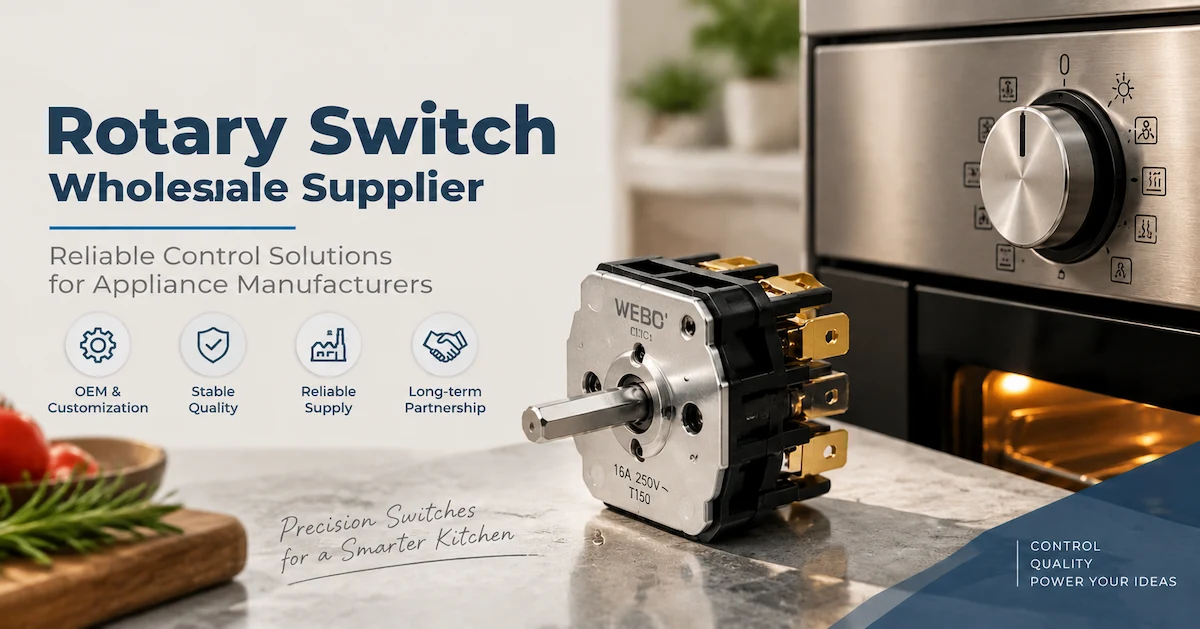



What Does a Rotary Switch OEM Manufacturer Provide for Appliance Projects?
A rotary switch OEM manufacturer provides more than a standard mechanical switch. For appliance brands and equipment manufacturers, OEM cooperation means developing or producing rotary switches according to specific application requirements, including electrical performance, installation structure, control functions, appearance, and production expectations.
A rotary switch is an important control component used in many appliances where users need reliable mechanical operation. It may control heating modes, cooking functions, operating levels, or different equipment settings. Because the switch directly affects user interaction and appliance performance, selecting the right OEM partner requires evaluating engineering capability, manufacturing control, and long-term supply stability.
For appliance manufacturers, the main questions are:
- Can the supplier understand the appliance application?
- Can the switch match electrical and mechanical requirements?
- Can the supplier support product customization?
- Can the approved design remain consistent during mass production?
WEBO provides appliance control components. Buyers can review the rotary switch product category and evaluate suitable solutions based on their product requirements.
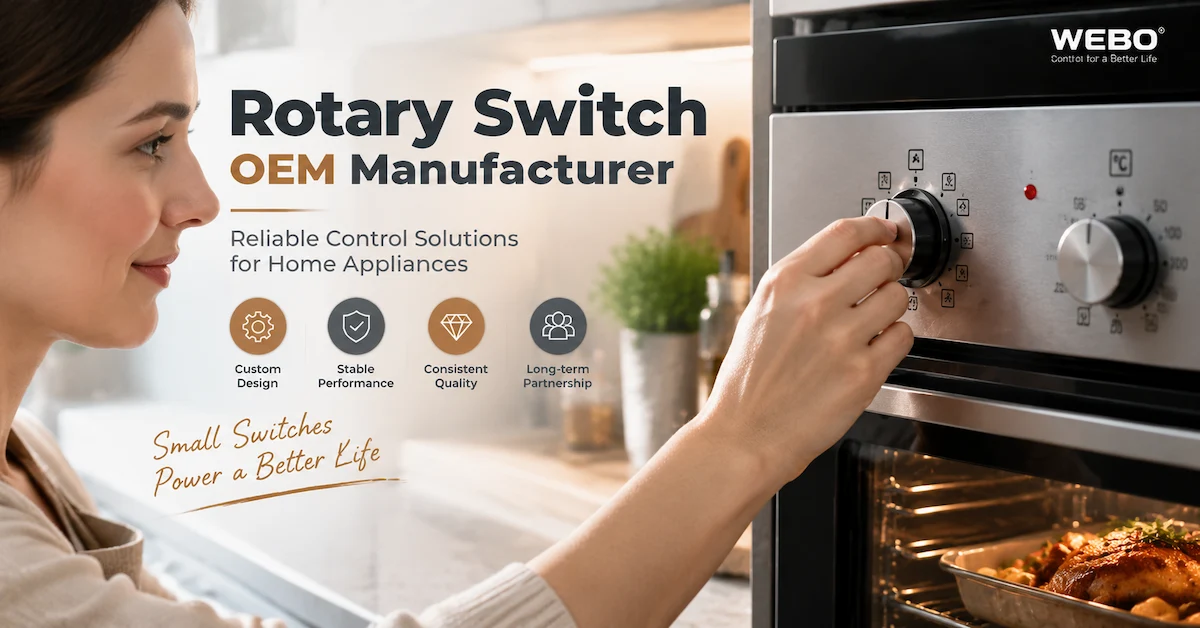
Why Appliance Brands Choose Rotary Switch OEM Manufacturers
OEM cooperation allows appliance brands to develop control components that better match their product design instead of relying only on standard market products.
A professional rotary switch OEM manufacturer can support:
| OEM Support Area | Buyer Value |
|---|---|
| Product Design Review | Helps confirm switch feasibility before production |
| Structural Adjustment | Allows adaptation to appliance installation requirements |
| Electrical Configuration | Matches appliance circuit requirements |
| Sample Development | Allows testing before mass production |
| Production Management | Maintains consistency for repeat orders |
For example, an oven manufacturer may require a rotary switch with specific positions, shaft dimensions, or connection methods. A kitchen appliance brand may need a switch design that matches its control panel appearance and user experience.
OEM development helps connect the switch design with the final appliance instead of treating the component as an isolated part.
Understand Rotary Switch Applications Before OEM Development
Before selecting an OEM supplier, buyers should define the intended application. Different appliances have different operating environments and control requirements.
Rotary Switch for Appliances
A rotary switch for appliances is commonly used in equipment where users need mechanical selection or adjustment.
Typical applications include:
- Kitchen appliances
- Cooking equipment
- Heating appliances
- Electrical equipment
- Household devices
Important selection factors include:
| Application Requirement | Why It Matters |
|---|---|
| Switching Function | Determines available control options |
| Rotation Position | Defines user operation experience |
| Electrical Rating | Ensures circuit compatibility |
| Mounting Structure | Ensures installation accuracy |
| Shaft Design | Matches external knob structure |
An experienced OEM supplier should evaluate the complete appliance environment instead of recommending a product based only on appearance.
Rotary Switch for Oven Applications
A rotary switch for oven applications requires stable operation because users frequently select different cooking functions.
Oven manufacturers should consider:
- Function selection requirements
- Temperature control interface
- Electrical connection
- Mechanical installation
- Long-term operation reliability
A suitable switch should integrate smoothly with the oven control system.
How to Evaluate a Rotary Switch Manufacturer
A reliable rotary switch manufacturer should demonstrate both manufacturing capability and technical understanding.
OEM buyers should evaluate:
| Evaluation Factor | Key Questions |
|---|---|
| Product Capability | Can the supplier produce suitable switch types? |
| Engineering Support | Can technical requirements be discussed clearly? |
| Manufacturing Process | Are production steps controlled? |
| Quality Inspection | Are functional checks available? |
| Production Stability | Can repeat orders maintain consistency? |
A manufacturer with strong engineering communication can help reduce development risks during OEM projects.
Key Specifications to Confirm Before OEM Production
Before starting cooperation with a rotary switch OEM manufacturer, buyers should prepare clear specifications.
Important specifications include:
| Specification | Buyer Consideration |
|---|---|
| Rated Voltage | Matches appliance electrical requirements |
| Rated Current | Supports required operating conditions |
| Switching Positions | Defines available functions |
| Shaft Structure | Matches knob and panel design |
| Terminal Configuration | Ensures wiring compatibility |
| Mounting Method | Supports correct installation |
| Operating Feel | Influences user experience |
A complete specification helps suppliers avoid incorrect assumptions during product development.
OEM Rotary Switch Supplier Selection Guide
Choosing an OEM rotary switch supplier requires reviewing both technical and commercial capability.
A suitable supplier should support:
Technical Communication
The supplier should understand:
- Appliance application
- Control requirements
- Installation limitations
- Electrical conditions
Sample Development
The supplier should support:
- Prototype production
- Design review
- Functional evaluation
- Customer approval
Mass Production
The supplier should maintain:
- Production consistency
- Quality inspection
- Revision control
- Delivery management
The purpose of OEM cooperation is not only creating one successful sample but establishing a repeatable production process.
Develop Custom Rotary Switch Solutions for OEM Projects
For appliance manufacturers, a custom rotary switch solution is often required when standard components cannot fully match the product structure or control requirements. Unlike purchasing an existing switch model, customization requires cooperation between the buyer’s engineering team and the supplier’s manufacturing team.
A professional rotary switch OEM manufacturer should evaluate the complete application before confirming customization feasibility.
Common customization areas include:
| Customization Area | Buyer Requirement |
|---|---|
| Shaft Design | Match the external knob and control panel structure |
| Terminal Configuration | Meet appliance wiring requirements |
| Switching Function | Support required operating positions |
| Mounting Structure | Fit the appliance installation design |
| Appearance | Match product appearance requirements |
| Packaging | Support OEM product management |
Before starting a custom rotary switch project, buyers should prepare:
- Appliance application information
- Product drawings
- Electrical specifications
- Required switching functions
- Expected order quantity
- Quality requirements
A clear technical specification helps avoid unnecessary redesign during later development stages.
OEM Rotary Switch Development Process
A reliable OEM rotary switch supplier should provide a structured development process instead of moving directly from quotation to production.
Step 1: Requirement Review
The supplier should review:
- Application environment
- Electrical requirements
- Mechanical dimensions
- Control functions
- Production expectations
This stage determines whether an existing solution can be adapted or whether a new design approach is required.
Step 2: Technical Evaluation
Engineering teams should confirm:
- Switch structure
- Contact configuration
- Rotation position
- Terminal arrangement
- Installation method
Technical evaluation reduces the risk of producing a component that cannot integrate with the final appliance.
Step 3: Sample Development
Prototype samples allow buyers to verify:
- Product dimensions
- Installation compatibility
- Rotation performance
- Electrical function
- User operation experience
Samples should be evaluated using the actual appliance or representative assembly whenever possible.
Step 4: Mass Production Approval
Before production release, confirm:
- Approved sample reference
- Final specification
- Inspection requirements
- Packaging standard
- Revision control
A controlled approval process helps maintain consistency during repeat orders.
How to Select a Rotary Selector Switch Manufacturer
A rotary selector switch manufacturer should understand both mechanical operation and appliance control requirements.
Rotary selector switches are commonly used when users need to select different operating modes, such as:
- Cooking functions
- Heating levels
- Appliance programs
- Equipment operating settings
When evaluating a supplier, buyers should review:
| Evaluation Factor | Buyer Questions |
|---|---|
| Switching Positions | Does the switch provide the required functions? |
| Rotation Performance | Is the operation smooth and consistent? |
| Electrical Contacts | Are connection requirements satisfied? |
| Mechanical Structure | Does it match the appliance design? |
| Production Capability | Can quality remain stable in bulk production? |
A supplier should explain how the selector switch performs within the complete appliance system rather than focusing only on the switch itself.
Evaluate Rotary Switch Wholesale Supplier China Options
Many global buyers search for a rotary switch wholesale supplier China because China has an established appliance component manufacturing supply chain.
However, supplier selection should focus on capability, not only manufacturing location.
Important evaluation factors include:
| Supplier Evaluation | What Buyers Should Confirm |
|---|---|
| Product Range | Available rotary switch types and applications |
| Manufacturing Ability | Production capacity and process control |
| Quality System | Inspection methods and standards |
| Customization Support | Ability to handle OEM requirements |
| Communication | Technical response and project management |
| Delivery Capability | Ability to support scheduled production |
A reliable supplier should provide clear information about:
- Product specifications
- Production process
- Quality inspection
- Sample approval
- Repeat-order management
Choose an Electric Rotary Switch Supplier Based on Application Needs
An electric rotary switch supplier should understand both electrical performance and appliance requirements.
Before purchasing, buyers should confirm:
Electrical Requirements
Important factors include:
- Rated voltage
- Rated current
- Switching load
- Terminal connection
Mechanical Requirements
Review:
- Shaft dimensions
- Rotation angle
- Mounting method
- Panel compatibility
Application Requirements
Consider:
- Appliance type
- Operating environment
- User frequency
- Expected service life
The correct supplier should recommend a solution based on the entire application instead of offering a generic component.
Rotary Switch Quality Control Before Mass Production
Quality control is essential for appliance control components because switch failure can affect the entire product experience.
A professional rotary switch OEM manufacturer should establish inspection procedures throughout production.
Incoming Material Inspection
Review:
- Material consistency
- Component quality
- Supplier documentation
Assembly Process Control
Monitor:
- Internal component assembly
- Terminal installation
- Mechanical structure
- Production consistency
Functional Testing
Evaluate:
- Switching operation
- Rotation performance
- Electrical connection
- Product reliability
Final Inspection
Confirm:
- Product specifications
- Quantity accuracy
- Appearance quality
- Packaging condition
WEBO provides company information and certification details through its certification information page. Buyers should confirm the documentation required for their specific appliance control project.
Prepare Your Rotary Switch OEM Project for WEBO
Before contacting WEBO, buyers should prepare:
- Appliance application
- Technical drawings
- Electrical requirements
- Switching requirements
- Quantity forecast
- Customization expectations
Buyers can review the WEBO rotary switch product category to understand available appliance control solutions.
For OEM project discussions, submit technical requirements through the WEBO contact page.
Providing complete project information allows both sides to evaluate:
- Product feasibility
- Customization scope
- Production requirements
- Development timeline
Frequently Asked Questions
1. What does a rotary switch OEM manufacturer provide?
A rotary switch OEM manufacturer provides customized or application-specific switch solutions for appliance manufacturers, including specification review, product adjustment, sample development, and production support.
2. What information should I provide for a rotary switch OEM project?
Provide the appliance application, drawings, electrical requirements, switching functions, installation details, quantity expectations, and quality requirements.
3. Can rotary switches be customized for different appliances?
Yes. Customization may include structure, terminals, switching positions, shaft design, and packaging depending on the appliance requirements.
4. How do I choose between a standard rotary switch and a custom solution?
If an existing product meets the electrical, mechanical, and application requirements, standard supply may be suitable. Custom solutions are better when specific design requirements cannot be achieved with standard products.
5. What applications use rotary switches?
Rotary switches are commonly used in appliances, ovens, heating equipment, cooking equipment, and other products requiring mechanical control selection.
6. Why is sample approval important for OEM rotary switches?
Sample approval allows buyers to verify dimensions, installation compatibility, electrical performance, and user operation before mass production.
7. How should buyers evaluate a rotary switch manufacturer?
Evaluate product capability, engineering support, customization ability, quality control processes, production stability, and communication efficiency.
8. What should I check before ordering rotary switches in bulk?
Confirm product specifications, approved samples, inspection requirements, packaging standards, and repeat-order conditions.
9. Can a rotary selector switch replace other control components?
Not always. Buyers should evaluate electrical functions, control logic, and appliance requirements before replacing one control component with another.
10. How can I request a quotation from WEBO?
Prepare your project requirements and contact WEBO through the contact page.
Conclusion
Selecting a rotary switch OEM manufacturer requires evaluating more than product availability and price. Appliance brands should review technical compatibility, customization capability, manufacturing control, sample approval procedures, and long-term supply reliability before starting production.
A reliable OEM partner should help transform appliance control requirements into stable, repeatable components while maintaining consistent quality during future orders. For your appliance control project, review the WEBO rotary switch products and submit your requirements through the WEBO contact page to discuss specifications, customization options, and OEM supply solutions.