



Choosing a Tube Heating Element Wholesale Supplier Is a Technical Procurement Decision
Finding a tube heating element wholesale supplier is not simply a matter of locating the lowest unit price. For appliance manufacturers, importers, distributors, and industrial equipment companies, the real purchasing challenge is ensuring that the heating element fits the equipment, delivers the required electrical output, survives the intended operating environment, and remains consistent across repeat bulk orders.
A wholesale buyer normally needs to confirm voltage, wattage, tube shape, installation dimensions, sheath material, terminal configuration, heating medium, certification requirements, packaging, and order quantity before comparing quotations.
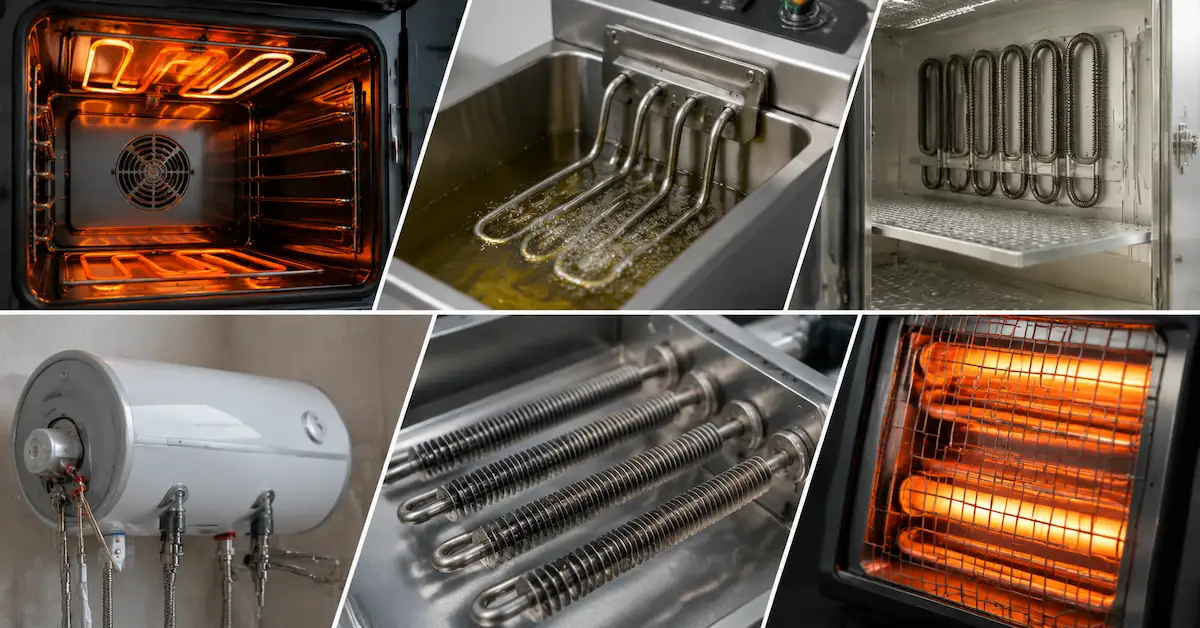
This is especially important because tubular heating elements are used across very different applications. Metal-sheathed tubular elements are commonly used in ovens, grills, hot plates, immersion heating, air heaters, oil heaters, and other appliance or industrial heating systems. Industry references such as Kanthal's electric appliance heating element guide describe the typical metal-sheathed design as a heating coil electrically insulated from the surrounding metal tube by granular insulating material such as MgO.
For B2B buyers, therefore, a reliable supplier should be evaluated as an engineering and supply-chain partner rather than only as a component seller.
Who Should Buy from a Tube Heating Element Wholesale Supplier?
Wholesale sourcing is most suitable for companies purchasing heating elements repeatedly or integrating them into finished equipment.
Typical buyers include:
- Electric oven manufacturers
- Electric grill manufacturers
- Water heater and boiler manufacturers
- Small appliance brands
- Industrial heating equipment companies
- Food-processing equipment manufacturers
- Drying equipment manufacturers
- Heating component importers
- Appliance parts wholesalers
- Replacement-parts distributors
- OEM and private-label buyers
- Procurement and product-development teams
WEBO's current tube heating element listings illustrate this application range. The company's tube-heating portfolio includes configurations intended for ovens and electric furnaces, water heaters and boilers, air-heating equipment, industrial ovens, drying machines, and other heating applications.
When Wholesale Supply May Not Be the Best Purchasing Route
A wholesale supplier is usually not the most efficient choice if you only need one consumer replacement element and already know an exact appliance part number.
Wholesale sourcing becomes more valuable when you need:
- Repeated orders
- Multiple models
- OEM dimensions
- Custom terminals
- Specific voltage or power
- Custom flanges or mounting
- Export packaging
- Private-label packaging
- Sample approval before mass production
- Long-term supply consistency
The difference is important because a technically correct bulk component must remain compatible not only in the first sample, but also across future production batches.
What Is a Tube Heating Element?
A tube heating element, often called a tubular heating element, is an electric resistance-heating component in which electrical energy is converted into heat.
The IEC Electropedia defines a heating resistor as the part of a heating element used to convert electrical energy into heat. IEC Electropedia provides standardized electrotechnical terminology used across the electrical industry.
A common metal-sheathed tubular heater construction includes:
- Resistance heating wire or coil
- Electrical insulating material
- Metal outer sheath
- Terminal pins or lead connections
- Mounting or flange structure where required
- Sealing or terminal insulation components
For metal-sheathed appliance elements, MgO is commonly used between the resistance coil and the metal sheath because the design must transfer heat while maintaining electrical insulation. Kanthal identifies this construction in its technical guidance for metal-sheathed tubular elements.
WEBO's own technical content likewise describes a typical tube heating element using a metallic sheath, resistance wire, and insulating powder, while noting stainless steel and alloys such as Incoloy as possible sheath materials depending on the design.
Start with the Application Before Asking for a Wholesale Price
One of the most common sourcing mistakes is sending only a photograph and asking:
"What is your best price?"
A tube heater should first be matched to the heating environment.
| Application | Typical Configuration Direction | Key Buying Questions |
|---|---|---|
| Electric oven | Formed or W-shaped tubular element | Voltage, wattage, dimensions, mounting, terminal layout |
| Electric grill | Bent tubular heating element | Heat-zone coverage, shape, sheath, fixing method |
| Water heater | Immersion or flange-mounted element | Water compatibility, flange/thread, wattage, sealing |
| Boiler | U-shaped or flange heating element | Power, fitting, corrosion environment, installation |
| Air heater | Open-air tubular arrangement | Airflow, surface loading, tube layout, temperature |
| Drying equipment | Custom formed element | Chamber size, airflow, operating cycle, mounting |
| Industrial equipment | Application-specific geometry | Process temperature, medium, dimensions, electrical load |
WEBO currently lists a W-shaped tube heating element for electric furnaces and ovens, a U-shaped flange-style element for water heaters and boilers, and a double-U configuration for air heaters, industrial ovens, and drying equipment.
This is why wholesale buyers should specify the equipment and heating medium first, and the physical element second.
Technical Specifications to Send Your Supplier Before Requesting a Quote
A professional RFQ should contain enough information for the supplier to determine whether an existing model can be used or whether an OEM design is required.
Essential Tube Heating Element RFQ Checklist
| Specification | Why It Matters |
|---|---|
| Application | Defines the heating environment |
| Heating medium | Air, water, metal surface, oven chamber, etc. |
| Rated voltage | Must match the equipment electrical system |
| Required wattage | Determines heating output |
| Overall dimensions | Must fit the equipment |
| Tube diameter | Influences mechanical and thermal design |
| Element shape | Determines heating-zone coverage |
| Mounting method | Must match the equipment structure |
| Flange/thread size | Critical for immersion applications |
| Terminal configuration | Must match internal wiring |
| Sheath material | Depends on temperature and environment |
| Operating temperature | Helps evaluate material and loading |
| Quantity | Determines tooling and production planning |
| Target market | Helps identify compliance requirements |
| Certification requirement | Should be confirmed before production |
| Packaging | Bulk, individual, private-label, export carton |
| Drawing/sample | Reduces compatibility errors |
Do Not Choose Wattage Independently of Element Size
The correct heater is not simply "the highest wattage that fits."
Wattage, heated length, tube surface area, operating temperature, heating medium, airflow, immersion condition, and sheath material interact with one another.
This is why watt density or surface load is an important engineering consideration. Kanthal's technical guide shows that allowable surface loading varies significantly between different heating element types and applications.
For OEM projects, the safer approach is to provide the required system performance and operating environment so the supplier can review the element design rather than selecting wattage from price alone.
Material Selection Matters in Bulk Tube Heating Element Orders
Different applications place different demands on the heating tube.
Metal Sheath
The sheath protects the internal heating structure and transfers heat into the surrounding environment.
Depending on the application, manufacturers may consider stainless steels, nickel-based alloys, or other suitable sheath materials. The correct choice depends on operating temperature, corrosion exposure, heating medium, oxidation conditions, and cost.
Material selection should therefore be based on the actual service environment rather than a generic assumption that one material is always "better."
Resistance Heating Wire
The internal resistance conductor converts electrical energy into heat.
Resistance alloy selection affects electrical resistance, operating temperature capability, oxidation behavior, and long-term dimensional stability. Kanthal, for example, documents nickel-chromium resistance alloys used in metal-sheathed tubular appliance elements.
Electrical Insulation
Granular MgO is widely used in metal-sheathed tubular elements to electrically isolate the resistance coil from the outer tube while supporting heat transfer.
Terminals and Mounting Components
Terminal layout is especially important for OEM appliance projects.
A heating element can have the correct voltage and wattage but still be unusable if:
- Terminals point in the wrong direction
- Terminal spacing conflicts with wiring
- Mounting brackets do not align
- The flange does not match the tank
- The cold section is positioned incorrectly
- The element interferes with surrounding components
These mechanical details should be confirmed before sample approval.
Comparing Common Tube Heating Element Configurations
A wholesale supplier should be able to recommend a structure that fits the application rather than forcing every customer into one standard model.
| Configuration | Main Advantage | Typical Application | Buyer Priority |
|---|---|---|---|
| W-shaped element | Covers a wider heating area | Oven, electric furnace | Size and mounting |
| Circular/loop element | Compact heating-zone coverage | Oven, hot plate, appliance | Diameter and terminal position |
| U-shaped element | Simple formed heating path | Appliance or industrial heater | Length and power |
| U-shaped flange element | Direct tank/boiler installation | Water heating, boiler | Flange, sealing, corrosion |
| Double-U element | Greater heating surface within a defined area | Air heating, drying, oven | Layout, airflow, watt density |
| Custom formed tube | Fits unique equipment geometry | OEM machinery | Drawing accuracy |
For example, buyers can review WEBO's Tube Heating Element category as the starting point for its current heating-tube portfolio. The site also lists application-specific products including TL-002, TL-022, and TL-023.
How to Evaluate a Tube Heating Element Wholesale Supplier
Wholesale buyers should evaluate suppliers in several dimensions rather than comparing quotations line by line.
1. Technical Review Capability
A strong supplier should ask questions before quoting a custom project.
Useful questions include:
- What equipment is the element used in?
- Is it heating air, water, or a metal surface?
- What voltage is available?
- What wattage is required?
- What is the installation space?
- What is the working temperature?
- What are the mounting dimensions?
- Are drawings available?
- Is an existing sample available?
- Which market will the final product enter?
A supplier that quotes an OEM heater without understanding the application may create avoidable engineering risk.
2. Sample-to-Bulk Consistency
For wholesale purchasing, one successful sample is not enough.
The buyer should establish which characteristics must remain controlled during mass production, such as:
- Overall dimensions
- Bend geometry
- Electrical resistance
- Rated power
- Terminal dimensions
- Flange position
- Surface condition
- Packaging method
Repeatability is particularly important for appliance assembly lines and replacement-parts distributors.
3. Quality-Control Documentation
Before bulk production, ask what inspections are performed and what acceptance criteria will be used.
Depending on the product and application, a quality plan may include:
- Incoming-material inspection
- Dimensional inspection
- Resistance or electrical-performance verification
- Insulation-resistance testing
- Dielectric/withstand testing where applicable
- Terminal inspection
- Surface inspection
- Heating verification
- Final packaging inspection
The exact safety tests and limits should be agreed according to the heating element design, finished appliance, destination market, and applicable standard rather than copied from a generic checklist.
4. Certification and Market Compatibility
A component certificate does not automatically mean the finished appliance complies with every destination-market requirement.
Buyers should therefore confirm:
- Which certificate applies to the exact model
- Whether the certificate covers the required voltage/power
- Whether the document is current
- Whether the final appliance requires additional certification
- Whether material or production changes affect the approved construction
WEBO's website states that the company operates under ISO 9001 and ISO 14001 management systems and that its products have obtained certifications including VDE, TUV, UL, CE, and RoHS. Buyers should still request the documents relevant to the exact model and project.
5. Production Capacity and Lead-Time Transparency
A supplier's factory size is useful context, but it does not by itself determine the lead time for your order.
Buyers should ask separately about:
- Sample lead time
- Tooling lead time
- Trial-order lead time
- Mass-production lead time
- Peak-season capacity
- Monthly capacity for the relevant product family
- Repeat-order planning
- Raw-material availability
WEBO states that its manufacturing operation was established in 1998, operates a plant of approximately 50,000 square meters, and employs more than 500 workers. Its site does not publish a specific monthly tube-heating-element capacity or universal lead time, so those figures should be confirmed per project rather than assumed.
What Affects Wholesale Tube Heating Element Pricing?
There is no useful universal wholesale price for every tubular heating element because the cost structure changes with specification.
Major cost drivers include:
- Sheath material
- Tube diameter
- Element length
- Number of bends
- Flange or threaded fitting
- Resistance wire specification
- Rated voltage
- Rated power
- Terminal structure
- Welding or brazing requirements
- Custom tooling
- Certification requirements
- Inspection requirements
- Order volume
- Packaging method
A standard existing design will generally have a different cost structure from a new OEM element requiring custom tooling, special materials, testing, and packaging.
For that reason, buyers should compare quotations based on an identical technical specification rather than comparing unit prices from different designs.
Common Risks When Buying Tube Heating Elements in Bulk
Specification Mismatch
A heater may physically resemble the original product but have different electrical characteristics.
Always confirm voltage, wattage, resistance, dimensions, terminal layout, and mounting.
Wrong Material for the Environment
A tube suitable for dry-air heating may not automatically be appropriate for water, corrosive liquids, food-processing environments, or high-temperature industrial service.
Sample and Production Differences
The approved sample should become the reference for mass production. Any material, terminal, dimension, or manufacturing change should be controlled.
Certification Assumptions
Never assume a supplier's general certification list automatically covers every element.
Confirm exact documents for the product and market.
Inadequate Export Packaging
Long heating tubes can be vulnerable to bending or terminal damage during transport.
Packaging design should account for product geometry, quantity, stacking, and export handling.
A Practical OEM and Wholesale Development Process
For custom projects, a structured development process reduces errors before mass production.
Step 1: Send Application Requirements
Provide:
- Equipment type
- Voltage
- Wattage
- Dimensions
- Quantity
- Market
- Operating environment
Step 2: Submit Drawing or Existing Sample
A technical drawing is preferred when dimensions and tolerances are critical.
Existing samples can also help the supplier understand shape, flange, terminal, and mounting requirements.
Step 3: Supplier Engineering Review
The supplier evaluates whether:
- A standard model is suitable
- An existing model can be modified
- A new design is required
Step 4: Confirm Commercial Terms
At this stage, confirm:
- Sample cost
- Tooling cost if applicable
- Estimated bulk price
- MOQ
- Packaging
- Development schedule
Step 5: Sample Development and Testing
The buyer should verify both electrical performance and mechanical compatibility in the actual equipment.
Step 6: Freeze the Approved Specification
Final drawings, dimensions, materials, electrical values, terminals, labels, and packaging should be documented.
Step 7: Trial or Mass Production
Production should follow the approved reference.
Step 8: Final Inspection and Export Packaging
Confirm inspection records and packaging requirements before shipment.
Why Consider WEBO for Wholesale Tube Heating Element Projects?
GUANGDONG WEBO TECHNOLOGY was established in 1998 in Yangjiang, Guangdong. Its current website states that the company operates approximately 50,000 square meters of manufacturing space, employs more than 500 workers, serves markets across Europe, Asia, Africa, and America, and manages its operations under ISO 9001 and ISO 14001.
Its broader heating-component portfolio currently includes Hot Plate, Ceramic Heater, Tube Heating Element, Cast Iron Pan Support, Induction Coil, Ceramic Glass, Rotary Switch, and Energy Regulator, which makes the company relevant to appliance buyers sourcing several related heating and control components.
For a tube heating element inquiry, buyers should send the application, voltage, power, dimensions, shape, quantity, terminal requirements, mounting details, certification requirements, and any available drawings or samples through the WEBO contact page.
FAQ
1. What should I send to a tube heating element wholesale supplier for a quotation?
Provide the application, voltage, wattage, dimensions, tube shape, mounting method, terminal type, quantity, destination market, certification needs, and packaging requirements. A technical drawing or existing sample is especially useful for OEM projects.
2. Can tube heating elements be customized for OEM equipment?
Yes, tubular elements can be produced in different shapes, dimensions, electrical ratings, terminal configurations, and mounting arrangements when the manufacturer's production capabilities support the design. WEBO's current product information also references multi-specification customization for certain tube-heating products.
3. What applications use tubular heating elements?
Common applications include ovens, grills, hot plates, immersion heaters, water-heating equipment, air heaters, dryers, and industrial heating equipment.
4. How do I choose between a standard and custom heating element?
Choose a standard model when its voltage, wattage, dimensions, mounting, terminals, and operating environment already match your equipment. Use an OEM design when one or more critical parameters require modification.
5. Which material is best for a tube heating element?
There is no single material that is best for every application. Sheath selection depends on temperature, corrosion environment, heating medium, oxidation conditions, mechanical requirements, and cost.
6. Why is watt density important when selecting a tubular heater?
Watt density describes the heat load applied over the element surface. Excessive loading for a particular application can increase element temperature and reduce design margin, so it should be evaluated together with airflow, immersion conditions, surface area, materials, and operating temperature. Industry guidance shows that appropriate surface loads vary by heating-element design and application.
7. What quality tests should I ask a wholesale supplier about?
Ask the supplier to define dimensional inspection, electrical-performance checks, insulation testing, terminal inspection, surface inspection, heating verification, and any safety tests required by the applicable specification or finished-appliance standard.
8. Does a CE, UL, VDE, or TUV certification apply to every heating element from the same supplier?
Not necessarily. Certification scope can depend on the exact construction, model, electrical rating, and application. Buyers should request documents for the actual component being purchased rather than relying only on a general supplier certification list.
9. What factors affect bulk tube heating element prices?
Material, dimensions, power, tube shape, number of bends, fittings, terminals, tooling, certification, inspection requirements, order quantity, and packaging can all affect quotation structure.
10. How can I request a wholesale tube heating element quote from WEBO?
Review the WEBO Tube Heating Element range, then send your application, drawings, voltage, wattage, dimensions, quantity, certification requirements, and packaging needs through the contact page.
Conclusion
Choosing the right tube heating element wholesale supplier requires more than comparing catalogs and unit prices. The most reliable sourcing process starts with the application and then verifies voltage, wattage, dimensions, materials, terminal design, mounting, quality testing, certification scope, sample approval, production consistency, packaging, and long-term supply capability.
For appliance manufacturers, industrial equipment companies, importers, distributors, and OEM buyers, a technically qualified supplier can help reduce compatibility errors and simplify repeat purchasing.
WEBO provides tube heating elements alongside a broader range of appliance heating and control components. Buyers developing a new project or sourcing a bulk replacement program can contact WEBO with drawings, samples, application requirements, and target order quantities for technical review and quotation.