


What Should an OEM Buyer Expect from a Ceramic Glass Factory?
Choose a ceramic glass factory by its ability to supply a defined panel consistently—not simply by its quoted price or a photograph of a finished cooktop. Before approving an order, establish the material identity, drawing revision, dimensional limits, decoration requirements, verification plan, and responsibility for rejected parts. This guide is intended for appliance manufacturers, component importers, purchasing teams, and engineers sourcing cooktop panels. It is not a universal replacement-glass guide or an approval for fireplace, architectural, or laboratory applications. WEBO includes ceramic glass in its product portfolio; the appropriate grade and configuration for your project should be confirmed through product documentation and technical review.
Confirm the Material and the Factory’s Actual Manufacturing Scope
For cooktop projects, specify the glass-ceramic material rather than relying on descriptions such as “black glass,” “heat-resistant glass,” or “premium ceramic panel.” Low thermal expansion and resistance to temperature changes are important glass-ceramic characteristics, but a general material description is not a model-specific performance guarantee. Request the material designation, producer information, and relevant technical data. Separately, ask the ceramic glass factory to identify what it performs internally: base-material production, panel processing, decoration, inspection, or coordinated supply. Do not assume that a company selling finished panels also manufactures the original glass-ceramic sheet. Neither a processing business nor a coordinated supply arrangement should be rejected automatically; the essential questions are whether responsibilities are transparent and whether the supplied material can be traced.
Match the Panel to the Cooktop and Operating Environment
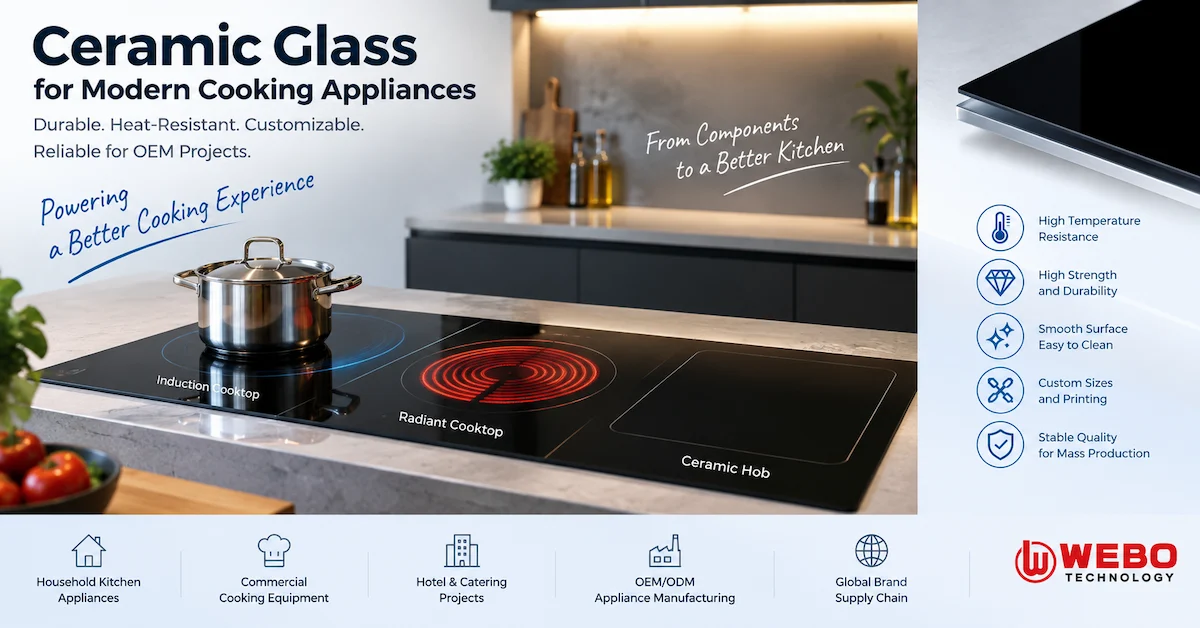
A glass-ceramic cooking surface does not, by itself, identify the appliance’s heating technology. Start the project discussion by distinguishing an induction cooktop from a radiant electric cooktop, then describe the installation and intended operating conditions. For an induction design, bring the coil arrangement, panel stack-up, control layout, and support drawing into the review. For a radiant design, include the heater layout, clearances, temperature-control arrangement, and intended heating zones. WEBO lists both induction coils and ceramic heaters, but catalog availability does not establish compatibility between individual components. Specify residential or commercial use, expected operating duration, cleaning conditions, and installation constraints, and request verification for the assembled appliance rather than treating the panel as an isolated purchase.
Prepare a Specification That Suppliers Can Quote Against
Before requesting ceramic glass factory pricing, give each supplier the same technical package. A panel outline and a target price are not enough to define what constitutes an acceptable delivery. Use the following table as an RFQ specification template, not as a list of WEBO model ratings; numerical limits must come from the approved design and confirmed supplier capability. Mark unresolved fields as “to be confirmed” rather than letting each bidder make a different assumption. Assign a drawing revision and identify the person authorized to approve changes so that purchasing, engineering, and the supplier work from the same requirements.
| Specification Item | Information to Define | Evidence to Request |
|---|---|---|
| Application | Cooktop type, installation, and operating conditions | Application review |
| Material | Material designation, source, and approved substitutions | Material documentation |
| Panel geometry | Length, width, shape, thickness, and tolerances | Controlled drawing and measurement report |
| Mounting interface | Support areas, clearances, gasket or bonding arrangement | Assembly drawing and fit assessment |
| Edges and corners | Edge profile, corner geometry, and acceptable condition | Drawing details and inspection criteria |
| Openings | Hole or cutout dimensions, positions, and permitted variation | Measurement method and report |
| Decoration | Artwork, orientation, colors, symbols, and placement limits | Approved artwork and reference sample |
| Display areas | Window locations and visibility requirements, where applicable | Assembled display evaluation |
| Performance | Required thermal, mechanical, and cleaning evaluations | Agreed test plan and results |
| Packing and identification | Separators, protection, labels, and batch references | Approved packing specification |
Compare Panel Configurations Without Assuming Model Equivalence
When reviewing offers from a ceramic glass factory, compare the complete configuration rather than matching length and width alone. The following is an application-based comparison, not a WEBO model catalog or a confirmation that every configuration is available. Its purpose is to help buyers decide which questions belong in the technical review before asking suppliers to recommend actual models. An existing design may provide a useful starting point, but any proposed substitution should still be checked against the approved material, installation, and verification requirements.
| Project Configuration | Main Selection Priority | What to Compare Between Offers | Verification Before Approval |
|---|---|---|---|
| Compact single-zone panel | Outline, edge support, and zone placement | Dimensions, edge finish, decoration, and packing scope | Fit, heating arrangement, and assembled operation |
| Multi-zone built-in panel | Zone layout, support structure, and control area | Geometry, mounting requirements, and inspection coverage | Panel fit and complete-appliance operation |
| Panel with display windows | Window position, printed masking, and interface layout | Artwork control, window requirements, and sample approval scope | Visibility and control operation in the assembled product |
| Service replacement panel | Exact match to the approved original specification | Material identity, dimensional conformity, and revision status | Interfaces and authorization for substitution |
Inspect Workmanship Where the Panel Meets the Appliance
WEBO’s cooktop buying content identifies surface quality, thickness, and edge treatment as relevant purchasing considerations. Turn those broad considerations into written acceptance criteria for your project. Specify how edges, corners, holes, and exposed surfaces will be inspected instead of relying on the phrase “good finish.” For printed panels, define artwork orientation, symbol placement, acceptable appearance, and any display-window requirements. Include the viewing conditions used to approve cosmetic details so that the sample reviewer and incoming inspector work to the same standard. A photograph may be useful for discussing appearance, but approve dimensions through measurements and approve functional interfaces through assembly checks. Ask suppliers to identify any feature they cannot reliably inspect against the proposed drawing.
Approve Samples in Three Stages: Identity, Fit, and Function
A useful sample-approval process separates three decisions: whether the delivered material and configuration match the order, whether the panel fits the appliance, and whether the assembled design meets the agreed requirements. Record each decision separately. Begin with document and dimensional checks, continue with installation and interface inspection, and complete the agreed functional evaluations with the actual heating and control arrangement. WEBO’s radiant-heating specification guide also recommends requesting model-specific drawings, compliance information, and installation guidance before shortlisting. Do not let approval of the printed appearance stand in for approval of the whole component. Retain the approved drawing, inspection results, and reference sample together, and identify which changes would require another review.
Request Test Evidence with Conditions and Acceptance Criteria
Ask the ceramic glass factory what evidence it can provide for the exact material, thickness, decoration, and configuration under discussion. Instead of accepting an unexplained temperature rating, request the test method, specimen identification, exposure conditions, duration, and acceptance criteria. Keep continuous exposure, short-duration exposure, and temperature-change evaluations separate so that one result is not mistaken for evidence covering all three. Where thermal cycling, mechanical loading, cleaning resistance, or packaging evaluations are part of the project, agree on their scope before samples are produced. Distinguish supplier inspection from the appliance manufacturer’s validation program, and identify who will perform additional tests. For certificates and reports, check the issuing organization, document number, holder, and covered product or material. Use the WEBO company information for background, but request documents relevant to the proposed panel rather than treating a company introduction as its test record.
Control OEM Customization from Drawing to Repeat Order
For an OEM ceramic glass project, establish the baseline design before discussing changes. Submit the panel drawing, artwork, application information, sample quantity, and expected purchasing schedule, then ask which features are feasible and which require clarification. Confirm sample charges, any tooling or setup costs, and the process for approving revised artwork before authorizing development. After validation, freeze the agreed material, drawing revision, decoration, inspection criteria, and packaging specification as the production reference. Require written approval for proposed substitutions or changes, including those presented as minor improvements. Address ownership and confidentiality of drawings and artwork in the commercial agreement. These are recommended project controls; the specific customization scope and service terms available from WEBO should be confirmed in the quotation.
Verify Capacity and Lead Time for Your Actual Panel
Evaluate a ceramic glass factory’s delivery proposal against the quoted configuration, not a general statement about factory size or overall production. Request separate milestones for technical clarification, sample preparation, customer approval, production, inspection, and dispatch. Ask which milestones depend on material availability, artwork approval, special processing, or order changes. For repeat purchases, confirm the planned order frequency, forecast requirements, and treatment of urgent replenishment. A useful schedule names its starting condition—for example, approval of the final drawing and commercial terms—rather than offering an unexplained number of days. WEBO-specific minimum order quantities, panel-production capacity, sample timing, and bulk lead times should be confirmed for the project; this guide does not assign unverified figures to them.
Compare Total Procurement Cost, Not Just Price per Panel
Put quotations on the same basis before negotiating. Compare material identification, processing scope, dimensional requirements, decoration, inspection, sample charges, packaging, and delivery terms. For an illustrative comparison, imagine two offers for the same panel outline: one includes defined edge inspection and approved protective packing, while the other leaves both unspecified. The unit prices alone do not tell you whether the offers are equivalent. A useful internal comparison is total procurement cost divided by the number of accepted, usable panels, with freight, inspection, and any agreed rework or replacement exposure accounted for consistently. Ask the supplier to explain exclusions explicitly. Removing an unnecessary cosmetic requirement may be worth discussing; removing an essential fit or verification requirement is a different decision.
Specify Export Packaging and Receiving Checks Before Dispatch
Treat packaging as a controlled part of the order rather than a last-minute shipping choice. Agree how panels will be separated, how edges and corners will be protected, how movement inside the package will be limited, and how cartons or crates will be identified. Match any packaging evaluation to the proposed transport and handling route. Define the receiving procedure before shipment: who checks the packaging, which records are kept, how suspected damage is photographed, and how the supplier should be notified. Keep part numbers and revision identifiers distinct where several panel designs ship together. Ask the ceramic glass factory to submit its proposed packing arrangement for approval and confirm that the same arrangement will be used for repeat orders.
Discuss the Ceramic Glass Project with WEBO in a Component Context
WEBO’s published product range includes ceramic glass alongside induction coils, ceramic heaters, hot plates, and other appliance components. That makes the WEBO product portfolio a useful starting point for a coordinated component inquiry, rather than a reason to assume that every listed part has already been validated together. Describe the appliance and interfaces first, then request confirmation of the available glass material, processing scope, sample options, and documentation. For a focused discussion, send a drawing revision, application description, artwork, expected quantities, target market, and required delivery schedule. Ask WEBO to distinguish confirmed capabilities from items that need project-specific evaluation before you authorize samples or production.
Frequently Asked Questions
1. What information should I send to a ceramic glass factory first?
Send the application, panel drawing, material requirements, decoration file, quantity, and intended market. Include the installation arrangement and any existing test requirements. Identify unknown specifications so they can be discussed explicitly rather than assumed.
2. Does a black panel automatically identify the correct material?
Do not approve material identity from color or appearance alone. Ask for the material designation and supporting documentation, then link that information to the actual sample and production specification.
3. Can I approve induction and radiant cooktop panels using the same specification?
Only after the relevant design requirements have been reviewed. Treat the heating arrangement, mounting interfaces, controls, and verification plan as part of the approval; a similar-looking cooking surface is not sufficient evidence of interchangeability.
4. Which thickness should I choose?
Request a recommendation against the appliance drawing and verification requirements. Do not adopt a thickness from an unrelated catalog without reviewing the installation. The selected value and its permitted variation should appear on the approved specification.
5. Can WEBO provide custom dimensions and printed artwork?
Submit both requirements for feasibility confirmation. Ask WEBO to identify available material and processing options, artwork requirements, sample costs, and approval steps. Do not treat proposed customization as confirmed until it appears in the agreed quotation.
6. How many samples should I request?
Determine the quantity from the agreed inspection and validation plan. Allow for dimensional review, assembly trials, any destructive evaluations, and retained references where needed. Confirm whether production-representative samples will be required after design changes.
7. What should a useful test report identify?
Look for the tested sample or material, configuration, test method, conditions, results, acceptance criteria, and issuing party. Ask for clarification when the report cannot be connected to the panel you intend to purchase.
8. How should I compare minimum order quantity and lead time?
Request terms for the exact panel, decoration, packaging, and order quantity. Separate sampling from bulk production, and confirm when the lead-time clock starts. Compare supplier proposals only after their assumptions are aligned.
9. What should happen when material or artwork changes?
Require the change to be documented and reviewed before implementation. Record the new revision, determine whether samples or tests need repeating, and prevent old and new versions from being mixed without authorization.
10. How do I request a WEBO ceramic glass quotation?
Use the WEBO contact page to submit the drawing, application, artwork, quantities, target market, and schedule. Request confirmation of technical scope, sampling, inspection documentation, packaging, and commercial terms.
Conclusion
Selecting a ceramic glass factory for OEM cooktops is a specification and approval decision, not simply a search for the lowest panel price. Confirm the material, define the interfaces, inspect the workmanship, validate samples in the appliance, and carry the approved requirements into repeat production. A clear quotation should connect what will be supplied with how it will be checked and when it can be delivered. To begin a WEBO project discussion, submit your ceramic glass requirements with the drawing and operating conditions so that availability, customization, and verification needs can be reviewed against the same project brief.