


Start with the Design Decisions You Have Not Made Yet
Choose a ceramic glass ODM supplier by the design work it agrees to deliver, not by the word “custom” in a quotation. When your brand has a cooktop concept but no released panel drawing, the immediate task is to turn open questions into a proposed material, geometry, interface layout, and verification plan. This guide is intended for appliance brands, importers developing private-label ranges, and engineering teams seeking panel-development support. It does not cover universal replacement glass or assume that a component supplier will develop the complete appliance. WEBO includes ceramic glass in its product range; use that category to begin a project-specific discussion about available products and development scope.
Distinguish ODM Design Support from OEM Production
The useful distinction is the starting point: OEM work generally follows a buyer-defined design, whereas ODM involves supplier input into selecting or developing the proposed solution. WEBO makes this distinction in its broader appliance-component sourcing content. For a ceramic glass project, specify what that input must include: recommending an available starting design, explaining feasible modifications, preparing proposed drawings, or coordinating sample evaluation. Do not treat adding a logo as evidence of broader engineering support. Equally, do not reject an existing panel simply because it is not newly designed. If your specification is complete, request build-to-print supply; if only branding changes, request decoration options. Reserve a larger development scope for requirements that genuinely remain unresolved.
Give the Supplier a Design Brief, Not a List of Guesses
An effective inquiry to a ceramic glass ODM supplier separates fixed requirements from decisions you want help making. State the appliance type, installation space, intended users, target market, expected order volume, and design priorities. Mark uncertain dimensions, material choices, or interface details as open questions rather than inventing values to complete the form. Identify which appliance parts are already selected and which can still change. The following table is a proposed specification-development brief, not a WEBO product datasheet; the supplier’s response should convert relevant open items into documented proposals for your approval.
| Brief Item | Buyer Input | Supplier Proposal to Request | Approval Output |
|---|---|---|---|
| Application | Induction or radiant cooktop; residential or commercial use | Candidate panel approach and limitations | Agreed application scope |
| Fixed installation constraints | Available space, frame, support points, and existing interfaces | Feasible outline and mounting requirements | Proposed geometry and assembly references |
| Material | Known requirements or unresolved selection | Material designation, source, and supporting data | Approved material specification |
| Product appearance | Brand direction, finish references, and graphics | Feasible decoration options | Artwork and appearance reference |
| Controls and displays | Selected electronics or required functions | Panel-interface requirements and questions for the electronics team | Coordinated layout |
| Operating environment | Intended duty, cleaning conditions, and installation constraints | Relevant verification needs | Agreed test plan |
| Product family | Planned sizes, models, and regional variations | Features that could remain common and those requiring separate designs | Record of shared and model-specific features |
| Commercial objectives | Forecast quantities, target cost, and launch window | Development scope, pricing assumptions, and schedule | Project quotation and milestones |
Compare Starting Designs Before Commissioning New Geometry
Ask the ceramic glass ODM supplier to explain why each proposed starting design suits the brief and what must change. Compare the amount of reusable design information, the affected interfaces, and the verification still required—not just the visual difference between renderings. Where an existing design is proposed, request its drawing revision and supporting information, then identify the boundaries of that evidence. The table below compares development concepts rather than named WEBO models or confirmed catalog options. Availability and processing scope require project review.
| Development Concept | What Changes | Potential Value | Main Limitation | Commercial Question |
|---|---|---|---|---|
| Existing geometry with new decoration | Approved graphics or branding | Keeps the mechanical development scope narrow | New artwork may still require interface and appearance review | Which setup and sample charges apply? |
| Adapted starting design | Selected dimensions, openings, or control layout | Reuses relevant design information while addressing a defined need | Changed features need their own feasibility and verification review | What remains reusable, and what must be developed again? |
| New panel design within a shared product range | Geometry and interfaces developed around several planned models | Allows common and model-specific features to be considered together | More decisions must be resolved before release | Which deliverables and development costs cover each variant? |
Illustrative Example: Two Models, One Possible Panel Footprint
Imagine a brand planning an entry model and a premium model with the same intended cabinet opening. The entry model uses a simple control layout; the premium version adds a larger display. Before requesting two entirely separate panels, ask whether the outline, material, edge treatment, and packaging could remain common. Then examine the display area, printed graphics, underlying components, and mounting interfaces separately. A shared footprint is worth considering only if both assembled designs meet their requirements. This is a hypothetical planning example, not a WEBO case study or proof that any particular panel is interchangeable between appliances.
Confirm Material Identity and the Actual Processing Scope
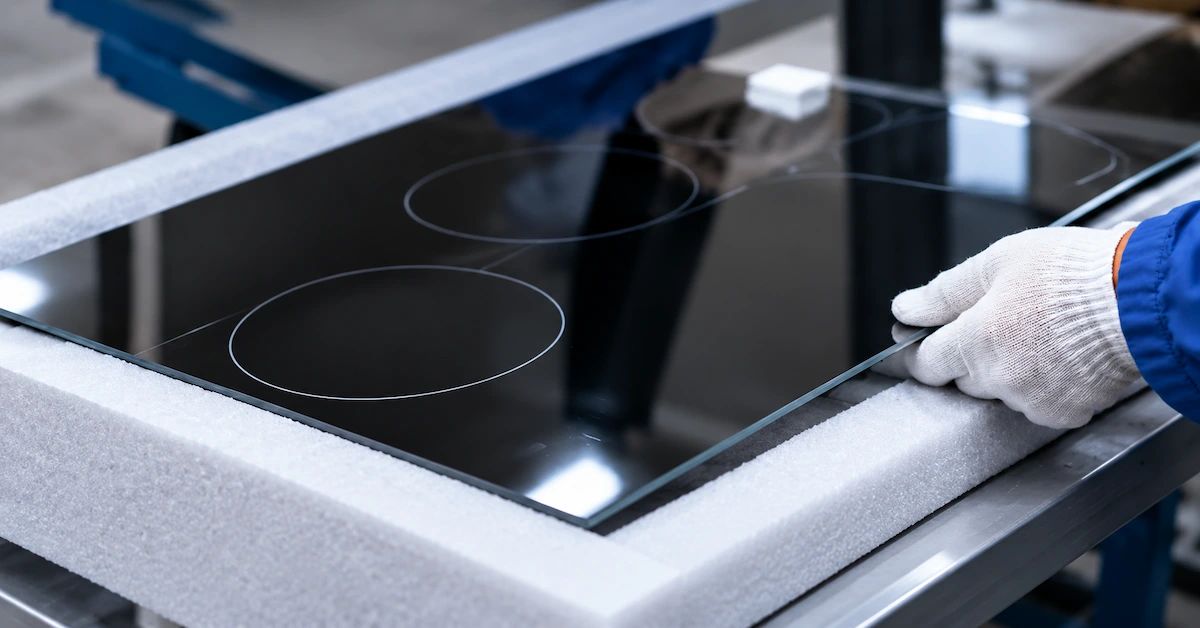
WEBO’s ceramic glass material overview discusses low thermal expansion and heat resistance as relevant material characteristics. Use grade-specific documentation to set project limits rather than turning those broad descriptions into a universal temperature rating. Ask who supplies the base material and who performs panel processing, decoration, and final inspection. Review the proposed outline, thickness, edge finish, corner details, and any holes or cutouts for feasibility. Require written approval before material substitutions. A ceramic glass ODM supplier should also identify which features it can produce and inspect consistently; an attractive concept drawing should not become a manufacturing commitment until the relevant operations have been reviewed.
Review Heating Zones, Graphics, and Controls as One Layout
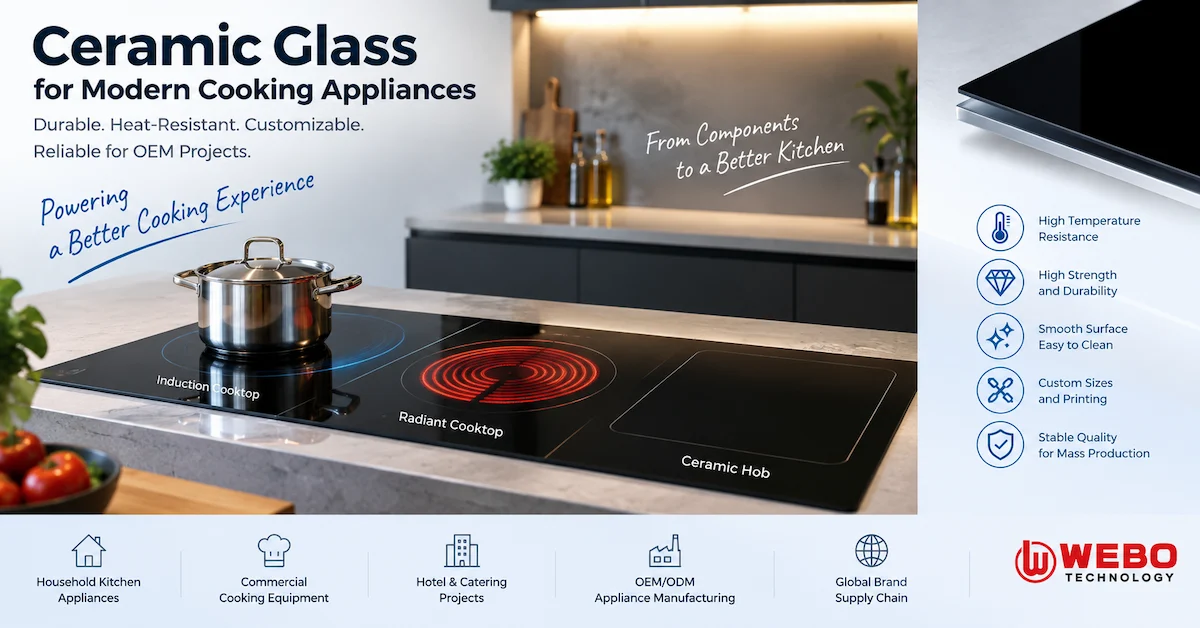
WEBO’s portfolio includes induction coils and ceramic heaters alongside ceramic glass. Discuss the intended component combination rather than assuming that separately listed parts form an approved assembly. For an induction project, bring the coil arrangement, support structure, electronics, and user interface into the review. For a radiant project, include heater positions, clearances, temperature-control provisions, and intended operating conditions. Require the printed zone markings and control graphics to correspond to the selected hardware. Evaluate display areas using the intended display and agreed viewing conditions, and assign touch-control evaluation to the appropriate appliance team. Describe commercial duty or unusual cleaning conditions explicitly instead of treating a residential concept as approval for every environment.
Make Design Assistance Measurable Through Deliverables
Before paying for development, ask the ceramic glass ODM supplier to name the documents and decisions included in the work. A useful package may include a requirements review, proposed panel drawing, material recommendation, artwork layout, manufacturability comments, and a sample-verification plan. For each deliverable, agree who prepares it, who reviews it, and who can authorize changes. Request reasons for significant proposals: why retain an existing outline, change a display boundary, or use separate variants? Record assumptions that depend on other teams. A note such as “control module selection pending” makes an unresolved dependency visible; a polished rendering alone does not. Agree what will be delivered if the initial concept proves unsuitable, including how alternative proposals or extra revisions will be charged.
Validate the Adapted Design Before Releasing Production
Organize the project around evidence rather than a single “sample approved” signature. First, review the proposed geometry, material, and artwork against the brief. Next, evaluate representative samples for workmanship, fit, display visibility, and the agreed functional requirements. Finally, assess parts made through the proposed production route, including inspection and packaging. Ask the ceramic glass ODM supplier to identify any differences between development samples and intended production parts. Define measurable acceptance criteria for dimensions, edge condition, surface appearance, and print placement. Request relevant test documents with the specimen identity, configuration, conditions, and results. Where a starting design already has supporting evidence, document which requirements it addresses and which changes need further evaluation. Keep panel acceptance separate from approval of the complete cooktop.
Discuss Design Files, Exclusivity, and Future Changes Early
Treat design access and permitted use as explicit commercial questions rather than assumptions attached to the ODM label. Ask which drawings, artwork files, inspection specifications, and development records you will receive. Distinguish the supplier’s existing design from changes commissioned for your project, and clarify whether any exclusivity is being offered, for which variants and markets, and under what conditions. Address confidentiality and the permitted use of customer branding and technical information. Also discuss how future modifications will be managed: revision identification, approval before implementation, treatment of remaining inventory, and documentation for repeat orders. The intended arrangement should be reflected in the agreed terms before substantial development expenditure, rather than left to interpretation after launch.
Compare Development Cost Separately from Unit Price
Request separate figures for design work, artwork preparation, special processing or fixtures, samples, agreed testing, packaging development, and production. Ask which charges are one-time, which apply to each variant, and which recur after changes. For comparison, estimate the development charge allocated to each planned accepted unit by dividing the relevant fixed development cost by that unit quantity. Keep this planning calculation separate from the supplier’s production price, and revisit it if forecast demand changes. A ceramic glass ODM supplier offering a lower piece price is not automatically the lower-cost option if your team must complete substantial excluded design work. Conversely, paying for development has little value unless the quotation identifies useful deliverables and an approval process.
Build the Launch Schedule Around Decisions and Capacity
Ask for a schedule covering feasibility review, concept selection, sample preparation, customer evaluation, revisions, production preparation, and shipment. Identify the approved inputs required to start each stage and who must provide them. Request capacity information for the actual panel configuration and launch quantity rather than relying on overall factory size. Discuss what happens if display selection, artwork, or appliance testing changes after sampling. Confirm minimum quantities by design and decoration, and agree on packaging identification for multiple variants. Do not assume that prototype availability guarantees the bulk-production slot you need. Have the ceramic glass ODM supplier distinguish estimated dates, confirmed commitments, and dependencies before your team builds a launch plan around them.
Bring WEBO a Clear Brief and Request a Defined Scope
WEBO presents its manufacturing background on the company introduction page, and its product portfolio provides a starting point for component sourcing. To evaluate WEBO as a ceramic glass ODM supplier, send your appliance concept, installation constraints, reference drawings or sketches, branding direction, target market, sample needs, and expected quantities. State what is fixed and where design support is required. Request written confirmation of available materials, processing options, development deliverables, sample terms, relevant documentation, and production conditions. Ask which work is included, excluded, or dependent on your appliance team. The next useful outcome is a scoped proposal, not an assumption that a ceramic-glass inquiry includes complete cooktop design, electronics development, or final-appliance certification.
Frequently Asked Questions
1. Can I start an ODM inquiry without a finished CAD drawing?
Yes, you can begin the discussion with an application brief, sketches, installation limits, and design priorities. Ask the supplier which drawing work it can undertake and what additional inputs are needed. Starting an inquiry does not authorize production from incomplete information.
2. Does changing a logo count as a full ODM project?
Specify the actual work rather than relying on the label. A decoration-only change may need artwork preparation and sample review without broader panel development. Request an itemized scope so that design charges correspond to the work you need.
3. How should I compare suppliers proposing different starting designs?
Compare both proposals against the same brief. Examine unresolved requirements, interfaces, evidence, deliverables, and excluded work. Ask each supplier to explain why its proposal fits the application rather than judging only from the rendering or unit price.
4. Can related cooktop models share one panel design?
Investigate common geometry and material requirements, then review graphics, controls, displays, and mounting separately. Approve each intended configuration against its requirements. A common external size alone is not a sufficient basis for approving a shared component.
5. Does a panel-development quotation include the entire cooktop?
Only rely on work explicitly included in the proposal. Ask who is responsible for electronics, heating components, assembly design, functional validation, and documentation. Treat absent responsibilities as questions to resolve, not services automatically included with the panel.
6. Who should choose the glass-ceramic material?
Ask the supplier to propose a documented material against the application brief, then have the responsible engineering team review it. Record the selected grade and any substitution procedure. Do not approve material solely from appearance or a general heat-resistance description.
7. Will I receive the drawings and have exclusive use of the design?
Confirm both points in the proposed terms. Ask which files are delivered, what use is permitted, and whether exclusivity applies to the underlying design or only particular modifications. Do not infer the arrangement from payment for samples or artwork.
8. How many design revisions and samples are included?
Request a stated allowance and a procedure for additional work. Identify whether charges change when you alter geometry, material, artwork, or interfaces after approval. Match sample quantities to the agreed inspection and validation plan rather than choosing an arbitrary number.
9. What evidence should accompany the proposed design?
Request the material identity, drawing revision, inspection requirements, and relevant sample or test records. Check that any cited certificate or report covers the proposed configuration. Record additional validation still needed before production release.
10. What should I send WEBO for an initial review?
Use the WEBO contact page to submit the application, sketches or drawings, fixed constraints, unresolved design questions, artwork references, quantities, and timing. Ask for a scope covering proposed design support, samples, pricing assumptions, and the next approval step.
Conclusion
A ceramic glass ODM supplier should be evaluated on its proposed design contribution, documented deliverables, and ability to support an agreed production specification. Begin with a clear application brief, compare reusable starting designs, and separate panel development from complete-appliance responsibilities. Resolve material, interfaces, verification, design access, and commercial conditions before committing to bulk production. For a new cooktop range, send WEBO your ODM project brief with both fixed requirements and open questions so the available design-support scope, sampling plan, and supply terms can be reviewed together.