


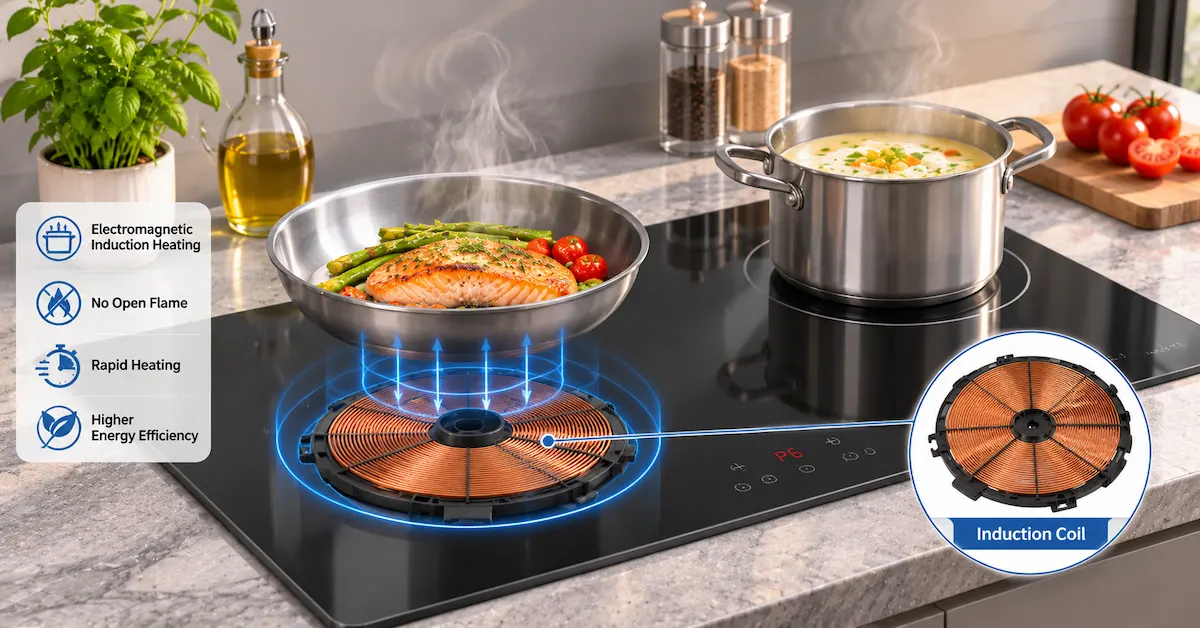
Quick Answer: An induction coil is used to generate a changing magnetic field that transfers energy into nearby conductive materials. In induction cooktops, a copper coil beneath the cooking surface induces electrical currents in compatible cookware, generating heat directly in the pan. Induction coils are also used in specialized industrial heating systems, but their construction and electrical requirements vary significantly by application.
Induction coils are essential components in many modern cooking appliances, yet their role is often misunderstood.
Unlike conventional electric heating elements, an induction coil is not primarily designed to become hot and transfer heat through direct contact.
Instead, it works with high-frequency power electronics to create a magnetic field that heats a suitable cooking vessel.
This distinction is important for appliance manufacturers, product engineers, and component purchasing managers.
A properly designed induction heating system depends on the interaction between the coil, inverter, resonant circuit, cookware, ceramic-glass surface, and temperature-control system.
Selecting a coil based only on diameter or advertised power can therefore lead to compatibility and performance problems.
WEBO, officially GUANGDONG WEBO TECHNOLOGY CO., LTD, is a China-based manufacturer of heating elements and cooking appliance components established in 1998.
Its published product portfolio includes induction coils, solid hot plates, ceramic heaters, and related components.
This guide explains the practical uses of induction coils, how they work, the applications they support, and the information OEM buyers should prepare before selecting a component.
Explore the WEBO Induction Coil Product Category for product information.
Key Takeaways
-
Induction coils generate changing magnetic fields. In cooking appliances, these fields induce heat-producing electrical currents in compatible cookware.
-
Induction coils serve multiple applications. Uses include built-in cooktops, portable induction cookers, certain induction cooking vessels, and specialized industrial heating equipment.
-
The coil is part of a complete system. Its performance depends on the inverter, resonant components, ferrite arrangement, cookware, and control electronics.
-
Coil geometry matters. Flat and shaped coils suit different appliance designs.
-
Technical compatibility is essential. Inductance, dimensions, winding construction, connectors, and thermal behavior should be evaluated together.
-
OEM buyers need application-specific verification. A component that looks suitable may not work correctly in the intended appliance.
1. What Is an Induction Coil?
An induction coil is an electrical conductor arranged in a winding that produces a magnetic field when current passes through it.
When alternating current flows through the coil, the magnetic field changes over time.
This changing field can induce electrical currents in nearby conductive materials.
In induction heating applications, those induced currents generate heat within the target material.
What Is an Induction Cooker Coil Made Of?
A typical induction cooking coil assembly may contain several components.
| Component | Primary function |
|---|---|
| Copper winding | Generates the alternating magnetic field |
| Winding support | Maintains coil geometry and positioning |
| Electrical insulation | Separates conductive parts where required |
| Ferrite elements | Help guide or concentrate magnetic flux |
| Lead wires | Connect the coil to the power circuit |
| Electrical connectors | Provide the required interface |
| Temperature sensor, if included | Supports temperature monitoring |
The exact materials and construction depend on the approved design.
Not every induction coil contains the same ferrite arrangement, winding pattern, or sensor configuration.
For OEM applications, these features should be defined in the technical specification.
2. How Does an Induction Coil Work?
An induction coil works through electromagnetic induction.
In a typical cooktop, power electronics supply alternating current at an operating frequency suitable for the resonant heating system.
The coil generates a changing magnetic field.
When compatible cookware is placed within that field, electrical currents are induced in its conductive base.
The cookware's electrical resistance converts much of this induced current energy into heat.
The Five Main Steps
-
Electrical power enters the system. The cooktop's power-conversion electronics prepare electrical energy for high-frequency operation.
-
Alternating current flows through the coil. The winding generates a changing magnetic field.
-
The field couples with compatible cookware. The cookware acts as an electromagnetic load.
-
Heat develops inside the cookware. Induced currents and associated material losses create heat.
-
The cookware heats the food. The control system adjusts power according to operating conditions.
The U.S. Department of Energy's explanation of induction cooking confirms that induction technology creates heat within compatible cookware rather than first heating a conventional burner.
Does the Induction Coil Itself Get Hot?
The coil is not intended to function as a conventional resistance heating surface.
However, it can still experience electrical losses and temperature rise during operation.
Heat may also reach nearby components from the cookware and cooking environment.
Therefore, the coil assembly requires appropriate thermal management.
Important: The cooking surface can remain hot after the cookware is removed because heat transfers from the hot pan into the glass. Induction technology does not eliminate residual-heat hazards.
3. What Is an Induction Coil Used For in Cooking Appliances?
If you are wondering what is induction coil used for in modern kitchen appliances, the primary answer is electromagnetic heating. Induction coils generate changing magnetic fields that transfer energy into compatible cookware, making them essential components in induction hobs, portable induction cookers, and other specialized cooking systems.
The most relevant applications for WEBO's published Induction Coil category are induction cooking systems.
Different appliances require different coil geometries, heating-zone configurations, and operating conditions.
Common Induction Coil Applications
| Application | How the coil is used | Main engineering consideration |
|---|---|---|
| Built-in induction hob | Generates magnetic energy beneath a cooking zone | Heating area, glass spacing, inverter compatibility |
| Portable induction cooker | Heats compatible cookware in a compact appliance | Size, cooling, electrical integration |
| Multi-zone induction cooktop | Supports several independently controlled cooking zones | Coil positioning and interaction |
| Induction wok cooker | Transfers energy to a compatible wok | Coil shape and cookware geometry |
| Induction rice-cooking system | Heats a compatible cooking vessel | Coil arrangement and vessel coupling |
| Specialized food-heating equipment | Supplies induction heat to conductive vessels | Duty cycle, controls, thermal management |
These are application categories, not confirmation that every WEBO coil is suitable for every listed device.
Built-In Induction Cooktops
Built-in cooktops typically use coils positioned beneath a ceramic-glass surface.
The cookware is placed above the heating zone while the coil remains inside the appliance.
OEM engineers must coordinate the coil dimensions with the heating-zone layout, support structure, cookware requirements, and power electronics.
Portable Induction Cookers
Portable induction cookers use a similar electromagnetic principle within a compact enclosure.
The available space for electronics, cooling, insulation, and mechanical support may be more limited.
The coil must therefore be evaluated within the actual portable cooker design.
Multi-Zone Induction Hobs
Multi-zone cooktops may use several coils, allowing different cooking zones to operate.
The system must manage power allocation, temperature monitoring, cookware detection, and potential interaction between neighboring zones.
A multi-zone application requires more than simply installing several identical coils.
Induction Wok and Rice-Cooking Systems
Some induction appliances use shaped coils rather than flat circular windings.
The purpose is to improve electromagnetic coupling with a particular cooking vessel geometry.
For example, a curved coil arrangement may be considered for a compatible bowl-shaped cooking vessel.
This design is different from the flat coil typically associated with standard induction hobs.
4. Are Induction Coils Used Outside the Kitchen?
Yes. Induction heating technology is also used in industrial operations.
However, industrial induction coils should not automatically be considered interchangeable with induction cooker coils.
Industrial systems can involve different frequencies, power levels, coil geometries, cooling requirements, and operating environments.
Other Induction Heating Applications
| Industrial application | Purpose of induction heating |
|---|---|
| Metal hardening | Heat selected regions before controlled treatment |
| Induction brazing | Heat metal components for joining operations |
| Metal melting | Supply energy for melting conductive materials |
| Forging preparation | Heat metal workpieces before forming |
| Induction sealing | Heat suitable conductive sealing materials |
| Industrial process heating | Heat conductive materials during manufacturing |
The U.S. Department of Energy's overview of industrial process heating identifies induction as an electricity-based process that uses magnetic fields to heat conductive materials.
Can a Cooktop Coil Be Used for Industrial Heating?
Not without engineering qualification.
A coil designed for a domestic cooktop may have different operating requirements from one used in metal processing.
The power supply, magnetic coupling, conductor construction, insulation, cooling, and safety system must be designed for the intended process.
WEBO publicly lists induction coils within its cooking appliance component portfolio. Its available product information does not establish suitability for industrial metalworking equipment.
5. What Is the Difference Between an Induction Coil and a Traditional Heating Element?
Induction heating and resistance heating use different mechanisms.
A conventional solid hot plate or radiant heating element generates heat within its own resistive structure.
An induction coil generates a changing magnetic field that causes compatible cookware to heat.
Induction Coil vs. Electric Hot Plate vs. Radiant Heater
| Feature | Induction coil system | Solid electric hot plate | Ceramic radiant heater |
|---|---|---|---|
| Heating principle | Electromagnetic induction | Electrical resistance and contact heat transfer | Electrical resistance and radiant heat transfer |
| Main heat-generation location | Compatible cookware | Heating element or plate | Radiant heating element |
| Cookware requirement | Suitable induction-compatible base | Appropriate heat-resistant cookware | Suitable cookware for the hob |
| Power-control requirements | High-frequency inverter and controls | Compatible electrical regulation | Compatible heating control |
| Thermal management | Coil, electronics, cookware, glass | Plate and appliance enclosure | Heater, glass, and enclosure |
| Main OEM challenge | Electromagnetic and power-stage matching | Contact heating and mounting | Radiant-zone and glass compatibility |
Which Technology Should an OEM Choose?
Induction is appropriate when a product is designed around compatible cookware and the necessary power electronics.
A solid electric hot plate may suit a different appliance architecture where contact heating is required.
A ceramic radiant heater may be considered for an electric cooking appliance using a compatible glass-ceramic surface.
WEBO also offers Hot Plate and Ceramic Heater product categories.
The final selection should reflect the finished appliance's intended performance, construction, and compliance requirements.
6. Why Does Cookware Compatibility Matter?
Cookware is part of the electromagnetic heating system.
The coil does not operate independently of the cooking vessel.
The material, diameter, construction, and position of the cookware influence magnetic coupling and heating performance.
Induction Cookware Compatibility
| Cookware material | General compatibility |
|---|---|
| Cast iron | Typically compatible |
| Magnetic stainless steel | Generally compatible when appropriately constructed |
| Carbon steel | Often compatible |
| Nonmagnetic stainless steel | May be unsuitable unless designed with a magnetic base |
| Aluminum | Usually requires an induction-compatible magnetic base |
| Copper | Usually requires an induction-compatible magnetic base |
| Glass or ceramic cookware | Not directly suitable without an appropriate induction interface |
Actual compatibility depends on the cookware construction and the induction system.
Does Pan Size Affect Heating?
Yes.
The relationship between the cookware base and the active coil area affects electromagnetic coupling.
A very small pan may not be detected by some cooktops, while a much larger vessel may experience a different heating distribution.
OEM manufacturers should validate a defined range of cookware materials and sizes.
A successful test with one pan does not establish compatibility with every cookware type.
7. What Components Work Together With an Induction Coil?
An induction coil is only one part of an induction cooking system.
For OEM engineers, it is important to understand the functions of the surrounding components.
Induction Cooking System Architecture
| System component | Function | Why it matters |
|---|---|---|
| Rectifier and DC-link circuit | Prepares electrical energy | Provides the power stage input |
| High-frequency inverter | Drives the induction system | Determines electrical operating conditions |
| Resonant components | Work with the coil in the power-conversion circuit | Influence circuit behavior and compatibility |
| Induction coil | Generates the alternating magnetic field | Transfers energy electromagnetically |
| Ferrite arrangement | Influences magnetic flux distribution | Affects system performance |
| Ceramic-glass surface | Supports cookware and separates it from internal components | Mechanical and thermal design |
| Temperature monitoring | Provides relevant thermal feedback | Supports system protection |
| Control electronics | Manage operating conditions | Coordinate power and protective functions |
Why Coil Diameter Alone Is Not Enough
Two coils with similar dimensions may differ in inductance, winding construction, resistance, ferrite arrangement, or connection requirements.
Those differences can influence their interaction with the inverter.
For an OEM project, the induction coil should be selected as part of the complete heating system—not as an isolated copper component.
8. What Are the Main Induction Coil Designs?
Induction coils can have different shapes depending on the equipment and heating objective.
Coil Structure Comparison
| Coil design | Typical use | Main consideration |
|---|---|---|
| Flat circular coil | Induction hobs and portable cookers | Cookware base coupling and installation space |
| Shaped or bowl-type coil | Certain induction vessel applications | Vessel contour and magnetic field geometry |
| Multiple-coil arrangement | Multi-zone cooking systems | Zone layout and coordinated control |
| Industrial shaped coil | Specialized metal heating | Workpiece geometry and process conditions |
These categories illustrate general design principles.
WEBO's published product page does not provide sufficient technical details to confirm which designs or configurations are currently available.
Buyers should request drawings or a current product datasheet before selecting a specific coil.
9. What Technical Specifications Matter When Selecting an Induction Coil?
The coil's physical dimensions are important, but its electrical and thermal characteristics are equally significant.
OEM Induction Coil Specification Checklist
| Specification | What OEM buyers should confirm |
|---|---|
| Outer diameter | Available heating-zone and installation space |
| Inner diameter | Winding geometry and component clearance |
| Overall height | Mechanical compatibility |
| Inductance | Required value and tolerance |
| Inductance measurement | Test frequency and specified conditions |
| DC resistance | Conductor and winding consistency |
| Conductor construction | Wire type, strand arrangement, insulation |
| Number of turns | Approved winding configuration |
| Ferrite layout | Quantity, geometry, position, material |
| Operating conditions | Inverter and resonant-system compatibility |
| Lead wires | Length, routing, and termination |
| Connector | Exact electrical and mechanical interface |
| Temperature sensor | Type and location, if included |
| Mounting arrangement | Support geometry and fastening |
| Product identification | Part number and drawing revision |
Inductance and Operating Frequency
Inductance is a key parameter in the coil's interaction with the resonant circuit.
However, there is no universal inductance value suitable for every cooktop.
The required specification depends on the inverter design and intended operating conditions.
Winding Construction
Conductor construction affects electrical losses and temperature rise.
Multi-strand conductor arrangements may be used in high-frequency applications to manage AC resistance.
The correct specification should be established through engineering design and verification.
Ferrite Configuration
Ferrite elements may help shape magnetic flux and reduce unwanted field exposure to nearby components.
Their geometry and placement should be controlled in the approved design.
Temperature Monitoring
Where temperature sensors form part of the assembly, their characteristics must match the control system.
The type, placement, connection, and relevant response behavior should be documented.
10. How Should OEMs Test an Induction Coil in a Cooktop?
Standalone inspection can confirm important component characteristics.
However, functional approval requires evaluation within the intended induction appliance.
Recommended Validation Matrix
| Test | Main objective |
|---|---|
| Dimensional inspection | Confirm assembly fit |
| Inductance measurement | Verify electrical specification |
| Resistance measurement | Check winding consistency |
| Insulation testing | Evaluate applicable insulation requirements |
| Ferrite inspection | Confirm correct assembly |
| Cookware detection | Verify system response to intended vessels |
| Heating performance | Evaluate output under representative conditions |
| Coil temperature rise | Check thermal behavior |
| Extended operation | Assess performance under intended duty cycle |
| Abnormal-condition testing | Evaluate protective behavior |
| Electromagnetic compatibility | Assess relevant emissions and immunity |
| Production-lot inspection | Support repeat manufacturing consistency |
Example OEM Qualification Scenario
Consider an appliance manufacturer developing a two-zone induction hob.
The design team chooses a candidate coil that fits the allocated installation space.
However, the coil's inductance and magnetic behavior must also be evaluated against the intended inverter and cookware range.
Engineers should test both heating zones under representative operating conditions.
They should also evaluate temperature rise, cookware detection, and potential interaction between the zones.
This is an illustrative engineering scenario, not a documented WEBO customer project.
11. Which Safety Standards Apply to Induction Cooking Appliances?
Applicable safety requirements depend on the type of appliance and the destination market.
For stationary household induction hobs, IEC 60335-2-6:2024 — Particular Requirements for Stationary Cooking Ranges, Hobs, Ovens and Similar Appliances is an important reference.
This standard specifically includes induction hobs and induction wok elements within its stated scope.
Portable cooking appliances may be covered by different requirements, including relevant provisions of IEC 60335-2-9.
Commercial catering equipment can also have different applicable requirements.
What Should an OEM Verify?
The finished appliance manufacturer should evaluate relevant electrical protection, insulation, temperature limits, abnormal operation, control behavior, electromagnetic compatibility, and market-specific requirements.
Product certification depends on the actual equipment and the relevant certification scope.
WEBO's company website references ISO 9001, ISO 14001, VDE, TÜV, UL, CE, and RoHS.
These references do not establish that every induction coil or finished cooktop carries all of those approvals.
Request model-specific documentation where required.
12. What Affects Induction Coil Cost and Customization?
Induction coil quotations depend on the approved design and purchasing conditions.
Relevant factors may include copper usage, winding construction, geometry, ferrite materials, connectors, sensors, inspection requirements, order quantity, and packaging.
Existing vs. Customized Coil
| Supply option | Potential advantage | Main consideration |
|---|---|---|
| Existing compatible coil | Less development work | Must meet system requirements |
| Modified existing coil | Targeted design changes | Requires affected-characteristic verification |
| Fully customized coil | Supports application-specific geometry | Greater development and qualification effort |
The lowest unit price is not necessarily the lowest total project cost.
If a candidate coil requires additional engineering changes or repeated testing, those expenses can affect the purchasing decision.
MOQ, customization feasibility, sample availability, tooling costs, production capacity, and lead time should be confirmed for the actual WEBO project.
13. Why Consider WEBO for Induction Coil Sourcing?
WEBO is a manufacturer of heating elements and appliance components established in 1998 in Yangjiang, Guangdong, China.
Its product range includes induction coils together with hot plates, ceramic heaters, tubular heating elements, ceramic glass, and related components.
For induction cooktop development, this portfolio provides an opportunity to discuss the required coil and other applicable appliance-component categories.
What Does WEBO Publicly List?
WEBO publishes an Induction Coil Product Page and an Induction Coil Category.
However, the public product listing does not provide a complete verified electrical specification.
Buyers should therefore request the current drawings and technical details before making an engineering decision.
What Should OEM Buyers Confirm?
The main questions include whether a suitable coil configuration is available, which electrical parameters can be documented, what modification options are technically feasible, and how samples can be evaluated.
Buyers should also ask about applicable quality records, packaging, minimum order quantities, lead times, and relevant compliance documentation.
14. How to Request an Induction Coil Quotation from WEBO
A technical inquiry should describe the intended application and system requirements.
Induction Coil RFQ Checklist
| RFQ field | Information to provide |
|---|---|
| Appliance type | Built-in hob, portable cooker, or other application |
| Target heating zone | Required dimensions and cookware range |
| Coil geometry | Drawing or existing sample |
| Electrical requirements | Target inductance, tolerance, and resistance |
| Power electronics | Relevant inverter and resonant circuit information |
| Winding requirements | Conductor and winding specification, if available |
| Ferrite arrangement | Required configuration |
| Mechanical integration | Mounting dimensions and available height |
| Connections | Lead length and connector requirements |
| Sensor requirements | Type and interface, if applicable |
| Validation | Required tests and approval criteria |
| Target market | Destination country and compliance needs |
| Order quantity | Samples, pilot lot, and annual forecast |
| Commercial requirements | Packaging, pricing, MOQ, and schedule |
Request an OEM Induction Coil Evaluation
Developing an induction cooker, upgrading an existing cooktop, or looking for a compatible induction coil component?
Share your appliance application, engineering drawing, target inductance, dimensions, electronic interface requirements, and expected purchasing quantity with WEBO.
The company can review the inquiry against its available product information and discuss the feasibility of a suitable supply arrangement.
Explore WEBO Induction Coil Products
Contact WEBO for Technical Evaluation and Quotation
15. Frequently Asked Questions
1. What is an induction coil used for?
For buyers asking what is induction coil used for, the main application is generating a changing magnetic field that heats compatible conductive materials. In kitchen appliances, induction coils are used in built-in induction hobs, portable induction cookers, and specialized induction cooking systems. They are also used in industrial heating applications with different technical requirements.
2. Is an induction coil the same as a heating element?
Not exactly. A conventional resistive heating element generates heat within itself. An induction cooking coil generates a magnetic field that causes heat to develop in suitable cookware.
3. What is the main application of an induction coil in a kitchen?
Its primary application is supplying electromagnetic energy to cookware in induction cooking systems, including suitable built-in hobs, portable induction cookers, and other specialized induction appliances.
4. Does an induction coil work without cookware?
The coil can generate a magnetic field, but the system requires a suitable conductive load for effective cooking energy transfer. Many induction cooktops monitor cookware presence and restrict operation when an appropriate vessel is absent.
5. Can aluminum cookware work on an induction coil?
Conventional nonmagnetic aluminum cookware generally requires an induction-compatible magnetic base or appropriate interface. The actual compatibility depends on cookware construction and the appliance.
6. Why do induction cooktops use copper coils?
Copper has high electrical conductivity and is suitable for manufacturing windings that carry the current required to produce the changing magnetic field. The conductor construction must match the operating requirements.
7. What determines the heating area of an induction coil?
The heating behavior depends on coil geometry, magnetic field distribution, cookware properties, cookware size, and the operating system. Coil diameter alone does not fully define the effective heating area.
8. Can induction coils be customized for OEM cooktops?
Customization may be possible for dimensions, winding arrangements, ferrite configuration, leads, connectors, and other features. Each modification requires engineering assessment and appropriate validation.
9. What specifications should I request from an induction coil supplier?
Request the coil dimensions, inductance and measurement conditions, resistance, winding construction, ferrite configuration, connections, mounting details, and relevant test documentation.
10. How can I request an induction coil quotation from WEBO?
Provide your appliance type, drawings or existing sample, required electrical characteristics, mechanical dimensions, expected order quantity, and destination market through the WEBO Contact Page.
Conclusion
Understanding what an induction coil is used for is essential for both appliance product development and component sourcing.
In induction cooking, the coil generates a changing magnetic field that transfers energy into suitable cookware, allowing heat to develop directly within the cooking vessel.
This principle makes induction coils fundamental to many built-in cooktops, portable induction cookers, and specialized electric cooking systems.
However, the coil does not operate independently.
Its performance depends on the inverter, resonant components, cookware, magnetic structure, controls, and overall thermal design.
For OEM manufacturers, selecting the correct coil requires more than matching its outer diameter or advertised application.
Electrical specifications, winding construction, ferrite arrangement, mechanical integration, thermal performance, and safety requirements should all be evaluated within the finished appliance.
WEBO, established in 1998, supplies electric heating elements and cooking appliance components, including an induction coil product category.
The availability and specifications of a particular coil configuration must be confirmed directly.
Planning a new induction cooktop or sourcing an induction coil for an existing appliance platform?
Provide your technical drawing, operating requirements, target heating zone, electrical interface, and purchasing forecast to WEBO for a project-specific discussion.
View WEBO Induction Coil Products or Request an OEM Induction Coil Quotation to begin your component evaluation.