


Quick Answer: When sourcing a wholesale induction cooktop coil for distributors, prioritize verified appliance compatibility, controlled electrical specifications, clear SKU identification, protective packaging, and sustainable landed costs. Start with products supported by documented customer demand, validate samples before bulk purchasing, and establish replenishment levels based on actual sales. This approach helps reduce incorrect-fit returns, excess inventory, and avoidable supply disruptions.
For appliance-parts distributors, purchasing induction coils involves more than negotiating a competitive factory price.
A coil that sells quickly and matches an approved appliance platform can support repeat business. A similar-looking coil with incorrect electrical characteristics may remain unsold or generate costly returns.
Distributors must therefore balance three important objectives: technical suitability, inventory availability, and commercial profitability.
Buyers searching for a wholesale induction cooktop coil for distributors should evaluate the entire distribution process, from initial product selection to warehouse handling, customer identification, and repeat purchasing.
This guide explains how to build a more controlled induction coil wholesale program for international appliance-component markets.
1. What Is an Induction Cooktop Coil, and Who Should Buy It Wholesale?
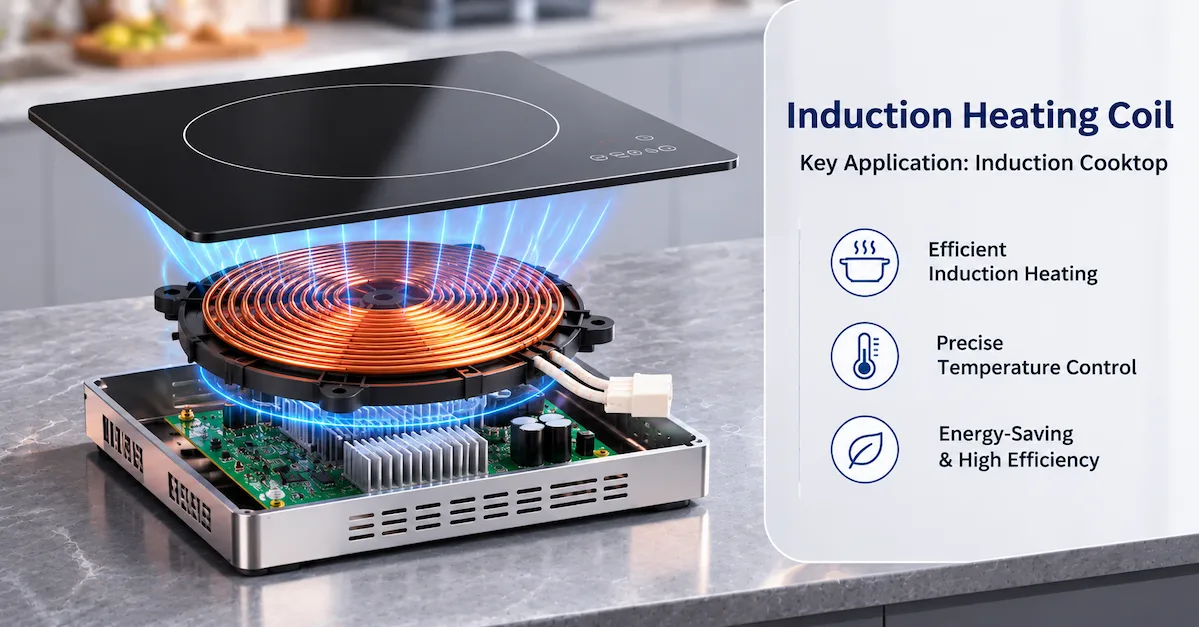
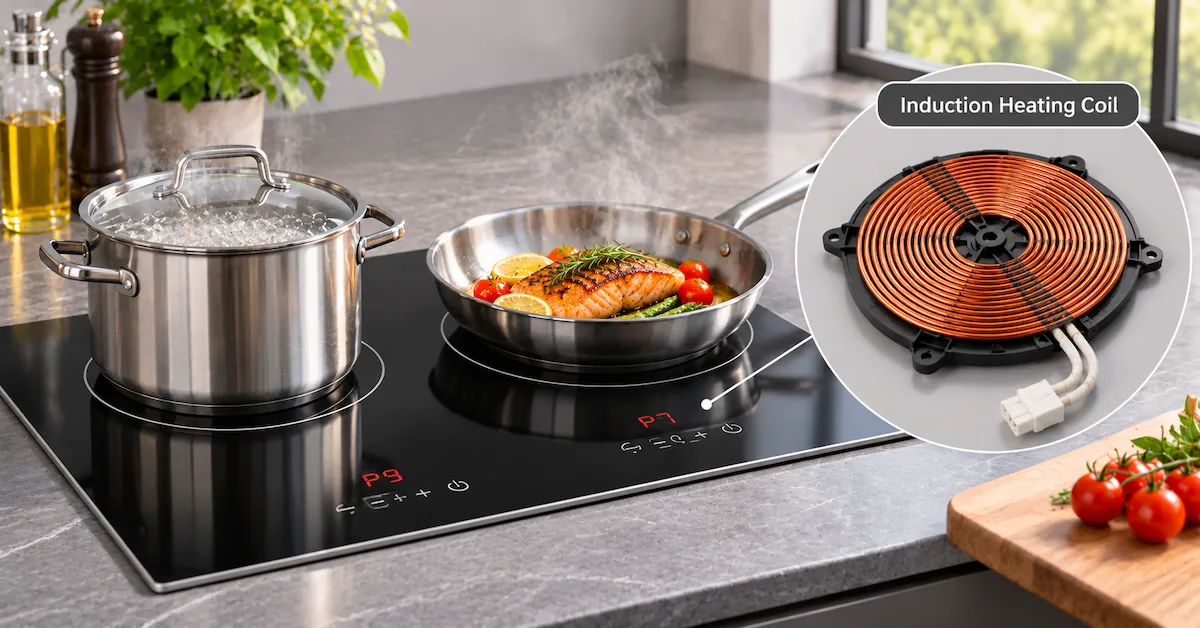
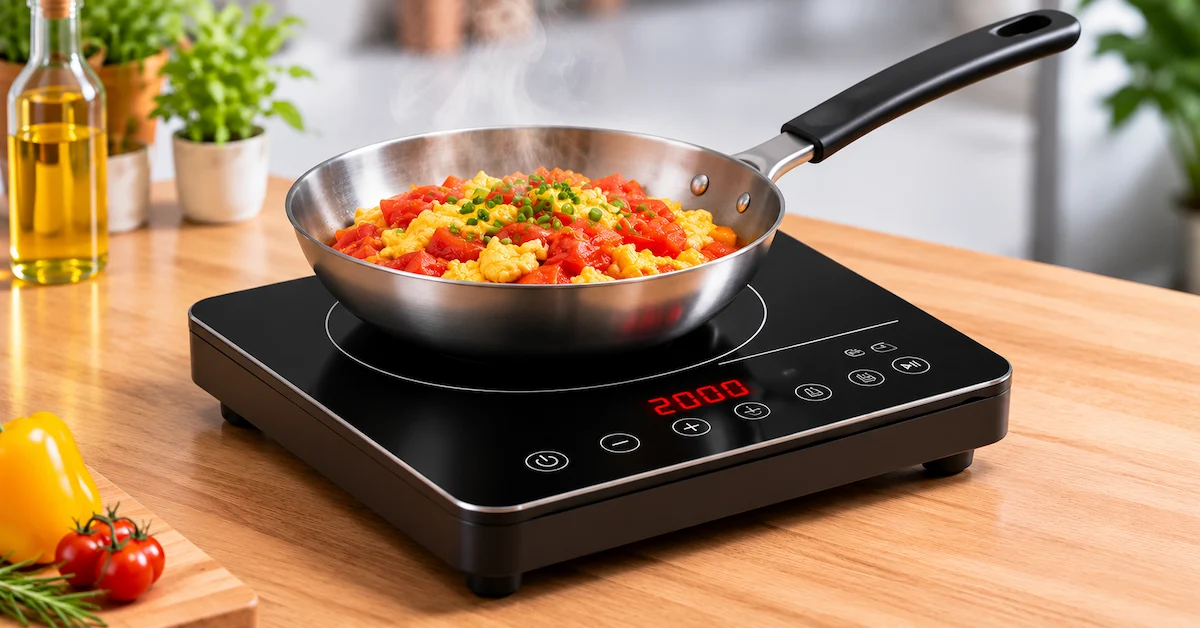
An induction cooktop coil is an electromagnetic component used within an induction cooking system.
High-frequency alternating current flowing through the winding creates a changing magnetic field that induces heating in compatible cookware.
The coil normally operates together with an inverter, resonant circuit, magnetic components, temperature sensors, and appliance controls.
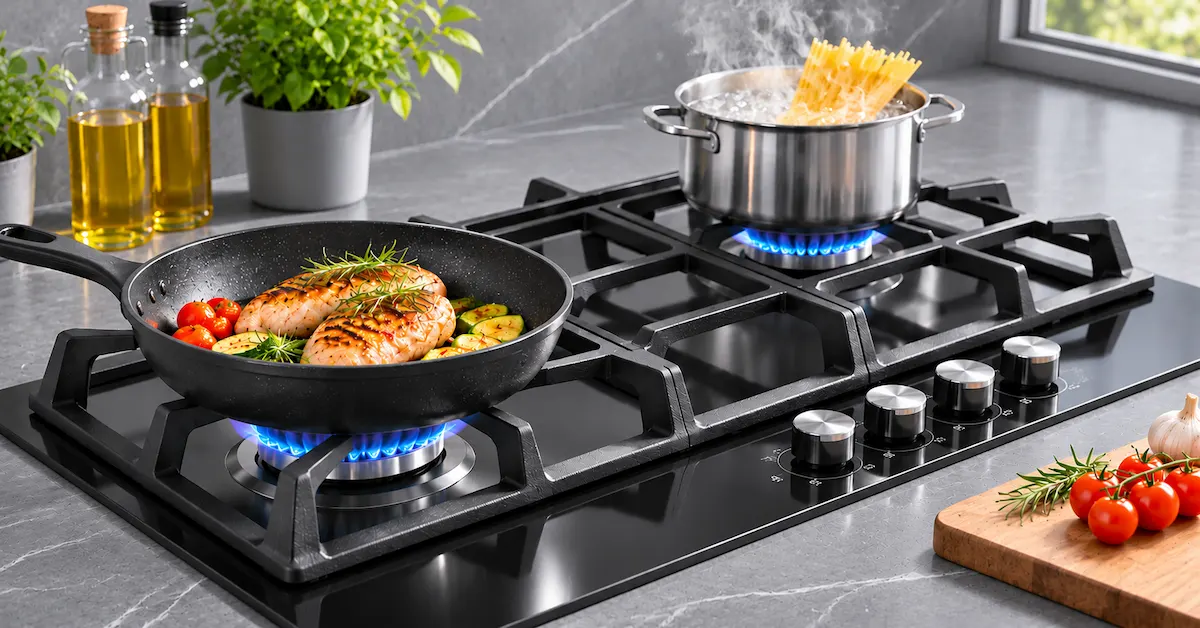
Unlike conventional electric hot plates or ceramic radiant heaters, induction coils transfer energy electromagnetically rather than directly heating cookware through a resistance-heating surface.
Typical Distribution Customers
| Target customer | Main purchasing requirement |
|---|---|
| Appliance-parts distributors | Multiple approved component references |
| Kitchen appliance importers | Competitive landed costs and documentation |
| Professional repair-parts wholesalers | Verified replacement compatibility |
| Regional appliance manufacturers | Consistent components for production |
| Private-label appliance brands | Approved product configurations |
| Authorized service networks | Reliable identification and replacement supply |
Who Is This Wholesale Purchasing Model Not Suitable For?
Bulk component purchasing is not recommended for buyers without reliable appliance compatibility information or access to qualified technical evaluation.
Induction coils should not be marketed as universal replacement parts based solely on appearance, diameter, or advertised power.
Explore the WEBO Induction Coil Product Range for product sourcing inquiries.
2. How to Choose a Wholesale Induction Cooktop Coil for Distributors
Product compatibility is the foundation of a sustainable wholesale business.
Two coils may appear almost identical while having different electrical characteristics, winding arrangements, mounting dimensions, and connection interfaces.
Purchasing unsuitable products can create customer complaints and inventory losses even when the supplier delivers the ordered quantity correctly.
Induction Coil Technical Specification Checklist
| Specification | What distributors should confirm |
|---|---|
| Outer diameter | Approved heating-zone dimensions |
| Inner diameter | Winding geometry |
| Overall thickness | Installation clearance |
| Inductance | Target value, tolerance, and measurement conditions |
| DC resistance | Approved resistance limits |
| Winding construction | Conductor and insulation specification |
| Ferrite arrangement | Material, quantity, and positioning |
| Lead wires | Length and routing requirements |
| Connector | Exact electrical interface |
| Temperature sensor | Type and specification, if included |
| Mounting structure | Carrier dimensions and fastening points |
| Product revision | Approved drawing or part identification |
| Appliance compatibility | Documented applicable appliance platforms |
These are recommended purchasing parameters, not published specifications for an individual WEBO model.
Why Matching Diameter and Wattage Is Not Enough
The induction coil operates as part of a complete electrical system.
Even if two coils have the same diameter or are marketed for appliances with similar power ratings, they may have different inductance, winding losses, magnetic configurations, and thermal behavior.
Distributors should require technical approval before listing one coil as a substitute for another.
A qualified appliance manufacturer or service engineer should determine whether the component is compatible with the intended equipment.
3. How Should Distributors Build Their Initial Induction Coil SKU Assortment?
A successful wholesale program does not necessarily require hundreds of different coil models.
A smaller assortment supported by documented demand can be easier to manage than a large inventory of unverified components.
Compare Product Configuration Opportunities
| General coil configuration | Potential distribution market | Purchasing consideration |
|---|---|---|
| Flat coil for portable cookers | Compact appliance-parts channels | Installation height and electrical matching |
| Flat coil for built-in hobs | Kitchen appliance supply networks | Heating-zone geometry and mounting |
| Larger heating-zone coil | Compatible multi-zone cooking appliances | Inverter and cookware requirements |
| Specialized curved coil | Induction wok equipment | Vessel geometry and system validation |
| Customized OEM coil | Appliance manufacturers | Project-specific engineering approval |
These configurations represent general industry sourcing opportunities. They are not confirmed WEBO stock models.
Use Three Inventory Categories
| Inventory category | Recommended strategy |
|---|---|
| Core SKUs | Stock approved products with consistent customer demand |
| Secondary SKUs | Maintain limited quantities while monitoring demand |
| Project-specific SKUs | Purchase against confirmed orders or development projects |
As sales records become available, move products between categories according to actual demand, margin, return rates, and replenishment requirements.
Avoid committing too much working capital to specialized models with uncertain sales potential.
Start With Customer Demand
Before placing the first wholesale order, collect:
-
Frequently requested appliance part numbers
-
Historical sales and customer inquiries
-
Verified replacement requirements
-
Expected monthly demand
-
Existing customers' approved technical specifications
-
Target wholesale selling prices
The resulting assortment should reflect actual market opportunities rather than catalog size alone.
4. How Can SKU Identification Reduce Incorrect-Fit Returns?
A wholesale induction cooktop coil for distributors should have a controlled product identity that remains consistent across quotations, purchasing records, warehouse labels, and customer orders.
Similar-looking products must not be mixed under one internal SKU without documented interchangeability.
Recommended Product Master Data
| Product identification field | Purpose |
|---|---|
| Supplier part number | Purchasing accuracy |
| Distributor SKU | Inventory management |
| Product revision | Configuration control |
| Technical drawing | Mechanical identification |
| Electrical specification | Compatibility verification |
| Approved appliance references | Customer selection |
| Connector photograph | Visual confirmation |
| Batch or lot number | Traceability |
| Carton quantity | Warehouse receiving |
| Barcode or GTIN, where required | Distribution identification |
When Should a New SKU or Barcode Be Created?
Changes in winding construction, electrical specifications, connector types, ferrite configuration, or other significant characteristics may require a separate internal SKU.
For businesses using standardized trade-item identifiers, the GS1 guidance on product changes and GTIN management explains when changes to an existing product may require a new GTIN.
Distributors should distinguish between internal inventory codes and standardized GS1 identifiers. The applicable GTIN rules should be reviewed separately.
Accurate identification makes it easier to prevent incorrect shipments, manage product revisions, and investigate customer returns.
5. What Affects Induction Cooktop Coil Wholesale Prices?
Wholesale prices depend on more than the amount of copper used in the winding.
Main Cost Drivers
| Cost factor | Potential impact |
|---|---|
| Conductor construction | Material and winding requirements |
| Coil geometry | Material usage and manufacturing complexity |
| Ferrite components | Magnetic structure and assembly cost |
| Lead wires and connectors | Electrical interface requirements |
| Temperature sensors | Additional component and assembly costs |
| Electrical inspection | Testing and documentation requirements |
| Order quantity | Production and purchasing economics |
| Customized packaging | Labeling and protection costs |
| International transportation | Landed cost and delivery risk |
When evaluating a wholesale induction cooktop coil for distributors, calculate the cost of obtaining a sellable product at your warehouse rather than comparing factory quotations alone.
Illustrative Landed-Cost Calculation
Assume a distributor purchases 1,000 induction coils under the following hypothetical conditions.
| Cost item | Amount |
|---|---|
| Product purchase price | $5,200 |
| Freight, duties and related charges | $900 |
| Inspection expenses | $200 |
| Packaging and receiving costs | $200 |
| Total purchasing cost | $6,500 |
| Expected sellable units | 980 |
| Effective cost per sellable unit | $6.63 |
The example assumes 20 units become unsellable and their costs are not recovered.
If the distributor sells each approved unit for $9.50, the indicative gross margin based on this effective product cost is approximately 30.2%.
However, this is not net profit. Additional expenses may include warehouse storage, customer support, outbound transportation, financing, sales commissions, and returns.
All figures are illustrative and do not represent WEBO quotations, market prices, or actual product defect rates.
6. How Should Distributors Negotiate MOQ and Mixed-Model Orders?
A large minimum order may reduce the unit purchase price while increasing inventory exposure.
For distributors entering a new regional market, smaller initial purchases across carefully selected SKUs may provide more useful demand information.
Wholesale Purchasing Options
| Order structure | Potential advantage | Main limitation |
|---|---|---|
| Single-model bulk order | Concentrates purchasing volume | Greater exposure to one product |
| Mixed-model order | Tests several market segments | Separate SKU quantities may affect pricing |
| Scheduled repeat orders | Supports inventory planning | Requires dependable forecasts |
| Project-specific order | Reduces speculative inventory | May involve customization and longer development |
Questions to Confirm Before Ordering
Ask whether the supplier can offer separate MOQ and price quotations for each approved SKU.
Confirm whether mixed-model orders are commercially feasible, whether packaging quantities differ by model, and how customization affects production requirements.
A supplier's overall production capacity does not establish available capacity for every coil design.
WEBO's MOQ, mixed-model arrangements, production capacity, and delivery schedule should be confirmed for the actual purchasing project.
7. How Can Distributors Improve Induction Coil Inventory Turnover?
Inventory availability supports customer service, but excess stock consumes capital and increases obsolescence risk.
A useful replenishment strategy connects purchasing quantities with actual demand and confirmed lead times.
Calculate a Practical Reorder Point
A simplified reorder-point formula is:
Reorder Point = Expected Demand During Replenishment Lead Time + Safety Stock
Consider a hypothetical distributor selling 25 units of an approved coil SKU each week.
| Inventory planning item | Illustrative value |
|---|---|
| Average weekly demand | 25 units |
| Replenishment lead time | 6 weeks |
| Expected demand during lead time | 150 units |
| Safety stock | 50 units |
| Reorder point | 200 units |
Under these assumptions, the distributor should review replenishment when its inventory position reaches 200 units.
Inventory position generally includes stock on hand plus open purchase orders, minus backorders.
Actual order quantities should also consider MOQ, carton quantities, demand variation, available capital, and expected product changes.
These values are hypothetical planning assumptions, not WEBO delivery or production commitments.
Monitor Distribution Performance
| Performance indicator | Business purpose |
|---|---|
| Monthly sales per SKU | Identify customer demand |
| Inventory turnover | Evaluate stock efficiency |
| Gross margin | Assess product profitability |
| Stockout frequency | Review replenishment effectiveness |
| Return rate | Identify compatibility or quality problems |
| Inventory aging | Detect slow-moving products |
| Supplier delivery performance | Improve purchasing forecasts |
Tracking these indicators can help distributors expand their assortment based on evidence rather than speculation.
8. What Quality and Packaging Requirements Should Distributors Establish?
Induction coils contain components that may be affected by incorrect handling, impact, or compression.
A suitable packaging design should protect the winding structure, ferrite elements, supporting carrier, lead wires, and connectors.
Recommended Incoming Inspection
| Inspection item | Main purpose |
|---|---|
| SKU and revision | Prevent mixed-product inventory |
| Winding appearance | Identify visible damage |
| Ferrite condition | Detect cracks or missing components |
| Carrier dimensions | Verify mechanical configuration |
| Lead wires and connectors | Confirm approved interfaces |
| Electrical measurements | Verify agreed acceptance criteria |
| Carton labels | Maintain batch traceability |
| Packaging condition | Identify transportation damage |
Electrical inspection should follow agreed procedures and be performed by appropriately qualified personnel.
Recommended Wholesale Packaging Controls
-
Separate individual assemblies to prevent abrasion and compression.
-
Protect fragile ferrite components from impact.
-
Prevent excessive bending or pulling of lead wires.
-
Protect electrical connectors during transport.
-
Use accurate outer-carton labels and packing lists.
-
Evaluate packaging against the intended transportation environment.
The International Safe Transit Association packaging test procedures provide recognized approaches for assessing packaged products under different transportation conditions.
For example, ISTA Procedure 3A addresses suitable individual packages transported through parcel delivery systems. Other distribution environments may require different procedures.
Distributors can use this framework to discuss packaging validation with suppliers rather than assuming that one carton design is suitable for every shipping route.
Reference to ISTA does not mean WEBO's packaging has been tested or certified under an ISTA procedure.
9. How Should International Delivery and Customer Returns Be Managed?
Wholesale profitability can be affected by transportation responsibilities, customs charges, damaged goods, and customer returns.
The ICC Incoterms® 2020 rules define specified delivery responsibilities, cost allocations, and risk transfer between buyers and sellers.
When comparing international quotations, distributors should confirm the applicable Incoterm, named location, and costs included in each offer.
Incoterms do not replace contractual provisions covering payment, quality acceptance, warranties, or claims.
Common Distribution Risks
| Risk | Recommended control |
|---|---|
| Incorrect coil identification | Approved product master data |
| Transit damage | Agreed packaging and inspection procedures |
| Delayed replenishment | Confirmed schedules and inventory planning |
| Unapproved component changes | Revision control and change notification |
| Incorrect replacement sales | Documented appliance compatibility |
| Slow-moving stock | Demand-based purchasing |
| Unclear quality claims | Written acceptance and claims procedures |
Classify Returns Before Taking Action
Distributors should distinguish among incorrect product selection, transportation damage, confirmed component nonconformity, and unrelated appliance faults.
These categories require different corrective actions.
Agree with the supplier on the documentation required for investigating claims, including photographs, batch identification, product references, and relevant inspection results.
10. When Are OEM Customization and Private Labeling Worth Considering?
Some distributors serve appliance manufacturers requiring specific coil configurations or branded packaging.
Potential customization discussions may include:
-
Winding geometry and electrical requirements
-
Ferrite configuration
-
Lead wire length and connector selection
-
Supporting carrier and mounting dimensions
-
Product identification and packaging labels
-
Customer-specific inspection documentation
Customization can create product differentiation, but it may also increase purchasing commitments, development costs, and inventory risks.
Any modified coil should be evaluated for compatibility with the intended appliance.
Before purchasing customized products, confirm the engineering scope, sample approval requirements, MOQ, tooling responsibilities, packaging specifications, and change-control process.
Specific OEM, ODM, and private-label services must be confirmed with WEBO for the intended project.
11. Why Consider WEBO for Wholesale Induction Coil Sourcing?
WEBO, officially GUANGDONG WEBO TECHNOLOGY CO., LTD, is a heating element and cooking appliance component manufacturer established in 1998 in Yangjiang, Guangdong, China.
Its published product portfolio includes induction coils and several complementary appliance-component categories.
Relevant WEBO Product Categories
| Product | Distribution opportunity |
|---|---|
| Induction Coil | Induction cooking component sourcing |
| Ceramic Glass | Compatible cooktop surface components |
| Ceramic Heater | Radiant cooking appliance components |
| Hot Plate | Resistance-heating appliance components |
| Tube Heating Element | Suitable oven and cooking equipment projects |
These categories may provide opportunities to expand an appliance-parts portfolio. They are not automatically compatible with one another or interchangeable.
WEBO states that it has implemented ISO 9001 and ISO 14001 management standards and serves international customers.
Buyers should verify current certificate validity, applicable scope, and model-specific compliance documentation before making purchasing decisions.
The public Induction Coil listing does not provide a complete model-specific technical datasheet. Distributors should therefore request confirmed specifications, available configurations, wholesale quotations, and packaging information directly.
Learn more about WEBO's Company Background.
12. What Should Be Included in a Wholesale Induction Coil RFQ?
A detailed wholesale RFQ helps the supplier understand both product requirements and the distributor's commercial objectives.
| RFQ information | What to provide |
|---|---|
| Buyer profile | Distributor, importer, wholesaler, or service network |
| Target market | Countries and customer segments |
| Product references | Drawings, approved samples, or part numbers |
| Required specifications | Dimensions and electrical characteristics |
| Compatibility requirements | Approved appliance applications |
| Initial assortment | Requested SKU list |
| Purchase quantity | Quantity per SKU |
| Sales forecast | Estimated monthly or annual demand |
| Packaging | Individual protection and carton requirements |
| Identification | SKU labels and barcode requirements |
| Quality requirements | Inspection and documentation needs |
| Delivery conditions | Destination, schedule, and preferred Incoterm |
| Customization | Product, labeling, or packaging requirements |
Request a Wholesale Induction Coil Quotation
Are you expanding your appliance-parts distribution business or looking for induction cooktop coils for repeat bulk purchasing?
Share your product references, technical specifications, expected quantities per SKU, destination market, and packaging requirements with WEBO.
Request a project-specific quotation covering suitable configurations, sample evaluation, MOQ, bulk pricing, packaging, and replenishment arrangements.
Explore WEBO Induction Coil Products
Contact WEBO for Wholesale Pricing and Technical Evaluation
13. Frequently Asked Questions
1. What should I check when buying a wholesale induction cooktop coil for distributors?
Verify appliance compatibility, electrical specifications, product identification, sample quality, packaging, landed cost, MOQ, and repeat-order arrangements.
2. Can distributors sell one induction coil for several cooktop models?
Only when compatibility with those appliance platforms has been appropriately verified. Similar diameter or appearance alone is insufficient.
3. What determines the wholesale price of induction coils?
Conductor construction, coil geometry, ferrite components, electrical interfaces, inspection requirements, customization, order volume, and packaging can influence pricing.
4. Can I purchase multiple induction coil models in one order?
Mixed-model purchasing depends on the supplier's available configurations, MOQ requirements, production arrangements, and packaging conditions. Request a quotation for the complete SKU list.
5. How many induction coil SKUs should a new distributor stock?
There is no universal quantity. Begin with approved products supported by documented customer demand, then expand according to sales, margins, and inventory turnover.
6. How can distributors reduce induction coil return rates?
Maintain accurate product identification, verified compatibility records, protective packaging, incoming inspection, and controlled product revisions.
7. How should induction coils be packaged for export?
Packaging should protect windings, ferrite components, mounting structures, connectors, and lead wires. The design should reflect the intended shipping and handling environment.
8. Can WEBO provide customized induction coils for distributors?
WEBO publishes induction coil products and describes customized heating-component solutions. Specific customization capabilities, packaging options, MOQ, and development requirements must be confirmed through project review.
9. How can distributors calculate the right reorder quantity?
Review sales demand, inventory position, replenishment lead time, safety stock, MOQ, and available working capital. Adjust purchasing quantities as actual demand changes.
10. How can I request wholesale induction coil pricing from WEBO?
Submit your required product specifications, appliance references, quantities per SKU, destination country, and packaging requirements through the WEBO Contact Page.
Conclusion
When sourcing a wholesale induction cooktop coil for distributors, prioritize verified compatibility, accurate product identification, manageable inventory levels, and sustainable landed costs.
A successful distribution program should be built around approved components and documented customer demand rather than the largest possible assortment or the lowest initial factory quotation.
By controlling SKU information, evaluating representative samples, protecting products during transportation, monitoring inventory turnover, and planning replenishment, distributors can reduce avoidable purchasing and operational risks.
WEBO, established in 1998, manufactures heating elements and cooking appliance components and publishes induction coils within its product portfolio.
International distributors, appliance-parts importers, and wholesale buyers can discuss suitable product configurations, technical requirements, purchasing quantities, customization feasibility, and commercial arrangements with WEBO.
Looking to develop or expand your induction coil wholesale product portfolio?
View WEBO Induction Coil Products or Contact WEBO for a Wholesale Quotation to discuss your SKU requirements, estimated order volumes, and target distribution market.