


Quick Answer: In an induction heating coil manufacturer vs supplier comparison, a manufacturer may offer closer access to winding design, material selection, and production controls, while a supplier may provide component sourcing, technical coordination, and delivery management. For induction cooktop OEMs, the better choice is the partner that can demonstrate electrical compatibility, comparable measurement results, controlled engineering changes, and consistent production. Neither factory-direct purchasing nor a competitive quotation alone establishes component suitability.
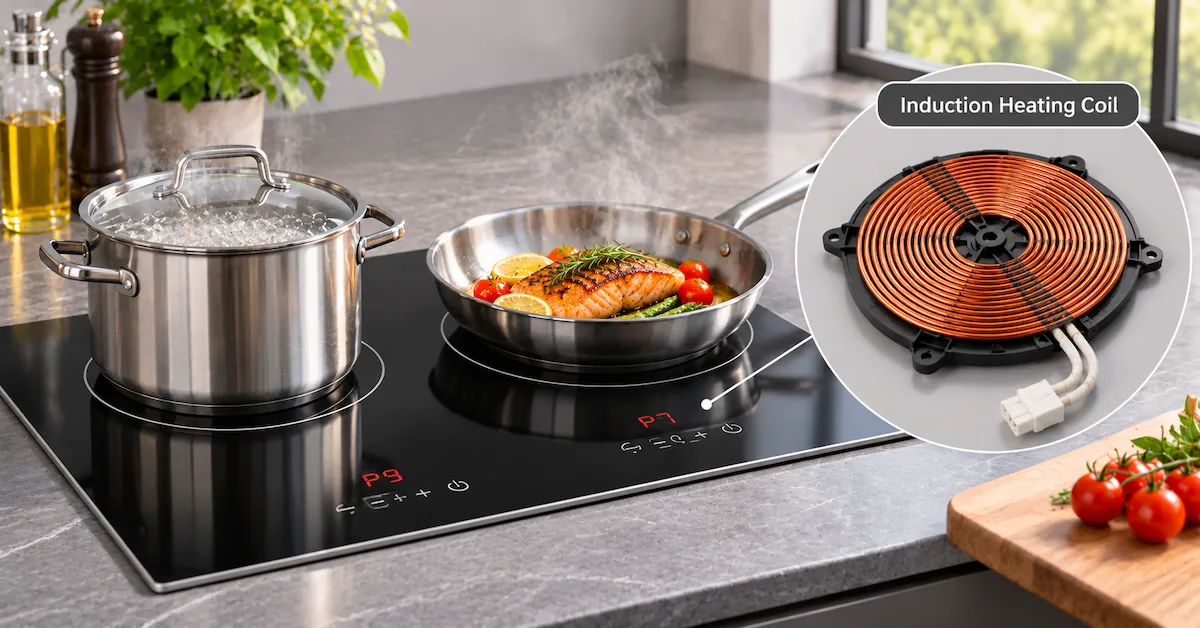
An induction heating coil is not an isolated heating element that can be selected solely by diameter or advertised wattage.
It operates within an electromagnetic heating system involving an inverter, resonant components, ferrite structures, compatible cookware, temperature monitoring, and appliance controls.
A replacement coil may fit perfectly beneath the ceramic-glass surface but still behave differently from the original component.
For an appliance manufacturer, this can create unexpected electrical loading, inconsistent cookware detection, excessive temperature rise, or additional engineering validation costs.
The induction heating coil manufacturer vs supplier decision should therefore focus on technical equivalence, engineering access, and supply continuity rather than company labels alone.
WEBO, officially GUANGDONG WEBO TECHNOLOGY CO., LTD, is a China-based manufacturer of heating elements and cooking appliance components established in 1998. Its product portfolio includes induction coils, ceramic heaters, solid hot plates, tubular heating elements, ceramic glass, and related appliance components.
This guide focuses on induction cooking applications and the practical decisions OEM buyers face when selecting a new component source.
Explore the WEBO Induction Coil Product Range.
Key Takeaways
-
Manufacturer and supplier roles can overlap. One company may perform both functions.
-
Two induction coils with identical dimensions are not necessarily electrically interchangeable.
-
Inductance measurements must be compared under agreed testing conditions.
-
Winding construction, ferrite configuration, and electrical interfaces influence system compatibility.
-
A second-source coil requires engineering validation before production approval.
-
Procurement costs should include qualification, engineering changes, inspection, and potential production disruption.
-
Product-specific specifications and manufacturing capabilities should be confirmed before placing an order.
1. Induction Heating Coil Manufacturer vs Supplier: What Is the Difference?
An induction heating coil manufacturer produces coil assemblies or manages defined manufacturing operations. An induction coil supplier provides components to customers and may also coordinate engineering, purchasing, production, and logistics.
A manufacturer can also be a supplier, while a supplier may work with qualified manufacturing partners.
Manufacturer and Supplier Comparison
| Evaluation factor | Manufacturer-led sourcing | Supplier-led sourcing |
|---|---|---|
| Winding production | May provide direct production access | Depends on manufacturing partners |
| Engineering communication | Potentially closer to production engineering | Depends on technical coordination |
| Custom electrical parameters | Subject to development capability | Subject to partner capabilities |
| Material control | May directly manage winding materials | Requires supply-chain visibility |
| Test documentation | May generate production measurements | May collect and verify manufacturing records |
| Existing-model sourcing | Depends on available designs | May coordinate multiple product sources |
| Mixed-component orders | Depends on product portfolio | May offer consolidated purchasing |
| Second-source projects | Suitable when engineering evidence is available | Suitable when source identity and specifications are controlled |
| Delivery management | Direct production scheduling | May coordinate multiple supply arrangements |
Neither arrangement automatically guarantees lower prices, better engineering support, or higher product quality.
The relevant question is whether the organization can meet your approved component requirements and accept responsibility for its supply.
2. Which Buyers Should Choose Each Sourcing Route?
Different appliance programs require different levels of technical involvement.
Application-Based Sourcing Matrix
| Buyer or application | Main procurement requirement | Recommended starting approach |
|---|---|---|
| New built-in induction hob | Electrical and mechanical development | Engineering-capable manufacturer |
| Portable induction cooker OEM | Compact assembly and thermal integration | Manufacturer or technical supplier |
| Multi-zone induction cooktop | System coordination and coil interaction | Engineering development partner |
| Existing appliance production | Approved specification consistency | Qualified manufacturer or supplier |
| Appliance-parts distributor | Accurate product identification | Supplier with verified technical documentation |
| Second-source development | Electrical equivalence and production continuity | Source with controlled validation capabilities |
Direct manufacturer cooperation may be particularly valuable when the coil geometry, winding configuration, or electrical characteristics require development.
A capable supplier may be appropriate when buyers already have approved specifications and need coordinated purchasing or repeat delivery.
This guide is primarily intended for professional OEM buyers, appliance engineers, technical purchasers, and component distributors. It is not a guide to installing unidentified replacement coils in consumer appliances.
3. Why Is Electrical Compatibility More Important Than Coil Appearance?
One of the most important factors in an induction heating coil manufacturer vs supplier comparison is whether each candidate can demonstrate compatibility with the intended power electronics.
Induction coils generate alternating magnetic fields that transfer energy to suitable cookware.
The coil, cookware, and magnetic structure influence the electrical load presented to the inverter.
Changing the coil can therefore affect the behavior of the complete appliance.
Critical Electrical and Mechanical Specifications
| Parameter | Why it matters | Information to request |
|---|---|---|
| Outer diameter | Heating-zone geometry | Approved dimensions |
| Inner diameter | Winding configuration | Drawing and tolerance |
| Assembly height | Installation clearance | Mechanical specification |
| Inductance | Resonant circuit compatibility | Target value and tolerance |
| Measurement frequency | Comparability of inductance results | Defined test conditions |
| DC resistance | Winding and connection consistency | Resistance limits and temperature |
| AC resistance or losses | High-frequency behavior | Test data where relevant |
| Winding construction | Electrical and thermal characteristics | Conductor specification |
| Ferrite arrangement | Magnetic field distribution | Material and layout requirements |
| Lead wires | Connection and assembly | Length, routing, and termination |
| Connector | Electrical interface | Approved connector reference |
| Temperature sensor | Thermal feedback | Type and response requirements |
| Insulation | Electrical protection | Approved construction and test criteria |
These are engineering specification requirements rather than published WEBO model parameters.
Why Matching Inductance Alone Is Insufficient
Two induction coils may have similar inductance readings but different winding losses, ferrite arrangements, and thermal behavior.
Their electrical characteristics may also change differently when coupled with cookware.
Consequently, a matching nominal inductance value should be treated as one part of component evaluation, not proof of complete interchangeability.
4. How Should Buyers Compare Induction Coil Test Data?
Manufacturers and suppliers may use different measuring instruments, fixtures, frequencies, and environmental conditions.
As a result, apparently similar or different readings may not be directly comparable.
Standardize the Measurement Conditions
Before evaluating quotations or samples, agree on the following measurement requirements.
| Measurement factor | Required clarification |
|---|---|
| Test instrument | Equipment type and applicable settings |
| Test frequency | Frequency used for inductance measurement |
| Test signal level | Excitation conditions |
| Equivalent circuit mode | Series or parallel measurement representation |
| Test fixture | Connection method and fixture compensation |
| Coil assembly condition | With or without ferrite and related components |
| Measurement temperature | Defined conditions for resistance comparison |
| Nearby conductive materials | Controlled measurement environment |
| Cookware condition | Unloaded or defined cookware-loaded setup |
| Acceptance limits | Approved tolerance and decision criteria |
The National Institute of Standards and Technology guidance on metrological traceability explains that traceable measurement results depend on documented calibration relationships and measurement uncertainty.
For procurement teams, the practical implication is that an instrument calibration certificate alone does not establish the comparability or suitability of every measurement produced with that instrument.
Buyers should evaluate the complete measurement method.
Illustrative Test-Correlation Example
Suppose two candidate coils have the same nominal diameter and a target inductance of 100 µH.
| Measurement item | Candidate A | Candidate B |
|---|---|---|
| Reported inductance | 100 µH | 102 µH |
| Measurement frequency | 1 kHz | 10 kHz |
| Ferrite configuration | Installed | Installed |
| Test fixture | Method A | Method B |
At first glance, the reported values appear close.
However, because the measurement frequencies and fixtures differ, the buyer cannot determine electrical equivalence from this table alone.
Both candidates should be retested using an agreed measurement procedure.
The figures above are hypothetical and do not represent WEBO product specifications or test results.
5. Which Materials and Manufacturing Processes Affect Coil Equivalence?
The induction heating coil manufacturer vs supplier decision should include verification of the materials and construction behind the measured electrical values.
A coil assembly may contain copper windings, ferrite elements, insulation, lead wires, connectors, and mechanical supporting structures.
Winding Construction
High-frequency induction systems may use appropriately designed multi-strand conductors to manage AC losses.
However, copper appearance, conductor weight, or strand count alone does not establish suitable electrical performance.
The approved conductor specification should identify relevant material and construction requirements.
Ferrite Configuration
Ferrite elements influence magnetic flux distribution and interaction with nearby structures.
Changing ferrite material, dimensions, quantity, or positioning may affect appliance behavior even when the outer coil dimensions remain unchanged.
Assembly and Connection Control
The supplier should explain how the approved winding, ferrite, leads, connectors, and sensor arrangement are maintained during repeat production.
| Manufacturing characteristic | Potential consequence of uncontrolled change |
|---|---|
| Winding geometry | Changed electrical characteristics |
| Conductor construction | Different losses and temperature rise |
| Ferrite arrangement | Changed magnetic coupling |
| Lead termination | Connection or resistance problems |
| Sensor location | Different thermal feedback |
| Carrier dimensions | Assembly interference |
These are general engineering considerations. Buyers should verify which manufacturing and inspection operations are performed or controlled by the proposed supplier.
6. How Do You Qualify an Induction Coil as a Second Source?
Second-source qualification allows appliance manufacturers to evaluate an alternative supply option without automatically changing the entire product platform.
However, adding another supplier should not mean accepting an uncontrolled alternative component.
Three Second-Source Development Routes
| Sourcing route | Description | Main qualification requirement |
|---|---|---|
| Build-to-print alternative | Produces the approved design to controlled requirements | Manufacturing and component conformity |
| Functionally equivalent design | Uses an alternative construction intended to meet system requirements | Broader electrical and appliance validation |
| Modified replacement coil | Changes selected dimensions, interfaces, or electrical features | Evaluation of affected system characteristics |
A build-to-print component still requires appropriate supplier and production approval.
A functionally equivalent alternative may require more extensive engineering work because its internal construction can differ from the existing design.
Five Qualification Gates
-
Baseline definition: Record the approved reference coil, drawing revision, electrical specifications, and appliance requirements.
-
Component comparison: Evaluate dimensions, electrical characteristics, winding construction, ferrite, and interfaces.
-
Measurement correlation: Verify that the original and alternative coils are measured using comparable procedures.
-
Appliance validation: Evaluate performance, temperatures, protective behavior, and relevant safety and EMC requirements.
-
Production release: Approve the alternative part number, manufacturing arrangement, inspection plan, and change-control conditions.
A candidate should not be approved for unrestricted production simply because it passes a short heating demonstration.
7. What System-Level Tests Should OEM Buyers Require?
A technically meaningful induction heating coil manufacturer vs supplier evaluation must extend beyond component inspection.
The induction coil should be tested within the appliance platform for which it is intended.
Recommended Appliance Validation Matrix
| Validation item | Main purpose |
|---|---|
| Startup and cookware detection | Confirm intended control behavior |
| Heating performance | Compare operation with representative cookware |
| Inverter electrical behavior | Evaluate compatibility with the power stage |
| Coil temperature rise | Check relevant thermal conditions |
| Ferrite and nearby component temperatures | Assess magnetic and thermal interaction |
| Multi-zone operation | Evaluate neighboring-zone interaction |
| Extended operation | Verify intended operating conditions |
| Abnormal-condition response | Assess relevant protective functions |
| EMC evaluation | Review applicable electromagnetic compatibility requirements |
| Mechanical fit | Confirm installation and assembly compatibility |
The precise test procedures, operating conditions, and acceptance limits should be established by qualified appliance engineers.
Which Safety Standard Is Relevant?
IEC 60335-2-6:2024 addresses safety requirements for household stationary electric cooking appliances, including induction hobs and induction wok elements.
Its scope does not cover every type of portable cooker or commercial catering appliance.
For OEM buyers, replacing an induction coil may therefore require reassessing relevant finished-appliance requirements according to the design change, product category, and target market.
The reference to IEC 60335-2-6 does not establish certification of an individual WEBO coil.
8. How Should Engineering Changes Be Managed Across Multiple Sources?
Once two sources are approved, each supplier must maintain its authorized product configuration.
Uncontrolled substitutions can undermine the original qualification results.
Recommended Change-Control Matrix
| Proposed change | Main issue to reassess |
|---|---|
| Conductor material or construction | Electrical losses and thermal behavior |
| Winding turns or geometry | Inductance and system matching |
| Ferrite material or position | Magnetic performance and heating behavior |
| Connector or terminal | Electrical and mechanical interface |
| Lead length or routing | Assembly and relevant electrical conditions |
| Sensor specification or position | Temperature-control behavior |
| Supporting structure | Installation and thermal compatibility |
| Production location or critical process | Manufacturing consistency |
Not every change requires complete appliance requalification.
The extent of retesting should be based on engineering impact, contractual requirements, and applicable product conformity obligations.
Avoid Unapproved Cross-Substitution
Two qualified sources may use different approved component constructions.
Maintain distinct manufacturer part numbers or other controlled identification where necessary.
Purchasing and warehouse teams should know which component configurations are authorized for each appliance platform.
This helps prevent unapproved substitutions during purchasing shortages.
9. Is Buying Directly From an Induction Coil Manufacturer Cheaper?
Direct sourcing may reduce certain intermediary costs, but it does not automatically provide the lowest total procurement cost.
Technical qualification, engineering coordination, delivery, inventory, and quality risks also affect the final purchasing decision.
Total Sourcing Cost Comparison
| Cost factor | Direct manufacturing route | Supplier-led route |
|---|---|---|
| Unit purchase price | Project-specific | Project-specific |
| Development expenses | May require direct engineering investment | Depends on included support |
| Sample costs | Depends on design maturity | Depends on sourcing arrangements |
| Tooling or fixtures | May be required | May be included or quoted separately |
| Technical validation | Required | Required |
| Purchasing coordination | Managed directly by buyer | May be partly coordinated by supplier |
| Quality claims | Depends on agreed responsibilities | Depends on contractual arrangements |
| Supply continuity | Requires capacity and contingency planning | Depends on actual manufacturing sources |
Illustrative Qualification Cost Example
Consider two hypothetical options for sourcing 10,000 approved coils.
| Cost item | Source A | Source B |
|---|---|---|
| Unit purchase price | $5.00 | $5.20 |
| Total goods cost | $50,000 | $52,000 |
| Development and qualification cost | $4,000 | $1,000 |
| Combined estimated cost | $54,000 | $53,000 |
Although Source A offers a lower unit price, Source B has a lower combined cost for this illustrative order volume.
The example excludes freight, taxes, inventory costs, and future purchasing conditions. It does not represent actual WEBO pricing.
The purchasing lesson is that qualification and development expenses should be compared alongside the component price.
10. What Quality, Capacity, and Customization Information Should Buyers Confirm?
Before selecting a long-term partner, buyers should request technical and commercial information for the actual coil configuration.
WEBO's company materials describe ISO 9001 and ISO 14001 management systems and refer to various international product certification and conformity schemes.
However, company-level statements do not establish the approval status of every induction coil.
Supplier Approval Requirements
| Evaluation area | Information to request |
|---|---|
| Quality management | Relevant certificate scope and quality procedures |
| Measurement capability | Agreed test methods and supporting records |
| Production traceability | Part number, revision, and batch identification |
| Production capacity | Output available for the selected configuration |
| MOQ | Minimum quantity per approved model |
| Sample schedule | Availability and development requirements |
| Mass-production lead time | Project-specific delivery proposal |
| OEM/ODM customization | Confirmed engineering and manufacturing scope |
| Packaging | Protection for winding, ferrite, leads, and connectors |
| Product documentation | Applicable model-specific test and conformity evidence |
Potential customization may involve winding geometry, electrical targets, ferrite arrangements, lead wires, connectors, sensors, and mounting interfaces.
The feasibility of each modification must be evaluated against the actual appliance requirements.
11. Why Consider WEBO for Induction Heating Coil Sourcing?
WEBO is a China-based manufacturer and supplier of heating elements and cooking appliance components established in 1998 in Yangjiang, Guangdong Province.
Its published induction coil range provides a starting point for OEM component sourcing and alternative-source discussions.
Relevant WEBO Products
| Product | Application | Procurement consideration |
|---|---|---|
| Induction Coil | Induction cooking systems | Electrical matching and installation |
| Ceramic Glass | Cooktop surface integration | Glass-to-coil spacing and mechanical design |
| Ceramic Heater | Radiant cooking appliances | Alternative heating architecture |
| Hot Plate | Resistance-based electric cooking | Alternative appliance design |
Ceramic radiant heaters and solid hot plates operate through different heating mechanisms and are not direct replacements for induction coils.
WEBO's public Induction Coil listing does not provide enough verified technical information to compare specific electrical models. Buyers should request current datasheets and drawings rather than assume universal compatibility.
For additional purchasing guidance, explore WEBO's Induction Coil Manufacturer Guide and Induction Coil Factory Audit Guide.
12. What Should You Include in an Induction Coil RFQ?
An effective request for quotation should clearly identify whether the project involves a new appliance design, an existing approved component, or a second-source qualification program.
OEM Induction Coil RFQ Template
| RFQ field | Required information |
|---|---|
| Appliance application | Built-in hob, portable cooker, or other intended equipment |
| Project objective | New development, replacement, or second source |
| Reference coil | Approved sample, part number, or drawing |
| Mechanical dimensions | Diameter, height, mounting, and clearances |
| Electrical targets | Inductance, resistance, and tolerances |
| Measurement conditions | Frequency, fixture, temperature, and method |
| Power electronics | Relevant inverter and resonant circuit information |
| Magnetic structure | Ferrite specification and arrangement |
| Interfaces | Leads, connectors, and sensors |
| Cookware range | Representative materials and sizes |
| Validation requirements | Component and appliance acceptance tests |
| Commercial requirements | Sample quantity, annual forecast, packaging, and delivery |
| Change control | Notification and reapproval requirements |
Looking for an alternative induction coil source or developing a new induction cooktop platform?
Send your drawings, reference samples, electrical targets, test requirements, and projected purchasing volume to WEBO for a project-specific discussion.
Explore WEBO Induction Coil Products
Request an OEM Induction Coil Evaluation and Quotation
13. Frequently Asked Questions
1. What matters most in an induction heating coil manufacturer vs supplier comparison?
The most important factors are electrical compatibility, access to engineering information, measurement reliability, production consistency, and supply accountability. The actual capabilities matter more than the company's business label.
2. Is an induction coil manufacturer better than a trading supplier?
Not necessarily. A manufacturer may offer closer production access, while a capable supplier may provide technical coordination and purchasing support. Both should demonstrate conformity with the approved specification.
3. Can two induction coils with the same diameter be interchangeable?
Not automatically. Their inductance, winding construction, ferrite arrangement, electrical losses, mounting features, and connections may differ.
4. Why do induction coil inductance readings differ between suppliers?
Differences may arise from measurement frequency, instrument settings, fixtures, assembly conditions, temperature, or actual component construction. Agree on a common measurement procedure before comparing results.
5. Can an alternative coil work with an existing inverter?
Potentially, but the proposed coil must be evaluated against the inverter, resonant circuit, cookware range, and appliance-control requirements.
6. What is second-source qualification for induction coils?
It is the technical and commercial process of approving an alternative manufacturing or supply source against defined component and appliance requirements.
7. Does matching inductance guarantee identical heating performance?
No. Heating behavior also depends on electromagnetic coupling, winding losses, ferrite arrangement, cookware, power electronics, and thermal conditions.
8. Can WEBO discuss custom induction coil projects?
WEBO lists induction coils and describes customized heating-component solutions. Specific electrical targets, dimensions, manufacturing arrangements, and customization feasibility should be confirmed through technical review.
9. What affects induction heating coil prices?
Pricing may depend on conductor construction, copper usage, coil geometry, ferrite, connectors, sensors, testing, customization, order volume, and packaging.
10. How can I request an induction heating coil quotation from WEBO?
Provide your appliance application, reference coil, technical drawings, electrical requirements, measurement conditions, validation criteria, and expected order quantity through the WEBO Contact Page.
Conclusion
The most useful outcome of an induction heating coil manufacturer vs supplier comparison is identifying a sourcing partner that can support the approved electrical design, technical documentation, and long-term component requirements of the intended appliance.
Manufacturer-led sourcing may offer advantages when the project involves custom winding development, electrical optimization, or direct production coordination.
Supplier-led sourcing may be suitable for established components, coordinated purchasing, and alternative supply arrangements, provided the actual manufacturing sources and technical requirements are controlled.
For OEM induction cooktop manufacturers, the key purchasing priorities should include comparable electrical measurements, winding and ferrite consistency, inverter compatibility, engineering change control, appliance validation, and documented second-source approval.
WEBO, established in 1998, supplies induction coils and related cooking appliance components for international sourcing inquiries.
Whether you are developing a new induction hob, evaluating an existing coil configuration, or qualifying an alternative component source, begin with a clearly defined technical specification rather than unit price alone.
View WEBO Induction Coil Products or Contact WEBO for Technical Evaluation and OEM Pricing to discuss your next induction heating component project.