


What Should OEM Buyers Verify Inside an Energy Regulator Factory?
An energy regulator factory should be evaluated by its ability to manufacture a defined electrical control component consistently—not simply by the size of its workshop, the appearance of its equipment, or the number of products shown in a catalog.
For electric cooktop manufacturers, heating appliance brands, and international procurement teams, the most important question is whether the factory can reproduce an approved regulator specification across thousands of units and multiple production batches.
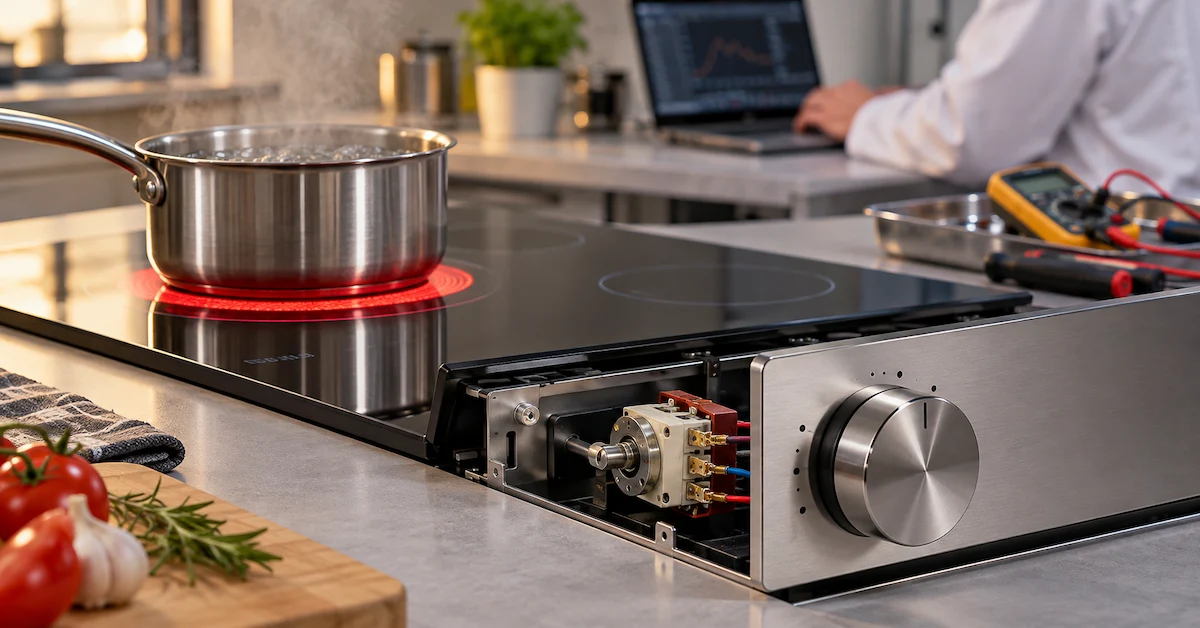
An energy regulator may control the average electrical power delivered to a resistive heating element. In conventional electromechanical designs, its performance can depend on the interaction of electrical contacts, insulating components, temperature-responsive mechanisms, mechanical adjustments, terminals, and the control shaft.
Variation in one critical component or assembly operation can affect the finished regulator.
A sample may perform correctly during initial evaluation, yet production batches may behave differently if the factory does not control its materials, assembly parameters, functional tests, and engineering revisions.
This creates several purchasing risks:
-
inconsistent heating-control behavior;
-
unsuitable electrical contact performance;
-
incorrect shaft or mounting dimensions;
-
terminal connection problems;
-
excessive manufacturing variation;
-
incomplete product traceability;
-
delayed production approval;
-
and costly appliance requalification.
A reliable factory should be able to demonstrate how a component moves from an approved engineering specification to controlled production, verified performance, and traceable shipment.
For buyers evaluating an energy regulator factory, six questions deserve priority:
-
Which production operations are performed in-house, and which are outsourced?
-
What are the critical electrical and mechanical characteristics of the proposed regulator?
-
How are incoming materials and purchased subcomponents controlled?
-
What functional tests are performed during production and final inspection?
-
How are approved samples, production revisions, and batches connected?
-
Can the factory demonstrate sufficient qualified capacity for the required order volume?
These questions provide a much stronger foundation for factory evaluation than general statements about advanced equipment or competitive pricing.
WEBO lists Energy Regulator among its heating and appliance-component categories. Buyers can review the WEBO product portfolio to understand its broader product scope before requesting information for a specific regulator project.
What Makes an Energy Regulator Factory Different From a General Component Supplier?
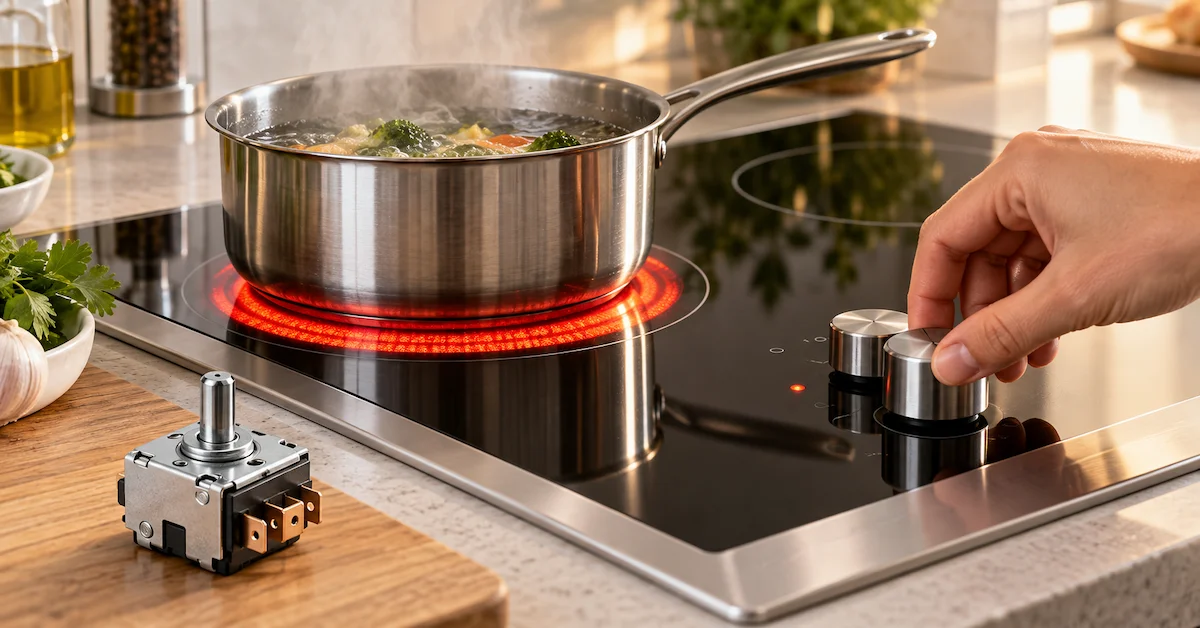
The distinction between a factory and a supplier is important, but the business label alone does not establish technical capability.
A supplier may purchase finished regulators from another manufacturer, coordinate export shipments, or manage inventory for several factories.
A factory may manufacture regulator components, assemble purchased parts, perform functional testing, or operate a combination of these activities.
Some businesses use subcontractors for specialized manufacturing operations while retaining responsibility for design, inspection, and final product conformity.
The correct sourcing decision depends on what the buyer requires.
Why Direct Production Visibility Matters
OEM buyers often need to investigate issues that cannot be resolved through a catalog.
For example, an appliance manufacturer may identify variation in control behavior between two batches.
The investigation may require access to:
-
component lot information;
-
assembly process records;
-
calibration or adjustment information;
-
inspection results;
-
test equipment records;
-
and approved engineering revisions.
A factory with a documented production-control system should be able to support this investigation.
A supplier that cannot obtain the relevant information from its upstream manufacturing source may struggle to explain the cause.
Does Every Factory Need to Manufacture Every Component In-House?
No.
Vertical integration is not automatically a guarantee of quality.
A factory may purchase stamped contacts, insulating housings, springs, or other parts from qualified subcontractors.
What matters is whether purchased components are specified, inspected, traceable, and controlled appropriately.
During an audit, buyers should determine who owns responsibility for each critical operation.
A transparent manufacturing arrangement can be acceptable if quality responsibilities are clearly defined.
What Does an Energy Regulator Manufacturing Process Look Like?
Manufacturing operations vary according to the regulator architecture.
A conventional mechanical energy regulator may contain insulating components, electrical contacts, a rotary adjustment mechanism, terminals, and a temperature-responsive element.
Other energy regulator designs can use different control technologies, including electronic components.
The following process is an illustrative audit framework for electromechanical regulators. It should not be interpreted as a verified production-line description for any particular WEBO model.
| Manufacturing Stage | Typical Activity | Factory Audit Focus |
|---|---|---|
| 1. Technical release | Approve specifications and drawings | Revision control |
| 2. Component sourcing | Obtain electrical and mechanical parts | Supplier qualification |
| 3. Incoming inspection | Check critical purchased components | Material conformity |
| 4. Subcomponent preparation | Prepare contacts, terminals and mechanical parts | Dimensional consistency |
| 5. Mechanism assembly | Assemble switching and adjustment components | Process repeatability |
| 6. Electrical assembly | Install and connect electrical components | Contact and terminal integrity |
| 7. Functional adjustment | Establish required operating characteristics | Controlled test conditions |
| 8. Electrical verification | Confirm specified electrical behavior | Test results and acceptance criteria |
| 9. Mechanical verification | Check shaft, movement and mounting | Mechanical compatibility |
| 10. Final inspection | Verify product identity and quality | Release authorization |
| 11. Packing and dispatch | Pack and identify approved batches | Traceability and protection |
A buyer should confirm which stages actually exist in the proposed manufacturing process.
The purpose of a factory audit is not to insist that every manufacturer follow an identical sequence.
It is to establish whether the operations necessary for that specific product are controlled and verifiable.
Incoming Quality Control: The First Critical Factory Checkpoint
Incoming quality control, often called IQC, is particularly important for electromechanical controls.
A regulator's performance depends on the characteristics of its internal components.
Final inspection may identify some problems, but it cannot always compensate for inconsistent materials or poorly controlled purchased parts.
Electrical Contact Components
Electrical contacts must be appropriate for the intended switching duty.
Depending on the design, important characteristics may include:
-
contact material specification;
-
surface condition;
-
geometry;
-
contact alignment;
-
attachment quality;
-
and dimensional consistency.
An auditor should ask how the factory prevents incorrect or nonconforming contact components from entering assembly.
The factory should also be able to explain how relevant incoming lots are identified.
Bimetallic Components
In regulators that use a thermally responsive bimetallic mechanism, variation in the temperature-responsive component can affect operating behavior.
Possible control considerations include:
-
material specification;
-
component geometry;
-
forming consistency;
-
thermal response;
-
and handling conditions.
A buyer does not need to demand proprietary manufacturing information unnecessarily.
However, the factory should be able to demonstrate that critical purchased components meet defined requirements.
Insulating Housings
Insulating components contribute to mechanical support and electrical separation.
Depending on the design, inspection may consider:
-
material identity;
-
molding condition;
-
dimensions;
-
cracks or damage;
-
deformation;
-
and relevant heat-resistance requirements.
The specific safety requirements must come from the applicable product design and standards.
Shafts, Springs, and Terminals
Mechanical and connection components can also influence product consistency.
Relevant checks may include shaft dimensions, spring characteristics, terminal geometry, and retention features.
For appliance OEMs, these small details can determine whether the final regulator fits the control panel and wiring harness correctly.
What Evidence Should an Auditor Request?
Ask to see an example of:
-
an incoming inspection specification;
-
an approved material or component reference;
-
a receiving inspection record;
-
a rejected-lot record;
-
and a component lot identification method.
These records are more informative than a photograph of incoming materials stacked in a warehouse.
How Should a Factory Control Energy Regulator Assembly?
Assembly quality depends on controlling operations that influence electrical contact behavior, mechanical movement, and product dimensions.
A professional energy regulator factory should be able to identify the characteristics most important to the approved design.
Critical Assembly Parameters
Depending on the regulator, important process characteristics may include:
-
contact positioning;
-
component alignment;
-
fastening or attachment quality;
-
terminal retention;
-
adjustment mechanism assembly;
-
spring installation;
-
and shaft positioning.
The factory should establish appropriate work instructions for these operations.
Where process settings materially affect performance, the settings should be controlled.
Equipment and Tooling
The buyer should not judge capability only by the quantity of machines.
Instead, ask whether the equipment used for critical operations is appropriate for the required specification.
Relevant questions include:
-
Are fixtures designed for the correct model?
-
How are fixtures identified?
-
How is equipment condition checked?
-
Are maintenance records available?
-
Can incorrect components be assembled accidentally?
-
What prevents operators from using an obsolete drawing?
A modest but well-controlled manufacturing cell may be more suitable for a specialized OEM order than a larger operation with weak revision management.
Operator Training
Some assembly characteristics depend on operator technique.
The factory should be able to explain how operators are trained and authorized for relevant processes.
For important operations, buyers can ask whether the factory uses visual instructions, standardized work methods, or process verification.
The goal is to reduce variation between operators and production shifts.
How Can a Factory Maintain Consistent Power-Control Performance?
One of the most important differences between energy regulator manufacturing and general mechanical assembly is the need to verify functional behavior.
A conventional electromechanical energy regulator may adjust average power through repeated electrical switching.
Its control characteristics depend on its internal design and operating conditions.
A correctly assembled product therefore needs more than a satisfactory visual appearance.
Functional Adjustment and Calibration
Some regulator designs require adjustment or calibration operations to establish the intended behavior.
Others may use manufacturing methods that provide the required characteristics without a separate manual adjustment step.
The audit should establish which approach applies to the proposed product.
Ask:
-
Which operating characteristics are controlled?
-
What equipment is used to measure them?
-
What test conditions are specified?
-
How are acceptance limits defined?
-
How is measurement equipment checked?
-
What happens when a unit fails?
Why Test Conditions Matter
Switching behavior may be influenced by electrical conditions and the temperature-responsive mechanism.
Consequently, two measurements made under different conditions may not be directly comparable.
The factory should define appropriate test parameters.
For example, the test procedure may specify electrical input, loading conditions, measurement duration, and acceptance criteria.
Do not assume that a regulator should produce one universal duty-cycle percentage at each knob position.
The approved model specification determines the expected behavior.
Distinguish Testing From Adjustment
A factory may perform a test without adjusting the product.
Alternatively, the process may include adjustment followed by verification.
Buyers should understand which occurs.
This helps clarify how the factory handles failed units.
A rejected regulator should not simply be adjusted repeatedly without controlled procedures and reinspection.
Review Measurement Repeatability
If small measurement differences determine whether a product passes, measurement-system capability becomes important.
For demanding OEM programs, buyers may consider whether a measurement-system analysis is needed.
The appropriate method depends on the parameter and equipment involved.
The objective is to ensure that apparent product variation is not primarily caused by inconsistent measurement.
What Electrical Tests Should an Energy Regulator Factory Perform?
Testing requirements vary by model, application, and applicable standard.
No universal test list or acceptance value should be imposed without reviewing the actual product.
However, several evaluation areas are relevant to energy regulator manufacturing.
OFF-State Verification
The OFF position should produce the electrical behavior required by the approved design.
The factory should have a defined method for verifying this function where it is a critical characteristic.
Control-Characteristic Verification
The regulator's output behavior should be evaluated against its specification.
For cycling regulators, this may involve measuring operating behavior under defined conditions.
Electrical Contact Performance
Contact-related performance is important because the regulator operates an electrical load.
Qualification testing may examine behavior under relevant switching conditions.
The appropriate tests depend on the construction and intended electrical duty.
Insulation and Dielectric Performance
Depending on the applicable requirements, tests may address electrical insulation and dielectric withstand characteristics.
The exact method and acceptance criteria must be based on the appropriate technical documentation and standards.
Temperature Rise
Electrical contacts and connections may experience heating during operation.
Where required, temperature-rise evaluation helps determine whether the component operates within acceptable limits under specified conditions.
Endurance Testing
Electrical endurance and mechanical endurance should not be confused.
A regulator can continue rotating mechanically even when its electrical switching performance has deteriorated.
Buyers should ask for the test conditions, including load, operating sequence, cycle definition, and failure criteria.
Test Record Integrity
A useful audit does not stop at seeing a test station.
Ask to examine a representative test record.
Can the factory identify:
-
the tested model;
-
applicable specification revision;
-
test date;
-
test equipment;
-
result;
-
acceptance decision;
-
and related batch information?
A test station without traceable records provides limited evidence for repeat-order quality.
Which Characteristics Should Be Included in a Factory Control Plan?
The following matrix can help engineering and purchasing teams determine which product characteristics deserve particular attention.
| Critical Characteristic | Manufacturing Risk | Potential Verification |
|---|---|---|
| Electrical configuration | Incorrect circuit behavior | Schematic and functional verification |
| OFF-state performance | Incorrect switching state | Defined functional test |
| Control characteristics | Inconsistent heating response | Controlled performance evaluation |
| Electrical contacts | Switching degradation | Relevant qualification and process controls |
| Insulating components | Inadequate electrical separation | Material and electrical verification |
| Shaft geometry | Knob mismatch | Dimensional inspection |
| Mounting dimensions | Assembly interference | Drawing-based measurement |
| Terminal position | Harness incompatibility | Dimensional and connection checks |
| Terminal retention | Connection instability | Specified mechanical verification |
| Mechanical operation | Poor user control | Rotation and functional inspection |
| Product identification | Mixed models or revisions | Label and traceability review |
| Packaging | Shipping damage | Packaging inspection |
This is a suggested control-plan framework.
The approved regulator specification should determine which characteristics are mandatory, how they are measured, and the applicable acceptance limits.
How to Verify Factory Testing Equipment and Calibration
An equipment room filled with instruments does not automatically prove that measurements are reliable.
Buyers should determine whether the instruments used for product acceptance are controlled.
Equipment Identification
Each relevant instrument should have a unique identifier.
This allows test results to be associated with the correct equipment.
Calibration Status
The factory should know whether instruments requiring calibration are within their defined calibration period.
Calibration requirements depend on the equipment and measurement use.
Measurement Instructions
Operators should follow defined methods for tests that affect product acceptance.
Out-of-Tolerance Equipment
Ask what happens if measuring equipment is found outside its acceptable calibration limits.
A mature quality system should consider whether previous measurement results could have been affected.
Test Fixture Validation
Specialized fixtures may introduce measurement errors or mechanical positioning differences.
Where appropriate, the factory should verify that fixtures remain suitable for their intended use.
These checks help establish confidence in test data rather than merely the presence of testing equipment.
What Is the Difference Between Prototype Approval and Mass-Production Readiness?
A successful prototype demonstrates that a particular sample can meet defined requirements.
It does not automatically prove that the manufacturing process can reproduce that result consistently.
This is why OEM buyers should distinguish between design approval and production-process approval.
Engineering Samples
Engineering samples are used to assess product function and feasibility.
They may not always represent the final production process.
Pre-Production Samples
Pre-production samples should represent the intended production design and, where agreed, the planned production process.
The buyer should understand any remaining differences.
First-Article Inspection
First-article inspection can establish whether initial production output meets the approved critical requirements.
The inspection scope should be agreed for the project.
Pilot Production
A pilot run can reveal issues involving:
-
operator training;
-
assembly repeatability;
-
fixture performance;
-
test station capacity;
-
material handling;
-
quality yield;
-
and packaging.
Production Release
Before mass production, the buyer and factory should confirm that the required documents, approved references, test methods, and commercial arrangements are in place.
A useful production-release package may include:
-
final drawing;
-
approved specification;
-
approved sample;
-
control plan;
-
acceptance criteria;
-
and production revision.
For a new appliance program, this staged approach is generally more reliable than moving directly from a few prototypes to a large purchase order.
How to Conduct an On-Site Energy Regulator Factory Audit
A factory audit should follow the manufacturing process from documentation to shipment.
The buyer does not need to inspect every machine.
The objective is to determine whether the factory has control over the operations that matter to the proposed product.
Checkpoint 1: Confirm the Manufacturing Site
Verify the legal company identity and the location where the proposed regulators are manufactured or assembled.
If another facility performs critical operations, clarify its role.
Checkpoint 2: Review the Production Flow
Ask the factory to explain the complete process for the specific model.
Follow the route from receiving inspection to final packaging.
Checkpoint 3: Examine Technical Documents
Choose one current product and confirm that its drawing, work instructions, and inspection documents refer to compatible revisions.
Checkpoint 4: Review Incoming Quality Records
Select a critical purchased component and examine how the factory verifies acceptance before production.
Checkpoint 5: Observe a Critical Assembly Operation
Determine whether operators follow the approved method.
Review applicable tooling, fixtures, and process instructions.
Checkpoint 6: Review Functional Testing
Ask the operator to explain the test purpose, test method, acceptance criteria, and failure handling.
Checkpoint 7: Examine Nonconforming Product Control
Ask to see how rejected materials and finished products are identified and segregated.
Checkpoint 8: Review Traceability
Select a finished batch and determine whether relevant production and component information can be retrieved.
Checkpoint 9: Verify Capacity Planning
Review how the factory schedules the proposed model and manages material supply.
Checkpoint 10: Review Shipping Controls
Confirm how approved products are identified, packed, counted, and released for shipment.
These ten checkpoints form a practical starting point.
More detailed audits may require additional engineering, safety, or quality specialists.
Can You Audit an Energy Regulator Factory Remotely?
Remote factory audits can be useful when an on-site visit is not practical.
They are especially valuable during preliminary supplier qualification.
However, remote evidence should be evaluated critically.
Request a Live Production Walkthrough
Ask the supplier to show relevant production and testing areas in a live session, where permitted.
A prerecorded promotional video is less useful because it may not show the specific product or current process.
Review Representative Records
Request redacted examples of appropriate quality records.
These might include:
-
incoming inspection;
-
equipment calibration;
-
functional tests;
-
lot identification;
-
and production-release records.
Confidential supplier information can be protected while still providing meaningful evidence.
Follow One Product Lot
Ask the factory to demonstrate how a chosen lot moves through production records.
This is often more informative than viewing an entire factory from a distance.
Confirm Outstanding Questions
Record unanswered questions and request follow-up evidence.
A remote audit should not be marked complete simply because a video call has ended.
How to Evaluate Real Production Capacity Instead of Factory Size
Factory area and total employee count are useful indicators of company scale.
They do not establish the capacity of a particular energy regulator production line.
For example, a factory may manufacture several different appliance components.
The labor and equipment used for heating elements may be separate from those used for electrical controls.
Consequently, a buyer should not calculate regulator capacity from total factory size.
Identify the Relevant Production Process
Ask where the proposed regulator will be assembled and tested.
Determine whether the production equipment is dedicated or shared.
Review Bottleneck Operations
Actual output may be limited by:
-
specialized assembly;
-
functional adjustment;
-
electrical testing;
-
endurance qualification;
-
material availability;
-
or inspection capacity.
A fast assembly station does not create high production capacity if the functional test requires substantially more time.
Calculate Qualified Output
A simple capacity estimate may consider:
Qualified daily output = Planned production units × Actual accepted yield
This expression is only a simplified planning relationship.
The calculation should reflect real operating time, bottleneck throughput, equipment availability, staffing, and accepted product yield.
Ask for Model-Specific Evidence
Useful questions include:
-
What is the demonstrated output for this model?
-
Which operation limits throughput?
-
How much capacity is already committed?
-
What is the typical production yield?
-
What happens if demand increases?
-
Can the factory support repeat monthly orders?
Production capability should be assessed against the buyer's actual demand profile.
Why Batch Traceability Matters in Energy Regulator Manufacturing
Traceability is particularly important for electrical components used in large appliance production programs.
If a field problem appears, the buyer needs to identify potentially affected products.
A useful traceability system connects several elements.
Product Identification
Each finished product should have a defined part number or specification reference.
Engineering Revision
The production batch should correspond with the approved design version.
Material Lots
Where necessary, critical incoming material and component lots should be identifiable.
Manufacturing Records
Relevant production and inspection information should be associated with the batch.
Shipment Identification
The factory should know which finished batches were shipped under particular orders.
Example of a Traceability Investigation
Suppose an appliance brand reports a control problem involving a limited shipment.
With suitable traceability, the factory may be able to identify the production lot, relevant test records, and critical component lots.
Without traceability, the investigation may become much broader and more expensive.
The required traceability level should reflect product risk and customer requirements.
How Should a Factory Manage Engineering Changes?
A successful OEM project may continue for several years.
During that period, the factory may need to replace tooling, change a purchased component, improve a process, or update documentation.
Change control prevents these activities from creating unintended product differences.
Changes That May Require Review
Depending on the design, changes may involve:
-
electrical contact materials;
-
bimetallic components;
-
insulating housing materials;
-
internal adjustment mechanisms;
-
shaft geometry;
-
terminals;
-
tooling;
-
production location;
-
critical subcontractors;
-
or test procedures.
Not every change requires full requalification.
However, the decision should be made through a documented engineering and quality review.
Why Silent Substitutions Are Risky
A product can retain the same appearance while its operating characteristics change.
For appliance manufacturers, this can create compatibility or compliance concerns.
A suitable supply agreement should define which changes require notification, customer approval, or additional testing.
Maintain a Controlled Golden Sample
The approved sample should correspond with the current technical specification.
When an approved change affects the reference product, the golden-sample arrangement should be reviewed.
This helps prevent confusion between historical and current production versions.
How Should a Factory Handle Defects and Customer Complaints?
No manufacturing process should be evaluated on the assumption that defects are impossible.
A more useful question is how the factory responds when a problem occurs.
Identification and Containment
The factory should be able to identify potentially affected material or production batches.
Suspect products should be controlled to prevent unintended shipment.
Root-Cause Investigation
A useful investigation looks beyond the visible symptom.
For example, inconsistent regulator performance may require review of:
-
incoming component variation;
-
assembly process settings;
-
test conditions;
-
equipment status;
-
or engineering revisions.
Corrective Action
Actions should address the verified cause.
Replacing defective components without understanding why they failed may not prevent recurrence.
Verification of Effectiveness
The factory should determine whether the corrective action actually resolved the problem.
For substantial OEM programs, buyers may request a structured corrective-action report.
The format can vary; what matters is the quality of the analysis and supporting evidence.
Energy Regulator Factory Audit Scorecard for Procurement Teams
A weighted audit scorecard can help buyers compare several factories consistently.
The following weighting is an illustrative purchasing framework, not an official certification standard.
| Audit Area | Suggested Weight | Evidence to Review |
|---|---|---|
| Product engineering control | 15% | Specifications and revision management |
| Incoming quality control | 10% | Material records and supplier controls |
| Assembly process control | 15% | Work instructions and process records |
| Functional testing | 20% | Test methods, records and equipment |
| Traceability | 10% | Lot identification and record retrieval |
| Change and defect management | 10% | Change approvals and corrective actions |
| Production capacity | 10% | Qualified output and planning |
| OEM communication and support | 5% | Engineering response and sample control |
| Packaging and shipment control | 5% | Final release and identification |
| Total | 100% | Overall manufacturing readiness |
Separate Mandatory Requirements From Scored Criteria
A strong overall score should not compensate for a critical product-safety or compatibility failure.
Before scoring commercial advantages, confirm that the proposed product can satisfy essential technical requirements.
For example, a factory should not pass qualification solely because it has efficient packaging and excellent delivery performance if the regulator does not meet the required electrical specification.
Use the scorecard to support engineering judgment rather than replace it.
What Certifications Should an Energy Regulator Factory Have?
Certifications can provide useful evidence, but they must be interpreted correctly.
A factory's management-system certification is different from an approval covering a particular electrical control.
ISO 9001
ISO 9001 addresses quality management systems.
It provides a framework for managing processes, customer requirements, and continual improvement.
However, an ISO 9001 certificate does not prove that a specific energy regulator meets every electrical safety requirement.
ISO 14001
ISO 14001 concerns environmental management systems.
It should not be described as electrical product certification.
IEC 60730-2-11
IEC 60730-2-11:2025 is titled Automatic Electrical Controls — Part 2-11: Particular Requirements for Energy Regulators.
It is a relevant technical reference for energy regulators within its defined scope.
The standard addresses applicable construction, operation, testing, and safety considerations.
Buyers should determine which requirements apply to the proposed control and request appropriate evidence.
IEC 60335-2-6
IEC 60335-2-6:2024 concerns particular safety requirements for stationary household electric cooking ranges, hobs, ovens, and similar appliances.
The final appliance may require evaluation under this or another applicable appliance standard.
For portable cookers and commercial equipment, different requirements may apply.
Product Certification Scope
When reviewing VDE, TÜV, UL, or other approval information, confirm:
-
the covered product;
-
exact model;
-
applicable rating;
-
standard;
-
certification status;
-
and any construction limitations.
CE and RoHS requirements must also be evaluated in their appropriate regulatory contexts.
Never assume that certification covering one component, product family, or factory automatically covers every customized model or the finished appliance.
What OEM Customization Should Buyers Discuss With a Factory?
Customization should address specific application requirements.
For an energy regulator program, these may involve:
-
shaft dimensions;
-
knob interface;
-
mounting structure;
-
terminal configuration;
-
approved electrical characteristics;
-
product labeling;
-
or packaging.
Not every characteristic can be changed within an existing regulator platform.
Changes affecting the operating mechanism or electrical safety may require substantial engineering work.
Standard Platform Adaptation
Where a suitable existing regulator is available, limited mechanical adaptation may provide a practical approach.
Customized Mechanical Interface
A buyer may need a specific shaft profile or mounting arrangement to match an existing appliance.
This must be evaluated for manufacturability and product integrity.
Electrical or Functional Modification
A change to the switching mechanism or operating characteristics may be considerably more complex.
The factory should explain the technical feasibility, tooling requirements, tests, and certification implications before accepting the project.
Private-Label and Packaging Requirements
Importers and appliance brands may require customized labels, barcodes, cartons, or other identification.
Packaging customization should not be confused with changes to the electrical component itself.
How to Compare Factory Quotations Without Hiding Quality Costs
A factory quotation should be compared against a defined technical and quality scope.
Two quotations may appear similar but include different responsibilities.
One may cover only a standard product.
Another may include drawing review, sample development, additional testing, customized packaging, or traceability requirements.
Review the Full Commercial Scope
| Cost Element | Buyer Should Confirm |
|---|---|
| Unit price | Exact approved configuration |
| Tooling | Requirement, ownership and maintenance |
| Samples | Quantity and revision scope |
| Qualification | Included testing and documentation |
| MOQ | Minimum quantity for the selected model |
| Lead time | Starting point and production conditions |
| QC requirements | Agreed inspection and release criteria |
| Packaging | Material, labels and protection |
| Freight terms | Incoterm and delivery location |
| Repeat orders | Specification and price-change arrangements |
Consider the Cost of Production Disruption
An unsuitable regulator can affect more than the purchase order.
Potential costs include:
-
assembly-line interruption;
-
engineering rework;
-
delayed appliance launch;
-
repeated testing;
-
rejected incoming inventory;
-
additional freight;
-
and after-sales investigations.
This is why a factory with stronger process evidence may offer greater long-term value, even when its initial quotation is not the lowest.
The comparison should be based on verified requirements, not assumptions about future performance.
What Should You Send an Energy Regulator Factory for an OEM Quotation?
A complete RFQ improves technical evaluation and reduces unnecessary sampling cycles.
Product and Application Details
Appliance type:
Electric cooktop / Solid hot plate cooker / Radiant hob / Electric grill / Other resistance-heating appliance
Project type:
New development / Existing product / Replacement / Second-source qualification
Connected heating element:
Provide available technical information.
Required control function:
Describe the intended electrical and user-control behavior.
Electrical Requirements
Nominal voltage:
[Required value]
Rated heating load:
[Required power and current information]
Connection diagram:
[Attached / Available]
Applicable control requirements:
[Project specification]
Mechanical Requirements
Existing regulator model:
[If available]
Existing sample:
[Yes / No]
Shaft drawing:
[Attached / Available]
Mounting dimensions:
[Attached / Available]
Terminal requirements:
[Attach drawing or schematic]
Quality and Compliance
Target market:
[Country or region]
Required documents:
[Specify]
Qualification tests:
[Specify]
Traceability requirements:
[Specify]
Change-control requirements:
[Specify]
Production and Commercial Requirements
Sample quantity:
[Quantity]
Pilot quantity:
[Quantity]
Expected annual demand:
[Quantity]
Target production date:
[Date]
Packaging requirements:
[Specify]
Preferred delivery terms:
[Specify]
Factory audit requirements:
On-site / Remote / Document review
A buyer can use this information to obtain a more meaningful quotation and determine which technical matters remain unresolved before production approval.
Why Consider WEBO for Heating and Appliance Component Projects?
GUANGDONG WEBO TECHNOLOGY CO., LTD is based in Yangjiang, Guangdong, China, and reports that it was established in 1998.
According to its company introduction, WEBO operates approximately 50,000 square meters of manufacturing space and employs more than 500 workers.
The company also states that it operates under ISO 9001 and ISO 14001 management systems and serves customers across Europe, Asia, Africa, and America.
WEBO's published product categories include:
-
Hot Plate
-
Ceramic Heater
-
Tube Heating Element
-
Cast Iron Pan Support
-
Induction Coil
-
Ceramic Glass
-
Rotary Switch
-
Energy Regulator
This broader component portfolio is relevant to appliance manufacturers developing electric cooking and heating equipment.
For example, an electric stove OEM may need to coordinate the electrical characteristics of its hot plate and associated power-control component.
However, overall factory scale and company certifications do not establish the exact production capabilities of an individual Energy Regulator model.
Buyers evaluating WEBO should request confirmation of the applicable product, manufacturing arrangement, technical specifications, available testing, and production capacity.
For related manufacturing-control considerations, WEBO also provides a hot plate factory selection guide covering component sourcing, quality control, and OEM production.
What Should You Ask WEBO About Its Energy Regulator Factory Capability?
Before qualification, clarify:
-
Which energy regulator models are available?
-
Where are these products manufactured or assembled?
-
Which critical manufacturing operations are performed in-house?
-
What model-specific ratings and drawings are available?
-
What functional tests are performed?
-
How are approved samples and production revisions controlled?
-
What product-specific compliance documents are available?
-
How is batch traceability managed?
-
What production capacity applies to the selected model?
-
What sample, MOQ, and delivery terms can be confirmed?
These questions allow buyers to evaluate the actual project rather than relying only on general company information.
For drawings, existing samples, technical requirements, or production inquiries, use the WEBO contact page.
Frequently Asked Questions About Energy Regulator Factories
1. What does an energy regulator factory manufacture?
An energy regulator factory may produce or assemble electrical control components used to regulate the average energy delivered to compatible heating loads.
Depending on the design, manufacturing operations may involve insulating components, contacts, terminals, mechanical adjustment mechanisms, and functional testing.
Buyers should confirm the manufacturing scope of the actual facility because some operations may be outsourced.
2.How can I verify whether an energy regulator company is a real factory?
Request the manufacturing address, legal company identity, relevant production-flow information, and evidence of production and inspection operations.
An on-site audit provides direct visibility.
A remote audit can also help when supported by current production demonstrations and appropriate records.
Company identity alone does not prove that every listed product is manufactured in-house.
3. What is the most important quality-control process?
There is no single process that replaces all others.
For an electromechanical regulator, product consistency depends on suitable incoming components, controlled assembly, verified electrical behavior, dimensional accuracy, and traceable production records.
Buyers should focus on the controls that prevent the most significant risks for their application.
4. Does a large factory guarantee reliable regulator quality?
No.
Factory size may indicate overall company scale, but it does not prove the capability of a particular production line.
Buyers should assess relevant equipment, qualified output, manufacturing controls, testing, and the ability to reproduce the approved specification.
5. What tests should an energy regulator factory perform?
Required tests depend on the regulator design and applicable standards.
They may address electrical operation, control characteristics, mechanical function, insulation, temperature rise, endurance, and dimensional requirements.
The exact test methods and limits should be defined for the specific product rather than taken from a generic checklist.
6. Why is batch traceability important?
Traceability helps identify potentially affected products when a quality problem occurs.
A suitable system may connect product model, drawing revision, component lots, manufacturing records, inspection results, and shipment identification.
The required depth depends on product risk and customer requirements.
7. Can an energy regulator factory support OEM customization?
Some factories may offer modifications to an existing regulator platform or develop application-specific configurations.
Possible requirements include shaft, terminals, mounting, labeling, and other product characteristics.
Actual feasibility must be confirmed with the manufacturer.
Changes affecting electrical safety or control performance may require additional qualification.
8. What is the difference between factory testing and appliance validation?
Factory testing evaluates the component against its approved specification under defined conditions.
Appliance validation evaluates whether the component works correctly after integration into the actual appliance.
Both may be necessary because electrical loading, enclosure temperature, wiring, and heating-system behavior can affect the finished product.
9. How can I verify production capacity?
Ask for model-specific production information.
Relevant evidence may include output records, bottleneck operations, qualified yield, material planning, and available production capacity.
Do not calculate individual regulator capacity from the total factory area or number of employees.
10. What should I check during a remote factory audit?
Review the production flow, current technical documents, relevant assembly operations, test equipment, sample records, traceability, and nonconforming product controls.
Where possible, request a live walkthrough rather than relying only on promotional footage.
Record outstanding questions and obtain supporting evidence before supplier approval.
11. Which IEC standard applies to energy regulators?
IEC 60730-2-11:2025 addresses particular requirements for energy regulators within its scope.
The applicable standard and conformity requirements must be determined for the actual design and intended application.
Additional standards may apply to the finished appliance.
12. What is a golden sample in OEM regulator production?
A golden sample is a controlled reference representing the approved component configuration.
It should correspond with the applicable drawing, technical specification, and revision.
The factory and buyer can use it when investigating product differences or reviewing future production batches.
13. How do I prevent unexpected changes in repeat orders?
Establish a controlled part number, approved drawing revision, critical specifications, traceability requirements, and change-notification process.
The supplier should clarify which manufacturing or material changes require customer review.
Repeat orders should reference the approved configuration rather than only a general product description.
14. What information should I prepare before requesting factory pricing?
Provide the appliance application, electrical requirements, heating load, existing sample or model, circuit diagram, mechanical drawings, quantity forecast, target market, packaging requirements, and required qualification scope.
This allows the factory to estimate the appropriate product and production requirements.
15. How can I request a factory-level evaluation from WEBO?
Prepare your intended appliance application, available technical drawings, existing samples, forecast order quantities, and any factory audit requirements.
Then contact the WEBO team to confirm the available Energy Regulator models, relevant manufacturing arrangements, technical documentation, and applicable production-support options.
Conclusion
Evaluating an energy regulator factory should focus on verified manufacturing capability rather than general factory claims. For electric cooktop OEMs and international buyers, the strongest evidence includes controlled production processes, reliable functional testing, qualified capacity, batch traceability, and effective engineering change management.
WEBO lists Energy Regulator within its broader heating and appliance-component portfolio. If you are preparing an OEM project, evaluating a production facility, or sourcing regulators for long-term supply, contact WEBO with your specifications and factory qualification requirements to discuss available products, supporting documentation, and production options.