


How to Choose a Reliable Energy Regulator Supplier for OEM and Bulk Orders
Finding the right energy regulator supplier is a critical purchasing decision for electric cooktop manufacturers, heating appliance brands, importers, and wholesale distributors.
The challenge is not simply locating a company that sells energy regulators. The real objective is finding a supplier capable of providing electrically compatible products, reliable technical documentation, consistent batch quality, predictable delivery, and long-term support for repeat orders.
An energy regulator is a relatively small component, but it influences how electrical power is delivered to a heating element. When the component is incorrectly specified, the final appliance may experience unexpected heating behavior, control problems, wiring incompatibility, or premature component failure.
For appliance OEMs, these problems can delay production and create significant after-sales costs.
For distributors, they can lead to incorrect replacement shipments, product returns, customer complaints, and unsold inventory.
The best energy regulator supplier is not necessarily the one offering the lowest quotation. It is the supplier that can demonstrate product compatibility, provide verifiable technical information, maintain quality consistency, and support your purchasing requirements throughout the product lifecycle.
Before approving a supplier, buyers should confirm five essential areas:
-
Product compatibility: Does the proposed regulator match the appliance's electrical, mechanical, and control requirements?
-
Technical evidence: Can the supplier provide drawings, model identification, electrical specifications, and relevant supporting documentation?
-
Quality assurance: How are product performance, critical dimensions, and manufacturing consistency verified?
-
Supply capability: Can the supplier support samples, trial orders, regular production, and future replenishment?
-
Commercial reliability: Are pricing, MOQ, lead time, packaging, delivery terms, and quality responsibilities clearly defined?
This article focuses on the supplier-selection and bulk-procurement decisions that follow basic product understanding.
It explains how to compare energy regulator suppliers, qualify replacement models, evaluate samples, manage purchasing costs, and prepare a detailed RFQ.
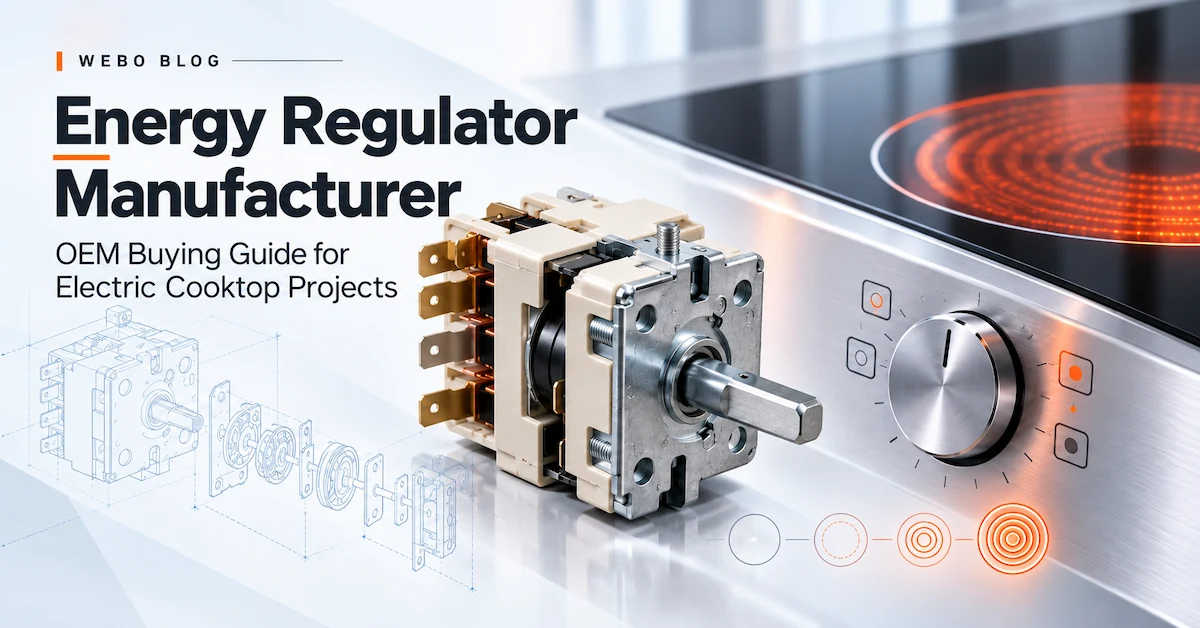
WEBO includes Energy Regulator among its heating and kitchen appliance components. Buyers can explore the WEBO appliance component portfolio to understand the related product categories available for sourcing discussions.
What Should a Professional Energy Regulator Supplier Actually Provide?
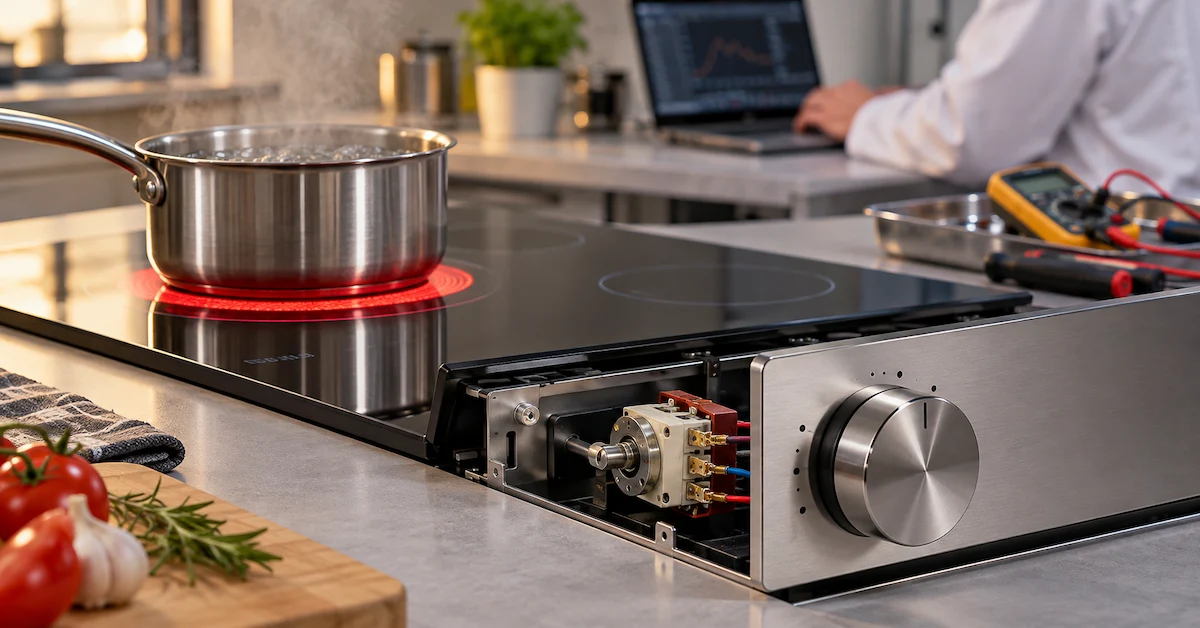
An energy regulator supplier provides components used to control the electrical energy delivered to suitable heating loads.
For electric cooking appliances, conventional mechanical energy regulators are commonly associated with adjustable, cyclic power delivery to resistive heating elements.
They may also be referred to as infinite switches or simmerstats, depending on the market and product design.
However, supplying the component itself is only one part of a successful B2B relationship.
Product Selection Support
The supplier should be able to evaluate whether an available regulator is suitable for the buyer's application.
This requires more than asking for the number of units.
Useful technical questions include:
-
What appliance will use the regulator?
-
What heating element is connected?
-
What are the electrical supply and load characteristics?
-
What control behavior is required?
-
Is the project a new design or a replacement application?
-
Are there fixed shaft, terminal, or mounting requirements?
A supplier that asks relevant engineering questions before quoting is better positioned to identify compatibility risks.
Technical Documentation
Reliable product identification requires controlled information.
Depending on the product, buyers may need:
-
technical datasheets;
-
electrical connection diagrams;
-
installation drawings;
-
product identification;
-
applicable ratings;
-
available test information;
-
and compliance documents.
These documents help purchasing teams avoid selecting products based on photographs or incomplete catalog descriptions.
Sample and Qualification Support
For OEM projects, buyers should expect to evaluate samples before production approval.
Sample evaluation may include electrical operation, mounting, knob fit, terminal connections, control behavior, and integration with the heating element.
Bulk Supply and Replenishment
Distributors and manufacturers often require the same approved component over an extended period.
A dependable supplier should be able to discuss production planning, order forecasts, model continuity, packaging, and change control.
The key question is whether the supplier can support the buyer after the first successful shipment.
Energy Regulator Manufacturer vs Supplier vs Distributor: Which Should You Choose?
The words manufacturer, supplier, and distributor are often used interchangeably in online searches.
However, they describe different business relationships.
Understanding these differences helps buyers choose a suitable sourcing channel.
| Sourcing Channel | Primary Strength | Potential Limitation | Best-Fit Buyer |
|---|---|---|---|
| Direct manufacturer | Engineering and production communication | Commercial flexibility varies by factory | OEMs and large repeat orders |
| Manufacturer-backed supplier | Product supply with access to production resources | Technical scope must be verified | OEMs, brands, importers |
| Specialist component distributor | Existing models and inventory management | Customization may be limited | Replacement-parts buyers |
| General trading company | Multiple product categories and sourcing coordination | Technical information may depend on third parties | Mixed-component importers |
| Authorized replacement-parts channel | Model-specific replacement support | Limited customization and product scope | Repair networks and service operations |
When Direct Manufacturing Access Matters
For a new electric stove design, the buyer may need to review electrical compatibility, shaft geometry, terminal layout, and appliance-level performance.
Direct access to the component manufacturer's technical team can simplify these discussions.
It can also help when sample modifications or production changes are involved.
However, buyers should not assume that every company describing itself as a manufacturer offers the same engineering capabilities.
Request evidence for the exact product line.
When a Distributor Makes More Sense
A repair-parts distributor may be the most practical source when the buyer needs a small quantity of an established replacement model.
In this situation, inventory availability, verified interchangeability, and product identification may matter more than custom engineering.
When a Manufacturer-Backed Supplier Is Valuable
Some buyers want both access to manufacturing capabilities and coordinated export supply.
A manufacturer-backed supplier may be useful when purchasing several appliance components under one commercial relationship.
The buyer should still confirm which products are manufactured directly, which are sourced through partners, and who is responsible for technical verification and quality claims.
Supplier type alone does not prove supplier quality. The supplier's documented responsibilities and demonstrated performance are more important.
Which Applications Need an Energy Regulator Supplier?
Energy regulators are relevant to several categories of electrical heating equipment, but one model should not be assumed suitable for every application.
Electric Solid Hot Plate Appliances
Portable electric stoves and solid hot plate cookers are common applications for adjustable power-control components.
The regulator needs to be compatible with the heating element and appliance circuit.
Relevant considerations include electrical rating, control characteristics, mounting, terminals, and thermal conditions.
An OEM project may involve several components working together.
For example, selecting an appropriate electric hot plate for an OEM cooker is only one part of the design. The associated control component must also be qualified for the intended heating system.
Radiant Electric Cooktops
Radiant cooking appliances use electrical heating elements beneath a suitable cooking surface.
Depending on the appliance architecture, a power-control component may form part of the heating-zone control system.
Buyers should verify the electrical load, required control behavior, and relationship with temperature-limiting devices.
A component suitable for one heating zone should not automatically be used in a different configuration.
Electric Grills and Warming Equipment
Some resistive-heating appliances require adjustable average power rather than precise closed-loop temperature control.
A suitable energy regulator may be considered where its operating principle and electrical rating match the application.
Commercial equipment may have different duty cycles, environmental conditions, and safety requirements from household equipment.
These differences must be reviewed before purchasing.
Replacement and Aftermarket Programs
Replacement-parts importers often manage multiple appliance brands and component models.
For these buyers, product interchangeability is a major concern.
A replacement may look identical while having a different electrical configuration or control characteristic.
Model-level verification is essential.
Applications That May Require a Different Control Solution
A conventional mechanical energy regulator is not automatically appropriate for every heating system.
For example:
-
induction cooking requires compatible electronic power conversion and control;
-
precision temperature-controlled equipment may require feedback from a temperature sensor;
-
equipment with unusual electrical loads may require a different switching or control architecture;
-
safety-limiting functions must be evaluated separately from ordinary user power adjustment.
The final application should determine the control strategy.
How to Confirm Energy Regulator Compatibility Before Buying
One of the greatest risks in component sourcing is assuming that a familiar-looking product will function correctly in another appliance.
Energy regulator compatibility should be evaluated across several independent dimensions.
Electrical Rating and Load Compatibility
The supplier needs to confirm the component's suitability for the appliance's electrical conditions.
Buyers should identify:
-
nominal supply voltage;
-
AC or DC operation;
-
supply frequency where relevant;
-
heating-element rated power;
-
operating current;
-
load type;
-
and circuit configuration.
For simple resistive loads, electrical relationships can help engineers estimate operating current.
However, nominal calculations alone do not establish the suitability of the switching contacts.
The proposed regulator must be evaluated according to its manufacturer-defined ratings and application conditions.
Control Characteristics
Conventional mechanical energy regulators may vary average power by repeatedly switching a resistive heating load on and off.
Different designs can have different operating characteristics.
The buyer should confirm:
-
intended adjustment behavior;
-
OFF-state operation;
-
low-setting behavior;
-
high-setting behavior;
-
any continuous-output position;
-
and specified operating conditions.
The control knob position should not be interpreted as a guaranteed cooking-surface temperature.
Mechanical and Knob Compatibility
An otherwise suitable regulator can become unusable if it does not fit the appliance.
Check:
-
shaft length;
-
shaft diameter;
-
shaft profile;
-
shaft orientation;
-
mounting dimensions;
-
available installation space;
-
and control-panel alignment.
These details matter particularly when a manufacturer is replacing an existing component without redesigning the front panel.
Terminal and Wiring Compatibility
Terminal layout must be checked carefully.
A replacement regulator should not be accepted merely because it has the same number of terminals.
The connection diagram, terminal identification, terminal dimensions, and harness arrangement must be compatible with the appliance.
Incorrect assumptions can cause equipment damage or unsafe operation.
Environmental Compatibility
The regulator's installation environment may include elevated temperatures, restricted ventilation, vibration, or exposure to cooking vapors.
A supplier should know where the component will be installed.
The appliance manufacturer should verify the component under representative operating conditions.
Energy Regulator Supplier Specification Comparison Table
The following matrix can be used when comparing products from several suppliers.
| Technical Item | Buyer Requirement | Supplier Evidence Needed | Purchasing Risk |
|---|---|---|---|
| Product model | Correct regulator type | Controlled model identification | Wrong component supplied |
| Rated voltage | Matches appliance design | Datasheet and applicable rating | Electrical incompatibility |
| Load suitability | Appropriate for heating circuit | Rating and application information | Contact stress or failure |
| Control behavior | Matches intended user settings | Functional specification or test data | Unsatisfactory heating response |
| OFF-state function | Meets circuit requirements | Connection diagram and verification | Incorrect switching behavior |
| Shaft geometry | Fits existing knob | Dimensional drawing | Assembly rejection |
| Mounting | Fits enclosure | Mounting drawing | Installation interference |
| Terminal arrangement | Matches harness | Terminal drawing and circuit diagram | Wiring incompatibility |
| Operating environment | Suitable for installation | Environmental limitations | Reduced reliability |
| Endurance | Meets project requirement | Defined test method and results | Premature failure risk |
| Compliance | Meets target-market requirements | Model-specific documentation | Market-entry complications |
| Traceability | Identifiable batches | Labeling and records | Difficult defect investigation |
A supplier should be evaluated against this complete requirement set rather than one attractive specification.
Why Matching an Existing Part Number Is Not Enough
Replacement sourcing is one of the most difficult areas of appliance-component procurement.
An importer may receive a request such as:
“We need an equivalent energy regulator for this stove model.”
The customer might supply only a photograph or a number printed on the component.
That information may help identify possible candidates, but it may not establish equivalence.
Part Numbers Can Refer to Different Variants
Related products sometimes share similar housings or numbering patterns.
However, different variants may have different:
-
electrical ratings;
-
terminal arrangements;
-
control characteristics;
-
mounting features;
-
shaft lengths;
-
or approved applications.
A part-number cross-reference should therefore be treated as a starting point rather than the final approval decision.
Physical Similarity Does Not Prove Functional Equivalence
Two products may fit the same panel opening but behave differently when connected to a heating load.
For example, low-setting performance may differ because of the regulator's internal operating characteristics.
A replacement may also use a different terminal arrangement.
Such differences may not be visible in a catalog photograph.
Build a Controlled Replacement Record
For repeat purchasing, maintain a record containing:
-
original manufacturer and model;
-
proposed replacement model;
-
electrical ratings;
-
control-function comparison;
-
wiring diagram;
-
dimensional comparison;
-
approved appliance application;
-
qualification results;
-
and replacement approval date.
This document provides far greater value than an informal note saying “compatible with Model X.”
Red Flags in Replacement Sourcing
Be cautious when a supplier:
-
claims universal compatibility without evidence;
-
provides no connection diagram;
-
cannot identify the applicable electrical rating;
-
relies exclusively on photographs;
-
refuses to clarify model differences;
-
or substitutes another model without approval.
Interchangeability must be demonstrated, not assumed.
A Practical 10-Point Checklist for Qualifying Energy Regulator Suppliers
Before issuing a substantial purchase order, use the following qualification framework.
1. Verify Product Knowledge
The supplier should understand the intended appliance and control application.
Ask why the proposed regulator is appropriate.
A technically competent response should consider electrical loading, control function, mounting, and installation requirements.
2. Confirm Product Identification
Every quoted component should have a clearly identifiable model or controlled specification.
Ambiguous product descriptions are unsuitable for long-term OEM purchasing.
3. Review Technical Documentation
Request the available datasheet, electrical diagram, and dimensional information.
If documentation is incomplete, identify the missing items before sample approval.
4. Assess Sample Availability
Ask whether representative samples are available and how they correspond with the eventual production specification.
The supplier should distinguish existing inventory from samples requiring development.
5. Evaluate Quality Control
Ask what is inspected during production.
The answer should address relevant critical characteristics rather than simply stating that quality is guaranteed.
6. Check Testing Capability
Determine whether the supplier can provide evidence for the electrical and mechanical tests relevant to the proposed component.
Testing claims should identify the test conditions and acceptance criteria.
7. Verify Compliance Documentation
Request applicable documents for the exact model and target market.
Do not assume that company-level certifications cover every energy regulator.
8. Confirm Production and Inventory Capability
Ask whether the supplier can support the forecast volume.
If a model is manufactured through another company, clarify who controls production quality and supply continuity.
9. Evaluate Communication and Change Control
Technical questions and product changes should be documented.
Ask whether the supplier will notify you before introducing changes affecting approved characteristics.
10. Review After-Sales and Commercial Responsibilities
Clarify how nonconforming shipments, quality complaints, replacement orders, and delivery issues are handled.
These responsibilities should be agreed before a large order is placed.
How to Score and Compare Energy Regulator Suppliers
Procurement teams can improve decision-making by using a weighted scorecard.
The following is a proposed purchasing framework, not an official industry rating system.
| Supplier Evaluation Area | Suggested Weight | What to Evaluate |
|---|---|---|
| Product compatibility | 20% | Electrical, control and mechanical fit |
| Technical documentation | 15% | Datasheets, drawings and model clarity |
| Quality assurance | 15% | Inspection, testing and traceability |
| Supply stability | 15% | Capacity, replenishment and continuity |
| Compliance evidence | 10% | Relevant model-specific documents |
| Commercial competitiveness | 10% | Comparable price and purchasing terms |
| Engineering communication | 10% | Technical responses and change management |
| Packaging and logistics | 5% | Identification, protection and shipment support |
| Total | 100% | Overall supplier suitability |
Establish Mandatory Acceptance Conditions
Not every purchasing issue can be balanced against a lower price.
Certain requirements should be treated as mandatory.
For example, a supplier should not pass qualification if the proposed regulator cannot meet an essential electrical requirement.
Similarly, an unacceptable safety or compliance gap should not be offset by strong delivery performance.
Use two stages:
Stage 1 — Mandatory qualification: Confirm essential product compatibility, safety requirements, and critical documentation.
Stage 2 — Commercial comparison: Compare suppliers that have passed the mandatory technical requirements.
This approach prevents a high overall score from hiding a serious product risk.
Avoid False Precision
A supplier receiving 88 points instead of 84 points does not automatically guarantee better real-world performance.
Scores should support engineering judgment, not replace it.
Document the evidence behind each assessment and revisit the score after sample testing or actual deliveries.
What Quality Documents Should You Request From an Energy Regulator Supplier?
A supplier qualification file should contain enough information to support technical approval and future purchasing decisions.
The exact document package depends on the application and commercial arrangement.
Basic Technical Documents
Useful documents include:
-
product datasheet;
-
model or specification code;
-
electrical rating information;
-
connection diagram;
-
mechanical drawing;
-
installation requirements;
-
available application limitations.
Qualification Documents
Depending on the project, buyers may request:
-
relevant test reports;
-
endurance-test evidence;
-
material information;
-
insulation-related test information;
-
and product-specific compliance documents.
Production Quality Documents
For significant repeat orders, consider requesting:
-
inspection requirements;
-
traceability approach;
-
sample approval record;
-
revision identification;
-
and agreed change-notification procedures.
Commercial Documents
These may include:
-
quotation;
-
MOQ;
-
sample terms;
-
production lead time;
-
packaging specification;
-
delivery terms;
-
and quality-claim arrangements.
The purpose is not to collect paperwork unnecessarily.
Each document should help answer a real procurement question.
Certification Requirements for Energy Regulator Sourcing
Compliance documentation is particularly important when energy regulators are used in appliances sold across international markets.
One relevant international standard is IEC 60730-2-11:2025, Automatic Electrical Controls — Part 2-11: Particular Requirements for Energy Regulators.
This standard addresses relevant construction, operation, and safety requirements for energy regulators within its scope.
At the finished-appliance level, IEC 60335-2-6:2024 concerns particular safety requirements for stationary household electric cooking ranges, hobs, ovens, and similar appliances.
Other appliance categories may require different particular standards.
Confirm Which Standard Applies
The appropriate standard depends on:
-
regulator function;
-
product construction;
-
appliance category;
-
target market;
-
and the applicable regulatory framework.
A standard being relevant to a product category does not prove that a specific component has been tested or approved to that standard.
Request Model-Specific Evidence
Buyers should confirm:
-
certificate or report identification;
-
covered model;
-
applicable ratings;
-
issuing organization where relevant;
-
current validity;
-
and any limitations affecting the proposed application.
Understand Different Compliance Claims
Terms such as UL, VDE, TÜV, CE, and RoHS should not be treated as interchangeable.
They relate to different certification, assessment, or regulatory contexts.
A company holding an ISO management-system certification does not automatically establish product approval.
For customized components, buyers should also determine whether a modification affects the validity of existing certification or test evidence.
The final appliance manufacturer remains responsible for confirming the complete appliance's compliance with applicable requirements.
How to Validate Energy Regulator Samples Before Bulk Purchasing
Sample approval should be a structured process, not simply a visual inspection.
A regulator that looks acceptable may still have unsuitable electrical or control characteristics.
Step 1: Identify the Exact Sample
Record the model, supplier, version, and available technical documents.
Where several candidates are being evaluated, identify each sample separately.
Step 2: Review Dimensions and Installation
Check the agreed critical dimensions, including:
-
shaft;
-
mounting interface;
-
housing envelope;
-
terminal arrangement;
-
and required assembly clearances.
The component should fit the appliance without unapproved modifications.
Step 3: Confirm Electrical Connections
Compare the supplier's connection diagram with the appliance design.
Terminal numbering and function must be understood before installation.
Step 4: Verify Functional Operation
Qualified engineering personnel should evaluate whether the regulator provides the intended electrical behavior under defined conditions.
For a conventional cycling regulator, this may include reviewing output behavior at selected settings.
Step 5: Test in the Actual Appliance
The sample should be installed in a representative finished appliance or approved engineering test assembly.
Review:
-
OFF-state performance;
-
low-setting behavior;
-
intermediate settings;
-
maximum-output behavior;
-
knob operation;
-
temperature conditions;
-
and interaction with protective components.
Step 6: Evaluate Endurance Requirements
The buyer and supplier should agree on the endurance evidence necessary for qualification.
A claimed number of operating cycles is not meaningful without the associated test conditions.
Step 7: Record Results and Deviations
Document whether the sample passed.
If it fails, identify the deviation, correction, and need for further testing.
Step 8: Approve a Golden Sample
Once the sample meets the agreed requirements, retain a controlled reference linked to the approved specification.
This becomes an important basis for future production comparisons.
Sample Approval Matrix for OEM Buyers
| Evaluation | Acceptance Question | Evidence |
|---|---|---|
| Identification | Is the model clearly identified? | Model record |
| Dimensions | Does it fit the appliance? | Inspection results |
| Shaft and knob | Does the interface align and operate properly? | Assembly evaluation |
| Wiring | Do terminal functions match the circuit? | Connection verification |
| OFF operation | Does the required OFF function work? | Functional test |
| Power-control behavior | Is heating response acceptable? | Appliance-level evaluation |
| Thermal suitability | Are installed conditions acceptable? | Thermal test results |
| Endurance | Does it meet agreed performance requirements? | Qualification evidence |
| Documentation | Are applicable requirements traceable? | Technical file |
| Approval | Is the final specification frozen? | Signed approval record |
This table can be used as an internal approval checklist.
It should be adapted to the actual appliance and should not be treated as a substitute for required safety testing.
How to Check Supplier Quality Control and Batch Consistency
A successful sample does not automatically guarantee stable mass production.
For repeat OEM orders, buyers should understand how the supplier controls manufacturing variation.
Incoming Material Control
Depending on the design, important components may include insulating housings, metallic contacts, springs, shafts, terminals, and bimetallic mechanisms.
The supplier should have appropriate controls for components affecting electrical or mechanical performance.
In-Process Inspection
Relevant process controls may involve:
-
assembly accuracy;
-
critical mechanical positioning;
-
electrical connections;
-
operating mechanism adjustment;
-
and identification of the intended product configuration.
Final Functional Inspection
The outgoing inspection plan should cover critical characteristics appropriate to the approved product.
For example, it may address OFF-state behavior, terminal configuration, mechanical operation, and other specified electrical functions.
Batch Traceability
A supplier should be able to identify relevant production batches.
Useful traceability information may include:
-
part number;
-
revision;
-
manufacturing lot;
-
production date or lot code;
-
and inspection record references.
The appropriate traceability depth depends on the buyer's risk requirements.
Change Control
Ask whether the supplier will notify you before making changes to approved characteristics.
Relevant changes may affect materials, internal components, tooling, terminal construction, or manufacturing methods.
A product should not change silently while retaining the same approved commercial identification.
How to Manage MOQ, Lead Time, and Production Planning
Commercial planning becomes important once the regulator has passed technical qualification.
For long-term procurement, the supplier should understand the buyer's demand pattern.
Minimum Order Quantity
MOQ may depend on the model, manufacturing process, material availability, customization requirements, and commercial conditions.
Rather than assuming a universal MOQ, buyers should ask for the minimum quantity associated with the exact proposed specification.
If the supplier offers several quantity levels, compare prices under the same technical requirements.
Sample Lead Time
Ask when the sample timeline begins.
For example, is the timeline measured from initial inquiry, receipt of the existing sample, approval of the drawing, or confirmation of commercial terms?
A clear starting point makes the schedule more meaningful.
Production Lead Time
Production lead time may depend on:
-
material availability;
-
current production loading;
-
order volume;
-
custom requirements;
-
qualification status;
-
and inspection or documentation requirements.
A supplier should confirm lead time for the actual order rather than relying only on a generic website statement.
Forecast and Replenishment Planning
For repeat orders, provide an expected purchasing forecast.
Separate firm purchase commitments from nonbinding forecasts.
If demand fluctuates seasonally, discuss how the supplier manages production planning and inventory.
Emergency Supply
Ask what happens if demand increases unexpectedly.
Possible arrangements might involve reserved inventory, production scheduling, or agreed safety-stock planning, where commercially available.
Do not assume the supplier provides these services without confirmation.
What Should Be Included in a Bulk Energy Regulator Purchase Agreement?
A commercial agreement should make the technical and supply responsibilities clear.
Important items include the following.
Approved Product Specification
Reference the exact part number, drawing, revision, and agreed quality requirements.
A description such as “energy regulator, standard type” is not sufficient for a controlled OEM program.
Pricing and Currency
Specify the unit price, currency, quantity basis, and quotation validity.
Tooling and Customization
Where tooling is required, clarify ownership, maintenance, revision responsibilities, and any associated charges.
Delivery Terms
Agree on the applicable Incoterm and shipment location.
The Incoterm should be consistent with the buyer's logistics plan and commercial responsibilities.
Packaging and Identification
Define carton quantities, protective packaging, product labels, and traceability requirements.
Quality Acceptance
Specify the agreed inspection and acceptance process.
Nonconforming Product Handling
Clarify how suspected defects are reported, investigated, and resolved.
Engineering Changes
Establish requirements for notifying and approving changes that affect the accepted specification.
Repeat-Order Continuity
Discuss how the supplier will manage product availability, revisions, and potential discontinuation.
These items protect both the buyer and the supplier by reducing ambiguity.
How Should Importers and Distributors Manage Energy Regulator Inventory?
Wholesale distributors face a different set of purchasing challenges from appliance OEMs.
An OEM may require one approved regulator for a large production program.
A distributor may need multiple models serving different appliances and regional markets.
Build a Controlled SKU Database
Each stock-keeping unit should have enough information to identify the correct application.
A useful record can contain:
-
supplier;
-
supplier part number;
-
internal SKU;
-
approved cross-reference;
-
technical specification;
-
supported appliance applications;
-
packaging;
-
and current revision.
Avoid Combining Unverified Replacements
Do not place components with different characteristics under one SKU simply because they appear interchangeable.
Where alternatives have been qualified, maintain the evidence supporting the equivalence.
Maintain Lot Traceability
Traceability helps distributors investigate complaints and identify affected shipments.
Plan Packaging for International Shipping
Small electrical components can still be damaged by inadequate protection.
Packaging requirements should consider terminal deformation, mechanical impact, moisture exposure, and product identification.
Prepare Technical Information for Customers
A distributor can reduce incorrect orders by providing accurate technical information.
This is especially valuable for maintenance companies and repair networks managing many appliance models.
Comparing Quotations: Look Beyond Unit Price
An energy regulator quotation should be evaluated against the complete purchasing requirement.
A supplier offering a lower unit price may not necessarily provide lower total procurement cost.
What Is Total Cost of Ownership?
For a component sourcing project, total cost can include:
Component purchase cost + Tooling and qualification + Freight and import expenses + Inventory carrying cost + Inspection and quality costs + Expected failure-related costs
Not every category will apply to every project.
The purpose is to understand which expenses change when selecting a different supplier.
Example: Why Low Price Can Become Expensive
Consider two suppliers offering components that appear commercially similar.
Supplier A provides a lower unit price but incomplete technical documentation.
Supplier B offers a higher initial quotation but provides complete product identification, controlled drawings, and qualification support.
If Supplier A's product fails compatibility testing, the buyer may incur additional sample costs, engineering work, and schedule delays.
Supplier B is not automatically the better choice, but the comparison should include these differences.
The correct decision depends on verified performance and the full cost of the project.
Normalize Every Quotation
Before comparing prices, confirm that suppliers are quoting the same:
-
electrical configuration;
-
mechanical specification;
-
quality requirements;
-
documentation;
-
packaging;
-
quantity;
-
and delivery terms.
Without an equivalent technical scope, a price comparison can be misleading.
Common Mistakes When Choosing an Energy Regulator Supplier
Several recurring purchasing mistakes can be prevented through a disciplined qualification process.
Selecting Only From a Product Photograph
External appearance cannot prove electrical or functional compatibility.
Better approach: Request model-specific documentation and verify the actual application.
Treating Every Energy Regulator as Interchangeable
Different regulator designs may have different electrical ratings or operating characteristics.
Better approach: Qualify proposed substitutes using the appliance requirements.
Ignoring the Heating Element
The regulator and heating element operate as part of the same system.
Better approach: Review electrical loading and validate the complete appliance.
Skipping Sample Testing
Directly ordering a large batch can expose the buyer to avoidable integration problems.
Better approach: Establish sample acceptance criteria before production purchasing.
Assuming Certification Coverage
A supplier's company certificate does not automatically apply to every product model.
Better approach: Request evidence covering the exact component.
Focusing Only on MOQ and Price
Low prices do not compensate for incompatible products or uncontrolled quality.
Better approach: Compare qualification, manufacturing stability, and total procurement cost.
Failing to Control Repeat Orders
An acceptable first shipment does not guarantee identical future production.
Better approach: Maintain approved specifications, golden samples, revision control, and traceability.
Overlooking Packaging and Labels
Incorrect identification can cause shipment or warehouse errors even when the component itself is acceptable.
Better approach: Approve packaging and labeling before mass shipment.
Why Consider WEBO for Energy Regulator Sourcing?
GUANGDONG WEBO TECHNOLOGY CO., LTD is a China-based heating and appliance-component supplier established in 1998.
According to the company's About Us page, WEBO serves customers across international markets and has a manufacturing background in heating-related products.
Its current product categories include:
-
Hot Plate
-
Ceramic Heater
-
Tube Heating Element
-
Cast Iron Pan Support
-
Induction Coil
-
Ceramic Glass
-
Rotary Switch
-
Energy Regulator
This product portfolio is relevant to appliance manufacturers sourcing both heating and associated control components.
For example, a company developing an electric hot plate appliance may need to evaluate the heating plate, regulator, wiring interfaces, and appliance assembly together.
WEBO's broader heating-component content discusses the importance of product selection, specification review, quality control, OEM cooperation, and repeat-order stability.
Buyers can refer to the WEBO heating element supplier guide for related supplier-evaluation considerations.
What Should Buyers Confirm With WEBO?
WEBO lists Energy Regulator as a product category, but available public information should not be interpreted as confirmation of every technical specification or service.
For an actual inquiry, buyers should request confirmation of:
-
available regulator models;
-
electrical ratings;
-
control characteristics;
-
terminal diagrams;
-
dimensional drawings;
-
available customization;
-
sample arrangements;
-
product-specific testing information;
-
applicable compliance documentation;
-
MOQ;
-
lead time;
-
packaging options;
-
and repeat-order support.
This establishes a more reliable basis for cooperation than relying on generic product descriptions.
Energy Regulator RFQ Template for OEMs, Importers, and Wholesale Buyers
A well-prepared request for quotation helps the supplier identify the correct component and provide a meaningful commercial offer.
The following information can be included in your inquiry.
Buyer and Project Information
Company name:
[Your company]
Country / target market:
[Destination]
Buyer type:
Appliance OEM / Brand / Importer / Distributor / Replacement-parts supplier
Project type:
New development / Existing model replacement / Second-source qualification / Bulk wholesale
Appliance Application
Appliance type:
Electric cooktop / Solid hot plate cooker / Radiant hob / Electric grill / Other heating appliance
Connected heating element:
[Type and available specifications]
Required function:
[Description of expected power-control behavior]
Electrical Requirements
Nominal voltage:
[Required value]
Supply frequency:
[If applicable]
Heating load:
[Rated power and relevant current information]
Circuit diagram:
[Attached / Available on request]
Mechanical Requirements
Existing regulator model:
[Part number if available]
Existing sample:
[Yes / No]
Shaft dimensions:
[Drawing attached]
Mounting dimensions:
[Drawing attached]
Terminal arrangement:
[Diagram or sample attached]
Quality and Compliance
Required test information:
[Project-specific requirements]
Target-market compliance:
[Applicable requirements]
Traceability requirements:
[Lot code, labeling, etc.]
Purchasing Information
Sample quantity:
[Quantity]
Trial-order quantity:
[Quantity]
Estimated annual demand:
[Quantity]
Target delivery schedule:
[Date or period]
Packaging:
[Bulk carton / Custom label / Other]
Preferred delivery terms:
[Agreed Incoterm and location]
Additional requirements:
[Other project information]
Providing this information allows the supplier to distinguish between a standard inventory inquiry and an application requiring technical evaluation or customization.
If you are preparing a new project, you can submit your energy regulator sourcing requirements to WEBO for confirmation of available models, specifications, and quotation conditions.
Frequently Asked Questions About Energy Regulator Suppliers
1. What should I look for in an energy regulator supplier?
Look for a supplier that can identify the correct product, explain its electrical and mechanical characteristics, provide relevant documentation, support sample evaluation, maintain consistent quality, and communicate clearly about MOQ, lead time, and repeat orders.
A low unit price should not substitute for technical compatibility.
For OEM buyers, product-specific evidence is more valuable than general claims of manufacturing experience.
2. What information does a supplier need to recommend an energy regulator?
The supplier should know the appliance application, connected heating element, electrical supply, load requirements, required control behavior, mounting arrangement, shaft dimensions, and terminal configuration.
An existing part number or physical sample can help identify potential replacements.
For a custom application, circuit information and assembly drawings are especially useful.
3. Can I buy energy regulators in wholesale quantities?
Wholesale procurement may be available depending on the supplier and product model.
Buyers should confirm available specifications, MOQ, quantity-based pricing, packaging, production capacity, and replenishment arrangements.
For repeat orders, it is important to define product identification and quality requirements so future shipments remain consistent with the approved component.
4. How do I know whether two energy regulators are interchangeable?
Compare the exact electrical ratings, control characteristics, connection diagrams, terminals, shaft, mounting, and application requirements.
Physical appearance alone is insufficient.
Where appropriate, the replacement should undergo component-level and appliance-level qualification before approval.
Any claimed cross-reference should be supported by reliable technical evidence.
5. Is an energy regulator the same as a rotary switch?
Not necessarily.
A rotary selector switch generally connects or selects defined electrical circuits.
A conventional mechanical energy regulator can vary the average power delivered to a suitable resistive load by cyclic switching.
The correct component depends on the appliance's electrical function.
Similar knobs or housings do not establish functional equivalence.
6. What is the normal MOQ for an energy regulator supplier?
There is no universal MOQ applicable to every supplier or regulator.
MOQ depends on the selected model, available inventory, customization, production arrangements, and commercial terms.
Standard stock items may have different minimum quantities from customized components.
Buyers should provide sample, trial-order, and forecast quantities when requesting a quotation.
7. How can I verify an energy regulator supplier's quality control?
Ask for information about product identification, incoming component checks, critical dimensional inspection, functional verification, production traceability, and relevant qualification testing.
The supplier should be able to explain what is checked and how conformity is determined.
For substantial OEM programs, quality requirements should be documented and linked to the approved specification.
8. Which standards are relevant when sourcing energy regulators?
IEC 60730-2-11 addresses particular requirements for energy regulators within its scope.
The final appliance may also be subject to relevant appliance safety standards, such as applicable parts of the IEC 60335 series.
Specific requirements depend on the regulator, appliance, destination market, and regulatory framework.
A standard being relevant does not prove that a particular supplier's product has been certified to it.
9. Can energy regulators be customized for an OEM project?
Customization may be possible depending on the manufacturer's product platform and engineering capabilities.
Potential requirements can include shaft geometry, terminals, mounting, and other application-specific features.
Changes affecting electrical performance or safety may require additional development and qualification.
Buyers should confirm feasibility, tooling, sample costs, testing, and production terms before approving customization.
10. How can I reduce risk when importing energy regulators from China?
Begin with verified technical requirements and supplier qualification.
Request representative samples, confirm compliance documentation, evaluate product performance in the actual appliance, and agree on inspection and traceability requirements.
Before bulk orders, clarify MOQ, production lead time, packaging, delivery terms, and how quality problems will be handled.
A controlled specification and clear communication can help prevent costly procurement mistakes.
11. Can an energy regulator supplier provide replacement parts for older appliances?
Some suppliers may support existing models or compatible replacements, but availability must be confirmed.
Older appliance components can present challenges related to discontinued designs, incomplete documentation, and changes in product construction.
Buyers should provide the original model identification, sample, wiring information, and application details.
Any replacement should be technically verified before use.
12. Why do energy regulator prices vary between suppliers?
Prices can differ because of construction, component specifications, order volume, customization, testing requirements, documentation, packaging, and commercial terms.
Two quoted products may not be technically equivalent.
For a reliable comparison, buyers should ensure the quotation covers the same approved specification and required services.
13. What should I do if a supplier changes the energy regulator model after sample approval?
Do not approve the substitution automatically.
Request the revised technical documentation and a clear explanation of the differences.
Determine whether electrical, control, mechanical, compliance, or production requirements are affected.
Where necessary, obtain new samples and repeat the applicable qualification tests.
Changes should be documented before acceptance.
14. How can distributors reduce incorrect energy regulator orders?
Maintain accurate SKU records, model references, application information, and controlled replacement cross-references.
Provide customers with enough technical information to identify the correct part.
Avoid grouping visually similar but technically different products under one SKU.
Consistent labels and traceable shipment records also help reduce inventory and fulfillment errors.
15. How can I request an energy regulator quotation from WEBO?
Prepare the appliance application, heating-element information, existing regulator model or sample, electrical requirements, wiring diagram, mechanical dimensions, required quantity, and destination market.
Then use the WEBO contact page to submit your project information and confirm available products, technical documentation, sample arrangements, and commercial terms.
Conclusion
Choosing a dependable energy regulator supplier requires more than competitive pricing. OEM manufacturers and wholesale buyers should prioritize verified electrical compatibility, model-specific documentation, sample approval, consistent quality control, and reliable repeat-order supply.
For electric cooktop and heating appliance projects, a controlled RFQ and supplier qualification process can reduce incorrect purchasing decisions, assembly problems, and after-sales risks.
WEBO offers a wider portfolio of heating and kitchen appliance components that includes energy regulators. To discuss available models, technical requirements, samples, or bulk-order quotations, contact WEBO with your project specifications.