


How to Choose an Energy Regulator Manufacturer for Electric Cooktop OEM Projects
Choosing the right energy regulator manufacturer is an important sourcing decision for electric cooktop manufacturers, appliance brands, heating equipment developers, and OEM procurement teams.
An energy regulator may be relatively small compared with the heating element it controls, but its behavior influences how the appliance responds to the user. Incompatible electrical ratings, incorrect switching characteristics, poor terminal connections, or inconsistent mechanical operation can result in unstable heating, assembly problems, premature component failure, and increased after-sales costs.
For manufacturers developing electric stoves, solid hot plate cookers, radiant ceramic hobs, and other resistance-heating appliances, selecting an energy regulator requires a clear understanding of both the component and the complete heating system.
A suitable manufacturer should help buyers evaluate three fundamental requirements:
-
Electrical compatibility: Can the regulator control the intended heating load under the appliance's actual operating conditions?
-
Mechanical compatibility: Will the regulator fit the control panel, knob, mounting structure, wiring arrangement, and available installation space?
-
Production reliability: Can the approved design be manufactured, inspected, and supplied consistently across production batches?
These requirements matter more than whether two regulators look identical or share a similar part number.
For example, a manufacturer developing a portable electric stove may already have an approved hot plate and enclosure design. However, selecting a different regulator without reviewing its electrical rating, control characteristics, shaft geometry, and terminal layout could require changes to the appliance wiring or user interface.
A well-defined sourcing process helps avoid these complications before production begins.
WEBO includes energy regulators within its wider portfolio of heating and kitchen appliance components. Buyers can explore the WEBO product portfolio to understand the related product categories available for appliance development.
This guide explains how energy regulators work, which technical specifications matter, how to compare manufacturers, what to test before mass production, and how to prepare a professional OEM inquiry.
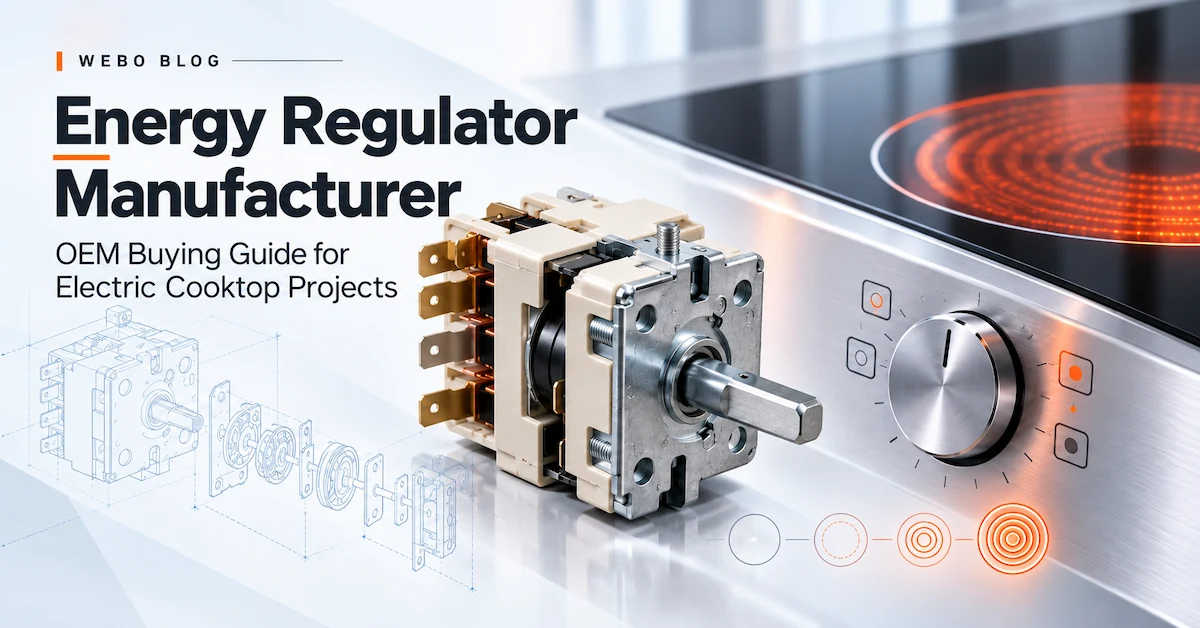
What Is an Energy Regulator in an Electric Appliance?
An energy regulator is a control component used to adjust the average electrical power delivered to a heating load.
In many conventional electric cooking appliances, a mechanical energy regulator operates by repeatedly connecting and disconnecting electrical power to a resistive heating element.
The user turns a control knob to select a heating level. Depending on the regulator's internal design, that setting changes the relationship between the periods when the heating element receives power and the periods when power is interrupted.
The result is an adjustable average heating output.
Energy regulators used for this purpose are also commonly associated with terms such as:
-
Infinite switch
-
Summer state
-
Electric stove energy regulator
-
Electric hob power regulator
-
Heating element power controller
-
Cooktop energy control switch
-
Bimetallic energy regulator
These terms are often used in related markets, although the exact construction and operating characteristics may differ between products.
For OEM buyers, the important distinction is that an energy regulator is not necessarily a temperature sensor or a closed-loop thermostat.
A conventional mechanical energy regulator can control the average energy delivered to a heating element without directly measuring cookware temperature.
This difference affects component selection, testing, and appliance performance.
How Does a Mechanical Energy Regulator Work?
Understanding the operating principle helps purchasing teams communicate more effectively with manufacturers.
Many mechanical energy regulators for resistive cooking loads use a combination of:
-
a rotary control shaft;
-
a mechanical adjustment mechanism;
-
a heated bimetallic element;
-
a contact mechanism;
-
electrical terminals;
-
and an insulating housing.
The control system is designed to produce repeated electrical switching according to the selected setting.
The Role of the Bimetallic Element
A bimetallic strip consists of bonded metals with different thermal expansion characteristics.
When heated, the strip bends because the metals expand at different rates.
In a conventional bimetallic energy regulator, this movement helps operate a switching mechanism.
As the internal heated element warms, the bimetallic strip changes position and can cause the electrical contact to open. When the strip cools, the mechanism can return toward its previous state, allowing the contact to close again.
This repeated movement creates an electrical operating cycle.
The knob setting influences the mechanical relationship within the regulator and therefore affects its switching behavior.
What Happens at Different Control Settings?
At a relatively low setting, the heating element may receive power for a smaller proportion of the operating cycle.
At a higher setting, the element may remain energized for a greater proportion of the cycle.
Some conventional regulator designs provide continuous output at their maximum setting.
However, the actual switching pattern, minimum output, maximum output, operating cycle, and adjustment characteristics depend on the specific regulator design.
OEM buyers should obtain the relevant control specifications rather than assuming that every energy regulator behaves identically.
Why Duty Cycle Matters
Duty cycle describes the proportion of time a load is energized during a defined period.
For a simplified resistive-heating example:
Average electrical input ≈ Full-on electrical input × On-time proportion
Consider a heating element that consumes 2,000 W while energized.
If the controller provides power for approximately 40% of an observed interval, the simplified average electrical input would be about 800 W over that interval.
This example assumes a stable electrical supply and resistive operating conditions. It does not represent a particular WEBO model or a guaranteed regulator setting.
More importantly, it does not mean the heating surface will maintain one exact temperature.
Heating performance also depends on the element's thermal mass, cookware, ambient conditions, heat loss, and appliance construction.
For engineering teams, this distinction is essential.
An energy regulator primarily influences electrical energy delivery. The resulting heating temperature is determined by the complete system.
Energy Regulator vs Rotary Switch vs Thermostat: What Is the Difference?
These components are sometimes confused because they may all be operated or associated with a control knob.
Their functions can be significantly different.
| Component | Main Function | Control Principle | Typical Selection Concern |
|---|---|---|---|
| Mechanical energy regulator | Adjust average power to a resistive heating load | Repeated electrical switching | Load rating, control characteristics, endurance |
| Rotary selector switch | Select different circuits or fixed operating states | Mechanical contact configuration | Positions, circuit sequence, terminals |
| Thermostat | Respond to temperature | Temperature-sensitive switching or control | Sensing location, setpoint, differential |
| Electronic power controller | Control power electronically | Electronic switching or modulation | Control circuit, load, thermal and EMC design |
| Temperature limiter | Restrict an unsafe temperature condition | Protective temperature-dependent action | Safety function, trip behavior, compliance |
The correct component depends on the function required by the appliance.
Energy Regulator vs Rotary Switch
A rotary switch generally selects between defined electrical contact arrangements.
For example, a selector may connect different heating circuits according to several fixed positions.
A mechanical energy regulator can provide a broader range of average power settings by changing its switching cycle.
These functions should not be treated as interchangeable.
If a buyer is replacing a selector switch with an energy regulator, the appliance circuit needs to be reviewed rather than assuming that similar shafts and terminals mean compatible operation.
Buyers sourcing selector components can also examine the WEBO Rotary Switch product page as a separate product category.
Energy Regulator vs Thermostat
A thermostat responds to temperature, normally using a temperature-sensitive element or sensor.
An energy regulator may adjust power without measuring the temperature of the heated surface.
Consequently, turning the regulator to a particular position does not inherently establish a specific cooking temperature.
An appliance may use both power regulation and temperature protection, depending on its design.
Mechanical Regulator vs Electronic Power Controller
Electronic controllers can offer different control strategies, including feedback-based regulation where appropriate sensors are present.
However, they also introduce other engineering considerations:
-
electronic circuit design;
-
electromagnetic compatibility;
-
thermal management;
-
control software where applicable;
-
component reliability;
-
and system-level validation.
For simpler resistive-heating appliances, a suitable mechanical energy regulator may provide an effective solution without a more complex electronic control architecture.
The most appropriate technology should be selected according to the appliance requirements, not merely the perceived sophistication of the control method.
Which Appliances Commonly Use Energy Regulators?
Energy regulators are particularly relevant to equipment using resistive heating elements.
However, the regulator must be evaluated against the actual load and operating environment.
Electric Solid Hot Plate Cookers
Solid hot plate appliances use electrical energy to heat a cooking surface.
The regulator influences the average power supplied to the heating element.
Important integration considerations include:
-
plate power rating;
-
supply voltage;
-
regulator electrical rating;
-
wiring configuration;
-
control shaft position;
-
appliance enclosure temperature;
-
and user-control markings.
A successful design requires both the heating element and the control device to be suitable for the same operating system.
For more information about the heating component side of the assembly, read WEBO's solid hot plate manufacturer guide.
Radiant Ceramic Cooktops
Radiant cooking zones use electrical heating components located beneath a suitable cooktop surface.
For these applications, the control system must be compatible with the heating circuit and any additional switching or protective devices.
The manufacturer should not assume that an energy regulator suitable for one solid hot plate is automatically suitable for every radiant heating zone.
The number of circuits, load characteristics, thermal environment, and control requirements may differ.
Electric Grills and Heating Equipment
Some electric grills and resistance-heating appliances use adjustable power controls.
For these applications, buyers should consider:
-
rated electrical load;
-
frequency of adjustment;
-
surrounding temperature;
-
operating duration;
-
grease or vapor exposure;
-
and the final equipment's safety requirements.
A regulator suitable for a domestic appliance should not automatically be assumed appropriate for a commercial or industrial application with different duty conditions.
Replacement Appliance Components
Importers and replacement-parts distributors may require energy regulators for established appliance platforms.
In this market, compatibility is particularly important.
A visually similar replacement component may have different:
-
terminal functions;
-
shaft dimensions;
-
operating characteristics;
-
contact ratings;
-
or mounting arrangements.
Replacement buyers should therefore prioritize exact model verification, approved substitutes, and application-specific equivalence.
Is a Mechanical Energy Regulator Suitable for an Induction Cooktop?
Not as a direct substitute for an induction inverter control system.
Induction cooking depends on electronic power conversion, high-frequency operation, a suitable induction coil, and coordinated control electronics.
A conventional mechanical energy regulator designed to cycle a resistive hot plate should not be assumed suitable for directly controlling an induction heating system.
For induction applications, the control architecture must be evaluated as a complete system.
WEBO's induction coil manufacturer guide discusses the different technical requirements involved in induction cooking components.
Who Should Buy Directly From an Energy Regulator Manufacturer?
Direct manufacturer cooperation is most valuable when the energy regulator is part of a recurring production program.
Appliance OEM Manufacturers
These buyers usually need:
-
confirmed electrical ratings;
-
stable dimensional interfaces;
-
sample development;
-
controlled inspection;
-
reliable production schedules;
-
and consistent repeat orders.
A regulator may be used in several appliance variants, but each variant should still be evaluated against its own electrical and mechanical requirements.
Appliance ODM Companies
ODM buyers may need help reviewing an existing control platform or adapting a component to a new appliance design.
They may require technical input about:
-
control characteristics;
-
shaft arrangement;
-
mounting structure;
-
connector compatibility;
-
and integration with the heating element.
Private-Label Appliance Brands
Brands often focus on user experience and long-term after-sales performance.
Their requirements may include:
-
consistent knob operation;
-
clear control markings;
-
stable heating behavior;
-
quality documentation;
-
and replacement-parts continuity.
Importers and Wholesale Distributors
Importers need product identification, traceability, order consistency, and documentation suitable for their target market.
They may manage multiple customers using different appliance designs, making accurate model identification especially important.
Procurement and Engineering Teams
Technical purchasing teams need evidence that the component has been evaluated properly.
They should be able to connect the quotation, drawing, sample, inspection requirements, and approved production specification.
A supplier relationship becomes more valuable when those documents remain consistent throughout the project.
What Technical Specifications Matter Most When Choosing an Energy Regulator?
A professional energy regulator manufacturer should evaluate the regulator as part of the appliance's electrical and mechanical system.
The following requirements should be clarified before finalizing a custom or OEM order.
1. Rated Voltage and Electrical Load
The first requirement is determining whether the regulator is suitable for the operating voltage and load.
Buyers should provide:
-
nominal supply voltage;
-
AC frequency where relevant;
-
connected heating element;
-
rated power;
-
expected operating current;
-
circuit configuration;
-
and relevant abnormal operating conditions.
A regulator's published rating must be interpreted under the conditions specified by its manufacturer.
A component should not be approved merely because its nominal current appears greater than the calculated heating-load current.
Contact construction, load type, endurance conditions, and applicable safety requirements may influence suitability.
Why Heating Load Compatibility Matters
Resistive heating elements draw electrical current according to their resistance and applied voltage.
For a simple resistive load, power and current can be estimated using established electrical relationships.
However, real appliance qualification must account for the actual component characteristics, supply conditions, and operating environment.
Before approving a regulator, the buyer should confirm that its rating is suitable for the intended heating circuit and the final appliance design.
2. Control Range and Switching Characteristics
The regulator's behavior across its control range is important.
Buyers should ask:
-
What is the available adjustment range?
-
How does the regulator behave at low settings?
-
What happens near the maximum setting?
-
Is there a defined continuous-output position?
-
How consistent is the control behavior between samples?
-
What operating conditions are specified for evaluation?
Two regulators with similar electrical ratings may provide noticeably different heating experiences because their control characteristics differ.
Why Low-Setting Behavior Deserves Attention
In cooking applications, low settings are often used for warming, simmering, and maintaining a lower average heat input.
If the regulator's operating characteristics are poorly matched to the heating element, users may find that the lower control positions do not provide the expected cooking behavior.
That does not automatically mean the regulator is defective.
The heating element, cookware, and thermal system also influence performance.
The correct validation method is to evaluate the complete appliance using agreed test conditions.
3. Number of Controlled Circuits
Some regulator designs are intended for one heating circuit, while others may support different circuit arrangements.
Buyers must confirm the actual switching architecture.
This may include:
-
number of controlled circuits;
-
contact configuration;
-
supply connections;
-
load connections;
-
auxiliary contact functions;
-
and required isolation arrangements.
The manufacturer should provide the correct schematic or terminal identification for the proposed model.
4. Shaft Dimensions and Control Knob Compatibility
The mechanical interface between the regulator and the appliance control knob must be controlled carefully.
Important parameters include:
-
shaft diameter;
-
shaft length;
-
shaft profile;
-
flat orientation;
-
usable engagement length;
-
rotation direction;
-
available rotation angle;
-
and the position of the OFF setting.
These details affect assembly and the user's interaction with the appliance.
A regulator may perform correctly electrically but still be unsuitable if the knob cannot be installed securely or its pointer does not align with the panel markings.
5. Mounting Structure and Installation Dimensions
The regulator must fit the appliance's internal structure.
Buyers should provide:
-
mounting-hole arrangement;
-
mounting-thread details if applicable;
-
bracket dimensions;
-
panel thickness;
-
required installation orientation;
-
rear clearance;
-
and available space around the terminals.
Incorrect mounting geometry may force changes to the control panel, bracket, wiring harness, or enclosure.
Reviewing the installation drawing before sampling is more efficient than discovering these problems during pilot production.
6. Terminal Configuration
Terminal compatibility is one of the most common concerns in replacement and OEM projects.
Buyers should confirm:
-
terminal count;
-
terminal identification;
-
connection function;
-
terminal dimensions;
-
connector type;
-
terminal orientation;
-
spacing;
-
and harness routing.
Never assume that terminal positions on two visually similar energy regulators have identical electrical functions.
Any substitution should be evaluated using the correct manufacturer documentation.
7. Operating Temperature
Energy regulators installed in heating appliances may be exposed to elevated surrounding temperatures.
Important considerations include:
-
proximity to heating elements;
-
cabinet ventilation;
-
internal appliance temperature;
-
mounting location;
-
electrical loading;
-
and expected operating duration.
The regulator's own internal mechanism may also generate heat during operation.
Therefore, appliance-level thermal validation is necessary.
A component that operates correctly in an open test environment may experience different conditions after being installed behind a cooktop control panel.
8. Materials and Insulation
Electrical control components require suitable insulating materials and mechanical construction.
Depending on the design, manufacturers may use insulating housings, metallic contacts, terminals, springs, and temperature-responsive components.
Buyers should ask how critical materials are specified and controlled.
Relevant concerns can include:
-
electrical insulation;
-
heat resistance;
-
dimensional stability;
-
contact material performance;
-
terminal retention;
-
and material consistency.
The exact construction should be reviewed using the proposed model's technical documentation rather than assumed from a generic industry description.
9. Mechanical and Electrical Endurance
A regulator is subjected to repeated adjustment and electrical switching during service.
Mechanical endurance and electrical endurance are related but different characteristics.
Mechanical endurance concerns the continued operation of the adjustment mechanism.
Electrical endurance concerns switching performance under defined electrical conditions.
Buyers should request the relevant test method and acceptance criteria.
10. Market Compliance
Compliance requirements depend on the component, finished appliance, destination market, and intended application.
A company-level certification or approval of another model does not automatically establish compliance for a customized energy regulator.
Buyers should confirm the exact documents needed before production approval.
Energy Regulator Specification Checklist for OEM Buyers
The following table can be used when preparing an RFQ.
| Specification | Information to Provide | Why It Matters |
|---|---|---|
| Appliance application | Electric stove, cooktop, grill, heater | Defines operating conditions |
| Control function | Required power-control behavior | Determines control suitability |
| Rated voltage | Target electrical supply | Electrical compatibility |
| Heating load | Wattage, current, load characteristics | Contact and thermal evaluation |
| Control range | Expected adjustment behavior | User experience |
| Circuit configuration | Electrical diagram | Prevents wrong connections |
| Maximum setting | Required full-output behavior | Performance compatibility |
| Shaft dimensions | Detailed drawing | Knob fit |
| Rotation direction | Clockwise/counterclockwise requirements | Panel compatibility |
| Mounting | Hole spacing, bracket, panel thickness | Assembly integration |
| Terminals | Type, number, assignment, orientation | Harness compatibility |
| Working environment | Temperature and installation conditions | Reliability planning |
| Endurance | Test cycles and operating conditions | Service-life evaluation |
| Certification | Destination market requirements | Compliance planning |
| Order quantity | Sample, pilot, annual demand | Production planning |
| Packaging | Bulk packing, labeling, protection | Logistics and traceability |
A detailed specification enables a manufacturer to determine whether a standard model is appropriate or a customized solution is necessary.
Standard Energy Regulator vs Custom OEM Energy Regulator
Customization should be driven by functional requirements.
Not every project needs a completely new component.
| Evaluation Factor | Standard Regulator | Modified Existing Platform | Custom Development |
|---|---|---|---|
| Existing electrical configuration | Fixed | Limited modifications | Project-specific |
| Control characteristics | Existing design | Depends on platform | May require development |
| Shaft dimensions | Standard | Potentially adjustable | Project-specific |
| Terminal arrangement | Standard | Depends on construction | Project-specific |
| Mounting interface | Standard | Potentially adjustable | Project-specific |
| Development time | Usually shorter | Moderate | Potentially longer |
| Tooling cost | Generally lower | Depends on changes | May be higher |
| Sample testing | Compatibility verification | Additional validation | Comprehensive validation |
| Best application | Standard replacement or established design | Adapted OEM platforms | Proprietary appliance projects |
For many appliance manufacturers, modifying a suitable existing platform can be more economical than developing a new design.
However, changes affecting the control mechanism, electrical contacts, housing, or safety-relevant construction may require more extensive engineering review.
A responsible manufacturer should explain which modifications are feasible before promising customization.
How Does an Energy Regulator Manufacturer Support OEM and ODM Projects?
OEM and ODM cooperation should be distinguished clearly.
OEM Energy Regulator Manufacturing
An OEM project generally begins with an established customer requirement.
The buyer may already possess:
-
a complete technical drawing;
-
an approved sample;
-
a defined circuit;
-
a component specification;
-
and an existing appliance platform.
The supplier's task is to evaluate whether it can manufacture or supply a component meeting those requirements consistently.
ODM Energy Regulator Development
An ODM-oriented project may begin with a functional requirement rather than a completed design.
For example, a buyer may be developing an electric cooker and know the desired heating-control behavior but not yet have a finalized regulator specification.
The project may require assistance with:
-
selecting an appropriate control platform;
-
reviewing load compatibility;
-
identifying mechanical constraints;
-
evaluating available configurations;
-
coordinating sample development;
-
and confirming production feasibility.
Not every energy regulator supplier offers the same ODM capabilities.
Buyers should verify the engineering services and customization scope available for the actual project.
A Practical OEM Development Process From RFQ to Mass Production
An effective development process should reduce uncertainty at each stage.
Step 1: Application and Requirement Confirmation
The buyer explains the appliance application.
This includes the heating element, circuit requirement, electrical supply, control expectations, mechanical structure, and destination market.
The supplier should identify any information that is missing before recommending a model.
Step 2: Existing Platform Evaluation
The manufacturer determines whether an existing regulator can satisfy the requirement.
This stage may include reviewing:
-
electrical rating;
-
control characteristics;
-
housing;
-
shaft;
-
terminals;
-
mounting;
-
and available documentation.
If an existing platform is suitable, the project may avoid unnecessary development work.
Step 3: Drawing and Specification Review
The buyer and supplier confirm the requirements that will govern sample production.
Critical dimensions and electrical characteristics should be documented.
Where tolerances are important, they should be stated explicitly.
Step 4: Sample Preparation
The supplier prepares representative samples according to the agreed configuration.
Samples should be identified by model and revision so that later test results can be traced.
Step 5: Component-Level Testing
The supplier and buyer define the tests required before sample acceptance.
These may include electrical operation, control behavior, dimensional verification, and mechanical inspection.
Step 6: Appliance-Level Validation
The buyer installs the regulator in the actual appliance or a representative assembly.
This is essential for verifying:
-
heating response;
-
knob operation;
-
installation fit;
-
wiring compatibility;
-
thermal behavior;
-
and integration with protective devices.
Step 7: Revision and Re-Sampling
If the sample does not meet the requirement, the parties should document the necessary modifications.
A revised sample should be linked to an updated specification.
Informal changes should not become uncontrolled production instructions.
Step 8: Golden Sample Approval
Once the component meets the agreed requirements, the buyer approves a controlled reference.
The golden sample should correspond with the current drawing, electrical specification, and inspection requirements.
Step 9: Pilot Production
A pilot batch can reveal process variations that may not be apparent in a small prototype quantity.
The buyer can use this stage to verify production consistency and assembly suitability.
Step 10: Mass Production and Repeat Supply
Production should proceed against the approved specification.
Future changes to relevant materials, components, tooling, or processes should be evaluated through a defined change-control procedure.
What Quality Control Should an Energy Regulator Manufacturer Provide?
Quality control needs to reflect the actual operating risks of a power-control component.
A generic claim of “strict inspection” is not enough for serious OEM sourcing.
Buyers should ask which characteristics are inspected and how the manufacturer determines conformity.
Incoming Material Inspection
Depending on the construction, incoming inspection may cover:
-
housing components;
-
electrical contacts;
-
bimetallic components;
-
springs;
-
terminals;
-
shafts;
-
mounting parts;
-
and other critical subassemblies.
The purpose is to prevent unsuitable or inconsistent materials from entering production.
Production Process Control
Manufacturing controls may involve:
-
component assembly;
-
contact positioning;
-
mechanical adjustment;
-
shaft installation;
-
terminal placement;
-
and other model-specific operations.
The exact controls depend on the regulator architecture.
Electrical Functional Testing
Functional tests should verify whether the regulator behaves according to its approved specification.
Relevant checks may include:
-
OFF-state function;
-
electrical continuity;
-
required contact operation;
-
switching behavior;
-
and specified performance under test conditions.
Control-Behavior Verification
Because an energy regulator's purpose is to adjust average power, control behavior is a critical characteristic.
For a conventional cycling regulator, engineers may evaluate the switching pattern or output behavior under specified conditions.
Results should be compared with an approved performance requirement, not an arbitrary expectation based on knob position.
Mechanical Inspection
Inspection may include:
-
shaft dimensions;
-
mounting dimensions;
-
rotation;
-
mechanical stops;
-
terminal position;
-
housing condition;
-
and operating feel.
Electrical Insulation and Safety Verification
Depending on the applicable product specification, qualification or routine tests may cover insulation and dielectric performance.
Test methods, limits, and frequencies should be established through the relevant engineering and compliance requirements.
Endurance Testing
Endurance validation should consider both electrical switching and mechanical operation.
Ask how the test is performed and whether it reflects the intended application.
Final Inspection and Packaging
Before shipment, the manufacturer should verify:
-
model identity;
-
revision;
-
quantity;
-
required inspection records;
-
packaging;
-
labels;
-
and shipment documentation.
For international buyers, packaging and traceability are part of quality assurance, not merely logistics.
Recommended Energy Regulator Testing Matrix
A structured testing plan makes it easier to compare suppliers and approve samples.
| Test or Inspection | Main Purpose | Typical Verification Stage |
|---|---|---|
| Visual inspection | Identify assembly and appearance defects | Incoming/final QC |
| Dimensional inspection | Confirm installation compatibility | Sample and production |
| Shaft operation | Verify rotation and control feel | Sample and production |
| Terminal verification | Confirm configuration and physical fit | Sample and production |
| OFF-state verification | Confirm required switching behavior | Functional testing |
| Control-characteristic test | Evaluate output behavior | Qualification |
| Electrical load test | Confirm performance under agreed load | Qualification |
| Thermal evaluation | Assess installed operating conditions | Appliance validation |
| Insulation verification | Evaluate specified electrical insulation | As required by control plan |
| Endurance test | Evaluate performance over repeated operation | Design qualification |
| Vibration or transport evaluation | Assess shipment/application robustness | Where relevant |
| Packaging inspection | Reduce shipment and identification errors | Pre-shipment |
This is a recommended evaluation framework, not a claim that every WEBO energy regulator has already undergone every listed test.
The final test program should be agreed for the actual component and appliance.
Why Sample Testing Must Include the Complete Heating System
A regulator should not be approved solely because it operates correctly on a bench.
The heating element, regulator, wiring, mounting structure, and appliance enclosure interact.
For example, a regulator may meet its component-level functional requirement while the installed appliance exhibits an unexpected heating response because of the selected heating element or thermal arrangement.
Similarly, a regulator that appears mechanically compatible may operate at an elevated surrounding temperature once installed inside a compact enclosure.
A Representative Appliance Validation Plan
An OEM engineering team can organize its evaluation around several questions.
Functional behavior: Does the appliance respond correctly across the intended control range?
Low-output operation: Does the appliance provide acceptable heating behavior at lower settings?
Maximum-output operation: Does the regulator operate as intended at its highest setting?
OFF-state behavior: Does the control achieve the required OFF function?
Thermal performance: Are relevant temperatures acceptable under the specified operating conditions?
Mechanical interface: Does the shaft engage properly with the knob, and do the markings align?
Wiring and clearance: Are terminals, connectors, and surrounding components correctly installed?
Endurance: Does the assembly maintain the required performance after the agreed qualification testing?
Protective functions: Do applicable temperature-limiting and other safety functions remain effective?
Test conditions and acceptance criteria should be defined by the appliance engineering team and applicable standards.
Common Energy Regulator Failures and Their Possible Causes
Understanding failure risks helps buyers identify useful supplier questions.
A failure symptom does not necessarily prove that the regulator itself is defective.
The complete circuit and appliance conditions must be evaluated by qualified personnel.
| Observed Symptom | Possible Causes | Recommended Engineering Review |
|---|---|---|
| Heating element does not energize | Wiring, connection, control or load issue | Verify circuit and component compatibility |
| Heating remains at maximum output | Control contact or system fault | Review regulator and protective control functions |
| Irregular heating behavior | Load mismatch, control characteristics, thermal conditions | Compare with approved performance |
| Knob does not align | Incorrect shaft orientation or indexing | Review shaft and panel drawing |
| Knob becomes difficult to operate | Mechanical interference or wear | Inspect mounting and operating mechanism |
| Terminal discoloration | Connection or thermal stress | Review connection quality and electrical loading |
| Inconsistent operation between batches | Material, adjustment or process variation | Review production records and testing |
| Premature component failure | Electrical, thermal or mechanical stress | Conduct structured failure analysis |
| Replacement part does not fit | Model or dimensional mismatch | Compare approved drawings and reference samples |
These symptoms should never be used as instructions for an unqualified person to open or repair an energized appliance.
Professional diagnosis and appropriate electrical safety procedures are necessary.
How Can OEM Buyers Reduce Energy Regulator Failure Risk?
Risk reduction starts before the first purchase order.
Define the Electrical Application Correctly
The supplier needs more than a voltage number.
Provide the load type, power requirement, circuit arrangement, and operating conditions.
Validate Control Characteristics
Confirm that the regulator's output behavior produces acceptable performance in the actual appliance.
Protect the Mechanical Interface
Shaft dimensions, knob engagement, mounting, and terminal orientation should be controlled through drawings.
Verify the Thermal Environment
Component selection should account for the temperature and ventilation of the installation area.
Avoid Unapproved Substitutions
A substitute should be accepted only after the relevant electrical, mechanical, and application requirements have been reviewed.
Establish Revision Control
Changes affecting critical components, materials, or manufacturing processes should not be introduced without appropriate evaluation.
Confirm Repeat-Order Quality
The manufacturer should be able to reproduce the approved specification across production batches.
These practices help convert a successful prototype into a more reliable production program.
Certification and Compliance: What Should Buyers Verify?
Electrical appliance controls may fall under different regulatory and standards requirements depending on their function and intended market.
For household electric cooking appliances, the IEC 60335 series is an important part of the international appliance-safety framework.
For example, IEC 60335-2-6 addresses particular safety requirements for stationary electric cooking ranges, hobs, ovens, and similar appliances.
Other standards may apply to portable cooking appliances or electrical control devices.
Applicable requirements must be determined from the exact product and final appliance.
Company Certification Is Not the Same as Product Approval
A supplier's ISO 9001 management-system certification does not automatically mean that a particular energy regulator is approved for every application.
Similarly, certification associated with one model does not automatically cover a modified construction or a different electrical rating.
Verify the Exact Documents
Buyers should request, where relevant:
-
certificate or approval identification;
-
covered manufacturer;
-
covered model;
-
electrical ratings;
-
applicable standard;
-
current validity;
-
construction limitations;
-
and requirements affected by customization.
Understand the Difference Between Compliance Claims
Terms such as UL, VDE, TÜV, CE, and RoHS do not all describe the same form of conformity assessment.
For example, CE marking is associated with applicable European conformity requirements; it should not be represented as an automatic third-party product certification.
RoHS concerns restrictions on certain hazardous substances in applicable electrical and electronic equipment.
The specific documentation required depends on the destination market and product scope.
The safest approach is to request evidence covering the exact energy regulator and to verify final appliance requirements separately.
How to Evaluate an Energy Regulator Manufacturer Before Placing an OEM Order
A reliable supplier should be evaluated across engineering, manufacturing, quality, and commercial dimensions.
1. Technical Understanding
Can the manufacturer explain how the proposed regulator matches the appliance?
Does it ask about the heating element, power requirement, control characteristics, and operating conditions?
A supplier that only requests quantity and target price may not have gathered enough information for a meaningful technical quotation.
2. Product Configuration
Can the supplier identify an existing model that meets the requirement?
If customization is proposed, which characteristics can actually be modified?
3. Documentation
Can the supplier provide relevant drawings, specifications, and available technical documentation?
4. Sample Management
How are samples identified?
Can each sample be connected with its configuration and revision?
5. Quality Control
Which characteristics are checked during production?
How is switching behavior verified?
6. Endurance Validation
Does the supplier define electrical and mechanical endurance under specified test conditions?
7. Production Consistency
How are critical manufacturing characteristics kept consistent?
8. Engineering Change Control
What happens when a critical material, component, or manufacturing process changes?
9. Capacity and Lead Time
Can the supplier support the actual projected order volume?
Ask for product-specific capacity and lead-time information rather than relying only on total factory size.
10. Communication
Can technical questions be answered clearly and documented?
For international OEM projects, communication quality can directly affect development time.
Energy Regulator Manufacturer Evaluation Scorecard
The following weighted scorecard is an example procurement tool. The weights are suggested priorities, not an industry certification system.
| Evaluation Category | Suggested Weight | Main Assessment |
|---|---|---|
| Electrical compatibility | 20% | Load rating and circuit suitability |
| Control performance | 15% | Required adjustment behavior |
| Manufacturing quality | 15% | Process control and consistency |
| Mechanical compatibility | 10% | Shaft, mounting, terminals |
| Testing capability | 10% | Functional and endurance validation |
| Compliance documentation | 10% | Relevant model-specific evidence |
| OEM development support | 10% | Technical review and sampling |
| Supply and commercial performance | 10% | Capacity, lead time, communication |
| Total | 100% | Complete supplier evaluation |
The scoring criteria should be established before comparing suppliers.
This reduces the risk of choosing a supplier solely because it offers the lowest initial unit price.
What Determines the Price of an OEM Energy Regulator?
The price of an energy regulator depends on its actual design and commercial requirements.
Important cost factors can include:
-
regulator architecture;
-
electrical rating;
-
contact construction;
-
materials;
-
shaft configuration;
-
terminal arrangement;
-
mounting design;
-
production quantity;
-
customization;
-
tooling;
-
inspection requirements;
-
endurance qualification;
-
compliance documentation;
-
and packaging.
A standard regulator ordered in regular production quantities may have different economics from a custom configuration requiring additional tooling and validation.
Why the Lowest Unit Price May Not Be the Lowest Total Cost
Procurement teams should consider the possible cost of:
-
rejected incoming components;
-
appliance assembly delays;
-
redesign;
-
additional sampling;
-
requalification;
-
warranty repairs;
-
replacement-parts inventory;
-
expedited shipping;
-
and supplier changes.
These costs can outweigh a small difference in component price.
Compare Suppliers Using the Same Specification
A meaningful quotation comparison should identify what is included.
| Commercial Item | What Buyers Should Confirm |
|---|---|
| Unit price | Exact model and specification |
| MOQ | Minimum quantity for the proposed design |
| Tooling | Whether tooling is required and who owns it |
| Sample cost | Cost and scope of prototype preparation |
| Sample lead time | Timing after complete specification approval |
| Production lead time | Timing for the actual order volume |
| Testing | Included routine and qualification tests |
| Certification documents | Exact available documentation |
| Packaging | Protection, labeling and carton requirements |
| Logistics | Agreed Incoterm and shipment conditions |
| Payment terms | Commercial agreement |
| Repeat orders | Price and specification stability |
Without this information, two quotations may not represent equivalent products or services.
How Can Buyers Improve Lead Time and Development Efficiency?
An energy regulator manufacturer cannot provide a reliable development plan without sufficient technical information.
The buyer can help reduce delays by preparing complete documentation early.
Freeze Critical Requirements
Avoid changing the heating load, control-panel geometry, or circuit architecture after samples have been prepared unless the changes are reviewed formally.
Provide the Existing Sample
If a replacement or adaptation project already has an approved component, provide the original sample and identification.
Share the Appliance Drawing
A component drawing alone may not show all installation constraints.
An assembly drawing can help identify interference and mounting risks.
Confirm the Target Market Early
Changing destination-market compliance requirements after design approval can introduce requalification work.
Provide a Realistic Volume Forecast
The manufacturer may need different production arrangements for prototype quantities, regular OEM orders, or distribution programs.
Establish a Feedback Schedule
Engineering feedback should be consolidated and documented.
Clear communication can reduce repeated sample revisions.
Why Repeat-Order Consistency Matters More Than One Successful Sample
An approved prototype demonstrates that one configuration can meet certain requirements.
It does not automatically prove that every future production batch will behave identically.
Production consistency requires control over the characteristics that influence performance.
These may include:
-
contact components;
-
bimetallic elements;
-
internal adjustment;
-
insulating parts;
-
shaft construction;
-
terminal positioning;
-
assembly processes;
-
and inspection methods.
An OEM buyer should therefore discuss how the manufacturer maintains specification continuity across repeat orders.
Golden Sample Management
The approved sample should represent the accepted design.
Drawing Revision Control
The current drawing revision should be identifiable in the supplier's documentation.
Critical Material Control
Safety-relevant or performance-critical material changes should be reviewed.
Production Traceability
Appropriate records should allow the parties to investigate quality problems and identify affected production batches.
Change Notification
The supplier and buyer should agree which changes require notification or requalification.
This is especially important for appliance brands using the same control component across multiple product generations.
What Should Buyers Know About WEBO?
GUANGDONG WEBO TECHNOLOGY CO., LTD is based in Yangjiang, Guangdong, China, and states that it was established in 1998.
According to its company introduction, WEBO reports approximately 50,000 square meters of manufacturing facilities and more than 500 employees.
The company presents a portfolio of heating and kitchen appliance components, including:
-
Hot Plate
-
Ceramic Heater
-
Tube Heating Element
-
Cast Iron Pan Support
-
Induction Coil
-
Ceramic Glass
-
Rotary Switch
-
Energy Regulator
This broader product scope makes WEBO relevant to buyers evaluating related heating and cooktop components.
For example, a manufacturer developing an electric hot plate cooker may need to evaluate the heating element and the power-control component together.
A supplier familiar with appliance heating applications can provide useful context during product selection and engineering communication.
WEBO's broader heating-component guidance also discusses product selection, drawing review, sample development, quality verification, and OEM cooperation.
For more background on evaluating heating components, see the WEBO heating element manufacturer selection guide.
What Should Energy Regulator Buyers Confirm With WEBO?
WEBO publicly identifies Energy Regulator as a product category, but buyers should obtain confirmation of the exact models, ratings, available customization, testing, and certification documents relevant to their project.
Important questions include:
-
Which energy regulator models are currently available?
-
What electrical ratings apply to each model?
-
What control characteristics are provided?
-
Which shaft and mounting options are available?
-
Can the existing appliance sample be reviewed?
-
What OEM modifications are feasible?
-
What testing documentation is available?
-
What quantity and lead time apply to the proposed specification?
A technical inquiry based on these questions is more useful than assuming that one generic catalog model will satisfy every appliance.
What Should You Send an Energy Regulator Manufacturer for a Quotation?
A complete RFQ helps the manufacturer identify the correct product and provide a more accurate commercial response.
Essential Engineering Information
1. Appliance application
Describe the finished product, such as an electric stove, solid hot plate cooker, radiant hob, grill, or other resistive-heating appliance.
2. Heating element information
Provide the heating element type, rated voltage, rated power, and relevant electrical characteristics.
3. Required control function
Explain the desired power-control behavior and whether an existing regulator is being replaced.
4. Electrical circuit
Provide the relevant circuit diagram and required connection arrangement.
5. Existing regulator
Include the original model, manufacturer identification, photographs, and physical sample when available.
6. Shaft requirements
Provide shaft length, diameter, profile, and required angular orientation.
7. Mounting dimensions
Include panel thickness, bracket details, mounting holes, and available installation space.
8. Terminal configuration
Identify required connections, connector dimensions, and harness direction.
9. Environmental conditions
Describe surrounding temperature, installation location, and relevant operating conditions.
10. Compliance requirements
State the destination market and required documentation.
Commercial Information
Provide:
-
sample quantity;
-
trial-order quantity;
-
expected annual demand;
-
target project schedule;
-
packaging requirements;
-
labeling requirements;
-
delivery destination;
-
and any approved commercial constraints.
For an existing replacement program, include the original sample and complete application information whenever possible.
For a new OEM design, supply the engineering requirements even if no physical sample exists yet.
Buyers can submit project information through the WEBO Contact Us page to discuss product availability, technical compatibility, and quotation requirements.
Frequently Asked Questions About Energy Regulator Manufacturers
1. What does an energy regulator manufacturer produce?
In the context of electric cooking appliances, an energy regulator manufacturer supplies control components that adjust the average electrical power delivered to suitable heating loads.
Depending on the manufacturer and product design, these components may be used in electric stoves, hot plate appliances, radiant cooktops, and other resistance-heating equipment.
OEM buyers should confirm the exact model and application rather than assuming all energy regulators have identical specifications.
2. How does an energy regulator control an electric hot plate?
A conventional mechanical energy regulator can control a resistive hot plate by repeatedly switching power on and off.
The selected knob position influences the operating cycle and therefore the average electrical input over time.
The actual hot plate temperature also depends on the heating element, cookware, environment, and thermal conditions.
3. Is an energy regulator the same as an infinite switch?
The terms are commonly associated with the same family of adjustable power-control devices used in conventional electric cooking appliances.
However, exact electrical ratings, switching characteristics, mounting configurations, and internal designs can differ.
For replacement or OEM procurement, model-specific technical documentation remains necessary.
4. Is an energy regulator the same as a thermostat?
No, not necessarily.
A conventional mechanical energy regulator commonly adjusts average electrical power through cycling operation.
A thermostat responds to temperature and may maintain a temperature around a selected setpoint.
Some appliances use both control functions in different parts of the system.
5. What is the difference between an energy regulator and a rotary switch?
A rotary selector switch typically changes electrical connections between defined positions.
An energy regulator can adjust the average power delivered to a heating load through repeated switching.
Because these functions are different, they should not be substituted without reviewing the appliance circuit and technical specifications.
6. Can an energy regulator be customized for OEM projects?
Customization may be possible depending on the existing regulator platform and manufacturer capabilities.
Potential requirements may involve:
-
shaft geometry;
-
mounting interface;
-
terminal arrangement;
-
mechanical configuration;
-
or application-specific documentation.
Changes to electrical or safety-relevant construction may require more extensive engineering evaluation and requalification.
7. How do I choose the correct energy regulator rating?
Start with the finished appliance's electrical design.
Provide the heating load, nominal voltage, expected current, circuit information, and operating conditions.
The selected regulator must be suitable for the actual electrical duty.
Nominal current alone is not sufficient to establish compatibility.
8. Can I replace an existing energy regulator with a different brand?
A replacement may be possible only if the proposed component is confirmed to meet the necessary electrical, control, mechanical, and compliance requirements.
Matching appearance or shaft size is insufficient.
Buyers should compare the exact specifications, connection diagram, and application performance before approval.
9. What tests should an OEM energy regulator pass?
The required tests depend on the product design and application.
Typical evaluation areas may include:
-
electrical functionality;
-
control behavior;
-
dimensions;
-
terminal compatibility;
-
mechanical operation;
-
temperature performance;
-
insulation requirements;
-
endurance;
-
and final appliance validation.
The test program and acceptance criteria should be agreed before sample approval.
10. What is the MOQ for custom energy regulators?
MOQ depends on the model, customization requirements, material availability, manufacturing arrangement, and order forecast.
Standard components and customized configurations may have different commercial requirements.
Buyers should provide both initial and expected annual quantities when requesting a quotation.
11. How long does energy regulator sample development take?
Development time depends on whether a suitable existing platform is available, what modifications are needed, and which testing requirements apply.
A standard-component sample may require less development work than a configuration involving tooling or electrical design changes.
A reliable timeline should be confirmed after technical review.
12. Are energy regulators suitable for induction cooktops?
A conventional mechanical energy regulator designed for resistive heating loads should not be assumed suitable for directly controlling an induction inverter.
Induction cooktops require coordinated electronic power-control systems.
The correct controller must be selected according to the induction appliance architecture.
13. Why does my electric cooker seem to heat differently at the same knob setting?
Apparent heating performance can be affected by the regulator, heating element, electrical supply, cookware, thermal conditions, and appliance construction.
The knob setting alone does not guarantee a fixed surface temperature.
If operation is abnormal, the appliance should be evaluated by appropriately qualified personnel using approved service procedures.
14. What should appliance manufacturers look for in an energy regulator supplier?
Key evaluation areas include:
-
electrical compatibility;
-
control characteristics;
-
technical documentation;
-
mechanical accuracy;
-
testing;
-
quality management;
-
sample approval;
-
production consistency;
-
change control;
-
and supply reliability.
A manufacturer capable of supporting controlled OEM development may provide greater long-term value than a supplier competing only on price.
15. What makes a strong energy regulator RFQ?
A strong inquiry includes the appliance application, electrical supply, heating load, required control behavior, circuit diagram, mechanical dimensions, terminals, operating environment, destination market, and projected order quantities.
An existing sample is helpful for replacement projects.
Complete information allows the supplier to evaluate compatibility before quotation and sampling.
Conclusion
Selecting an energy regulator manufacturer requires careful evaluation of electrical compatibility, control behavior, mechanical fit, testing requirements, and production consistency. For appliance OEMs, the most important step is to confirm that the regulator works correctly with the actual heating element and complete appliance—not simply that it matches an existing component's appearance.
WEBO lists energy regulators alongside a broader range of heating and cooktop components. If you are sourcing controls for an electric stove, radiant cooktop, or OEM heating appliance, contact WEBO with your circuit requirements, drawings, existing samples, and expected order quantities to discuss suitable product options and technical evaluation.