


Quick Answer: A custom induction coil is used when a standard cooking coil cannot adequately meet an appliance's mechanical, electromagnetic, thermal, or connection requirements. For OEM engineers searching "what is custom induction coil used for", common reasons include unusual cookware shapes, restricted enclosure space, multi-zone layouts, inverter matching, ferrite constraints, and specialized sensor or wiring interfaces. Customization must be validated in the complete induction heating system, not by coil appearance alone.
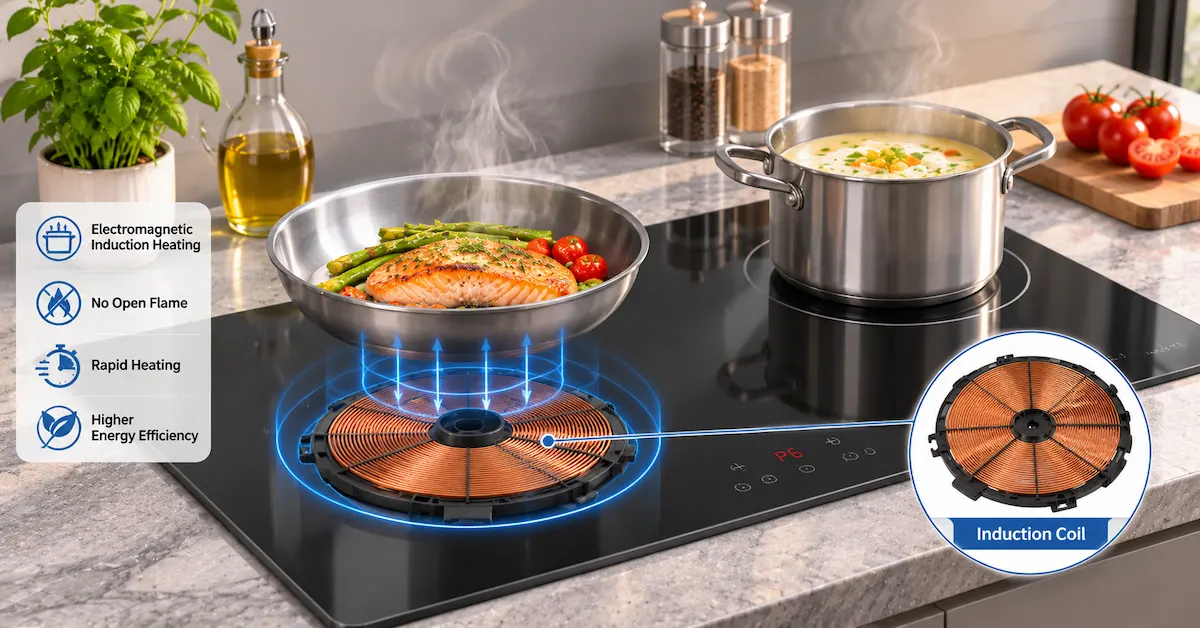
A standard induction coil produces a changing magnetic field that transfers energy to compatible cookware. A custom coil performs the same basic function, but its geometry or construction is tailored to a particular appliance platform. The U.S. Department of Energy's explanation of induction cooking describes how energy is transferred into cookware rather than generated by a conventional hot burner.
The question "what is custom induction coil used for" becomes commercially important when a product team cannot fit, power, cool, or reliably control an existing coil in its design. For manufacturers of induction hobs and portable cookers, the goal is not customization for its own sake: it is a documented solution to a measurable integration problem.
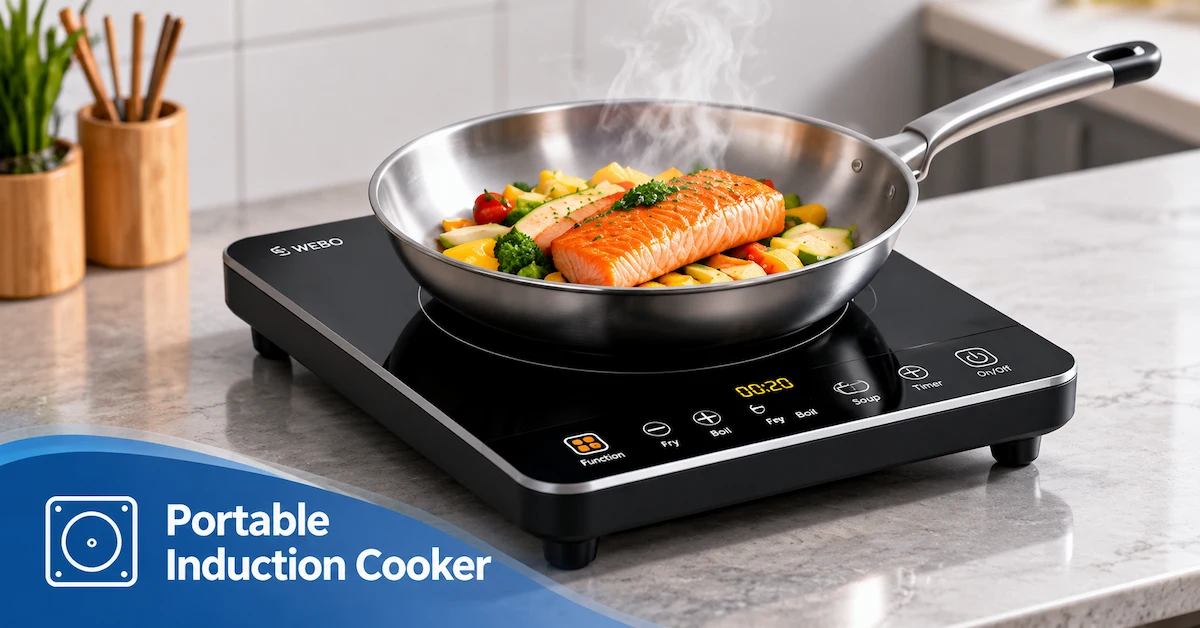
WEBO (GUANGDONG WEBO TECHNOLOGY CO., LTD), established in 1998 in Yangjiang, China, lists induction coils among its cooking-appliance components. Its Induction Coil product listing is a starting point for an inquiry; published information is insufficient to confirm specific inductance values, dimensions, or customized configurations.
Key Takeaways
-
Custom coils are useful when a verified design constraint cannot be met by a standard assembly.
-
The six main triggers concern space, vessel shape, cooking-zone layout, electrical matching, thermal/magnetic control, and assembly interfaces.
-
A different coil diameter does not by itself guarantee uniform heating, cookware compatibility, or higher efficiency.
-
The inverter, resonant network, ferrite, cookware, sensors, glass and enclosure must be evaluated together.
-
Ask for a controlled drawing, electrical requirements, sample plan, validation criteria, and commercial quotation before committing to tooling or production.
1. What Makes an Induction Coil “Custom”?
A custom induction coil is a winding assembly developed or modified for defined system requirements. It may change one feature—such as lead length—or several interacting features, including coil diameter, turn count, conductor construction, support geometry, ferrite layout, or temperature-sensor placement.
An appliance's rated wattage is not the independent power rating of a bare coil. Actual heating behavior depends on the power stage, resonant components, cookware load, spacing, control strategy, and thermal conditions.
Who Benefits From Customization?
Custom development is most relevant to OEM cooking-appliance engineers, platform designers, product-development teams and technical purchasers managing a defined appliance program. It is usually not the first choice for someone seeking a single unidentified spare part, or for a project that can use an existing qualified coil without modification.
A useful question is: Which measurable requirement does the catalog coil fail? If the team cannot answer, the business case for a new design is not yet established.
2. Six Practical Uses for a Custom Induction Coil
For engineers asking "what is custom induction coil used for", the following design situations offer a more useful answer than a generic list of induction-heating applications.
| OEM design trigger | What may need customization | Evidence needed before approval |
|---|---|---|
| Compact or shallow enclosure | Coil height, carrier, leads, mounting | Clearance and temperature-rise results |
| Curved or unusual cooking vessel | Flat versus shaped winding, coil-to-vessel gap | Cookware coupling and heating distribution |
| Wide or multiple cooking zones | Coil shape, position, spacing, zone arrangement | Cross-zone behavior and thermal mapping |
| Different inverter or resonant circuit | Inductance, resistance, winding construction | Electrical measurements under defined conditions |
| Limited thermal or magnetic clearance | Ferrite geometry, insulation, support | Temperature, magnetic interaction, appliance tests |
| Dedicated assembly interface | Sensor, connector, cable exit, fastening | Assembly fit and production repeatability |
Case 1: A Shallow Portable Cooker Has Limited Space
In a slim countertop cooker, an existing coil carrier may interfere with the enclosure or cooling path. A modified support, winding height, mounting arrangement or cable exit may solve the packaging problem. The OEM should check mechanical tolerances and operating temperatures; reducing space can make cooling harder.
Case 2: The Appliance Uses a Nonstandard Cooking Vessel
A flat circular cooking zone is different from an appliance designed around a shaped vessel, such as an induction-compatible bowl or wok. Coil geometry and the separation from the vessel influence electromagnetic coupling. A shaped coil may be worth evaluating, but the vessel material and inverter must be part of the test.
Case 3: A Wide or Multi-Zone Hob Needs Different Heating Coverage
Unusual zone dimensions can create limitations that are not solved simply by installing a larger circular coil. Engineers may explore segmented or multiple coils and their associated power controls. An IEEE Access study of dual-coil induction heating and temperature-distribution optimization investigates such design flexibility, while also recognizing the circuit-volume and cost trade-offs. Its research findings do not establish the performance of a WEBO product.
Case 4: An Existing Coil Does Not Match the Inverter
A new appliance platform may use different resonant circuitry or operating conditions. Changing turns, winding geometry or conductor construction may alter inductance and losses. Engineers should verify unloaded coil measurements and representative cookware-loaded behavior, with test frequency and temperature conditions recorded. An incorrect electrical match can affect switching behavior and component stress.
Case 5: Nearby Components Need Different Magnetic or Thermal Management
Ferrite pieces, winding position and the surrounding metal structure influence field distribution and losses. A custom ferrite arrangement may be considered when the mechanical architecture changes. This does not mean the coil alone can cure electromagnetic compatibility or overheating problems; shielding, cooling, electronics and enclosure design may also need revision.
Case 6: The OEM Needs a Dedicated Sensor or Wiring Interface
A coil assembly may require specific lead length, connector keying, routing, mounting points or a temperature-sensing component. Such changes can help the assembly fit an automated or manual production process. They must still be controlled on the drawing and validated for electrical, thermal and mechanical performance.
3. What Should Be Customized—and What Should Stay in the System Design?
The practical response to "what is custom induction coil used for" is to separate component-level changes from system-level outcomes.
| Coil-level design variable | System question it affects | Buyer documentation |
|---|---|---|
| Outer/inner diameter | Does the winding fit and cover the intended region? | Mechanical drawing, tolerances |
| Overall height and support | Will it fit below the glass and maintain clearance? | Assembly cross-section |
| Turn count and winding shape | Is the electrical behavior appropriate? | Inductance target and measurement conditions |
| Conductor specification | Are AC losses and thermal behavior acceptable? | Material and winding specification |
| DC resistance | Is production electrical consistency controlled? | Test method and acceptance limits |
| Ferrite position and material | How is magnetic flux managed? | Ferrite layout drawing |
| Lead wires and connector | Can the assembly connect reliably? | Harness interface drawing |
| Sensor location, if included | Is temperature feedback representative? | Sensor specification and placement |
The finished appliance—not the coil alone—determines heating performance, cookware detection, control stability, and compliance with applicable product requirements. WEBO's public product page does not publish verified values for these design variables, so the table is an OEM specification checklist, not a WEBO datasheet.
4. How Does Custom Coil Design Affect the Power Electronics?
An induction cooking system generally links power conversion → high-frequency inverter and resonant components → induction coil → compatible cookware. Ferrite, temperature sensors, cooling and control electronics support this interaction.
The coil and cookware create a load whose electrical characteristics change with operating conditions. A modification to geometry or winding may require changes to the inverter's operating strategy or resonant components. For this reason, copying the rated power from an old appliance is not an adequate coil specification.
The relevant test matrix should include defined cookware sizes and materials. A coil that starts successfully with one pan may perform differently with another pan or when it is off-center. Likewise, enlarging a coil does not automatically establish compatibility with nonmagnetic aluminum or copper cookware.
5. Standard, Modified or Fully Custom: Which Is Better?
Not every application requires a new design. Ask three questions in order: Can an approved reference coil meet the requirements? Can a limited modification solve the remaining gap? Is a full redesign justified by the measurable benefits?
| Development route | Appropriate situation | Principal trade-off |
|---|---|---|
| Existing qualified coil | Electrical, mechanical and thermal interfaces already match | Least design freedom |
| Modified existing assembly | A defined connector, mount or other change is required | Must revalidate affected characteristics |
| Fully custom coil | Geometry and system requirements cannot be met by existing options | More engineering, samples and potential tooling |
A fully custom coil is not automatically more efficient or reliable. Its value comes from resolving a real design constraint without unacceptable effects elsewhere.
For broader supplier-qualification questions, see WEBO's induction coil manufacturer guide. This article concentrates on the application decision, rather than repeating a general factory-selection checklist.
6. What Materials and Manufacturing Controls Matter?
The coil assembly may use a multi-strand copper winding, electrical insulation, a mechanical carrier, ferrite elements, leads and connectors. Their exact specifications depend on the design. High-frequency effects can make conductor construction important, but no single wire type is automatically best for all systems.
Recommended factory controls include documented winding pattern and dimensions, conductor and ferrite material identification, lead termination checks, and electrical measurements. The supplier and OEM should agree who controls subcontracted components and how engineering revisions are approved.
Avoid accepting “copper induction coil, suitable for all cookers” as a complete specification. It gives no basis for electrical matching, production consistency or product claims.
These are recommended engineering controls, not a claim that WEBO operates particular winding machines or tests every coil in a specified way.
7. How Do OEMs Validate a Custom Induction Coil?
A good answer to "what is custom induction coil used for" must also explain how the proposed design is proven in the appliance. Sample inspection alone is insufficient.
| Validation stage | What to verify | Typical evidence |
|---|---|---|
| Drawing review | Geometry, mounting, lead routing | Released drawing and revision |
| Standalone electrical test | Inductance and resistance at specified conditions | Measurement report |
| Materials and assembly | Conductor, ferrite, insulation, connections | Inspection records |
| System integration | Startup, power control, cookware detection | Appliance test results |
| Thermal evaluation | Coil, ferrite, electronics and enclosure temperatures | Temperature measurements |
| Representative operation | Intended cookware set and duty cycle | Defined performance tests |
| Safety and EMC | Relevant finished-appliance requirements | Test plan and applicable reports |
| Pilot production | Repeatability across a controlled lot | Acceptance and traceability records |
Which Safety Standard Should Be Considered?
For household stationary cooking appliances, IEC 60335-2-6:2024 covers safety requirements for equipment including induction hobs and induction wok elements. The standard is not a universal certification for all coil components and does not automatically cover portable or commercial-catering equipment. Determine the applicable product standards and market requirements for the actual finished appliance.
A modified coil may require reassessment even where the previous appliance design had already been tested. Product-specific certification and test evidence must be checked rather than inferred from company-wide claims.
8. What Does a Custom Coil Development Project Cost?
There is no universal custom-coil price. Commercial costs may involve engineering review, samples, fixtures or tooling, conductor and ferrite materials, connectors, tests, packaging, and production quantity.
A change to lead length is not commercially equivalent to developing a new electromagnetic geometry. Buyers should request a quote that separates one-time development charges from recurring unit costs, and ask what is included in sample and pilot-lot pricing.
| Risk | Why it increases cost | Practical preventive action |
|---|---|---|
| Vague electrical target | Repeated redesign | Agree on system and measurement conditions |
| Uncontrolled cookware set | Inconsistent test outcomes | Define representative pans |
| Late mechanical change | New carrier or lead routing | Freeze interface drawings |
| Incomplete thermal review | Unexpected rework | Test in final enclosure |
| Missing revision control | Conflicting production samples | Track part numbers and changes |
MOQ, tooling availability, lead time and production capacity must be requested for the specific project; they are not confirmed by the generic WEBO product listing.
9. What Should an OEM Send WEBO for a Technical RFQ?
If your search began with "what is custom induction coil used for", turn that question into a concrete design brief. A supplier can evaluate feasibility more effectively when it knows the failure of the existing design and the intended system architecture.
| RFQ item | Information to provide |
|---|---|
| Appliance and market | Built-in hob, portable cooker, target country |
| Reason for customization | Specific fit, heat-zone, electrical or interface problem |
| Reference design | Existing coil, photos and 2D/3D drawings |
| Mechanical envelope | Inner/outer diameter, height, clearance, mounting |
| Electrical platform | Inverter topology, resonant components, operating conditions |
| Electrical targets | Inductance, tolerance, resistance and measurement conditions |
| Winding and ferrite | Required materials or open design constraints |
| Interfaces | Leads, connectors and sensor requirements |
| Cookware and duty | Pan sizes, materials, operating scenarios |
| Validation | Acceptance criteria and required reports |
| Program volume | Samples, trial lot, annual forecast |
| Commercial details | MOQ, tooling, packaging, schedule and delivery terms |
WEBO lists Induction Coil within its appliance-component portfolio. The company was established in 1998 and describes support for heating-element and appliance-component projects. Available documentation does not establish that any particular custom geometry or electrical target is currently offered. Send an application brief to confirm feasibility rather than treating these examples as an available catalog.
OEM CTA: Contact WEBO with your coil drawing, inverter information, cookware range, target inductance, quantity and project timeline to discuss a technical review and quotation.
10. Frequently Asked Questions
1. What is a custom induction coil used for in an OEM cooktop?
For people asking "what is custom induction coil used for", the answer is to solve a specific integration constraint that a standard coil cannot satisfy—such as an unusual heating zone, limited space, different electrical matching or a dedicated mechanical interface.
2. How is a custom induction coil different from a standard coil?
Both generate alternating magnetic fields. A custom coil has dimensions, winding or assembly details selected for a defined appliance rather than taken directly from an existing specification.
3. Does a custom coil automatically heat cookware faster?
No. Heating depends on the entire inverter–coil–cookware system. Any claimed improvement requires testing under comparable conditions.
4. Can a custom coil work with nonmagnetic cookware?
Not automatically. Heating nonmagnetic cookware can require a different system architecture and control strategy. Changing the coil alone does not guarantee compatibility.
5. Can a manufacturer customize only the connector?
A limited change may be technically feasible, but lead routing, current handling, insulation, mechanical fit and affected tests still require review.
6. Why do ferrite pieces matter?
Ferrite elements can influence magnetic flux distribution and interactions with nearby structures. Their material, geometry and position should be controlled as part of the approved design.
7. Is coil diameter enough for an OEM quotation?
No. Provide electrical targets, geometry, ferrite, leads, mounting, representative cookware and relevant power-circuit information.
8. Which tests are most important before mass production?
Check standalone dimensions and electrical parameters, then verify cookware detection, heating behavior, temperatures, safety and electromagnetic compatibility at the finished-appliance level.
9. Does WEBO publish standard custom induction coil specifications?
WEBO publishes an induction coil product listing, but the public page does not provide a complete verified datasheet for a specific custom configuration. Request documentation and availability for the project.
10. How do I get a quotation for a custom induction coil?
Submit your existing coil or drawing, design constraint, target electrical characteristics, appliance application, sample quantity and forecast to WEBO's contact team.
Conclusion
The most useful answer to "what is custom induction coil used for" is application-specific integration: a custom design makes sense when a defined OEM cooktop needs a coil geometry, electrical behavior, magnetic arrangement or assembly interface that a qualified standard unit cannot provide.
A successful project begins with the constraint, not the coil price. Compare an existing coil with a modified or newly designed option; define the inverter and cookware conditions; validate the assembly in the complete appliance; and control the released specification before repeat orders.
For an application review, start with the WEBO Induction Coil product page and contact WEBO with drawings, electrical targets, test requirements and purchasing volumes. Confirm product-specific feasibility, specifications and commercial terms before ordering.